IITA and CIG strengthen strategic partnership for environment sustainability and agricultural innovation
December 22, 2025
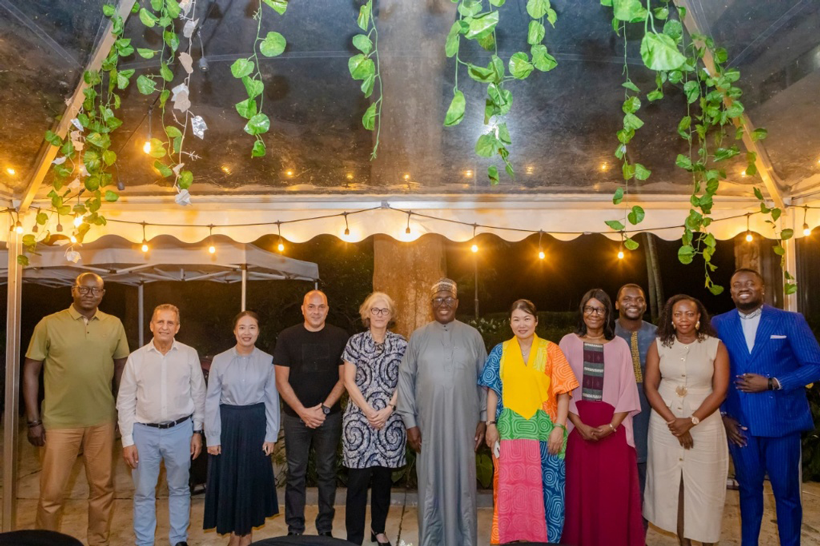
The IITA Management team and the CIG team with Dr Simeon Ehui and Chief Diana Chen.
IITA-CGIAR and the Choice International Group (CIG) have reaffirmed their commitment to a long-term strategic partnership that aims to drive green technology adoption, strengthen sustainability initiatives, and support agricultural innovation across Africa.
The partnership was reinforced during a working dinner organized by IITA Director General Dr Simeon Ehui for CIG Chairman, Chief Diana Chen, at the Institute’s headquarters in Ibadan. The discussion marked a new phase in the growing collaboration between both organizations, building on shared priorities around clean mobility, renewable energy, environmental stewardship, and youth empowerment.
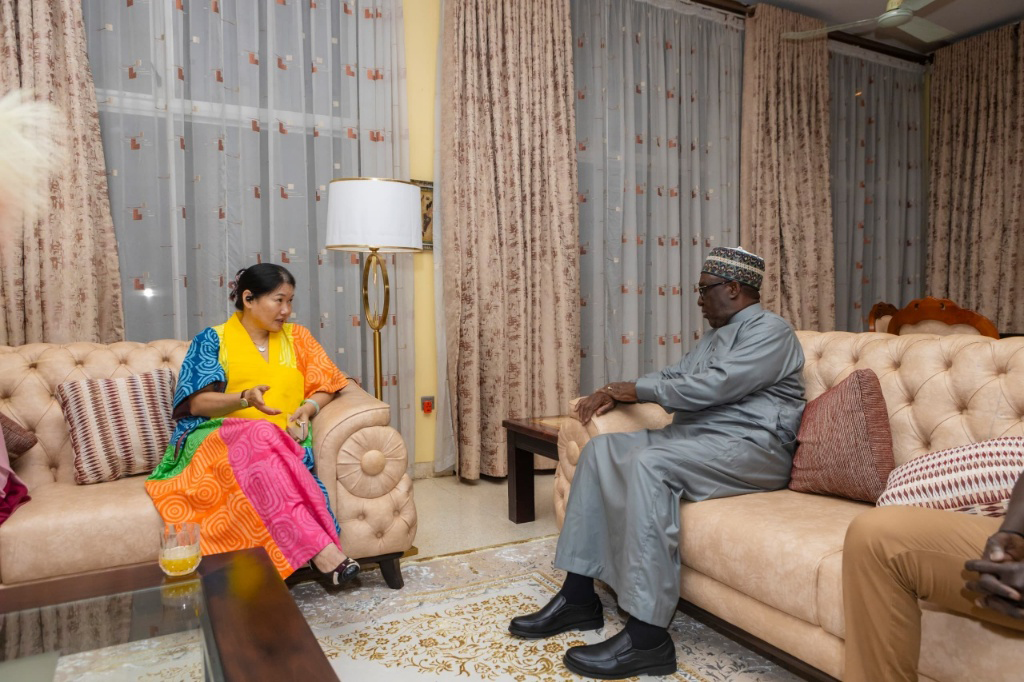
Chief Diana Chen during discussions with Dr Simeon Ehui.
During their strategic dialogue, Dr Ehui and Chief Chen outlined a collaborative roadmap that will guide future engagements. Discussions focused on integrating green technologies and innovative solutions into IITA’s research and operational infrastructure.
Key areas of technical cooperation under consideration include:
Clean mobility and electric vehicle deployment
Solar-powered mini-grid solutions
Smart and sustainable campus development
Youth agribusiness training and practical skills development
Biodiversity conservation and seed preservation
Ecotourism and environmental education
Cultural documentation and heritage preservation
Dr Ehui proposed a phased approach to the partnership—beginning with a technical assessment and pilot proof-of-concept, with the goal of progressing to full phase as both organizations align on long-term objectives.
Dr Ehui provided an overview of IITA’s scientific legacy and future plans, highlighting its Africa-wide climate-resilience programs, seed preservation archives, unique biodiversity assets, and upcoming initiatives such as a proposed Food Museum and a Genetic Resource Center.
Dr Simeon Ehui with Chief Diana Chen.
Chief Chen praised the Institute’s natural environment and scientific value, describing IITA as “a sanctuary for creativity, reflection, and renewal.” She expressed interest in developing cultural and educational projects on the IITA campus, including Yoruba heritage documentaries and films that explore the shared cultural depth of African and Asian civilizations.
A key highlight of the engagement was the alignment between IITA and CIG on youth development. IITA’s Youth in Agribusiness team presented ongoing efforts to combat youth unemployment through hands-on agricultural training, mechanization programs, entrepreneurship development, and NYSC youth engagements across 11 states.
Chief Chen reaffirmed that youth empowerment remains central to CIG’s corporate mission and expressed interest in collaborative initiatives that strengthen practical skills, enterprise development, and innovation-driven opportunities for young Africans.
CIG expressed readiness to support IITA’s vision of becoming a diesel-free campus powered fully by renewable energy. Proposed collaborative opportunities include:
Deployment of additional electric mobility solutions
Installation of a solar mini-grid system
Ecotourism development on the IITA campus
Strengthening mobility options for staff and visitors
Building an electric vehicle (EV) servicing and technical support hub
Supporting cultural, educational, and film projects
Chief Chen emphasized her commitment to environmental conservation, stating, “I regard every tree here as sacred. We must honor the environment and create a legacy for the next generation.”
CIG has evolved into one of Nigeria’s most influential industrial groups, with business footprints spanning automobiles, energy and green technology, and e-mobility solutions. Under Chief Chen’s leadership, the organization has positioned itself as a leading driver of Nigeria’s clean energy transition—an agenda strongly aligned with IITA’s sustainability ambitions.
Earlier in 2025, CIG donated a Wuling Bingo electric vehicle and an EV charging station to IITA, supporting the institute’s transition toward clean mobility. Dr Ehui expressed appreciation for the gesture, describing it as a “tangible demonstration of CIG’s commitment to IITA’s sustainability journey.”
The meeting concluded with a mutual reaffirmation of the IITA-CIG partnership, setting the stage for a deeper, more transformative collaboration that aligns technology, sustainability, research, and culture for Africa’s development.
Contributed by ’Timilehin Osunde
Olamide Deborah Nwanze is a Senior Research Associate specializing in gender mainstreaming research to inform participatory and inclusive breeding, variety development, and seed systems policies regarding root, tuber, and banana (RTB) crops in the International Institute of Tropical Agriculture Headquarters, Ibadan, Nigeria. She is a PhD candidate at the University of Ibadan and holds an MSc and B. Agric in Agricultural Extension and Rural Development. Olamide is a fellow of the African Women in Agricultural Research and Development – Gender Responsive Agricultural Systems Policy (AWARD-GRASP) and the Gender Responsive Researchers Equipped for Agricultural Transformation (GREAT). She seeks to apply her gender-mainstreaming learnings, gender-responsive research, and policy development, and review expertise to facilitate women, youth, children, and vulnerable social group’s access to and adoption of agricultural Innovations that guarantee food, nutrition, income, and livelihood security in Africa. Her current roles include mentoring research fellows, development of guides and training manuals, implementation and adaptation of gender frameworks and tools, value chain actors’ engagement as citizen science partners, policy review and redesign, data management, and analysis. Her current research explores mixed methods and participatory and interdisciplinary approaches to capture and highlight gender dynamics, needs, preferences, and challenges stakeholders face within the agricultural livelihood value chain to prioritize gender-inclusive strategies in breeding programs, policy design, and implementation.
de Sousa, K., van Etten, J., Manners, R. Bello, A., Teeken, B., Olaosebikan, O., et al. 2024. The tricot approach: an agile framework for decentralized on-farm testing supported by citizen science. A retrospective. Agron. Sustain. Dev. 44, 8. https://doi.org/10.1007/s13593-023-00937-1
Madu, T., Onwuka, S., Nwafor, S., Onyemauwa, N., Ejechi, M., Ofoeze, M., Ukeje, B., Eluagu, C., Olaosebikan, O., Okoye, B., 2024. Gender-Inclusive Consumer Studies Improve Cassava Breeding in Nigeria in: Frontiers in Sociology, volume 9, number: 1224504, doi: 10.3389/fsoc.2024.1224504
Olaosebikan, O.; Bello, A.; Utoblo, O.; Okoye, B.; Olutegbe, N.; Garner, E.; Teeken, B.; Bryan, E.; Forsythe, L.; Cole, S.; Madu, T. 2023. Stressors and Resilience within the Cassava Value Chain in Nigeria: Preferred Cassava Variety Traits and Response Strategies of Men and Women to Inform Breeding. Sustainability 15, 7837. https://doi.org/10.3390/su15107837
Okoye, B., Ofoeze, M., Ejechi, M., Onwuka, S., Nwafor, S., Onyemauwa, N., Ukeje, B., Eluagu, C., Obidiegwu, J.*, Olaosebikan, O., Madu, T.* 2023. Prioritizing preferred traits in the yam value chain in Nigeria: a gender situation analysis in: Frontiers in Sociology, volume 8, number: 1232626, pages 1 – 9, ISSN 2297-7775, 2023. https://www.frontiersin.org/articles/10.3389/fsoc.2023.1232626/full
Olaosebikan, O., Bello, A. A., de Sousa, K., Ndjouenkeu, R., Adesokan, M., Alamu, E. O., Agbona, A., van Etten, J., Kegah, F. N.*, Dufour, D., Bouniol, A., Teeken, B. 2023. Consumer acceptability of cassava gari-eba food products across cultural and environmental settings using the triadic comparison of technologies approach (tricot) in: Journal of the Science of Food and Agriculture,
Teeken, B., Olaosebikan, O., Bello, A. A., Madu, T.*, Cole, S. M. 2023. Qualitative assessment on the positionality and preferences of dyads in relation to cassava-related activities: working with tricot trial citizen scientists https://hdl.handle.net/10568/138326 Type: Manual
Bouniol, A., Ceballos, H., Bello, A. A., Teeken, B., Olaosebikan, O., Owoade, D., Agbona, A., Fotso Kuate, A., Madu, T.*, Okoye, B.*, Ofoeze, M.*, Nwafor, S.*, Onyemauwa, N.*, Adinsi, L.*, Forsythe, L., Dufour, D. 2023. Varietal impact on women’s labour, workload and related drudgery in processing root, tuber and banana crops: focus on cassava in sub-Saharan Africa in: Journal of the Science of Food and Agriculture, pages 1 – 25, ISSN 0022-5142,
Bello, A. A., Agbona, A., Olaosebikan, O., Edughaen, G., Dufour, D., Bouniol, A., Iluebbey, P., Ndjouenkeu, R.*, Rabbi, I. Y., Teeken, B. 2023. Genetic and environmental effects on processing productivity and food product yield: drudgery of women’s work in: Journal of the Science of Food and Agriculture, pages 1 – 32, ISSN 0022-5142, 5
Cavicchioli, M., Zimbiti, T., Teeken, B., Nwanze, D.O., Liani, M., Parkes, E. & Bello, A. 2023. IITA-Gender Responsive Breeding Training Report. Genetic Resources Center, IITA-HQ, Ibadan, 21-23 September, 2022. Ibadan, Nigeria: IITA, (34 p.).https://hdl.handle.net/10568/131368
Agbona, A. Peteti P., Teeken B., Olaosebikan O. Bello, A. A., Parkes, E., Rabbi, I. Y., Mueller, L., Egesi, C., Kulakow, P. 2022. Data Management in Multi-disciplinary African RTB Crop Breeding Programs. In: Williamson, H.F., Leonelli, S. (eds) Towards Responsible Plant Data Linkage: Data Challenges for Agricultural Research and Development. Springer, Cham. https://doi.org/10.1007/978-3-031-13276-6_5
Lora Forsythe, Pricilla Marimo, Sarah Mayanja, Olamide D. Olaosebikan, Esme Stuart, Bela Teeken, Benjamin Okoye, Tessy Madu, (2021). Cross-product Gender Analysis of RTBfoods Step 2 Gendered Food Mapping on RTB Products. Understanding the Drivers of Trait Preferences and the Development of Multi-user RTB Product Profiles, WP1. London, UK: RTBfoods Field Scientific Report, 30 p.
Teeken, B., Garner, E., Agbona, A., Balogun, I., Olaosebikan, O., Bello, A., Madu, T., Okoye, B., Egesi, C., Kulakow, P. and Tufan, H.A. 2021. Beyond “Women’s Traits”: Exploring How Gender, Social Difference, and Household Characteristics Influence Trait Preferences. Frontiers Sustainable Food Systems 5:740926. https://doi.org/10.3389/fsufs.2021.740926
Teeken, B., Agbona, A., Bello, A., Olaosebikan, O., Alamu, E., Adesokan, M., Awoyale, W., Madu, T., Okoye, B., Chijioke, U., Owoade, D., Okoro, M., Bouniol, A., Dufour, D., Hershey, C., Rabbi, I., Maziya‐Dixon, B., Egesi, C., Tufan, H. and Kulakow, P. (020. Understanding cassava varietal preferences through pairwise ranking of gari‐eba and fufu prepared by local farmer–processors. Int J Food Sci Technol.https://doi.org/10.1111/ijfs.14862
Bela Teeken, Olamide Olaosebikan, Ireti Balogun, Benjamin Okoye, Tessy Madu, Steven Cole, Abolore Bello, Elizabeth Parkes. (2020). Piloting the G+ customer and product profile tools for gender-responsive cassava breeding in Nigeria. Nigeria: International Institute of Tropical Agriculture (IITA). https://hdl.handle.net/20.500.11766/13000