
IITA NEWS

IITA, stakeholders push for stronger legume seed systems to boost food security in Nigeria
May 21, 2026

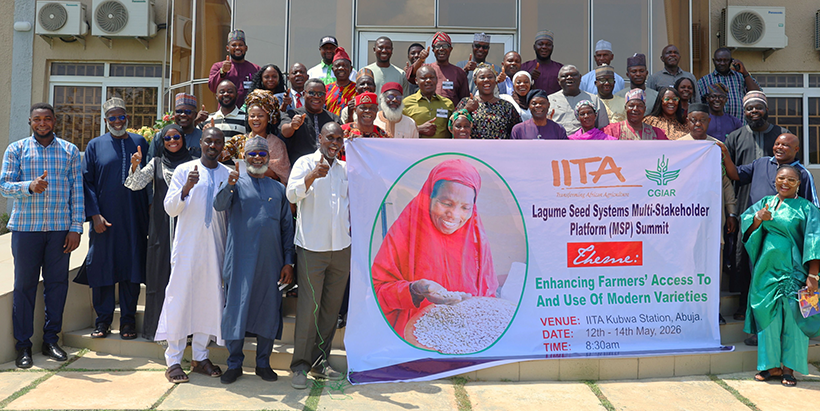
Participants after the Seed Systems Summit at IITA Abuja Station.

Stakeholders across Nigeria’s legume value chain have called for stronger collaboration, improved seed dissemination systems, and market-driven varietal development to accelerate food security and sustainable legume productivity.

The call was made during a two-day Legume Seed Systems Multi-Stakeholder Platform (MSP) Summit convened by IITACGIAR to accelerate the development and delivery of breakthrough cowpea varieties. The summit brought together key seed sector actors along legume value chains, including researchers, seed companies, farmers, agro-dealers, processors, marketers, traders, aggregators, extension agents, and policymakers to discuss practical strategies for strengthening legume seed systems, particularly cowpea in Nigeria.
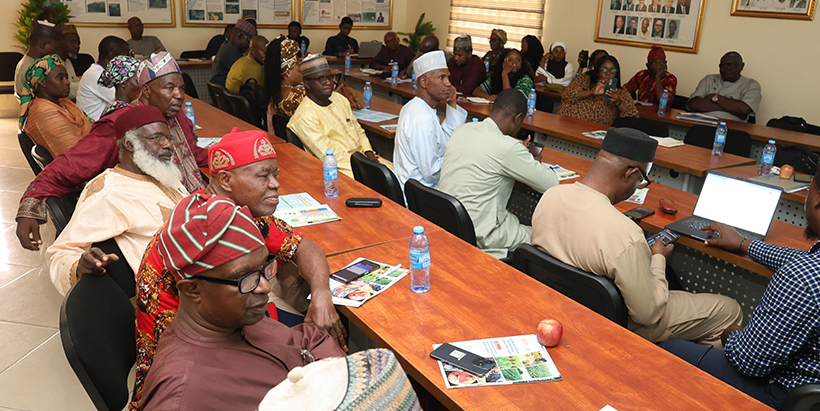
Participants during the Seed Systems Summit.

Speaking during the summit, Professor Lucky Omoigui said the platform was designed to improve farmers’ access to improved seed varieties and to strengthen coordination and collaboration among stakeholders across the legume value chain.

According to him, the initiative aims to create a sustainable, private sector-driven system that connects breeders, seed companies, marketers, processors, agro-dealers, and farmers more effectively.
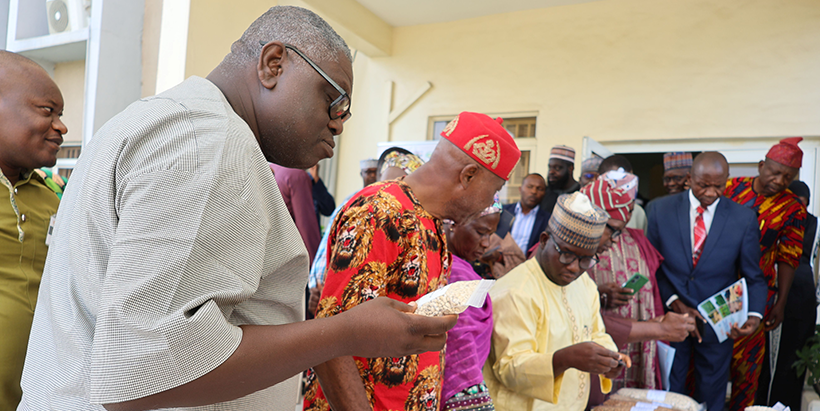
Participants of the Seed Systems Summit observing seed varieties on display during an exhibition tour.

“We want to build a sustainable platform that strengthens collaboration and ensures farmers can access the varieties they truly need,” he said.

Prof. Omoigui emphasized that consumer preferences must increasingly guide varietal dissemination and increase adoption, noting that farmers and consumers are now demanding varieties with specific traits such as faster cooking time, large seed size (brown and white seed coat), improved taste, high yield, drought tolerance, and resistance to pests and diseases.
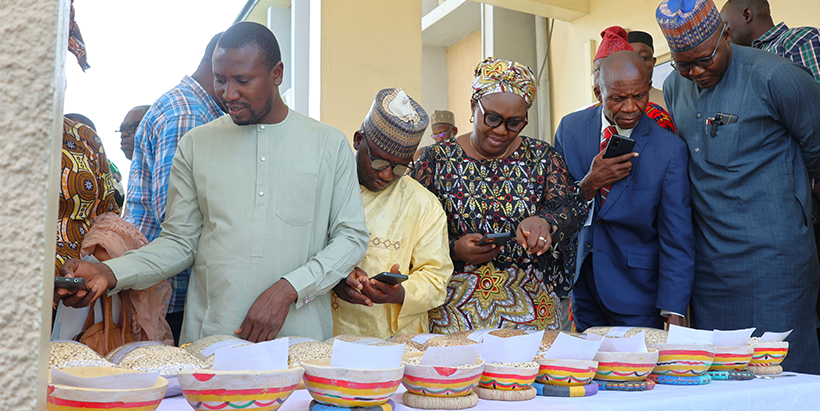
The Summit participants taking a tour of the seeds on display during an exhibition.

Participants at the summit stressed that improved seed systems remain critical to addressing food insecurity in Nigeria.

Chairman of the Crops Technical Subcommittee of the National Committee on Registration and Release of Crop Varieties, Livestock Breeds and Fisheries, from the Institute for Agricultural Research (IAR) Zaria, Professor Shehu Garki Ado, described the summit as timely and strategic.

“The seed system starts with the registration and release of varieties,” he said. “Nigeria, with its vast resources, should have no business importing food. It should be able to export food.”

He further highlighted the need to formalize agricultural commodity trade and strengthen awareness among stakeholders to improve productivity and national food security.

Breakout discussions during the summit identified several major constraints affecting legume seed systems, including limited seed availability and accessibility, weak coordination between research institutions and seed companies, rising production costs, poor extension coverage, and inadequate market linkages.

Stakeholders also emphasized the importance of involving farmers more actively in varietal development processes to ensure newly developed varieties reflect real production challenges and market demands.

Farmers and seed companies shared practical field experiences with preferred cowpea varieties such as ALKAM SUPER, FUAMPEA 2, and SAMPEA14, citing desirable traits including high yield potential, striga resistance, attractive seed size, minimal spray requirements, and excellent fast-cooking quality.

Ibrahim Muhammad Bello, representing Nagarta Seed Company Limited, Yobe State, observed that some improved varieties performed exceptionally well under heavy Striga infestation while maintaining high yields. Some of these varieties could be further enhanced to benefit farmers.

Stakeholders further advocated for stronger farmer training systems, increased use of local languages and media for awareness creation, improved extension services, and greater inclusion of Agro-dealers and marketers within the seed dissemination ecosystem.

Also speaking at the summit, Nefisa Aminu Idakwoji, CEO of PFGN Agricultural Ventures, Nasarawa State during an interview, highlighted the production challenges currently facing farmers, including climate variability, rising input costs, labor shortages, and poor market returns. She stated that the seed is the foundation of every crop production. “When you have access to a very good variety of seeds, you have solved about 50 percent of the challenges farmers face, including food insecurity and sustainability.”

Participants agreed on the need for stronger public-private partnerships, community-based seed systems, digital information platforms, and market-oriented dissemination strategies to improve the adoption of improved legume varieties across farming communities.

The summit concluded with renewed commitment among stakeholders to strengthen coordination, improve access to quality seed, and promote resilient, market-responsive legume seed systems that support Nigeria’s food security and agricultural transformation goals.

Contributed by Sarah Sallau


Contributed by

Related news

No items found

Leave a Reply

Your email address will not be published. Required fields are marked *

Scroll to Top
Olaosebikan, Olamide

Olamide Deborah Nwanze is a Senior Research Associate specializing in gender mainstreaming research to inform participatory and inclusive breeding, variety development, and seed systems policies regarding root, tuber, and banana (RTB) crops in the International Institute of Tropical Agriculture Headquarters, Ibadan, Nigeria. She is a PhD candidate at the University of Ibadan and holds an MSc and B. Agric in Agricultural Extension and Rural Development. Olamide is a fellow of the African Women in Agricultural Research and Development – Gender Responsive Agricultural Systems Policy (AWARD-GRASP) and the Gender Responsive Researchers Equipped for Agricultural Transformation (GREAT). She seeks to apply her gender-mainstreaming learnings, gender-responsive research, and policy development, and review expertise to facilitate women, youth, children, and vulnerable social group’s access to and adoption of agricultural Innovations that guarantee food, nutrition, income, and livelihood security in Africa. Her current roles include mentoring research fellows, development of guides and training manuals, implementation and adaptation of gender frameworks and tools, value chain actors’ engagement as citizen science partners, policy review and redesign, data management, and analysis. Her current research explores mixed methods and participatory and interdisciplinary approaches to capture and highlight gender dynamics, needs, preferences, and challenges stakeholders face within the agricultural livelihood value chain to prioritize gender-inclusive strategies in breeding programs, policy design, and implementation.

At IITA, she contributes to the implementation of the CGIAR Accelerated Breeding Initiative and Genetic Innovation Programs; participatory and gender research within the NextGen CassavaHarvestPlusRTBFoods, and Tricot-ClimMob 1000Farms Projects; and gender knowledge communication via the G-LENS webinar series, video documentary, policy briefspublications, and blogs.


Recent publications

de Sousa, K., van Etten, J., Manners, R. Bello, A., Teeken, B., Olaosebikan, O., et al. 2024. The tricot approach: an agile framework for decentralized on-farm testing supported by citizen science. A retrospective. Agron. Sustain. Dev. 44, 8. https://doi.org/10.1007/s13593-023-00937-1

Madu, T., Onwuka, S., Nwafor, S., Onyemauwa, N., Ejechi, M., Ofoeze, M., Ukeje, B., Eluagu, C., Olaosebikan, O., Okoye, B., 2024. Gender-Inclusive Consumer Studies Improve Cassava Breeding in Nigeria in: Frontiers in Sociology, volume 9, number: 1224504, doi: 10.3389/fsoc.2024.1224504

Olaosebikan, O.; Bello, A.; Utoblo, O.; Okoye, B.; Olutegbe, N.; Garner, E.; Teeken, B.; Bryan, E.; Forsythe, L.; Cole, S.; Madu, T. 2023.  Stressors and Resilience within the Cassava Value Chain in Nigeria: Preferred Cassava Variety Traits and Response Strategies of Men and Women to Inform Breeding. Sustainability 15, 7837. https://doi.org/10.3390/su15107837

Okoye, B., Ofoeze, M., Ejechi, M., Onwuka, S., Nwafor, S., Onyemauwa, N., Ukeje, B., Eluagu, C., Obidiegwu, J.*, Olaosebikan, O., Madu, T.* 2023. Prioritizing preferred traits in the yam value chain in Nigeria: a gender situation analysis in: Frontiers in Sociology, volume 8, number: 1232626, pages 1 – 9, ISSN 2297-7775, 2023. https://www.frontiersin.org/articles/10.3389/fsoc.2023.1232626/full

Olaosebikan, O., Bello, A. A., de Sousa, K., Ndjouenkeu, R., Adesokan, M., Alamu, E. O., Agbona, A., van Etten, J., Kegah, F. N.*, Dufour, D., Bouniol, A., Teeken, B. 2023. Consumer acceptability of cassava gari-eba food products across cultural and environmental settings using the triadic comparison of technologies approach (tricot) in: Journal of the Science of Food and Agriculture,

Teeken, B., Olaosebikan, O., Bello, A. A., Madu, T.*, Cole, S. M. 2023. Qualitative assessment on the positionality and preferences of dyads in relation to cassava-related activities: working with tricot trial citizen scientists https://hdl.handle.net/10568/138326 Type: Manual

Bouniol, A., Ceballos, H., Bello, A. A., Teeken, B., Olaosebikan, O., Owoade, D., Agbona, A., Fotso Kuate, A., Madu, T.*, Okoye, B.*, Ofoeze, M.*, Nwafor, S.*, Onyemauwa, N.*, Adinsi, L.*, Forsythe, L., Dufour, D. 2023. Varietal impact on women’s labour, workload and related drudgery in processing root, tuber and banana crops: focus on cassava in sub-Saharan Africa in: Journal of the Science of Food and Agriculture, pages 1 – 25, ISSN 0022-5142,

Bello, A. A., Agbona, A., Olaosebikan, O., Edughaen, G., Dufour, D., Bouniol, A., Iluebbey, P., Ndjouenkeu, R.*, Rabbi, I. Y., Teeken, B. 2023. Genetic and environmental effects on processing productivity and food product yield: drudgery of women’s work in: Journal of the Science of Food and Agriculture, pages 1 – 32, ISSN 0022-5142, 5

Cavicchioli, M., Zimbiti, T., Teeken, B., Nwanze, D.O., Liani, M., Parkes, E. & Bello, A. 2023. IITA-Gender Responsive Breeding Training Report. Genetic Resources Center, IITA-HQ, Ibadan, 21-23 September, 2022. Ibadan, Nigeria: IITA, (34 p.).https://hdl.handle.net/10568/131368

Agbona, A. Peteti P., Teeken B., Olaosebikan O. Bello, A. A., Parkes, E., Rabbi, I. Y., Mueller, L., Egesi, C., Kulakow, P. 2022. Data Management in Multi-disciplinary African RTB Crop Breeding Programs. In: Williamson, H.F., Leonelli, S. (eds) Towards Responsible Plant Data Linkage: Data Challenges for Agricultural Research and Development. Springer, Cham. https://doi.org/10.1007/978-3-031-13276-6_5

Lora Forsythe, Pricilla Marimo, Sarah Mayanja, Olamide D. Olaosebikan, Esme Stuart, Bela Teeken, Benjamin Okoye, Tessy Madu, (2021). Cross-product Gender Analysis of RTBfoods Step 2 Gendered Food Mapping on RTB Products. Understanding the Drivers of Trait Preferences and the Development of Multi-user RTB Product Profiles, WP1. London, UK: RTBfoods Field Scientific Report, 30 p.

Teeken, B., Garner, E., Agbona, A., Balogun, I., Olaosebikan, O., Bello, A., Madu, T., Okoye, B., Egesi, C., Kulakow, P. and Tufan, H.A. 2021. Beyond “Women’s Traits”: Exploring How Gender, Social Difference, and Household Characteristics Influence Trait Preferences. Frontiers Sustainable Food Systems 5:740926. https://doi.org/10.3389/fsufs.2021.740926

Teeken, B., Agbona, A., Bello, A., Olaosebikan, O., Alamu, E., Adesokan, M., Awoyale, W., Madu, T., Okoye, B., Chijioke, U., Owoade, D., Okoro, M., Bouniol, A., Dufour, D., Hershey, C., Rabbi, I., Maziya‐Dixon, B., Egesi, C., Tufan, H. and Kulakow, P. (020. Understanding cassava varietal preferences through pairwise ranking of gari‐eba and fufu prepared by local farmer–processors. Int J Food Sci Technol. https://doi.org/10.1111/ijfs.14862

Bela Teeken, Olamide Olaosebikan, Ireti Balogun, Benjamin Okoye, Tessy Madu, Steven Cole, Abolore Bello, Elizabeth Parkes. (2020). Piloting the G+ customer and product profile tools for gender-responsive cassava breeding in Nigeria. Nigeria: International Institute of Tropical Agriculture (IITA). https://hdl.handle.net/20.500.11766/13000