
IITA NEWS

Research and innovation key to Africa’s agricultural resilience – Dr Kwakwa
June 29, 2026
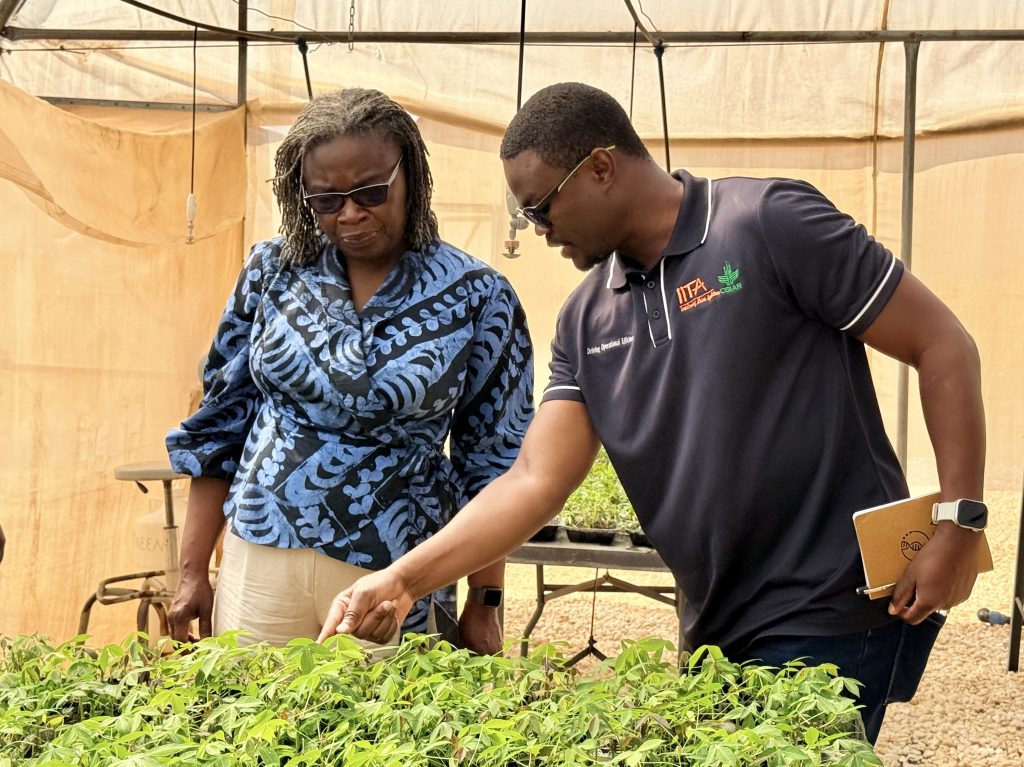
IITA Research Associate, Noah Manda explains the surface hydrophobic single node innovation to Dr Kwakwa.

Agriculture remains one of Africa’s greatest opportunities for economic transformation. As countries navigate changing climate conditions, evolving market dynamics, and growing pressure to create jobs and strengthen rural economies, the conversation is increasingly shifting beyond production alone to how agricultural systems create long-term value.

Increasingly, attention is turning to the systems that support agricultural growth, including research, innovation, seed systems, commercialization, and the ability to translate science into practical solutions that reach farmers and markets.
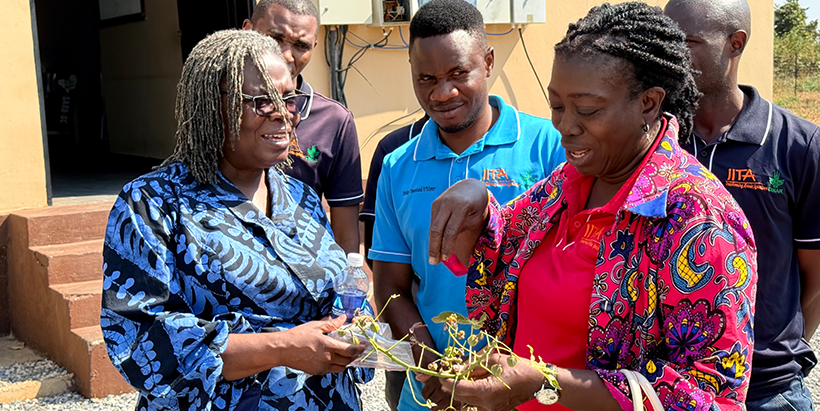
Dr Kwakwa (L) looks on with interest as Dr Parkes demonstrates a cassava flower used in developing improved cassava varieties.

It was within this context that IITA Board Member, Dr Victoria Kwakwa, emphasized the central role of research in building resilient food systems, reducing dependence on external markets, and accelerating economic transformation across Africa during a recent visit to the IITA Southern Africa Hub (SAH) in Lusaka, Zambia.

Dr Kwakwa visited the Hub to engage with staff and researchers and gain deeper insight into the Hub’s work and its contribution to advancing agricultural transformation across Southern Africa through research, innovation, and the delivery of scalable solutions.
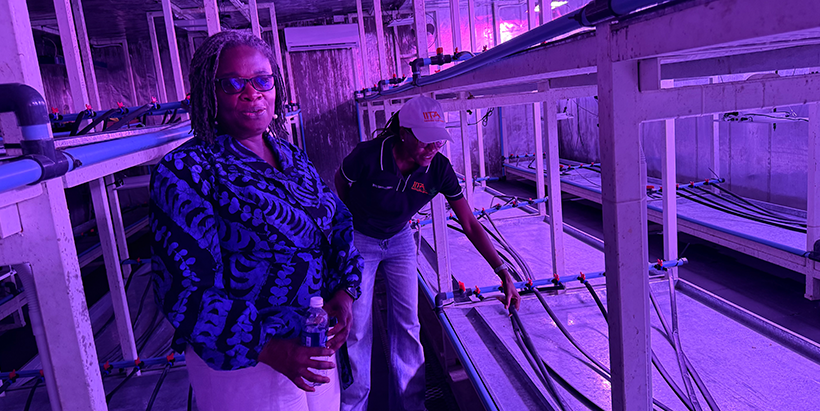
Dr Kwakwa is taken through the recently launched soybean speed breeding facility.

Addressing staff, she reflected on how recent global disruptions and climate-related shocks have reinforced the urgency for Africa to strengthen its agricultural systems and build greater resilience.

Drawing lessons from recent events, including supply chain disruptions linked to the Russia–Ukraine conflict, fertilizer market pressures, and climate variability across the continent, she observed that Africa’s continued dependence on external systems for food and agricultural inputs poses a growing challenge to long-term development.

“We really need to get our act together in the agriculture sector,” she said. “Africa cannot do this without Africa.”

Dr Kwakwa emphasized that agricultural transformation must extend beyond increasing production and instead focus on building stronger, more integrated systems that connect research, seed systems, commercialization, markets, and industry.
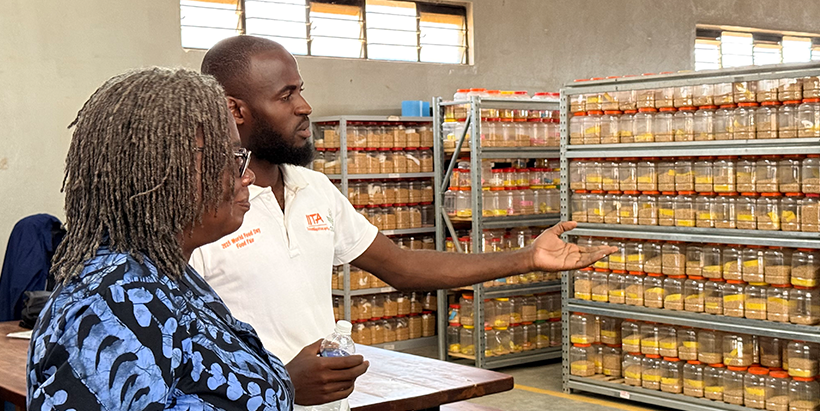
IITA-Field Technician, Maxwell Siamasimbi shows Dr Kwakwa the soybean storage facility.

For her, agricultural research institutions remain central to this transformation.

“Research allows us to develop the agriculture sector. We cannot develop agriculture based on what our fathers and grandparents did decades ago. We have to research new solutions, respond to emerging challenges, develop improved crop varieties, commercialize them, and bring them to farmers in meaningful and sustainable ways,” she said.

She noted that strengthening agricultural systems presents an opportunity not only to improve food security but also to drive industrial development, create jobs, revitalize rural economies, and position African countries as competitive players in regional and global agricultural markets.

Commending the work being undertaken by IITA, Dr Kwakwa described the institute as occupying an important position in helping shape the continent’s agricultural future.

“In my view, you are leaders in agriculture,” she said. “Your research and efforts to ensure that solutions are applied meaningfully and sustainably are super important.”

She further acknowledged the scientific excellence and technical capability across the institute and encouraged staff to continue pushing the frontier of agricultural innovation despite an increasingly constrained funding environment.

“What you do here impacts so many people. You are already successful, but the challenges ahead require going even further.”

The visit concluded with an institutional presentation and showcase of the Southern Africa Hub’s portfolio of work across crop improvement, breeding, seed systems, climate resilience, mechanization, and research-for-development initiatives being implemented across the region.

Speaking at the close of the engagement, Dr Elizabeth Parkes, IITA Cassava Breeder, who welcomed Dr Kwakwa, thanked her for the visit and reaffirmed IITA’s commitment to generating science-driven solutions that strengthen food systems, improve livelihoods, and contribute to agricultural transformation across Africa.

The priorities highlighted during the visit closely align with the ongoing efforts of the IITA Southern Africa Hub to strengthen agricultural resilience, accelerate commercialization, and improve livelihoods across the region.

Through investments in research and innovation platforms such as the Soybean Speed Breeding Facility, a first-of-its-kind in sub-Saharan Africa, the Hub is accelerating crop improvement cycles and supporting the development of improved varieties capable of responding to emerging agricultural challenges and changing climate conditions.

The Hub is also advancing youth-led agricultural transformation through the Young Agripreneurs initiative, which continues to equip young people with practical skills, technologies, and agribusiness opportunities while creating pathways for employment and participation across agricultural value chains.

In parallel, IITA’s cassava interventions continue to support productivity and commercialization by developing and promoting improved cassava varieties and technologies that strengthen seed systems, increase farmers’ access to quality planting material, and unlock opportunities for value addition and market development.

Contributed by Rachel Namukolo-Nali


Scroll to Top
Olaosebikan, Olamide

Olamide Deborah Nwanze is a Senior Research Associate specializing in gender mainstreaming research to inform participatory and inclusive breeding, variety development, and seed systems policies regarding root, tuber, and banana (RTB) crops in the International Institute of Tropical Agriculture Headquarters, Ibadan, Nigeria. She is a PhD candidate at the University of Ibadan and holds an MSc and B. Agric in Agricultural Extension and Rural Development. Olamide is a fellow of the African Women in Agricultural Research and Development – Gender Responsive Agricultural Systems Policy (AWARD-GRASP) and the Gender Responsive Researchers Equipped for Agricultural Transformation (GREAT). She seeks to apply her gender-mainstreaming learnings, gender-responsive research, and policy development, and review expertise to facilitate women, youth, children, and vulnerable social group’s access to and adoption of agricultural Innovations that guarantee food, nutrition, income, and livelihood security in Africa. Her current roles include mentoring research fellows, development of guides and training manuals, implementation and adaptation of gender frameworks and tools, value chain actors’ engagement as citizen science partners, policy review and redesign, data management, and analysis. Her current research explores mixed methods and participatory and interdisciplinary approaches to capture and highlight gender dynamics, needs, preferences, and challenges stakeholders face within the agricultural livelihood value chain to prioritize gender-inclusive strategies in breeding programs, policy design, and implementation.

At IITA, she contributes to the implementation of the CGIAR Accelerated Breeding Initiative and Genetic Innovation Programs; participatory and gender research within the NextGen CassavaHarvestPlusRTBFoods, and Tricot-ClimMob 1000Farms Projects; and gender knowledge communication via the G-LENS webinar series, video documentary, policy briefspublications, and blogs.


Recent publications

de Sousa, K., van Etten, J., Manners, R. Bello, A., Teeken, B., Olaosebikan, O., et al. 2024. The tricot approach: an agile framework for decentralized on-farm testing supported by citizen science. A retrospective. Agron. Sustain. Dev. 44, 8. https://doi.org/10.1007/s13593-023-00937-1

Madu, T., Onwuka, S., Nwafor, S., Onyemauwa, N., Ejechi, M., Ofoeze, M., Ukeje, B., Eluagu, C., Olaosebikan, O., Okoye, B., 2024. Gender-Inclusive Consumer Studies Improve Cassava Breeding in Nigeria in: Frontiers in Sociology, volume 9, number: 1224504, doi: 10.3389/fsoc.2024.1224504

Olaosebikan, O.; Bello, A.; Utoblo, O.; Okoye, B.; Olutegbe, N.; Garner, E.; Teeken, B.; Bryan, E.; Forsythe, L.; Cole, S.; Madu, T. 2023.  Stressors and Resilience within the Cassava Value Chain in Nigeria: Preferred Cassava Variety Traits and Response Strategies of Men and Women to Inform Breeding. Sustainability 15, 7837. https://doi.org/10.3390/su15107837

Okoye, B., Ofoeze, M., Ejechi, M., Onwuka, S., Nwafor, S., Onyemauwa, N., Ukeje, B., Eluagu, C., Obidiegwu, J.*, Olaosebikan, O., Madu, T.* 2023. Prioritizing preferred traits in the yam value chain in Nigeria: a gender situation analysis in: Frontiers in Sociology, volume 8, number: 1232626, pages 1 – 9, ISSN 2297-7775, 2023. https://www.frontiersin.org/articles/10.3389/fsoc.2023.1232626/full

Olaosebikan, O., Bello, A. A., de Sousa, K., Ndjouenkeu, R., Adesokan, M., Alamu, E. O., Agbona, A., van Etten, J., Kegah, F. N.*, Dufour, D., Bouniol, A., Teeken, B. 2023. Consumer acceptability of cassava gari-eba food products across cultural and environmental settings using the triadic comparison of technologies approach (tricot) in: Journal of the Science of Food and Agriculture,

Teeken, B., Olaosebikan, O., Bello, A. A., Madu, T.*, Cole, S. M. 2023. Qualitative assessment on the positionality and preferences of dyads in relation to cassava-related activities: working with tricot trial citizen scientists https://hdl.handle.net/10568/138326 Type: Manual

Bouniol, A., Ceballos, H., Bello, A. A., Teeken, B., Olaosebikan, O., Owoade, D., Agbona, A., Fotso Kuate, A., Madu, T.*, Okoye, B.*, Ofoeze, M.*, Nwafor, S.*, Onyemauwa, N.*, Adinsi, L.*, Forsythe, L., Dufour, D. 2023. Varietal impact on women’s labour, workload and related drudgery in processing root, tuber and banana crops: focus on cassava in sub-Saharan Africa in: Journal of the Science of Food and Agriculture, pages 1 – 25, ISSN 0022-5142,

Bello, A. A., Agbona, A., Olaosebikan, O., Edughaen, G., Dufour, D., Bouniol, A., Iluebbey, P., Ndjouenkeu, R.*, Rabbi, I. Y., Teeken, B. 2023. Genetic and environmental effects on processing productivity and food product yield: drudgery of women’s work in: Journal of the Science of Food and Agriculture, pages 1 – 32, ISSN 0022-5142, 5

Cavicchioli, M., Zimbiti, T., Teeken, B., Nwanze, D.O., Liani, M., Parkes, E. & Bello, A. 2023. IITA-Gender Responsive Breeding Training Report. Genetic Resources Center, IITA-HQ, Ibadan, 21-23 September, 2022. Ibadan, Nigeria: IITA, (34 p.).https://hdl.handle.net/10568/131368

Agbona, A. Peteti P., Teeken B., Olaosebikan O. Bello, A. A., Parkes, E., Rabbi, I. Y., Mueller, L., Egesi, C., Kulakow, P. 2022. Data Management in Multi-disciplinary African RTB Crop Breeding Programs. In: Williamson, H.F., Leonelli, S. (eds) Towards Responsible Plant Data Linkage: Data Challenges for Agricultural Research and Development. Springer, Cham. https://doi.org/10.1007/978-3-031-13276-6_5

Lora Forsythe, Pricilla Marimo, Sarah Mayanja, Olamide D. Olaosebikan, Esme Stuart, Bela Teeken, Benjamin Okoye, Tessy Madu, (2021). Cross-product Gender Analysis of RTBfoods Step 2 Gendered Food Mapping on RTB Products. Understanding the Drivers of Trait Preferences and the Development of Multi-user RTB Product Profiles, WP1. London, UK: RTBfoods Field Scientific Report, 30 p.

Teeken, B., Garner, E., Agbona, A., Balogun, I., Olaosebikan, O., Bello, A., Madu, T., Okoye, B., Egesi, C., Kulakow, P. and Tufan, H.A. 2021. Beyond “Women’s Traits”: Exploring How Gender, Social Difference, and Household Characteristics Influence Trait Preferences. Frontiers Sustainable Food Systems 5:740926. https://doi.org/10.3389/fsufs.2021.740926

Teeken, B., Agbona, A., Bello, A., Olaosebikan, O., Alamu, E., Adesokan, M., Awoyale, W., Madu, T., Okoye, B., Chijioke, U., Owoade, D., Okoro, M., Bouniol, A., Dufour, D., Hershey, C., Rabbi, I., Maziya‐Dixon, B., Egesi, C., Tufan, H. and Kulakow, P. (020. Understanding cassava varietal preferences through pairwise ranking of gari‐eba and fufu prepared by local farmer–processors. Int J Food Sci Technol. https://doi.org/10.1111/ijfs.14862

Bela Teeken, Olamide Olaosebikan, Ireti Balogun, Benjamin Okoye, Tessy Madu, Steven Cole, Abolore Bello, Elizabeth Parkes. (2020). Piloting the G+ customer and product profile tools for gender-responsive cassava breeding in Nigeria. Nigeria: International Institute of Tropical Agriculture (IITA). https://hdl.handle.net/20.500.11766/13000