
What does it take to develop a crop variety that can withstand disease, perform under difficult environmental conditions, meet consumer preferences, satisfy processors, and ultimately make sense to a farmer?
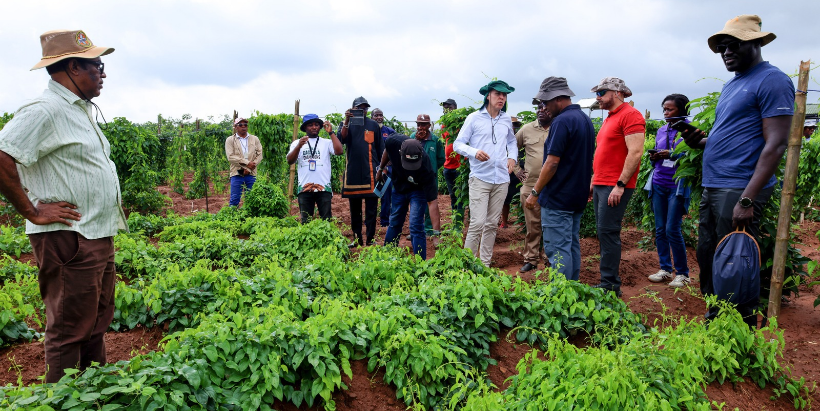
For Makram Geha, Director of CGIAR’s Breeding for Tomorrow (B4T) Science Program, the answer cannot be found in a laboratory alone. During his 14–18 September visit to IITA–CGIAR, Geha toured presentations, laboratories, breeding facilities, research fields, and partner engagements to see how IITA’s breeding programs connect science with the realities of agricultural production.
At the breeding field, the science becomes tangible. The field visit to Ikenne, one of IITA’s off-station sites, provided Geha with firsthand exposure to the program’s work. IITA staff demonstrated efforts to identify disease-resistant varieties, improve flowering to accelerate breeding, develop higher-dry-matter yams for processors, and better understand farmers’ preferences for tuber size and quality. Discussions also explored breeding for resistance to Yam Mosaic Virus (YMV), reducing staking costs, and the potential application of gene-editing technologies in future yam improvement efforts.
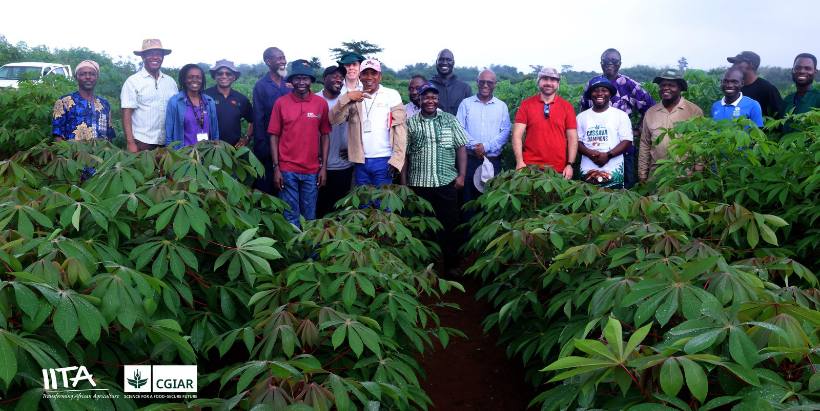
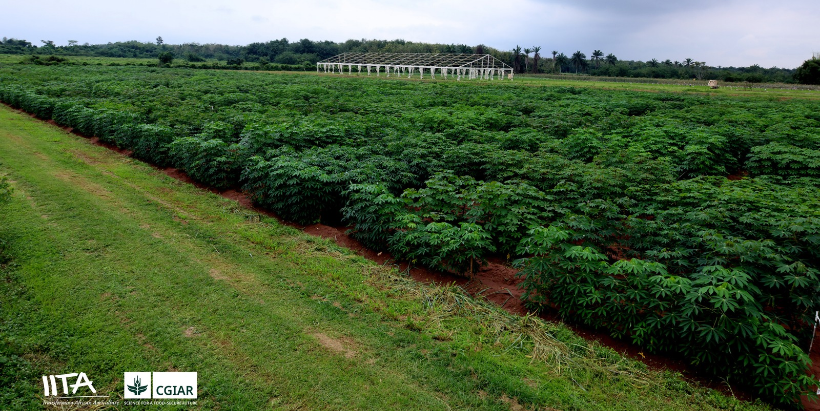
During field tours, Geha observed cassava trials involving materials conserved since 1994 and evaluated across multiple locations, including Ibadan, Oyo State; Mokwa, Niger State; Abuja; and Umudike, Abia State. Researchers are targeting both fresh-market and processing sectors while training farmers through crop tours and demonstrations. The team also outlined future priorities, including establishing rapid virus-cleaning facilities to support germplasm exchange, strengthening testing networks, and shortening the time between variety release and farmer adoption.
The breeding process also involves careful phenotyping and evaluation across generations to identify materials with the combinations of traits required for future products. Breeding is not simply about releasing varieties. It is about building products around defined needs. The question is increasingly not simply whether a variety can produce more, but whether the product fits the realities of the people who will grow and use it.
This principle was also visible in discussions on gender and social inclusion. IITA’s Social Inclusion and Gender Lead, Dr Bela Teeken, demonstrated how IITA is integrating farmers, processors, local leadership, and gender considerations into on-farm testing. Rather than asking only whether farmers like a variety, researchers examine who uses it, why they use it, what value-added traits matter to different users, and how adoption spreads through farming communities.
One example showed that 59 trial participants were associated with 273 additional farmers who became motivated to adopt the varieties. Such approaches help transform farmers from recipients of technologies into participants in the development and testing process.
The same philosophy extends into digital breeding. IITA is using tools for trial design, data management, genotyping, crossing records, genomic prediction, and phenotyping. At the field and farm level, researchers are also exploring drones, remote sensing, irrigation improvements, mechanization, and other technologies to make breeding and testing more efficient.
For Geha, seeing these systems in operation offered an opportunity to understand not only what IITA is breeding, but how the institute is building the infrastructure and partnerships needed to deliver those products. His reflections pointed toward greater integration: breeding must connect with agronomy, seed systems, markets, nutrition, climate action, and scaling. The message from the five-day engagement was therefore clear. A breeding program does not finish its work when a variety is released. The real measure of success is what happens when that product reaches the field—and whether it delivers value under the conditions in which farmers work.
Contributed by
Folake Oduntan