
NEWS

From soil data to decisions: IITA scientists lead the conversation at SSSN’s golden jubilee
October 27, 2026
Dr Samuel A. Mesele, IITA Soil Scientist, delivers the second lead paper at the 50th Annual Conference of the Soil Science Society of Nigeria, University of Ilorin.

From digital soil mapping and nutrient management to decision-support tools for farmers and policymakers, the focus of soil science is increasingly shifting from generating information to applying it. At the 50th Annual Conference of the Soil Science Society of Nigeria (SSSN), IITA co-led that conversation. Through a keynote paper, a masterclass, and technical presentations—showcasing new research focusing on turning soil information into practical decisions.

With one message: soil data matters only when it informs decisions, IITA scientists highlighted how turning soil data into actionable insights can drive more productive, resilient, and sustainable agricultural systems at the Golden Jubilee conference.

The conference, themed “Innovations in soil science for climate resilience, nutritional security and national development,” brought together researchers, policymakers, development partners and private sector actors. It was declared open by the Honorable Minister of State for Agriculture and Food Security, Senator Aliyu Sabi Abdullahi. SSSN President, Prof. Jibrin M. Jibrin, who also serves as an IITA consultant under the Regional Hub for Fertilizer and Soil Health for West Africa and the Sahel, welcomed delegates, and the keynote address was delivered by Dr Abdulhamid Umar, National Project Coordinator of the Agro-Climatic Resilience in Semi-Arid Landscapes (ACReSAL) project.
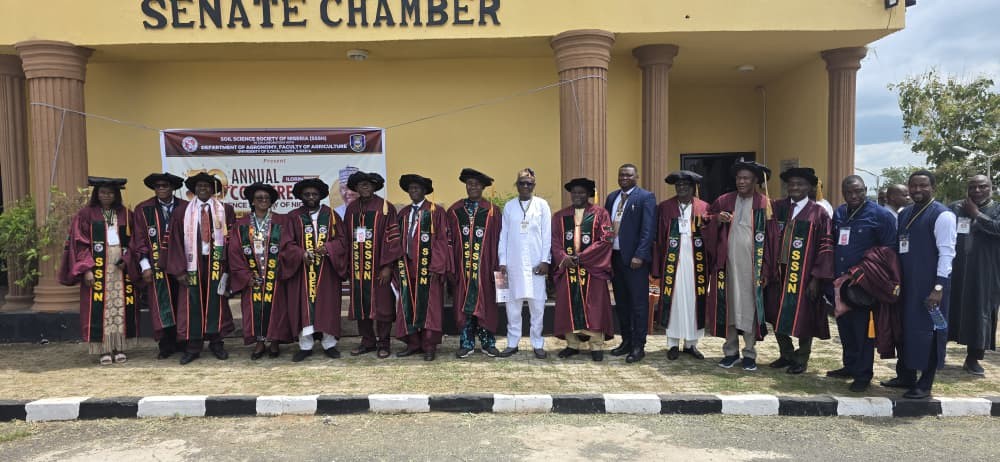
SSSN Executive, Fellows and keynote speakers at the Senate Chamber, University of Ilorin, during the Society’s Golden Jubilee conference.

From continental evidence to national action

Dr Samuel Mesele, IITA Soil Scientist, delivered one of the conference’s two lead papers, titled “Reading Africa’s Soils, Reimagining Nigeria’s Future: From Continental Evidence to National Action.” He traced the evolution of soil information systems across Africa and the case for coordinated action against soil degradation. Solutions to soil degradation are well established, he noted, yet adoption of sustainable soil management practices remains low, as the State of the World’s Soil Resources 2026 report shows.

Drawing on the continental soil survey conducted under the Soils4Africa project, Dr Mesele showed how harmonized, accessible and interoperable soil data can support evidence-based decisions. He also highlighted the roles of the Regional Hub for Fertilizer and Soil Health for West Africa and the Sahel, and the African Union Soil Observatory (AUSO), in translating soil information into practical recommendations for farmers and other end users. “Understanding Africa’s soils gives us the evidence to guide action,” he concluded. “Reimagining Nigeria’s future means translating that evidence into coordinated, practical and sustainable interventions.”
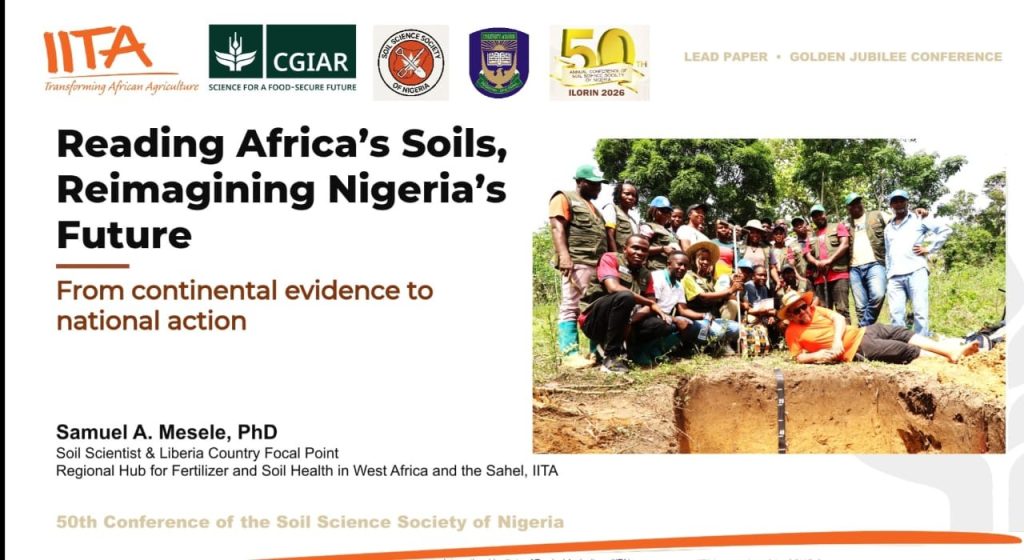
Title slide of Dr Mesele's lead paper, “Reading Africa's Soils, Reimagining Nigeria's Future: From Continental Evidence to National Action.”
Title slide of Dr Mesele’s lead paper, “Reading Africa’s Soils, Reimagining Nigeria’s Future: From Continental Evidence to National Action.”

Turning soil data into decisions

IITA also helped shape a first for the Society. Dr Mesele co-facilitated the inaugural SSSN Masterclass with Prof. James Jayeoba and Prof. Godwin Ajiboye, titled “From Soil Data to Decision: Practical Soil Information Systems for Sustainable Agriculture and Land Management in Nigeria.”

The interactive session covered how to generate reliable soil data, interpret soil indicators, and apply the results to farm and land management. Participants explored how soil information can guide agricultural planning, inform investment decisions, and support soil conservation.
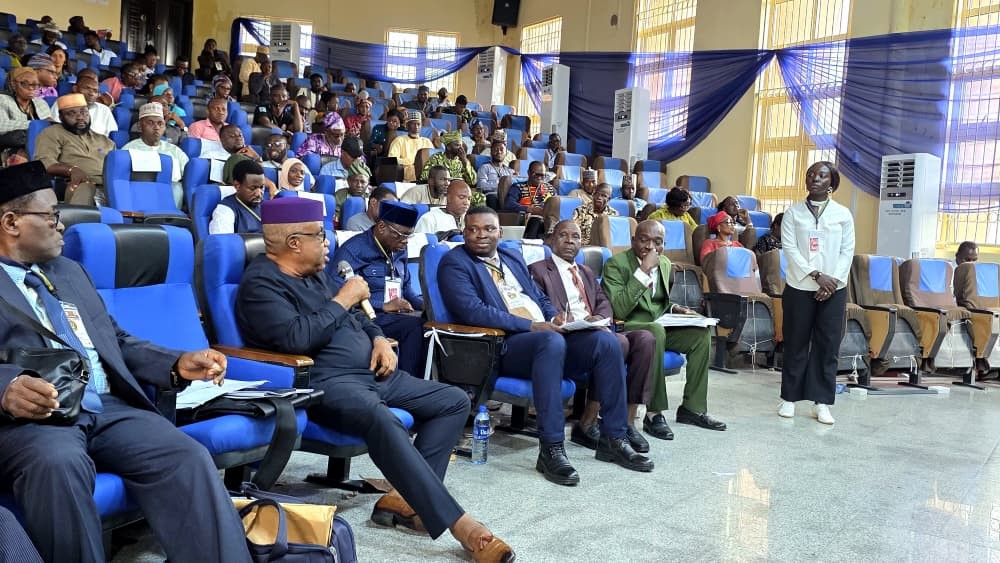
Participants contribute to discussions during the first SSSN Masterclass, “From Soil Data to Decision.”

The central takeaway was the need to move beyond data collection. Soil information creates value when it reaches the people making decisions about land, inputs and investment.

IITA Research Fellows share new findings

Two IITA Research Fellows from the Soil Management Unit in Ibadan also presented their work on digital soil information and site-specific nutrient management during the technical sessions. Abosede Busayo Babatunde used soil fertility and land degradation risk mapping under the Special Agro-Industrial Processing Zones (SAPZ) program to show how digital soil information can guide crop suitability and development priorities in southwestern Nigeria, while Olufolajimi Alofun compared soil phosphorus extractants to improve phosphorus assessment and support site-specific fertilizer recommendations for maize in tropical Alfisols.

Looking ahead

The lessons shared at conference are already traveling. Dr Mesele also serves as Technical Lead for the Liberia Land and Soil Resources Knowledge Project (Soils4Liberia), led by IITA in partnership with national and international organizations. The project is building Liberia’s first comprehensive land and soil information system, applying approaches refined through Soils4Africa to a country where modern soil data remains limited.

As Nigeria’s soil science community marks five decades, IITA remains committed to making soil information accurate, accessible and useful, from the laboratory to the farm.

About the IITA Soil Management Unit

The Soil Management Unit at IITA headquarters in Ibadan generates soil data, maps and fertility recommendations that support sustainable land management and farm productivity in sub-Saharan Africa. Its work spans continental initiatives such as Soils4Africa, national programs such as Soils4Liberia and SAPZ, and the Regional Hub for Fertilizer and Soil Health for West Africa and the Sahel.


Contributed by

Recent stories

No items found
Scroll to Top
Olaosebikan, Olamide

Olamide Deborah Nwanze is a Senior Research Associate specializing in gender mainstreaming research to inform participatory and inclusive breeding, variety development, and seed systems policies regarding root, tuber, and banana (RTB) crops in the International Institute of Tropical Agriculture Headquarters, Ibadan, Nigeria. She is a PhD candidate at the University of Ibadan and holds an MSc and B. Agric in Agricultural Extension and Rural Development. Olamide is a fellow of the African Women in Agricultural Research and Development – Gender Responsive Agricultural Systems Policy (AWARD-GRASP) and the Gender Responsive Researchers Equipped for Agricultural Transformation (GREAT). She seeks to apply her gender-mainstreaming learnings, gender-responsive research, and policy development, and review expertise to facilitate women, youth, children, and vulnerable social group’s access to and adoption of agricultural Innovations that guarantee food, nutrition, income, and livelihood security in Africa. Her current roles include mentoring research fellows, development of guides and training manuals, implementation and adaptation of gender frameworks and tools, value chain actors’ engagement as citizen science partners, policy review and redesign, data management, and analysis. Her current research explores mixed methods and participatory and interdisciplinary approaches to capture and highlight gender dynamics, needs, preferences, and challenges stakeholders face within the agricultural livelihood value chain to prioritize gender-inclusive strategies in breeding programs, policy design, and implementation.

At IITA, she contributes to the implementation of the CGIAR Accelerated Breeding Initiative and Genetic Innovation Programs; participatory and gender research within the NextGen Cassava, HarvestPlus, RTBFoods, and Tricot-ClimMob 1000Farms Projects; and gender knowledge communication via the G-LENS webinar series, video documentary, policy briefs, publications, and blogs.


Recent publications

de Sousa, K., van Etten, J., Manners, R. Bello, A., Teeken, B., Olaosebikan, O., et al. 2024. The tricot approach: an agile framework for decentralized on-farm testing supported by citizen science. A retrospective. Agron. Sustain. Dev. 44, 8. https://doi.org/10.1007/s13593-023-00937-1

Madu, T., Onwuka, S., Nwafor, S., Onyemauwa, N., Ejechi, M., Ofoeze, M., Ukeje, B., Eluagu, C., Olaosebikan, O., Okoye, B., 2024. Gender-Inclusive Consumer Studies Improve Cassava Breeding in Nigeria in: Frontiers in Sociology, volume 9, number: 1224504, doi: 10.3389/fsoc.2024.1224504

Olaosebikan, O.; Bello, A.; Utoblo, O.; Okoye, B.; Olutegbe, N.; Garner, E.; Teeken, B.; Bryan, E.; Forsythe, L.; Cole, S.; Madu, T. 2023.  Stressors and Resilience within the Cassava Value Chain in Nigeria: Preferred Cassava Variety Traits and Response Strategies of Men and Women to Inform Breeding. Sustainability 15, 7837. https://doi.org/10.3390/su15107837

Okoye, B., Ofoeze, M., Ejechi, M., Onwuka, S., Nwafor, S., Onyemauwa, N., Ukeje, B., Eluagu, C., Obidiegwu, J.*, Olaosebikan, O., Madu, T.* 2023. Prioritizing preferred traits in the yam value chain in Nigeria: a gender situation analysis in: Frontiers in Sociology, volume 8, number: 1232626, pages 1 – 9, ISSN 2297-7775, 2023. https://www.frontiersin.org/articles/10.3389/fsoc.2023.1232626/full

Olaosebikan, O., Bello, A. A., de Sousa, K., Ndjouenkeu, R., Adesokan, M., Alamu, E. O., Agbona, A., van Etten, J., Kegah, F. N.*, Dufour, D., Bouniol, A., Teeken, B. 2023. Consumer acceptability of cassava gari-eba food products across cultural and environmental settings using the triadic comparison of technologies approach (tricot) in: Journal of the Science of Food and Agriculture,

Teeken, B., Olaosebikan, O., Bello, A. A., Madu, T.*, Cole, S. M. 2023. Qualitative assessment on the positionality and preferences of dyads in relation to cassava-related activities: working with tricot trial citizen scientists https://hdl.handle.net/10568/138326 Type: Manual

Bouniol, A., Ceballos, H., Bello, A. A., Teeken, B., Olaosebikan, O., Owoade, D., Agbona, A., Fotso Kuate, A., Madu, T.*, Okoye, B.*, Ofoeze, M.*, Nwafor, S.*, Onyemauwa, N.*, Adinsi, L.*, Forsythe, L., Dufour, D. 2023. Varietal impact on women’s labour, workload and related drudgery in processing root, tuber and banana crops: focus on cassava in sub-Saharan Africa in: Journal of the Science of Food and Agriculture, pages 1 – 25, ISSN 0022-5142,

Bello, A. A., Agbona, A., Olaosebikan, O., Edughaen, G., Dufour, D., Bouniol, A., Iluebbey, P., Ndjouenkeu, R.*, Rabbi, I. Y., Teeken, B. 2023. Genetic and environmental effects on processing productivity and food product yield: drudgery of women’s work in: Journal of the Science of Food and Agriculture, pages 1 – 32, ISSN 0022-5142, 5

Cavicchioli, M., Zimbiti, T., Teeken, B., Nwanze, D.O., Liani, M., Parkes, E. & Bello, A. 2023. IITA-Gender Responsive Breeding Training Report. Genetic Resources Center, IITA-HQ, Ibadan, 21-23 September, 2022. Ibadan, Nigeria: IITA, (34 p.).https://hdl.handle.net/10568/131368

Agbona, A. Peteti P., Teeken B., Olaosebikan O. Bello, A. A., Parkes, E., Rabbi, I. Y., Mueller, L., Egesi, C., Kulakow, P. 2022. Data Management in Multi-disciplinary African RTB Crop Breeding Programs. In: Williamson, H.F., Leonelli, S. (eds) Towards Responsible Plant Data Linkage: Data Challenges for Agricultural Research and Development. Springer, Cham. https://doi.org/10.1007/978-3-031-13276-6_5

Lora Forsythe, Pricilla Marimo, Sarah Mayanja, Olamide D. Olaosebikan, Esme Stuart, Bela Teeken, Benjamin Okoye, Tessy Madu, (2021). Cross-product Gender Analysis of RTBfoods Step 2 Gendered Food Mapping on RTB Products. Understanding the Drivers of Trait Preferences and the Development of Multi-user RTB Product Profiles, WP1. London, UK: RTBfoods Field Scientific Report, 30 p.

Teeken, B., Garner, E., Agbona, A., Balogun, I., Olaosebikan, O., Bello, A., Madu, T., Okoye, B., Egesi, C., Kulakow, P. and Tufan, H.A. 2021. Beyond “Women’s Traits”: Exploring How Gender, Social Difference, and Household Characteristics Influence Trait Preferences. Frontiers Sustainable Food Systems 5:740926. https://doi.org/10.3389/fsufs.2021.740926

Teeken, B., Agbona, A., Bello, A., Olaosebikan, O., Alamu, E., Adesokan, M., Awoyale, W., Madu, T., Okoye, B., Chijioke, U., Owoade, D., Okoro, M., Bouniol, A., Dufour, D., Hershey, C., Rabbi, I., Maziya‐Dixon, B., Egesi, C., Tufan, H. and Kulakow, P. (020. Understanding cassava varietal preferences through pairwise ranking of gari‐eba and fufu prepared by local farmer–processors. Int J Food Sci Technol. https://doi.org/10.1111/ijfs.14862

Bela Teeken, Olamide Olaosebikan, Ireti Balogun, Benjamin Okoye, Tessy Madu, Steven Cole, Abolore Bello, Elizabeth Parkes. (2020). Piloting the G+ customer and product profile tools for gender-responsive cassava breeding in Nigeria. Nigeria: International Institute of Tropical Agriculture (IITA). https://hdl.handle.net/20.500.11766/13000