NEWS

IITA and partners strengthen banana and plantain breeding research in Arusha
November 6, 2026
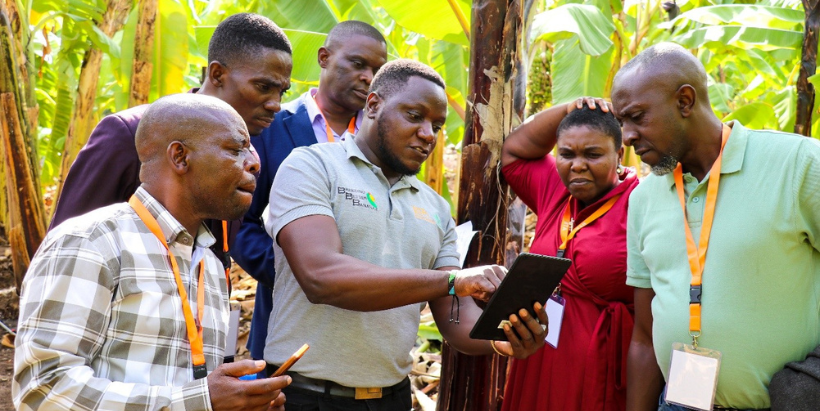
(L to R) Jules, Gerald, Michael, Udo and Allan learning about MusaBase, Ontology and Field Book. (Photo: H.Rashid/IITA)

Bananas and plantains are lifelines for millions in developing countries, particularly across Africa. Among the wide edible varieties, the East African Highland Banana (EAHB) alone accounts for 17% of all Musa grown worldwide, with plantain accounting for another 19%. For smallholder farmers, who are primarily producers, these crops provide both daily nourishment and income. Given their importance, researchers are working to accelerate their breeding.

IITA–CGIAR and the Tanzania Agricultural Research Institute (TARI) recently (28 September to 2 October) organized a Banana and Plantain Breeding Network meeting at the Nelson Mandela African Institution of Science and Technology in Arusha, Tanzania. The meeting brought together nine national banana and plantain programs comprising scientists and research partners to strengthen collaboration and share knowledge to improve banana and plantain breeding across the East and African regions.

IITA Banana Crop Lead, Prof. Rony Swennen, opened the meeting by highlighting the rising demand for bananas and plantains. He noted that both plantain and Matooke researchers stand to benefit from closer collaboration, which can lead to more effective results.
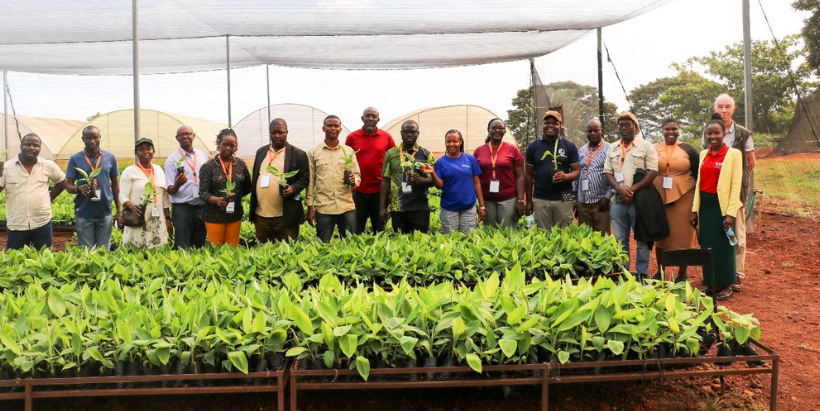
 Banana breeding network team at Maua Mazuri nursery. (Photo: H.Rashid/IITA)
Banana breeding network team at Maua Mazuri nursery. (Photo: H.Rashid/IITA)

“With our network now set up, we must consider how to work together more efficiently, and the key word is standardization across all programs,” Prof. Swennen said. “Taking part in the selection process makes you an essential part of this breeding community. Local selections have a regional impact. Each person’s role in breeding and selection is important. Your commitment is valued, both now and in years to come.”

During the workshop, participants received practical training on tools such as MusaBase, Ontology, Field Book, and field layout design. These sessions focused on collecting, managing, organizing, and sharing reliable data, which is essential for effective breeding.

Participants also went to the field to apply what they had learned. This experience helped them understand field activities and use the new tools with greater confidence. “The more you use these tools, the more skilled and confident you become. There is much to learn in the field than what a classroom session can cover,” explained Stanley Bayo, Data Manager from IITA.

The group also visited the partners’ fields, including TARI-Tengeru and farmers’ fields, where they observed banana evaluation trials and how local conditions affect the performance of different varieties. At TARI-Tengeru, they observed a demonstration of the sensory evaluation tool used to assess banana quality and consumer preferences. They also toured the Maua Mazuri Tissue Culture Laboratory and hardening nursery to learn about the multiplication of formerly released cooking banana varieties.
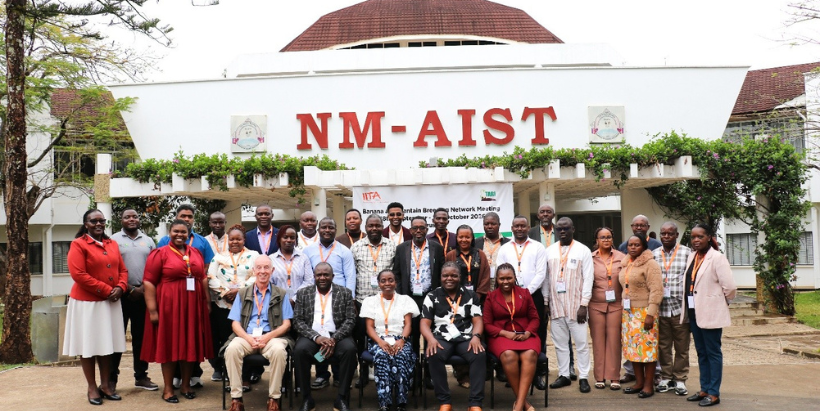
Participants during the Banana and Plantain Network Meeting in Arusha. (Photo: H.Rashid/IITA)

“Seeing the fieldwork up close gave us a better understanding of banana and plantain diversity, and how varieties respond to different environments. This showed the value in testing breeding materials in various places to identify those that perform well,” said Dr Victor Amankwaah, the banana research lead at CSIR-Crops Research Institute, Ghana.

He added, “The sensory evaluation program was interesting and helped us see how understanding preferences can guide breeders to develop varieties that meet consumers’ needs.”

Dr Michael Batte, the postdoctoral fellow and banana breeder at IITA, highlighted the importance of data management and timely uploads for the project. He said several partners, including TARI, had already begun sharing data. The network plans to establish multi-environment trials in all member countries, starting with Uganda, Tanzania, and the Democratic Republic of Congo, with some trials expected in Nigeria later this year.

The banana breeding network aims to allow the banana program to expand pre-breeding work to develop specific assets needed to transform banana breeding across Burundi, the Democratic Republic of Congo, Ghana, Kenya, Nigeria, Rwanda, Tanzania, Uganda, and the Ivory Coast.


Contributed by

Hadi Rashid, Rony Swennen and Michael Batte

Scroll to Top
Olaosebikan, Olamide

Olamide Deborah Nwanze is a Senior Research Associate specializing in gender mainstreaming research to inform participatory and inclusive breeding, variety development, and seed systems policies regarding root, tuber, and banana (RTB) crops in the International Institute of Tropical Agriculture Headquarters, Ibadan, Nigeria. She is a PhD candidate at the University of Ibadan and holds an MSc and B. Agric in Agricultural Extension and Rural Development. Olamide is a fellow of the African Women in Agricultural Research and Development – Gender Responsive Agricultural Systems Policy (AWARD-GRASP) and the Gender Responsive Researchers Equipped for Agricultural Transformation (GREAT). She seeks to apply her gender-mainstreaming learnings, gender-responsive research, and policy development, and review expertise to facilitate women, youth, children, and vulnerable social group’s access to and adoption of agricultural Innovations that guarantee food, nutrition, income, and livelihood security in Africa. Her current roles include mentoring research fellows, development of guides and training manuals, implementation and adaptation of gender frameworks and tools, value chain actors’ engagement as citizen science partners, policy review and redesign, data management, and analysis. Her current research explores mixed methods and participatory and interdisciplinary approaches to capture and highlight gender dynamics, needs, preferences, and challenges stakeholders face within the agricultural livelihood value chain to prioritize gender-inclusive strategies in breeding programs, policy design, and implementation.

At IITA, she contributes to the implementation of the CGIAR Accelerated Breeding Initiative and Genetic Innovation Programs; participatory and gender research within the NextGen Cassava, HarvestPlus, RTBFoods, and Tricot-ClimMob 1000Farms Projects; and gender knowledge communication via the G-LENS webinar series, video documentary, policy briefs, publications, and blogs.


Recent publications

de Sousa, K., van Etten, J., Manners, R. Bello, A., Teeken, B., Olaosebikan, O., et al. 2024. The tricot approach: an agile framework for decentralized on-farm testing supported by citizen science. A retrospective. Agron. Sustain. Dev. 44, 8. https://doi.org/10.1007/s13593-023-00937-1

Madu, T., Onwuka, S., Nwafor, S., Onyemauwa, N., Ejechi, M., Ofoeze, M., Ukeje, B., Eluagu, C., Olaosebikan, O., Okoye, B., 2024. Gender-Inclusive Consumer Studies Improve Cassava Breeding in Nigeria in: Frontiers in Sociology, volume 9, number: 1224504, doi: 10.3389/fsoc.2024.1224504

Olaosebikan, O.; Bello, A.; Utoblo, O.; Okoye, B.; Olutegbe, N.; Garner, E.; Teeken, B.; Bryan, E.; Forsythe, L.; Cole, S.; Madu, T. 2023.  Stressors and Resilience within the Cassava Value Chain in Nigeria: Preferred Cassava Variety Traits and Response Strategies of Men and Women to Inform Breeding. Sustainability 15, 7837. https://doi.org/10.3390/su15107837

Okoye, B., Ofoeze, M., Ejechi, M., Onwuka, S., Nwafor, S., Onyemauwa, N., Ukeje, B., Eluagu, C., Obidiegwu, J.*, Olaosebikan, O., Madu, T.* 2023. Prioritizing preferred traits in the yam value chain in Nigeria: a gender situation analysis in: Frontiers in Sociology, volume 8, number: 1232626, pages 1 – 9, ISSN 2297-7775, 2023. https://www.frontiersin.org/articles/10.3389/fsoc.2023.1232626/full

Olaosebikan, O., Bello, A. A., de Sousa, K., Ndjouenkeu, R., Adesokan, M., Alamu, E. O., Agbona, A., van Etten, J., Kegah, F. N.*, Dufour, D., Bouniol, A., Teeken, B. 2023. Consumer acceptability of cassava gari-eba food products across cultural and environmental settings using the triadic comparison of technologies approach (tricot) in: Journal of the Science of Food and Agriculture,

Teeken, B., Olaosebikan, O., Bello, A. A., Madu, T.*, Cole, S. M. 2023. Qualitative assessment on the positionality and preferences of dyads in relation to cassava-related activities: working with tricot trial citizen scientists https://hdl.handle.net/10568/138326 Type: Manual

Bouniol, A., Ceballos, H., Bello, A. A., Teeken, B., Olaosebikan, O., Owoade, D., Agbona, A., Fotso Kuate, A., Madu, T.*, Okoye, B.*, Ofoeze, M.*, Nwafor, S.*, Onyemauwa, N.*, Adinsi, L.*, Forsythe, L., Dufour, D. 2023. Varietal impact on women’s labour, workload and related drudgery in processing root, tuber and banana crops: focus on cassava in sub-Saharan Africa in: Journal of the Science of Food and Agriculture, pages 1 – 25, ISSN 0022-5142,

Bello, A. A., Agbona, A., Olaosebikan, O., Edughaen, G., Dufour, D., Bouniol, A., Iluebbey, P., Ndjouenkeu, R.*, Rabbi, I. Y., Teeken, B. 2023. Genetic and environmental effects on processing productivity and food product yield: drudgery of women’s work in: Journal of the Science of Food and Agriculture, pages 1 – 32, ISSN 0022-5142, 5

Cavicchioli, M., Zimbiti, T., Teeken, B., Nwanze, D.O., Liani, M., Parkes, E. & Bello, A. 2023. IITA-Gender Responsive Breeding Training Report. Genetic Resources Center, IITA-HQ, Ibadan, 21-23 September, 2022. Ibadan, Nigeria: IITA, (34 p.).https://hdl.handle.net/10568/131368

Agbona, A. Peteti P., Teeken B., Olaosebikan O. Bello, A. A., Parkes, E., Rabbi, I. Y., Mueller, L., Egesi, C., Kulakow, P. 2022. Data Management in Multi-disciplinary African RTB Crop Breeding Programs. In: Williamson, H.F., Leonelli, S. (eds) Towards Responsible Plant Data Linkage: Data Challenges for Agricultural Research and Development. Springer, Cham. https://doi.org/10.1007/978-3-031-13276-6_5

Lora Forsythe, Pricilla Marimo, Sarah Mayanja, Olamide D. Olaosebikan, Esme Stuart, Bela Teeken, Benjamin Okoye, Tessy Madu, (2021). Cross-product Gender Analysis of RTBfoods Step 2 Gendered Food Mapping on RTB Products. Understanding the Drivers of Trait Preferences and the Development of Multi-user RTB Product Profiles, WP1. London, UK: RTBfoods Field Scientific Report, 30 p.

Teeken, B., Garner, E., Agbona, A., Balogun, I., Olaosebikan, O., Bello, A., Madu, T., Okoye, B., Egesi, C., Kulakow, P. and Tufan, H.A. 2021. Beyond “Women’s Traits”: Exploring How Gender, Social Difference, and Household Characteristics Influence Trait Preferences. Frontiers Sustainable Food Systems 5:740926. https://doi.org/10.3389/fsufs.2021.740926

Teeken, B., Agbona, A., Bello, A., Olaosebikan, O., Alamu, E., Adesokan, M., Awoyale, W., Madu, T., Okoye, B., Chijioke, U., Owoade, D., Okoro, M., Bouniol, A., Dufour, D., Hershey, C., Rabbi, I., Maziya‐Dixon, B., Egesi, C., Tufan, H. and Kulakow, P. (020. Understanding cassava varietal preferences through pairwise ranking of gari‐eba and fufu prepared by local farmer–processors. Int J Food Sci Technol. https://doi.org/10.1111/ijfs.14862

Bela Teeken, Olamide Olaosebikan, Ireti Balogun, Benjamin Okoye, Tessy Madu, Steven Cole, Abolore Bello, Elizabeth Parkes. (2020). Piloting the G+ customer and product profile tools for gender-responsive cassava breeding in Nigeria. Nigeria: International Institute of Tropical Agriculture (IITA). https://hdl.handle.net/20.500.11766/13000