
IITA NEWS

IITA–AALI–Virunga Foundation pilot project boosts agricultural productivity for smallholder farmers in North Kivu
January 16, 2026
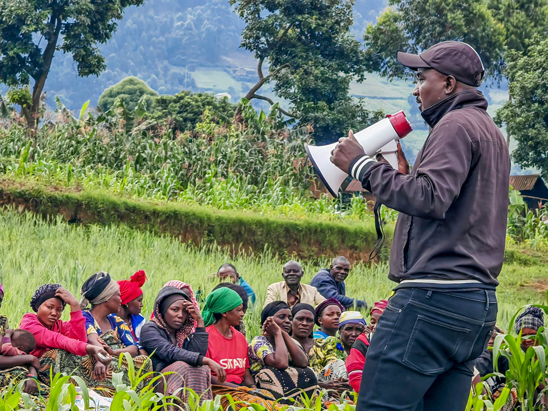
Farmers participating in an ISFM awareness session in Lubero, North Kivu.

Smallholder farmers in Lubero territory, North Kivu, in the Democratic Republic of Congo, are witnessing significant improvements in their harvests and agricultural practices thanks to the IITACGIAR, the African Agricultural Leadership Institute (AALI), and the Virunga Foundation pilot project for the Intensification of agricultural production. The initiative supports farmers in adopting Integrated Soil Fertility Management (ISFM) technologies that strengthen soil productivity and increase yields of wheat, maize, and soybean. The project also marks the first step toward the future Kivu–Kinshasa Green Corridor, an ambitious program aimed at transforming agriculture across eastern DRC.
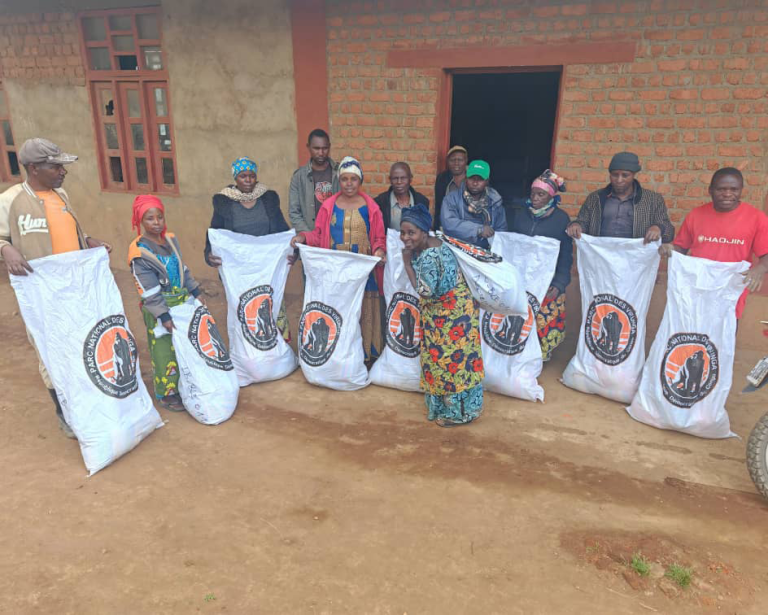
Women farmers learning improved agronomic practices during a field demonstration

So far, the pilot project has reached 350 smallholder farmers, of whom 60 percent are women, through a combination of awareness campaigns, theoretical and practical training, and the distribution of improved seeds and fertilizers. In total, 1,577 people, mostly farmers, have been sensitized on ISFM and its benefits for sustainable agriculture. These awareness efforts help farmers understand not only how to apply the improved technologies, but also why such changes are essential for reviving soil health in a region that has experienced decades of land degradation.

Farmers received complete input kits that included hybrid wheat seed (Hyrax), improved maize seed (Bazooka), soybean seed (Mak Soya 3), and mineral fertilizers such as DAP and urea. These inputs enable farmers to immediately establish their production fields and apply the practices learned during training. One of the project participants explains how these improved technologies have changed his farming experience.
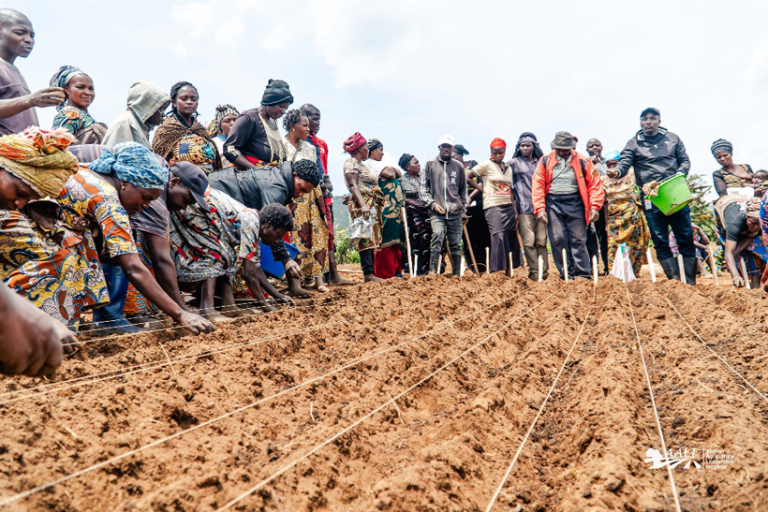
Women farmers learning improved agronomic practices during a field demonstration.

“Before IITA’s intervention through this project, no one in the village used mineral fertilizers. For generations, we had been told that chemical fertilizers degrade the soil, so farmers avoided them completely. Thanks to IITA’s training in good agronomic practices based on ISFM technology, we now understand the importance of using mineral fertilizers correctly and how to benefit from their advantages while avoiding the problems caused by misuse,” noted Mpangi Kambale, a farmer from Masereka

“As long as you tell us how we can access them when we want to buy them, we are ready,” he concludes.
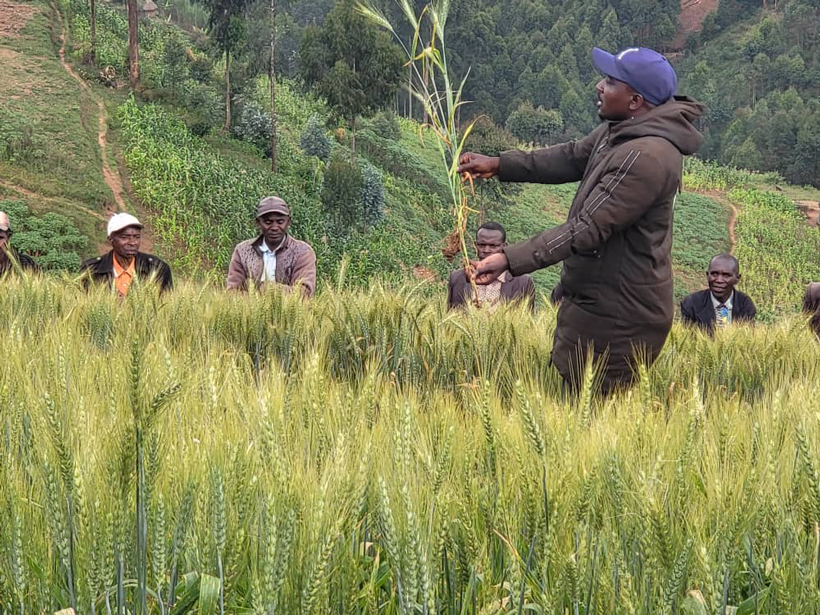
IITA researcher demonstrating to farmers the impact of fertilization on wheat growth during the field day.

Additionally, Rachele Kavira, a farmer from Lubero, expressed her sincere gratitude to the IITA, AALI, and the Virunga Foundation Consortium for their training and technical support. “We were on the verge of abandoning agriculture, even though it is the main source of income for more than 90% of the population, because our yields kept declining season after season due to soil degradation. Thanks to their practical training and technical guidance, they revealed the key techniques that enabled us to increase yields, improve productivity, and sustainably boost the production of wheat and maize.”

The project’s farmer field days, held from 1 to 5 December 2025 across Lubero Center, Masereka, Magheria, Kyondo, and Kasongwere, played a central role in strengthening the adoption of the ISFM package. These events served as open-air classrooms where farmers observed the direct impact of improved technologies on crop performance. Under the guidance of IITA researchers and AALI, participants compared traditional farming approaches with ISFM-enhanced fields, gaining first-hand experience that reinforced what they had learned during training.  

“Farmers trust what they see more than what they are told. These demonstration plots help them understand how improved seed and proper soil fertility management can easily double or even triple their yields,” noted Engineer Moustapha Kigangu from IITA.

By December 2025, the project had facilitated the establishment of 52.5 hectares of improved production fields, including 30 hectares of wheat and 22.5 hectares of maize. Expected yields from these fields are 60 tons of wheat and 67.5 tons of maize, corresponding to average yields of 2 tons per hectare and 3 tons per hectare, respectively. These gains translate into potentially significant income: an estimated USD 36,000 from wheat and USD 33,750 from maize. Beyond these numbers, the project has given farmers renewed confidence in their ability to increase their productivity using simple, proven practices that restore soil fertility and protect the environment


Scroll to Top
Olaosebikan, Olamide

Olamide Deborah Nwanze is a Senior Research Associate specializing in gender mainstreaming research to inform participatory and inclusive breeding, variety development, and seed systems policies regarding root, tuber, and banana (RTB) crops in the International Institute of Tropical Agriculture Headquarters, Ibadan, Nigeria. She is a PhD candidate at the University of Ibadan and holds an MSc and B. Agric in Agricultural Extension and Rural Development. Olamide is a fellow of the African Women in Agricultural Research and Development – Gender Responsive Agricultural Systems Policy (AWARD-GRASP) and the Gender Responsive Researchers Equipped for Agricultural Transformation (GREAT). She seeks to apply her gender-mainstreaming learnings, gender-responsive research, and policy development, and review expertise to facilitate women, youth, children, and vulnerable social group’s access to and adoption of agricultural Innovations that guarantee food, nutrition, income, and livelihood security in Africa. Her current roles include mentoring research fellows, development of guides and training manuals, implementation and adaptation of gender frameworks and tools, value chain actors’ engagement as citizen science partners, policy review and redesign, data management, and analysis. Her current research explores mixed methods and participatory and interdisciplinary approaches to capture and highlight gender dynamics, needs, preferences, and challenges stakeholders face within the agricultural livelihood value chain to prioritize gender-inclusive strategies in breeding programs, policy design, and implementation.

At IITA, she contributes to the implementation of the CGIAR Accelerated Breeding Initiative and Genetic Innovation Programs; participatory and gender research within the NextGen CassavaHarvestPlusRTBFoods, and Tricot-ClimMob 1000Farms Projects; and gender knowledge communication via the G-LENS webinar series, video documentary, policy briefspublications, and blogs.


Recent publications

de Sousa, K., van Etten, J., Manners, R. Bello, A., Teeken, B., Olaosebikan, O., et al. 2024. The tricot approach: an agile framework for decentralized on-farm testing supported by citizen science. A retrospective. Agron. Sustain. Dev. 44, 8. https://doi.org/10.1007/s13593-023-00937-1

Madu, T., Onwuka, S., Nwafor, S., Onyemauwa, N., Ejechi, M., Ofoeze, M., Ukeje, B., Eluagu, C., Olaosebikan, O., Okoye, B., 2024. Gender-Inclusive Consumer Studies Improve Cassava Breeding in Nigeria in: Frontiers in Sociology, volume 9, number: 1224504, doi: 10.3389/fsoc.2024.1224504

Olaosebikan, O.; Bello, A.; Utoblo, O.; Okoye, B.; Olutegbe, N.; Garner, E.; Teeken, B.; Bryan, E.; Forsythe, L.; Cole, S.; Madu, T. 2023.  Stressors and Resilience within the Cassava Value Chain in Nigeria: Preferred Cassava Variety Traits and Response Strategies of Men and Women to Inform Breeding. Sustainability 15, 7837. https://doi.org/10.3390/su15107837

Okoye, B., Ofoeze, M., Ejechi, M., Onwuka, S., Nwafor, S., Onyemauwa, N., Ukeje, B., Eluagu, C., Obidiegwu, J.*, Olaosebikan, O., Madu, T.* 2023. Prioritizing preferred traits in the yam value chain in Nigeria: a gender situation analysis in: Frontiers in Sociology, volume 8, number: 1232626, pages 1 – 9, ISSN 2297-7775, 2023. https://www.frontiersin.org/articles/10.3389/fsoc.2023.1232626/full

Olaosebikan, O., Bello, A. A., de Sousa, K., Ndjouenkeu, R., Adesokan, M., Alamu, E. O., Agbona, A., van Etten, J., Kegah, F. N.*, Dufour, D., Bouniol, A., Teeken, B. 2023. Consumer acceptability of cassava gari-eba food products across cultural and environmental settings using the triadic comparison of technologies approach (tricot) in: Journal of the Science of Food and Agriculture,

Teeken, B., Olaosebikan, O., Bello, A. A., Madu, T.*, Cole, S. M. 2023. Qualitative assessment on the positionality and preferences of dyads in relation to cassava-related activities: working with tricot trial citizen scientists https://hdl.handle.net/10568/138326 Type: Manual

Bouniol, A., Ceballos, H., Bello, A. A., Teeken, B., Olaosebikan, O., Owoade, D., Agbona, A., Fotso Kuate, A., Madu, T.*, Okoye, B.*, Ofoeze, M.*, Nwafor, S.*, Onyemauwa, N.*, Adinsi, L.*, Forsythe, L., Dufour, D. 2023. Varietal impact on women’s labour, workload and related drudgery in processing root, tuber and banana crops: focus on cassava in sub-Saharan Africa in: Journal of the Science of Food and Agriculture, pages 1 – 25, ISSN 0022-5142,

Bello, A. A., Agbona, A., Olaosebikan, O., Edughaen, G., Dufour, D., Bouniol, A., Iluebbey, P., Ndjouenkeu, R.*, Rabbi, I. Y., Teeken, B. 2023. Genetic and environmental effects on processing productivity and food product yield: drudgery of women’s work in: Journal of the Science of Food and Agriculture, pages 1 – 32, ISSN 0022-5142, 5

Cavicchioli, M., Zimbiti, T., Teeken, B., Nwanze, D.O., Liani, M., Parkes, E. & Bello, A. 2023. IITA-Gender Responsive Breeding Training Report. Genetic Resources Center, IITA-HQ, Ibadan, 21-23 September, 2022. Ibadan, Nigeria: IITA, (34 p.).https://hdl.handle.net/10568/131368

Agbona, A. Peteti P., Teeken B., Olaosebikan O. Bello, A. A., Parkes, E., Rabbi, I. Y., Mueller, L., Egesi, C., Kulakow, P. 2022. Data Management in Multi-disciplinary African RTB Crop Breeding Programs. In: Williamson, H.F., Leonelli, S. (eds) Towards Responsible Plant Data Linkage: Data Challenges for Agricultural Research and Development. Springer, Cham. https://doi.org/10.1007/978-3-031-13276-6_5

Lora Forsythe, Pricilla Marimo, Sarah Mayanja, Olamide D. Olaosebikan, Esme Stuart, Bela Teeken, Benjamin Okoye, Tessy Madu, (2021). Cross-product Gender Analysis of RTBfoods Step 2 Gendered Food Mapping on RTB Products. Understanding the Drivers of Trait Preferences and the Development of Multi-user RTB Product Profiles, WP1. London, UK: RTBfoods Field Scientific Report, 30 p.

Teeken, B., Garner, E., Agbona, A., Balogun, I., Olaosebikan, O., Bello, A., Madu, T., Okoye, B., Egesi, C., Kulakow, P. and Tufan, H.A. 2021. Beyond “Women’s Traits”: Exploring How Gender, Social Difference, and Household Characteristics Influence Trait Preferences. Frontiers Sustainable Food Systems 5:740926. https://doi.org/10.3389/fsufs.2021.740926

Teeken, B., Agbona, A., Bello, A., Olaosebikan, O., Alamu, E., Adesokan, M., Awoyale, W., Madu, T., Okoye, B., Chijioke, U., Owoade, D., Okoro, M., Bouniol, A., Dufour, D., Hershey, C., Rabbi, I., Maziya‐Dixon, B., Egesi, C., Tufan, H. and Kulakow, P. (020. Understanding cassava varietal preferences through pairwise ranking of gari‐eba and fufu prepared by local farmer–processors. Int J Food Sci Technol. https://doi.org/10.1111/ijfs.14862

Bela Teeken, Olamide Olaosebikan, Ireti Balogun, Benjamin Okoye, Tessy Madu, Steven Cole, Abolore Bello, Elizabeth Parkes. (2020). Piloting the G+ customer and product profile tools for gender-responsive cassava breeding in Nigeria. Nigeria: International Institute of Tropical Agriculture (IITA). https://hdl.handle.net/20.500.11766/13000