
IITA NEWS

IITA’s yam research shines with multiple international awards at ISTRC 2025 in India
December 9, 2025
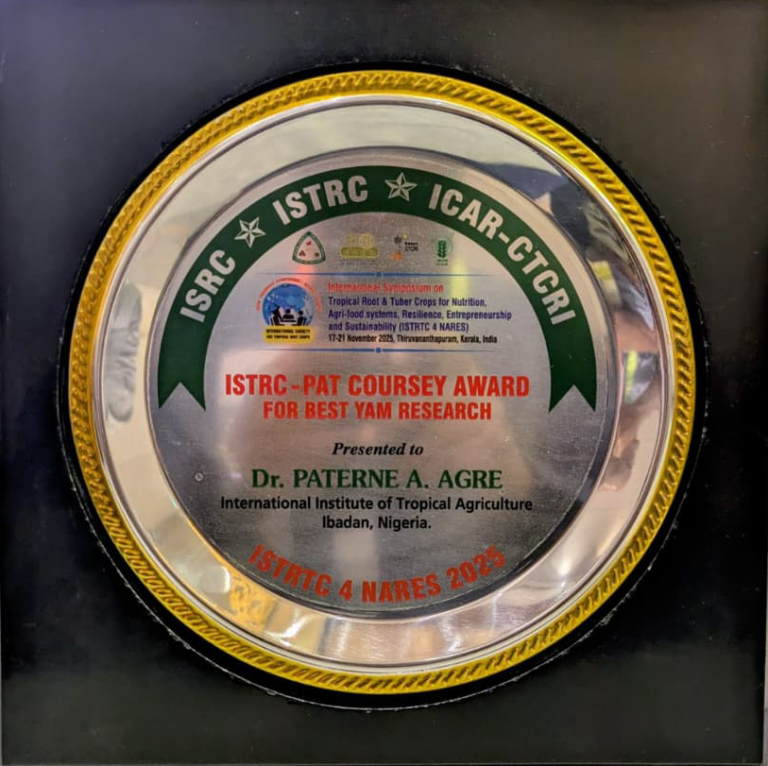
Yam research award.
Yam research award.

Tropical root and tuber crops—staples that quietly sustain millions across the tropical world, took center stage in Thiruvananthapuram, Kerala, as scientists, innovators, and policymakers converged for the 20th International Symposium of the International Society for Tropical Root Crops (ISTRC). The 2025 edition, hosted by the ICAR–Central Tuber Crops Research Institute (CTCRI) in collaboration with the Indian Society for Root Crops (ISRC), marked a significant milestone, returning to India nearly two decades after the country last hosted the event.

Held under the theme “Tropical Root & Tuber Crops for Nutrition, Agrifood Systems, Resilience, Entrepreneurship and Sustainability (ISTRTC 4 NARES)”, the symposium united the global community in a shared mission: to unlock the full potential of crops such as cassava, yam, sweet potato, taro, and other indigenous staples that anchor food security, rural livelihoods, and climate resilience across the tropics.

Over five days, the symposium welcomed more than 90 international delegates from 25 countries across six continents, alongside over 200 participants from India. It featured a rich blend of scientific presentations, keynote lectures, technical sessions, policy dialogues, poster exhibitions, and stakeholder roundtables—all aimed at reimagining the future of tropical agrifood systems. The conversations highlighted the urgency of strengthening diversified and climate-resilient food systems, moving away from monoculture, and harnessing every part of the plant to reduce waste and increase value.

The program was officially inaugurated on 17 November 2025 by Dr Sanjay Kumar Singh, Deputy Director General (Horticultural Sciences) at ICAR. In his address, Dr Singh spoke passionately about the potential of tropical root and tuber crops to address the global agrarian crisis and growing climate challenges. He described these crops as “resilience crops,” noting their ability to thrive under adverse conditions, support smallholder farmers, and contribute to nutrition and entrepreneurship in rural communities.

In his address, Prof. Lateef Sanni, President of ISTRC and Executive Director of the Nigerian Stored Products Research Institute (NSPRI), and IITA Program Lead for BASICS II, emphasized the centrality of tuber crops to food systems in sub-Saharan Africa, where they serve as staple foods and engines of income. He stressed the need for sustained investments in research and technology to elevate these crops and enable farmers to benefit from modern value chains.

The welcome address by Dr Ganesan Byju, President of ISRC and Director of ICAR-CTCRI, reinforced the global commitment to strengthening food and nutrition security by enhancing the production, utilization, and value addition of tropical tuber crops. The inaugural session also featured perspectives from distinguished guests including Dr Ramasamy Selvarajan, Dr Hugo Campos, Prof. Michael Abberton, Prof. Andrew Westby (OBE), and Dr Jan W. Low, each offering insights drawn from years of research, development practice, and international collaboration.

The session further recognized outstanding contributions within the tuber crop community. Dr A. N. Jyothi, Principal Scientist at ICAR-CTCRI, received the ISRC Fellow 2025 Award, while Smt. Jinimol and Dr M. Nedunchezhiyan were honored with the Dr A. Abraham Award for exceptional research papers published in the Journal of Root Crops. A special issue of the Kerala Karshakan E-Journal dedicated to tropical tuber crops was also unveiled during the event.
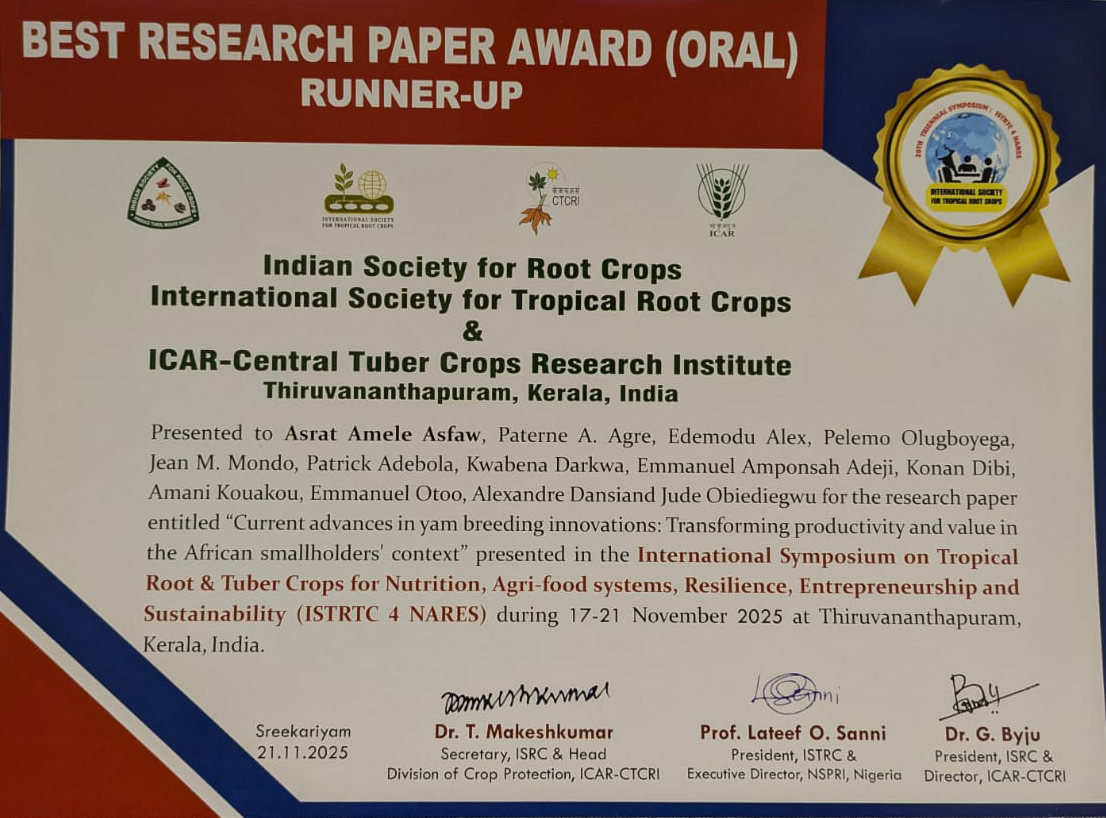
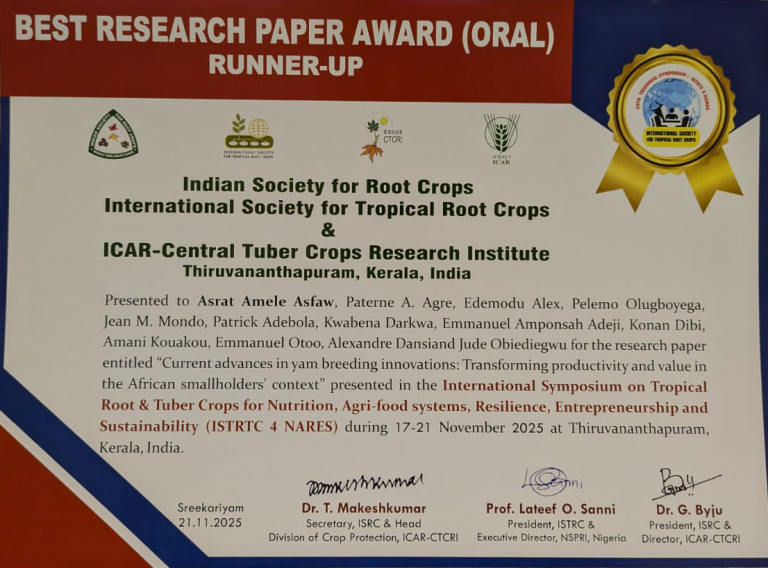
Best research paper award presented to Dr Asrat Amele Asfaw.

One of the most notable moments of the symposium was the international recognition awarded to IITA-CGIAR for its groundbreaking work in yam research. IITA researchers received the prestigious ISTRC–Pat Coursey Award for Best Yam Research, alongside Best Oral Presentation Awards won by Dr Agre Paterne and Dr Asrat Amele. These honors underscore IITA’s leadership in yam genomics, breeding, and agronomy, as well as the strong institutional support and collaborative research environment fostered across the institute.

As the symposium ended with stakeholder meetings and an institutional visit to ICAR-CTCRI, a clear message resonated through every presentation, panel, and discussion: tropical root and tuber crops are indispensable to building resilient, sustainable, and inclusive agrifood systems. From Asia to Africa, and from research labs to smallholder fields, the collective commitment witnessed at ISTRC 2025 points to a future where agricultural innovations uplift communities, strengthen economies, and nourish a climate-challenged world.


Scroll to Top
Olaosebikan, Olamide

Olamide Deborah Nwanze is a Senior Research Associate specializing in gender mainstreaming research to inform participatory and inclusive breeding, variety development, and seed systems policies regarding root, tuber, and banana (RTB) crops in the International Institute of Tropical Agriculture Headquarters, Ibadan, Nigeria. She is a PhD candidate at the University of Ibadan and holds an MSc and B. Agric in Agricultural Extension and Rural Development. Olamide is a fellow of the African Women in Agricultural Research and Development – Gender Responsive Agricultural Systems Policy (AWARD-GRASP) and the Gender Responsive Researchers Equipped for Agricultural Transformation (GREAT). She seeks to apply her gender-mainstreaming learnings, gender-responsive research, and policy development, and review expertise to facilitate women, youth, children, and vulnerable social group’s access to and adoption of agricultural Innovations that guarantee food, nutrition, income, and livelihood security in Africa. Her current roles include mentoring research fellows, development of guides and training manuals, implementation and adaptation of gender frameworks and tools, value chain actors’ engagement as citizen science partners, policy review and redesign, data management, and analysis. Her current research explores mixed methods and participatory and interdisciplinary approaches to capture and highlight gender dynamics, needs, preferences, and challenges stakeholders face within the agricultural livelihood value chain to prioritize gender-inclusive strategies in breeding programs, policy design, and implementation.

At IITA, she contributes to the implementation of the CGIAR Accelerated Breeding Initiative and Genetic Innovation Programs; participatory and gender research within the NextGen CassavaHarvestPlusRTBFoods, and Tricot-ClimMob 1000Farms Projects; and gender knowledge communication via the G-LENS webinar series, video documentary, policy briefspublications, and blogs.


Recent publications

de Sousa, K., van Etten, J., Manners, R. Bello, A., Teeken, B., Olaosebikan, O., et al. 2024. The tricot approach: an agile framework for decentralized on-farm testing supported by citizen science. A retrospective. Agron. Sustain. Dev. 44, 8. https://doi.org/10.1007/s13593-023-00937-1

Madu, T., Onwuka, S., Nwafor, S., Onyemauwa, N., Ejechi, M., Ofoeze, M., Ukeje, B., Eluagu, C., Olaosebikan, O., Okoye, B., 2024. Gender-Inclusive Consumer Studies Improve Cassava Breeding in Nigeria in: Frontiers in Sociology, volume 9, number: 1224504, doi: 10.3389/fsoc.2024.1224504

Olaosebikan, O.; Bello, A.; Utoblo, O.; Okoye, B.; Olutegbe, N.; Garner, E.; Teeken, B.; Bryan, E.; Forsythe, L.; Cole, S.; Madu, T. 2023.  Stressors and Resilience within the Cassava Value Chain in Nigeria: Preferred Cassava Variety Traits and Response Strategies of Men and Women to Inform Breeding. Sustainability 15, 7837. https://doi.org/10.3390/su15107837

Okoye, B., Ofoeze, M., Ejechi, M., Onwuka, S., Nwafor, S., Onyemauwa, N., Ukeje, B., Eluagu, C., Obidiegwu, J.*, Olaosebikan, O., Madu, T.* 2023. Prioritizing preferred traits in the yam value chain in Nigeria: a gender situation analysis in: Frontiers in Sociology, volume 8, number: 1232626, pages 1 – 9, ISSN 2297-7775, 2023. https://www.frontiersin.org/articles/10.3389/fsoc.2023.1232626/full

Olaosebikan, O., Bello, A. A., de Sousa, K., Ndjouenkeu, R., Adesokan, M., Alamu, E. O., Agbona, A., van Etten, J., Kegah, F. N.*, Dufour, D., Bouniol, A., Teeken, B. 2023. Consumer acceptability of cassava gari-eba food products across cultural and environmental settings using the triadic comparison of technologies approach (tricot) in: Journal of the Science of Food and Agriculture,

Teeken, B., Olaosebikan, O., Bello, A. A., Madu, T.*, Cole, S. M. 2023. Qualitative assessment on the positionality and preferences of dyads in relation to cassava-related activities: working with tricot trial citizen scientists https://hdl.handle.net/10568/138326 Type: Manual

Bouniol, A., Ceballos, H., Bello, A. A., Teeken, B., Olaosebikan, O., Owoade, D., Agbona, A., Fotso Kuate, A., Madu, T.*, Okoye, B.*, Ofoeze, M.*, Nwafor, S.*, Onyemauwa, N.*, Adinsi, L.*, Forsythe, L., Dufour, D. 2023. Varietal impact on women’s labour, workload and related drudgery in processing root, tuber and banana crops: focus on cassava in sub-Saharan Africa in: Journal of the Science of Food and Agriculture, pages 1 – 25, ISSN 0022-5142,

Bello, A. A., Agbona, A., Olaosebikan, O., Edughaen, G., Dufour, D., Bouniol, A., Iluebbey, P., Ndjouenkeu, R.*, Rabbi, I. Y., Teeken, B. 2023. Genetic and environmental effects on processing productivity and food product yield: drudgery of women’s work in: Journal of the Science of Food and Agriculture, pages 1 – 32, ISSN 0022-5142, 5

Cavicchioli, M., Zimbiti, T., Teeken, B., Nwanze, D.O., Liani, M., Parkes, E. & Bello, A. 2023. IITA-Gender Responsive Breeding Training Report. Genetic Resources Center, IITA-HQ, Ibadan, 21-23 September, 2022. Ibadan, Nigeria: IITA, (34 p.).https://hdl.handle.net/10568/131368

Agbona, A. Peteti P., Teeken B., Olaosebikan O. Bello, A. A., Parkes, E., Rabbi, I. Y., Mueller, L., Egesi, C., Kulakow, P. 2022. Data Management in Multi-disciplinary African RTB Crop Breeding Programs. In: Williamson, H.F., Leonelli, S. (eds) Towards Responsible Plant Data Linkage: Data Challenges for Agricultural Research and Development. Springer, Cham. https://doi.org/10.1007/978-3-031-13276-6_5

Lora Forsythe, Pricilla Marimo, Sarah Mayanja, Olamide D. Olaosebikan, Esme Stuart, Bela Teeken, Benjamin Okoye, Tessy Madu, (2021). Cross-product Gender Analysis of RTBfoods Step 2 Gendered Food Mapping on RTB Products. Understanding the Drivers of Trait Preferences and the Development of Multi-user RTB Product Profiles, WP1. London, UK: RTBfoods Field Scientific Report, 30 p.

Teeken, B., Garner, E., Agbona, A., Balogun, I., Olaosebikan, O., Bello, A., Madu, T., Okoye, B., Egesi, C., Kulakow, P. and Tufan, H.A. 2021. Beyond “Women’s Traits”: Exploring How Gender, Social Difference, and Household Characteristics Influence Trait Preferences. Frontiers Sustainable Food Systems 5:740926. https://doi.org/10.3389/fsufs.2021.740926

Teeken, B., Agbona, A., Bello, A., Olaosebikan, O., Alamu, E., Adesokan, M., Awoyale, W., Madu, T., Okoye, B., Chijioke, U., Owoade, D., Okoro, M., Bouniol, A., Dufour, D., Hershey, C., Rabbi, I., Maziya‐Dixon, B., Egesi, C., Tufan, H. and Kulakow, P. (020. Understanding cassava varietal preferences through pairwise ranking of gari‐eba and fufu prepared by local farmer–processors. Int J Food Sci Technol. https://doi.org/10.1111/ijfs.14862

Bela Teeken, Olamide Olaosebikan, Ireti Balogun, Benjamin Okoye, Tessy Madu, Steven Cole, Abolore Bello, Elizabeth Parkes. (2020). Piloting the G+ customer and product profile tools for gender-responsive cassava breeding in Nigeria. Nigeria: International Institute of Tropical Agriculture (IITA). https://hdl.handle.net/20.500.11766/13000