
IITA NEWS

7th World Cowpea Research Conference highlights climate-resilient technologies and food security
October 11, 2024

Cowpea, an indigenous crop to Africa, is vital for its protein-rich grains, constituting up to 25% of its dry weight. This makes it a crucial protein source in many African diets, which are predominantly based on starchy foods like cassava, yam, potato, plantain, and cereals such as sorghum, millet, maize, etc. Cowpea grains are rich in antioxidants that contribute to a healthy diet. It is primarily cultivated in the dry savannah regions of sub-Saharan Africa, areas that are often affected by drought and high temperatures. Despite these challenging conditions, cowpea thrives better than many other crops.
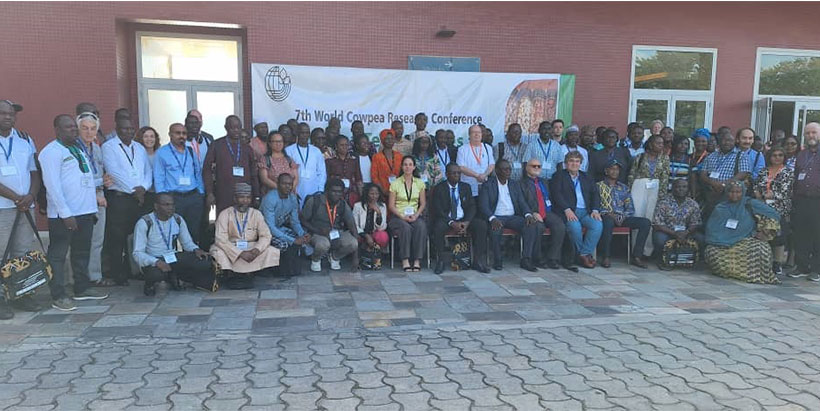
Participants at the conference.

Between 23 and 26 September, participants from around the world gathered in Cotonou, Benin, for the 7th World Cowpea Research Conference (WCRC). This conference provides a platform for cowpea scientists to interact, discuss their research findings, and exchange mutually beneficial ideas. The conference, themed “Cowpea Technologies for Enhancing Climate Resilience, Food and Nutritional Security,” featured oral presentations, poster displays, and exhibitions of cowpea processing equipment fabricated in the country.

In his welcome and goodwill address, IITA Deputy Director General, Partnerships for Delivery (DDG-P4D), Kenton Dashiell,  representing the IITA Director General, Simeon Ehui, emphasized the importance of the conference. He highlighted that it unites scientists, donors, and those who bring cowpea to farmers, fostering discussions on improving research, delivery, and scaling efforts to benefit millions through cowpea research.

Michael Abberton, the Director of IITA West Africa Hub and Head of the Genetic Resources Center, emphasized the critical role of the gene bank, especially concerning cowpea. He highlighted that IITA boasts the world’s largest and most diverse cowpea collection, with over 16,000 different accessions and around 1,000 accessions of cowpea relatives. “This invaluable resource has been instrumental for breeders in addressing climate change challenges by developing more drought-tolerant and heat-tolerant seeds,” he stated. Abberton also noted that the IITA gene bank employs various approaches to identify genes within specific accessions that could enhance the cowpea breeding program.
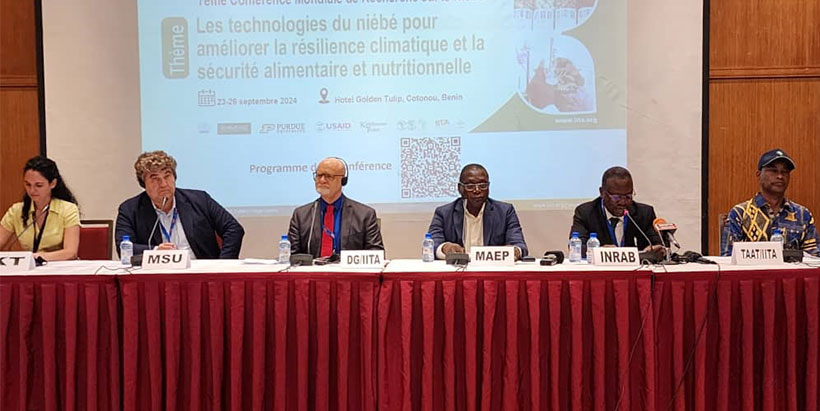
Panelists at WCRC 2024.

Patrick Ongom, a molecular breeder at IITA, discussed the latest technologies developed to tackle the challenges impacting cowpea productivity, which are worsened by climate change, leading to drought and heat stress. “We have been creating new tools to speed up the breeding process for these stress factors affecting cowpea production. By leveraging recent genetic advancements, we are developing molecular markers to identify genes that control traits related to heat stress, drought, and various diseases. These markers enable us to swiftly select varieties that are tolerant to these stresses,” he explained. Ongom further emphasized that these technologies are efficient, allowing breeders to quickly select and develop varieties that can be promptly distributed to farmers.

During the four-day event, Sir Edwin Southern, a distinguished molecular biologist, emeritus professor of Biochemistry, and fellow of Trinity College at the University of Oxford, received an honorary award. Southern has made significant contributions to research aimed at improving leguminous crops in semi-arid regions of India and East and West Central Africa. He has been instrumental in developing various important but neglected leguminous crops in Africa. As the founder of Oxford Gene Technology Limited, he has supported research through direct funding, infrastructure development, and capacity building. His efforts have empowered scientists to enhance their professional skills, enabling them to conduct vital research that addresses nutritional security across the continent.

The conference was highlighted by presentations that explored various topics, including research and innovation, climate resilience, food and nutritional security, sustainable practices, collaboration and impact, and future directions.

IITA is a leading global hub for cowpea research, boasting the world’s largest collection of cowpea germplasm. These seeds are freely available to requesters worldwide. IITA also excels in integrated pest management research, emphasizing genetic improvements for host plant resistance and using natural enemies, such as parasitoids, to mitigate pest issues in cowpea fields. IITA scientists conduct extensive studies on cowpea field management across various African nations. These initiatives are carried out in close partnership with national agricultural research systems (NARS) in sub-Saharan Africa and advanced research institutions (ARIs).

Contributed by Tolulope Olabode


Contributed by

Related news

No items found

Leave a Reply

Your email address will not be published. Required fields are marked *

Scroll to Top
Olaosebikan, Olamide

Olamide Deborah Nwanze is a Senior Research Associate specializing in gender mainstreaming research to inform participatory and inclusive breeding, variety development, and seed systems policies regarding root, tuber, and banana (RTB) crops in the International Institute of Tropical Agriculture Headquarters, Ibadan, Nigeria. She is a PhD candidate at the University of Ibadan and holds an MSc and B. Agric in Agricultural Extension and Rural Development. Olamide is a fellow of the African Women in Agricultural Research and Development – Gender Responsive Agricultural Systems Policy (AWARD-GRASP) and the Gender Responsive Researchers Equipped for Agricultural Transformation (GREAT). She seeks to apply her gender-mainstreaming learnings, gender-responsive research, and policy development, and review expertise to facilitate women, youth, children, and vulnerable social group’s access to and adoption of agricultural Innovations that guarantee food, nutrition, income, and livelihood security in Africa. Her current roles include mentoring research fellows, development of guides and training manuals, implementation and adaptation of gender frameworks and tools, value chain actors’ engagement as citizen science partners, policy review and redesign, data management, and analysis. Her current research explores mixed methods and participatory and interdisciplinary approaches to capture and highlight gender dynamics, needs, preferences, and challenges stakeholders face within the agricultural livelihood value chain to prioritize gender-inclusive strategies in breeding programs, policy design, and implementation.

At IITA, she contributes to the implementation of the CGIAR Accelerated Breeding Initiative and Genetic Innovation Programs; participatory and gender research within the NextGen CassavaHarvestPlusRTBFoods, and Tricot-ClimMob 1000Farms Projects; and gender knowledge communication via the G-LENS webinar series, video documentary, policy briefspublications, and blogs.


Recent publications

de Sousa, K., van Etten, J., Manners, R. Bello, A., Teeken, B., Olaosebikan, O., et al. 2024. The tricot approach: an agile framework for decentralized on-farm testing supported by citizen science. A retrospective. Agron. Sustain. Dev. 44, 8. https://doi.org/10.1007/s13593-023-00937-1

Madu, T., Onwuka, S., Nwafor, S., Onyemauwa, N., Ejechi, M., Ofoeze, M., Ukeje, B., Eluagu, C., Olaosebikan, O., Okoye, B., 2024. Gender-Inclusive Consumer Studies Improve Cassava Breeding in Nigeria in: Frontiers in Sociology, volume 9, number: 1224504, doi: 10.3389/fsoc.2024.1224504

Olaosebikan, O.; Bello, A.; Utoblo, O.; Okoye, B.; Olutegbe, N.; Garner, E.; Teeken, B.; Bryan, E.; Forsythe, L.; Cole, S.; Madu, T. 2023.  Stressors and Resilience within the Cassava Value Chain in Nigeria: Preferred Cassava Variety Traits and Response Strategies of Men and Women to Inform Breeding. Sustainability 15, 7837. https://doi.org/10.3390/su15107837

Okoye, B., Ofoeze, M., Ejechi, M., Onwuka, S., Nwafor, S., Onyemauwa, N., Ukeje, B., Eluagu, C., Obidiegwu, J.*, Olaosebikan, O., Madu, T.* 2023. Prioritizing preferred traits in the yam value chain in Nigeria: a gender situation analysis in: Frontiers in Sociology, volume 8, number: 1232626, pages 1 – 9, ISSN 2297-7775, 2023. https://www.frontiersin.org/articles/10.3389/fsoc.2023.1232626/full

Olaosebikan, O., Bello, A. A., de Sousa, K., Ndjouenkeu, R., Adesokan, M., Alamu, E. O., Agbona, A., van Etten, J., Kegah, F. N.*, Dufour, D., Bouniol, A., Teeken, B. 2023. Consumer acceptability of cassava gari-eba food products across cultural and environmental settings using the triadic comparison of technologies approach (tricot) in: Journal of the Science of Food and Agriculture,

Teeken, B., Olaosebikan, O., Bello, A. A., Madu, T.*, Cole, S. M. 2023. Qualitative assessment on the positionality and preferences of dyads in relation to cassava-related activities: working with tricot trial citizen scientists https://hdl.handle.net/10568/138326 Type: Manual

Bouniol, A., Ceballos, H., Bello, A. A., Teeken, B., Olaosebikan, O., Owoade, D., Agbona, A., Fotso Kuate, A., Madu, T.*, Okoye, B.*, Ofoeze, M.*, Nwafor, S.*, Onyemauwa, N.*, Adinsi, L.*, Forsythe, L., Dufour, D. 2023. Varietal impact on women’s labour, workload and related drudgery in processing root, tuber and banana crops: focus on cassava in sub-Saharan Africa in: Journal of the Science of Food and Agriculture, pages 1 – 25, ISSN 0022-5142,

Bello, A. A., Agbona, A., Olaosebikan, O., Edughaen, G., Dufour, D., Bouniol, A., Iluebbey, P., Ndjouenkeu, R.*, Rabbi, I. Y., Teeken, B. 2023. Genetic and environmental effects on processing productivity and food product yield: drudgery of women’s work in: Journal of the Science of Food and Agriculture, pages 1 – 32, ISSN 0022-5142, 5

Cavicchioli, M., Zimbiti, T., Teeken, B., Nwanze, D.O., Liani, M., Parkes, E. & Bello, A. 2023. IITA-Gender Responsive Breeding Training Report. Genetic Resources Center, IITA-HQ, Ibadan, 21-23 September, 2022. Ibadan, Nigeria: IITA, (34 p.).https://hdl.handle.net/10568/131368

Agbona, A. Peteti P., Teeken B., Olaosebikan O. Bello, A. A., Parkes, E., Rabbi, I. Y., Mueller, L., Egesi, C., Kulakow, P. 2022. Data Management in Multi-disciplinary African RTB Crop Breeding Programs. In: Williamson, H.F., Leonelli, S. (eds) Towards Responsible Plant Data Linkage: Data Challenges for Agricultural Research and Development. Springer, Cham. https://doi.org/10.1007/978-3-031-13276-6_5

Lora Forsythe, Pricilla Marimo, Sarah Mayanja, Olamide D. Olaosebikan, Esme Stuart, Bela Teeken, Benjamin Okoye, Tessy Madu, (2021). Cross-product Gender Analysis of RTBfoods Step 2 Gendered Food Mapping on RTB Products. Understanding the Drivers of Trait Preferences and the Development of Multi-user RTB Product Profiles, WP1. London, UK: RTBfoods Field Scientific Report, 30 p.

Teeken, B., Garner, E., Agbona, A., Balogun, I., Olaosebikan, O., Bello, A., Madu, T., Okoye, B., Egesi, C., Kulakow, P. and Tufan, H.A. 2021. Beyond “Women’s Traits”: Exploring How Gender, Social Difference, and Household Characteristics Influence Trait Preferences. Frontiers Sustainable Food Systems 5:740926. https://doi.org/10.3389/fsufs.2021.740926

Teeken, B., Agbona, A., Bello, A., Olaosebikan, O., Alamu, E., Adesokan, M., Awoyale, W., Madu, T., Okoye, B., Chijioke, U., Owoade, D., Okoro, M., Bouniol, A., Dufour, D., Hershey, C., Rabbi, I., Maziya‐Dixon, B., Egesi, C., Tufan, H. and Kulakow, P. (020. Understanding cassava varietal preferences through pairwise ranking of gari‐eba and fufu prepared by local farmer–processors. Int J Food Sci Technol. https://doi.org/10.1111/ijfs.14862

Bela Teeken, Olamide Olaosebikan, Ireti Balogun, Benjamin Okoye, Tessy Madu, Steven Cole, Abolore Bello, Elizabeth Parkes. (2020). Piloting the G+ customer and product profile tools for gender-responsive cassava breeding in Nigeria. Nigeria: International Institute of Tropical Agriculture (IITA). https://hdl.handle.net/20.500.11766/13000