Aflasafe: A natural product that safeguards food for Africans now available
August 4, 2023
A natural product that protects crops in farmers’ fields from toxic compounds such as aflatoxin is now available to farmers in Nigeria!
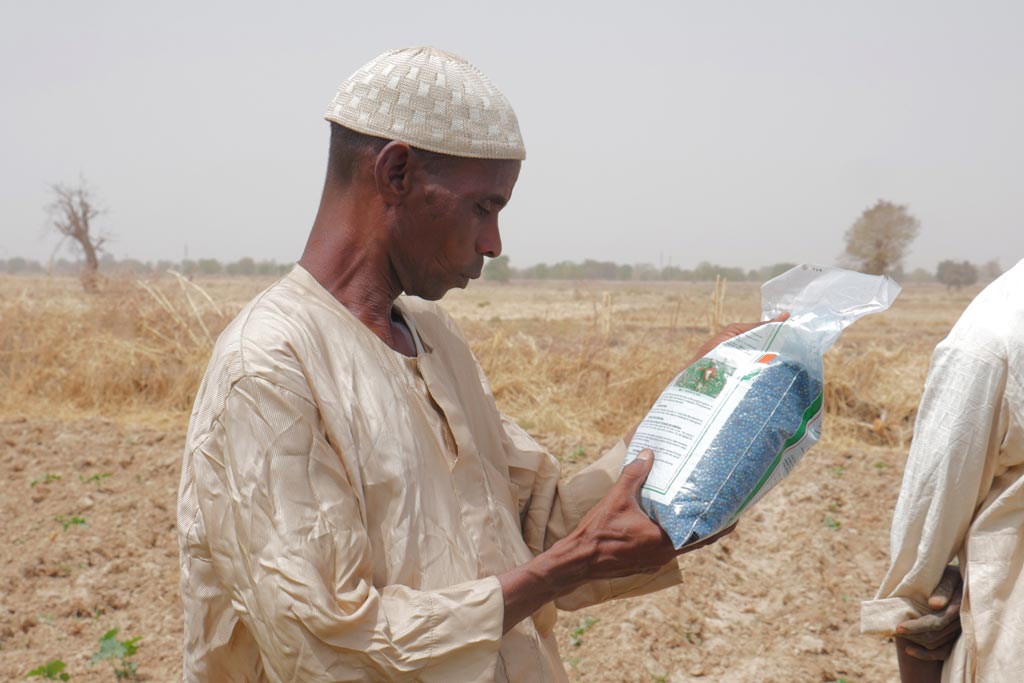
A farmer examining an aflasafe bag during awareness in a community
Called Aflasafe, this bioprotectant is an effective product (with 80 to 100% effectiveness) against pre-harvest crop contamination with aflatoxins. Aflatoxins are highly toxic carcinogenic compounds that can cause liver cancer and other health maladies. According to the Partnership for Aflatoxin Control in Africa (PACA): “It is estimated that aflatoxins cause between 5% and 30% of all liver cancer in the world, with the highest incidence of 40% occurring in Africa. In countries with high hepatitis B viremia, liver cancer risks increase with dietary exposure to aflatoxins.
Aflasafe helps enable the production of safe crops, reducing the risks of liver cancer caused by the consumption of aflatoxins in foods.
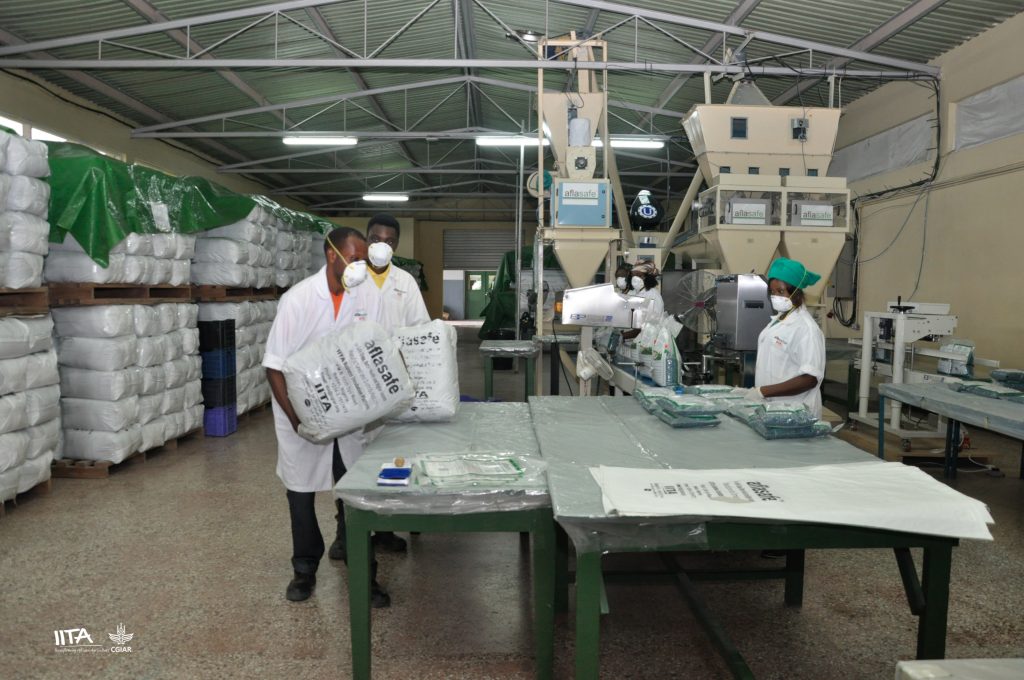
An Aflasafe packaging line in the factoryAflasafe is not a food for direct human consumption. It is also not a poisonous chemical. Aflasafe is a beneficial plant bioprotectant and a non-chemical agricultural product developed against aflatoxins, one of the most dangerous compounds on earth.
Aflasafe was developed by CGIAR’s International Institute of Tropical Agriculture (IITA) and several national and international partners. IITA registered the product after conducting rigorous tests as per the guidance of the National Agency for Food and Drug Administration and Control (NAFDAC). Product safety assessments demonstrate that Aflasafe passes safety requirements for toxicity and ecological safety.
Aflasafe in Nigeria is currently manufactured and distributed by Harvestfield Industries Limited (HIL), a Nigerian company, under a Technology Transfer Licensing Agreement (TTLA). According to Dr Abdullahi Ndarubu of HIL, “Aflasafe has been included in the Central Bank of Nigeria-Anchor Borrowers’ Programme (CBN-ABP)’s list of inputs for farmers’ use. Programs of the Federal Ministry of Agriculture and Rural Development (FMARD) and Nigerian Export Promotion Council (NEPC) have also encouraged the use of Aflasafe to produce safe and nutritious maize and groundnut for domestic and international markets.” This bioprotectant has been used by farmers in several hundred thousand hectares in several states in Nigeria, including Niger, for nearly 10 years without any untoward effect.
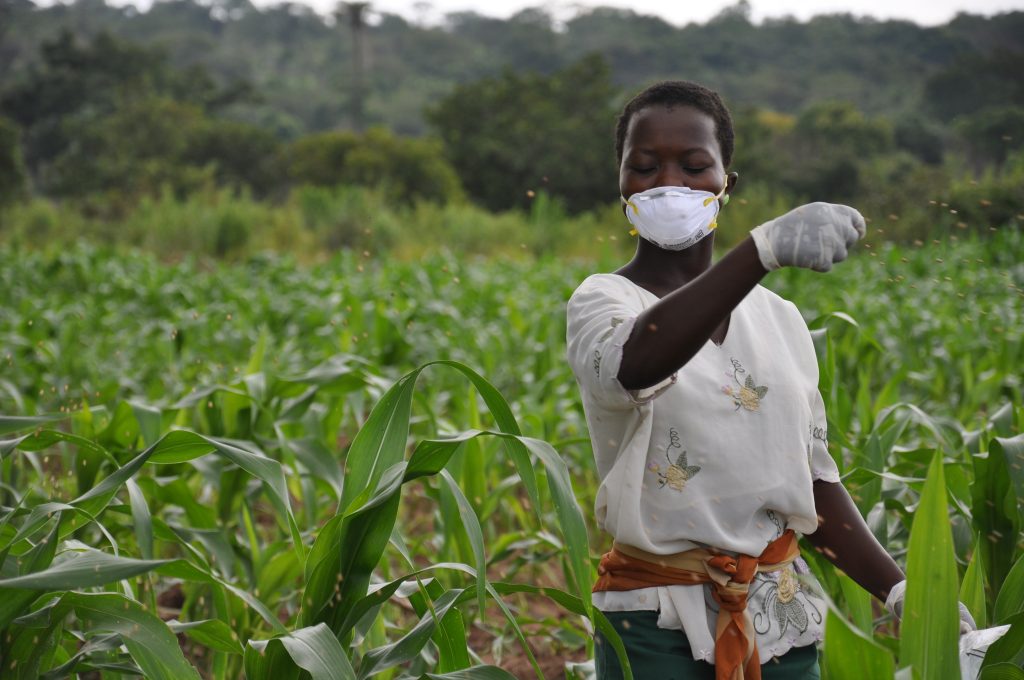
Broadcasting aflasafe in maize field deployed through IITA research
Aflasafe comprises naturally occurring strains of the fungus Aspergillusflavus native to Nigeria that have been identified as lacking the ability to produce aflatoxins. During pre-harvest application, Aflasafe strains can displace other highly toxigenic naturally occurring aflatoxin-producing Aspergillus.
Aflasafe appears as blue-coloured sorghum because it is coloured with a food-grade dye, after application of nature-based active ingredients, to differentiate it from regular food. The intended and approved use of Aflasafe is not as a food, but as a bioprotectant for use in the field on growing crops to control aflatoxins. This product is recommended for application at the rate of 10 kg per hectare by broadcast at about 30-40 days after planting the crop (e.g., maize, groundnut). Aflasafe contains safe natural microbes to control the dangerous aflatoxins found in food.
Apart from the blue food colorant, minute quantities of a maize-starch based polymer, and the active ingredient fungi (0.002 g of fungi per kg) there are no chemicals in the Aflasafe formulation.
Dr Titilayo Falade, IITA Associate Scientist/Food Safety Scientist says “Many organizations in Nigeria such as federal and state government organizations including but not limited to FMARD, state ADPs, notable quality-sensitive organizations, crop production groups and companies, national and international stakeholders in collaboration with farmers nationwide promote the use of Aflasafe because of the benefits that it brings.”
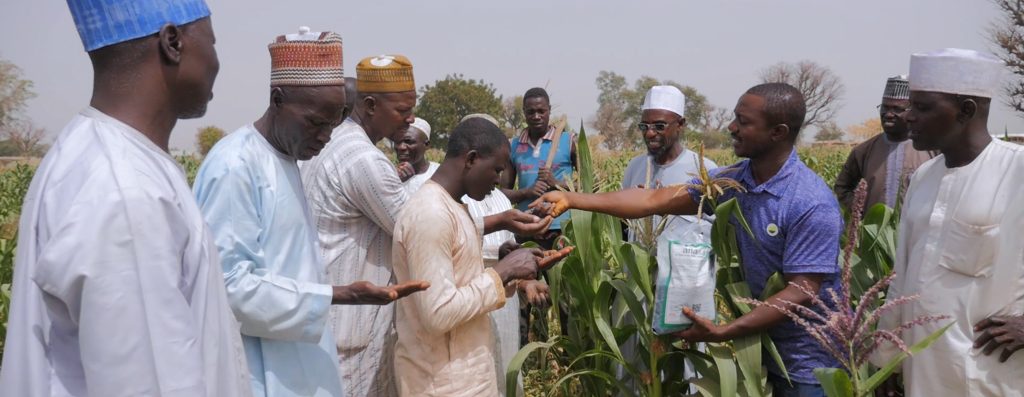
Training and distributing Aflasafe to farmers
Aflasafe is currently used in Nigeria, Ghana, Burkina Faso, Senegal, The Gambia, and Mali as well as in Kenya, Tanzania, Mozambique, Malawi, and Zambia. Several other African countries are at various levels of developing their country specific strains. These include Cameroon, Niger, Togo, Democratic Republic of Congo, Sudan, Uganda, Zimbabwe, Rwanda, and Burundi.
Related impact stories
Olamide Deborah Nwanze is a Senior Research Associate specializing in gender mainstreaming research to inform participatory and inclusive breeding, variety development, and seed systems policies regarding root, tuber, and banana (RTB) crops in the International Institute of Tropical Agriculture Headquarters, Ibadan, Nigeria. She is a PhD candidate at the University of Ibadan and holds an MSc and B. Agric in Agricultural Extension and Rural Development. Olamide is a fellow of the African Women in Agricultural Research and Development – Gender Responsive Agricultural Systems Policy (AWARD-GRASP) and the Gender Responsive Researchers Equipped for Agricultural Transformation (GREAT). She seeks to apply her gender-mainstreaming learnings, gender-responsive research, and policy development, and review expertise to facilitate women, youth, children, and vulnerable social group’s access to and adoption of agricultural Innovations that guarantee food, nutrition, income, and livelihood security in Africa. Her current roles include mentoring research fellows, development of guides and training manuals, implementation and adaptation of gender frameworks and tools, value chain actors’ engagement as citizen science partners, policy review and redesign, data management, and analysis. Her current research explores mixed methods and participatory and interdisciplinary approaches to capture and highlight gender dynamics, needs, preferences, and challenges stakeholders face within the agricultural livelihood value chain to prioritize gender-inclusive strategies in breeding programs, policy design, and implementation.
de Sousa, K., van Etten, J., Manners, R. Bello, A., Teeken, B., Olaosebikan, O., et al. 2024. The tricot approach: an agile framework for decentralized on-farm testing supported by citizen science. A retrospective. Agron. Sustain. Dev. 44, 8. https://doi.org/10.1007/s13593-023-00937-1
Madu, T., Onwuka, S., Nwafor, S., Onyemauwa, N., Ejechi, M., Ofoeze, M., Ukeje, B., Eluagu, C., Olaosebikan, O., Okoye, B., 2024. Gender-Inclusive Consumer Studies Improve Cassava Breeding in Nigeria in: Frontiers in Sociology, volume 9, number: 1224504, doi: 10.3389/fsoc.2024.1224504
Olaosebikan, O.; Bello, A.; Utoblo, O.; Okoye, B.; Olutegbe, N.; Garner, E.; Teeken, B.; Bryan, E.; Forsythe, L.; Cole, S.; Madu, T. 2023. Stressors and Resilience within the Cassava Value Chain in Nigeria: Preferred Cassava Variety Traits and Response Strategies of Men and Women to Inform Breeding. Sustainability 15, 7837. https://doi.org/10.3390/su15107837
Okoye, B., Ofoeze, M., Ejechi, M., Onwuka, S., Nwafor, S., Onyemauwa, N., Ukeje, B., Eluagu, C., Obidiegwu, J.*, Olaosebikan, O., Madu, T.* 2023. Prioritizing preferred traits in the yam value chain in Nigeria: a gender situation analysis in: Frontiers in Sociology, volume 8, number: 1232626, pages 1 – 9, ISSN 2297-7775, 2023. https://www.frontiersin.org/articles/10.3389/fsoc.2023.1232626/full
Olaosebikan, O., Bello, A. A., de Sousa, K., Ndjouenkeu, R., Adesokan, M., Alamu, E. O., Agbona, A., van Etten, J., Kegah, F. N.*, Dufour, D., Bouniol, A., Teeken, B. 2023. Consumer acceptability of cassava gari-eba food products across cultural and environmental settings using the triadic comparison of technologies approach (tricot) in: Journal of the Science of Food and Agriculture,
Teeken, B., Olaosebikan, O., Bello, A. A., Madu, T.*, Cole, S. M. 2023. Qualitative assessment on the positionality and preferences of dyads in relation to cassava-related activities: working with tricot trial citizen scientists https://hdl.handle.net/10568/138326 Type: Manual
Bouniol, A., Ceballos, H., Bello, A. A., Teeken, B., Olaosebikan, O., Owoade, D., Agbona, A., Fotso Kuate, A., Madu, T.*, Okoye, B.*, Ofoeze, M.*, Nwafor, S.*, Onyemauwa, N.*, Adinsi, L.*, Forsythe, L., Dufour, D. 2023. Varietal impact on women’s labour, workload and related drudgery in processing root, tuber and banana crops: focus on cassava in sub-Saharan Africa in: Journal of the Science of Food and Agriculture, pages 1 – 25, ISSN 0022-5142,
Bello, A. A., Agbona, A., Olaosebikan, O., Edughaen, G., Dufour, D., Bouniol, A., Iluebbey, P., Ndjouenkeu, R.*, Rabbi, I. Y., Teeken, B. 2023. Genetic and environmental effects on processing productivity and food product yield: drudgery of women’s work in: Journal of the Science of Food and Agriculture, pages 1 – 32, ISSN 0022-5142, 5
Cavicchioli, M., Zimbiti, T., Teeken, B., Nwanze, D.O., Liani, M., Parkes, E. & Bello, A. 2023. IITA-Gender Responsive Breeding Training Report. Genetic Resources Center, IITA-HQ, Ibadan, 21-23 September, 2022. Ibadan, Nigeria: IITA, (34 p.).https://hdl.handle.net/10568/131368
Agbona, A. Peteti P., Teeken B., Olaosebikan O. Bello, A. A., Parkes, E., Rabbi, I. Y., Mueller, L., Egesi, C., Kulakow, P. 2022. Data Management in Multi-disciplinary African RTB Crop Breeding Programs. In: Williamson, H.F., Leonelli, S. (eds) Towards Responsible Plant Data Linkage: Data Challenges for Agricultural Research and Development. Springer, Cham. https://doi.org/10.1007/978-3-031-13276-6_5
Lora Forsythe, Pricilla Marimo, Sarah Mayanja, Olamide D. Olaosebikan, Esme Stuart, Bela Teeken, Benjamin Okoye, Tessy Madu, (2021). Cross-product Gender Analysis of RTBfoods Step 2 Gendered Food Mapping on RTB Products. Understanding the Drivers of Trait Preferences and the Development of Multi-user RTB Product Profiles, WP1. London, UK: RTBfoods Field Scientific Report, 30 p.
Teeken, B., Garner, E., Agbona, A., Balogun, I., Olaosebikan, O., Bello, A., Madu, T., Okoye, B., Egesi, C., Kulakow, P. and Tufan, H.A. 2021. Beyond “Women’s Traits”: Exploring How Gender, Social Difference, and Household Characteristics Influence Trait Preferences. Frontiers Sustainable Food Systems 5:740926. https://doi.org/10.3389/fsufs.2021.740926
Teeken, B., Agbona, A., Bello, A., Olaosebikan, O., Alamu, E., Adesokan, M., Awoyale, W., Madu, T., Okoye, B., Chijioke, U., Owoade, D., Okoro, M., Bouniol, A., Dufour, D., Hershey, C., Rabbi, I., Maziya‐Dixon, B., Egesi, C., Tufan, H. and Kulakow, P. (020. Understanding cassava varietal preferences through pairwise ranking of gari‐eba and fufu prepared by local farmer–processors. Int J Food Sci Technol.https://doi.org/10.1111/ijfs.14862
Bela Teeken, Olamide Olaosebikan, Ireti Balogun, Benjamin Okoye, Tessy Madu, Steven Cole, Abolore Bello, Elizabeth Parkes. (2020). Piloting the G+ customer and product profile tools for gender-responsive cassava breeding in Nigeria. Nigeria: International Institute of Tropical Agriculture (IITA). https://hdl.handle.net/20.500.11766/13000