
IITA NEWS

Aflatoxin and conflict: Two sides of threat to food safety
March 21, 2023

The world is presently facing a myriad of challenges including, climate change, COVID-19, natural disasters, increased cost of living, and conflict. These in turn affect food safety and security—a situation that transcends frontiers across the globe.
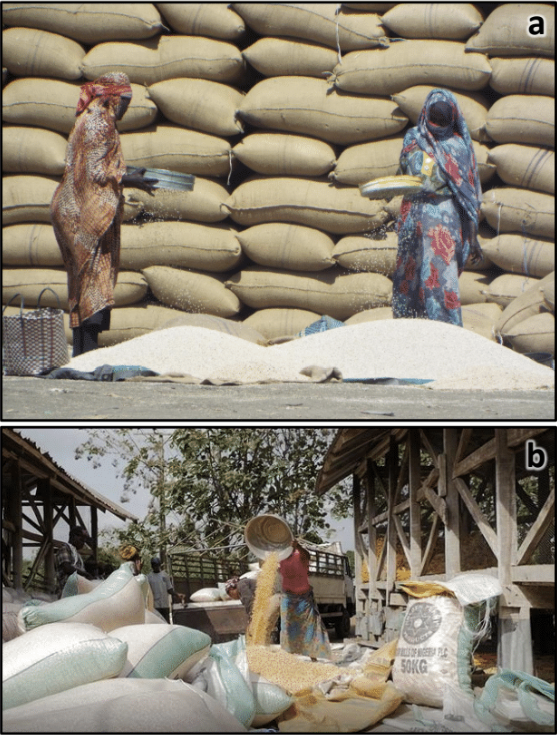
Populations in most African countries rely on wheat from Ukraine and Russia to achieve food security. With shortfalls because of conflict, consumers in affected countries must increase intake of other staples. This may increase exposure to dangerous mycotoxins if appropriate measures are not implemented. Two ladies in Gezira, Sudan, winnowing sorghum grains collected from the ground to meet the dietary needs of their families (a). Farmers in Oyo, Nigeria, winnowing maize to store it in the safest way possible (b)

Conflicts in countries like Ukraine, Ethiopia, Sudan, Somalia, Mali, Nigeria, Mozambique, Afghanistan, Palestine, Mexico, and Haiti, among others, are preventing the full potential of food production from being achieved. These conflict situations have severe repercussions, such as shortfalls in global food production.

In a recently published opinion paper on the influence of conflicts on food safety titled “Addressing another threat to food safety: conflict,” IITA/CGIAR researchers Alejandro Ortega-Beltran and Ranajit Bandyopadhyay explored the effect of the ongoing conflict between Ukraine and Russia on food security and safety across the globe with the resulting complex spillover problems such as mycotoxins that have the potential to negatively impact on health, society, and the economy.

According to the op-ed, this conflict is gradually negatively affecting not only food security but also food safety as crops produced in Ukraine and Russia, which are at a lower risk of aflatoxin contamination, are not reaching their final destination in many countries; and only a small fraction of the crops usually exported have left Ukraine since the conflict began in February 2022 because of the stalemate in agricultural production and/or trade. Food insecurity is worsening in many of the importing countries, including many in Africa—Somalia, Ethiopia, Nigeria, Benin, Sudan, and DR Congo—that rely heavily on wheat from Ukraine and Russia. Importing countries may have to increase production of staple crops. However, many of the importing countries located in tropical and subtropical areas will have a higher risk of mycotoxin contamination because their productive regions have conducive conditions for mycotoxin contamination.
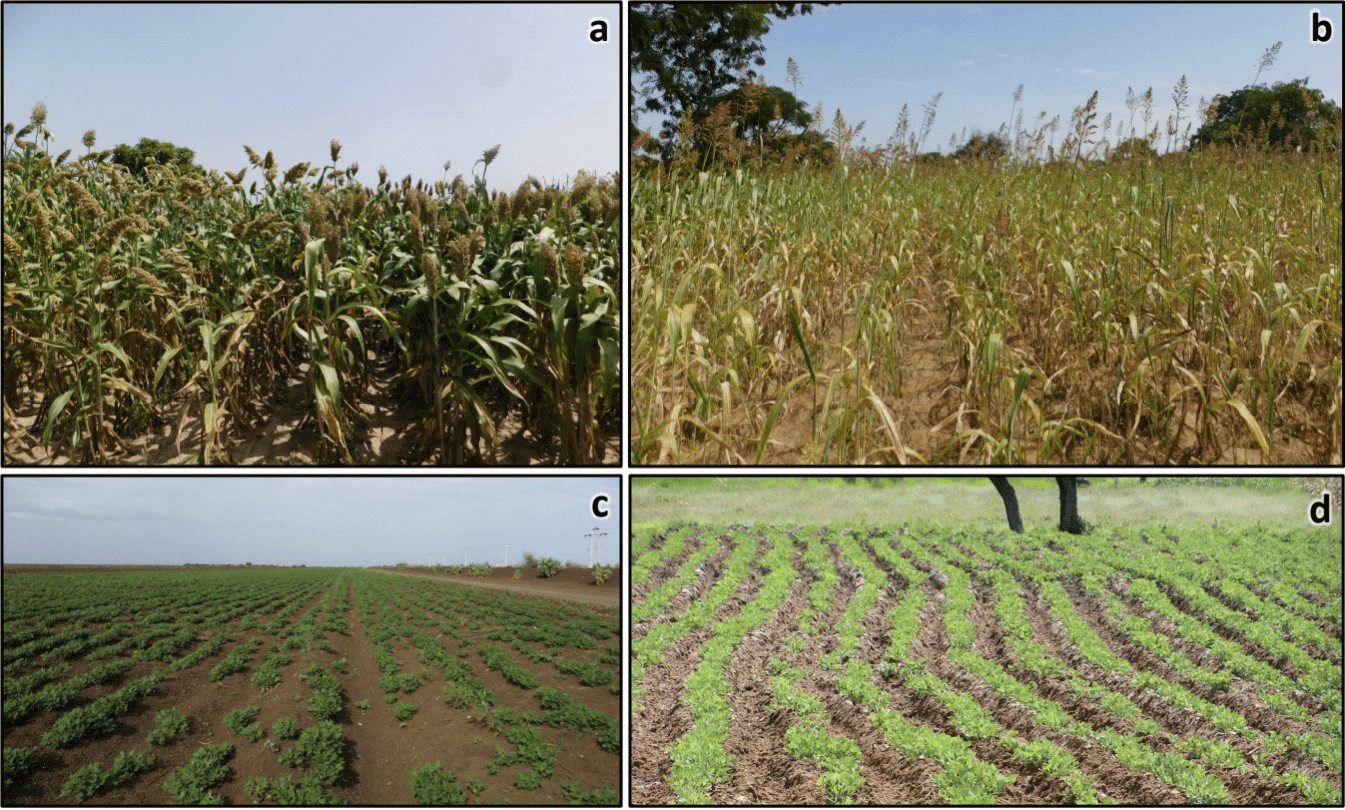
Reduced imports of wheat and maize from Ukraine and Russia will push affected countries to increase local production of other staples such as improved (a) or landrace (b) sorghums, or groundnut (c,d). In low- and middle-income countries, both sorghum and groundnut are greatly affected by mycotoxin contamination.

Exploring how conflict impacts food safety, the op-ed highlighted some of the common and often overlooked mycotoxin contamination problems prevalent in tropical and subtropical areas. According to Ortega-Beltran and Bandyopadhyay, Africa is already losing over US$ 670 million/year in export earnings due to aflatoxin, and climate change is exacerbating the mycotoxin challenge. Unlike high-income countries where aflatoxins are regulated at parts per billion (ppb) and strictly legislated due to the effects on human health, the situation is quite different in low- and middle-income countries, with countries in Africa linking over 30% of liver cancer cases to aflatoxins.

Among other concerns raised by the op-ed, in the face of a looming global food crisis, there is the urgent need to design agro-food systems to meet shortfalls from breadbaskets, and to include food safety in food security programs as part of measures to address these concerns. With the aid of integrated strategies converging policy, institutional, and technical innovations, food safety can be protected.
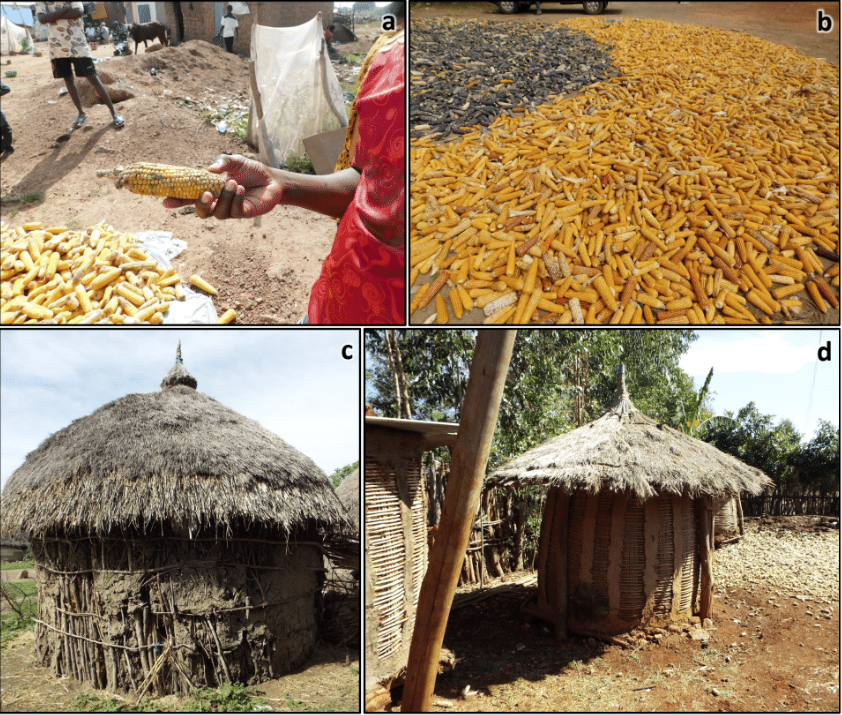
Mycotoxin contamination of staple crops is common in tropical and subtropical areas. Although the contamination may start in the field, drying crops on plastic tarps but with no sanitation practices (a), drying crops on the soil (b), or inadequate storage structures (c,d) drastically accentuate the problem.

IITA, a CGIAR research institute, and partners have made significant progress in developing technologies to reduce mycotoxin contamination. These include integrated mycotoxin management strategies consisting of sound pre- and postharvest interventions, extension services, mycotoxin testing, improved storage, and access to markets, among other practices. These are resulting in safer food, improved health, and greater income in various African countries with support from different programs, including One CGIAR Plant Health Initiative.

The op-ed posits that implementation of mycotoxin management programs must be accompanied by the appropriate support from the trade, health, and policy sectors among other key stakeholders in African countries and globally. Food security and safety programs aiming to address these concerns should employ integrated food safety management to fulfill their objectives.

As governments across Africa and the world are deploying various interventions to cope with the several threats—including climate change, pandemics, and conflict, it is a must that technical, institutional, and policy solutions are converged to prevent the crises of food security, food safety, and malnutrition. Governments, research consortia, the private sector, development organizations, and local communities must act in consonance now to ensure that this happens!

Contacts

Alejandro Ortega-Beltran, a.beltran@cgiar.org

Ranajit Bandyopadhyay, r.bandyopadhyay@cgiar.org

Contributed by Timilehin Osunde


Contributed by

Related news

No items found

Leave a Reply

Your email address will not be published. Required fields are marked *

Scroll to Top
Olaosebikan, Olamide

Olamide Deborah Nwanze is a Senior Research Associate specializing in gender mainstreaming research to inform participatory and inclusive breeding, variety development, and seed systems policies regarding root, tuber, and banana (RTB) crops in the International Institute of Tropical Agriculture Headquarters, Ibadan, Nigeria. She is a PhD candidate at the University of Ibadan and holds an MSc and B. Agric in Agricultural Extension and Rural Development. Olamide is a fellow of the African Women in Agricultural Research and Development – Gender Responsive Agricultural Systems Policy (AWARD-GRASP) and the Gender Responsive Researchers Equipped for Agricultural Transformation (GREAT). She seeks to apply her gender-mainstreaming learnings, gender-responsive research, and policy development, and review expertise to facilitate women, youth, children, and vulnerable social group’s access to and adoption of agricultural Innovations that guarantee food, nutrition, income, and livelihood security in Africa. Her current roles include mentoring research fellows, development of guides and training manuals, implementation and adaptation of gender frameworks and tools, value chain actors’ engagement as citizen science partners, policy review and redesign, data management, and analysis. Her current research explores mixed methods and participatory and interdisciplinary approaches to capture and highlight gender dynamics, needs, preferences, and challenges stakeholders face within the agricultural livelihood value chain to prioritize gender-inclusive strategies in breeding programs, policy design, and implementation.

At IITA, she contributes to the implementation of the CGIAR Accelerated Breeding Initiative and Genetic Innovation Programs; participatory and gender research within the NextGen CassavaHarvestPlusRTBFoods, and Tricot-ClimMob 1000Farms Projects; and gender knowledge communication via the G-LENS webinar series, video documentary, policy briefspublications, and blogs.


Recent publications

de Sousa, K., van Etten, J., Manners, R. Bello, A., Teeken, B., Olaosebikan, O., et al. 2024. The tricot approach: an agile framework for decentralized on-farm testing supported by citizen science. A retrospective. Agron. Sustain. Dev. 44, 8. https://doi.org/10.1007/s13593-023-00937-1

Madu, T., Onwuka, S., Nwafor, S., Onyemauwa, N., Ejechi, M., Ofoeze, M., Ukeje, B., Eluagu, C., Olaosebikan, O., Okoye, B., 2024. Gender-Inclusive Consumer Studies Improve Cassava Breeding in Nigeria in: Frontiers in Sociology, volume 9, number: 1224504, doi: 10.3389/fsoc.2024.1224504

Olaosebikan, O.; Bello, A.; Utoblo, O.; Okoye, B.; Olutegbe, N.; Garner, E.; Teeken, B.; Bryan, E.; Forsythe, L.; Cole, S.; Madu, T. 2023.  Stressors and Resilience within the Cassava Value Chain in Nigeria: Preferred Cassava Variety Traits and Response Strategies of Men and Women to Inform Breeding. Sustainability 15, 7837. https://doi.org/10.3390/su15107837

Okoye, B., Ofoeze, M., Ejechi, M., Onwuka, S., Nwafor, S., Onyemauwa, N., Ukeje, B., Eluagu, C., Obidiegwu, J.*, Olaosebikan, O., Madu, T.* 2023. Prioritizing preferred traits in the yam value chain in Nigeria: a gender situation analysis in: Frontiers in Sociology, volume 8, number: 1232626, pages 1 – 9, ISSN 2297-7775, 2023. https://www.frontiersin.org/articles/10.3389/fsoc.2023.1232626/full

Olaosebikan, O., Bello, A. A., de Sousa, K., Ndjouenkeu, R., Adesokan, M., Alamu, E. O., Agbona, A., van Etten, J., Kegah, F. N.*, Dufour, D., Bouniol, A., Teeken, B. 2023. Consumer acceptability of cassava gari-eba food products across cultural and environmental settings using the triadic comparison of technologies approach (tricot) in: Journal of the Science of Food and Agriculture,

Teeken, B., Olaosebikan, O., Bello, A. A., Madu, T.*, Cole, S. M. 2023. Qualitative assessment on the positionality and preferences of dyads in relation to cassava-related activities: working with tricot trial citizen scientists https://hdl.handle.net/10568/138326 Type: Manual

Bouniol, A., Ceballos, H., Bello, A. A., Teeken, B., Olaosebikan, O., Owoade, D., Agbona, A., Fotso Kuate, A., Madu, T.*, Okoye, B.*, Ofoeze, M.*, Nwafor, S.*, Onyemauwa, N.*, Adinsi, L.*, Forsythe, L., Dufour, D. 2023. Varietal impact on women’s labour, workload and related drudgery in processing root, tuber and banana crops: focus on cassava in sub-Saharan Africa in: Journal of the Science of Food and Agriculture, pages 1 – 25, ISSN 0022-5142,

Bello, A. A., Agbona, A., Olaosebikan, O., Edughaen, G., Dufour, D., Bouniol, A., Iluebbey, P., Ndjouenkeu, R.*, Rabbi, I. Y., Teeken, B. 2023. Genetic and environmental effects on processing productivity and food product yield: drudgery of women’s work in: Journal of the Science of Food and Agriculture, pages 1 – 32, ISSN 0022-5142, 5

Cavicchioli, M., Zimbiti, T., Teeken, B., Nwanze, D.O., Liani, M., Parkes, E. & Bello, A. 2023. IITA-Gender Responsive Breeding Training Report. Genetic Resources Center, IITA-HQ, Ibadan, 21-23 September, 2022. Ibadan, Nigeria: IITA, (34 p.).https://hdl.handle.net/10568/131368

Agbona, A. Peteti P., Teeken B., Olaosebikan O. Bello, A. A., Parkes, E., Rabbi, I. Y., Mueller, L., Egesi, C., Kulakow, P. 2022. Data Management in Multi-disciplinary African RTB Crop Breeding Programs. In: Williamson, H.F., Leonelli, S. (eds) Towards Responsible Plant Data Linkage: Data Challenges for Agricultural Research and Development. Springer, Cham. https://doi.org/10.1007/978-3-031-13276-6_5

Lora Forsythe, Pricilla Marimo, Sarah Mayanja, Olamide D. Olaosebikan, Esme Stuart, Bela Teeken, Benjamin Okoye, Tessy Madu, (2021). Cross-product Gender Analysis of RTBfoods Step 2 Gendered Food Mapping on RTB Products. Understanding the Drivers of Trait Preferences and the Development of Multi-user RTB Product Profiles, WP1. London, UK: RTBfoods Field Scientific Report, 30 p.

Teeken, B., Garner, E., Agbona, A., Balogun, I., Olaosebikan, O., Bello, A., Madu, T., Okoye, B., Egesi, C., Kulakow, P. and Tufan, H.A. 2021. Beyond “Women’s Traits”: Exploring How Gender, Social Difference, and Household Characteristics Influence Trait Preferences. Frontiers Sustainable Food Systems 5:740926. https://doi.org/10.3389/fsufs.2021.740926

Teeken, B., Agbona, A., Bello, A., Olaosebikan, O., Alamu, E., Adesokan, M., Awoyale, W., Madu, T., Okoye, B., Chijioke, U., Owoade, D., Okoro, M., Bouniol, A., Dufour, D., Hershey, C., Rabbi, I., Maziya‐Dixon, B., Egesi, C., Tufan, H. and Kulakow, P. (020. Understanding cassava varietal preferences through pairwise ranking of gari‐eba and fufu prepared by local farmer–processors. Int J Food Sci Technol. https://doi.org/10.1111/ijfs.14862

Bela Teeken, Olamide Olaosebikan, Ireti Balogun, Benjamin Okoye, Tessy Madu, Steven Cole, Abolore Bello, Elizabeth Parkes. (2020). Piloting the G+ customer and product profile tools for gender-responsive cassava breeding in Nigeria. Nigeria: International Institute of Tropical Agriculture (IITA). https://hdl.handle.net/20.500.11766/13000