IITA NEWS

Africa RISING, SIIL, and SIMLESA hold joint learning event
April 9, 2018
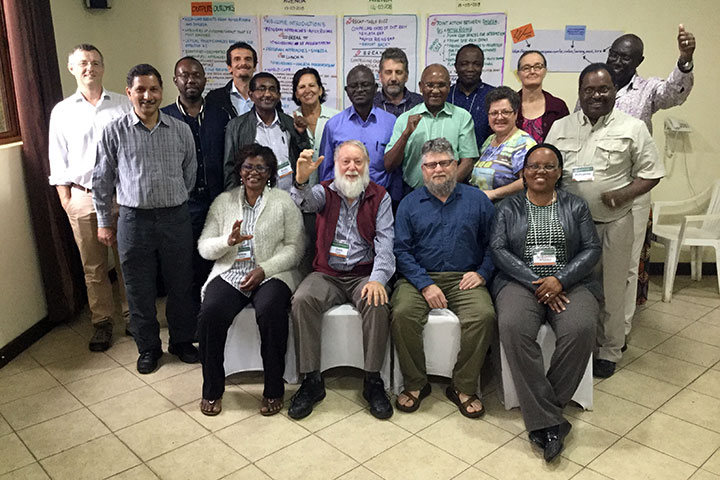
SIMLESA–Africa RISING joint learning event. Photo credit: Jonathan Odhong’/IITA.

SIMLESA–Africa RISING joint learning event. Photo credit: Jonathan Odhong’/IITA.

If you had a once-in-a-lifetime opportunity to talk to a policymaker about systems research in agriculture/sustainable intensification (in sub-Saharan Africa), its value, and why it should be funded, what relevant case studies, high line results, and lessons learned would you share to get a positive response? This was the question posed recently to a group of agricultural researchers at a joint learning event on sustainable intensification/farming systems research approaches. Convened by the United States Agency for International Development (USAID) and the Australian Centre for International Agricultural Research (ACIAR) on 13–15 March, in Arusha, Tanzania, the meeting sought to roll out the process for distilling common denominators in terms of impact, lessons learned, and value from Africa RISING, the Sustainable Intensification of Maize-Legume Cropping Systems for Food Security in Eastern and Southern Africa (SIMLESA), and the Feed the Future Innovation Lab for Collaborative Research on Sustainable Intensification (SIIL) programs. “We hope to see a common vision for systems research starting to emerge from this meeting. This does not mean that activities of the three programs have to be identical, but it would be nice to know in which areas each program is operating, geographically and the principles and strategies they are using. This information will help us improve coordination and better explain our work to the funders at USAID and ACIAR,” said USAID senior sustainable agricultural systems advisor, Jerry Glover, at the opening of the meeting. For two and a half days, participants examined the approaches used by the three programs in implementing research-in-development activities in different countries; distilled the important common/desired elements for systems research programs; teased out lessons learned about systems research; evaluated policy, market and institutional changes for effective sustainable intensification; documented compelling cases where systems research has made a difference; and also brainstormed on low-cost areas for joint action between SIMLESA, Africa RISING, and SIIL going forward. To highlight the intricacies of systems research in agriculture for sustainable intensification, ACIAR principal advisor for cropping systems, John Dixon, noted that the complexity of systems research/sustainable intensification is best illustrated by the universally acclaimed success story of the Green Revolution. “For many decades, people [most of us] thought that the Green Revolution was a magnificent success without downsides. We are now recognizing that the essential successes of the Green Revolution which were absolutely needed to feed Asia [at the time], came at a huge environmental cost. In fact, in India, China, and other Asian countries there is a huge run-down of the environment, aquifers, underground water, the soils, and biodiversity. We also see a lot of other externalities, for example, the news that Beijing is the most polluted city in the world; now it seems that New Delhi has been granted that mantle. And that is connected back to agriculture. So in this example, the ‘S’ part of SI (which stands for sustainable) has been neglected at the expense of the I part (intensification). Was it neglected in research or did researchers not pay attention to things like natural resources, to water, etc.?” he posed. While broad consensus and common understanding/appreciation of progress in systems research/sustainable intensification developed among participants as the meeting unfolded, a few sticky points also emerged that will form the basis of discussions in future joint learning events. These included: the need to establish common definitions for terms like “reach”, “use”, “adoption”, etc.; approaches to scaling as an integral part of research-in-development action; measuring risk and establishing metrics for systems resilience; data management challenges/opportunities, and integration of plot-level interventions into the landscape level. At the close of the meeting, participants also pored over the future possibility of setting up a multi-donor platform that would bring together different donors and stakeholders involved in systems research in agriculture for sustainable intensification. A key output from this meeting (expected to be finalized by June 2018) will be a synthesis document articulating the progress and achievements of systems research/sustainable intensification in Africa that will be shared with all key stakeholders and donor agencies.

Contributed by

Related news

No items found

Leave a Reply

Your email address will not be published. Required fields are marked *

Scroll to Top
Olaosebikan, Olamide

Olamide Deborah Nwanze is a Senior Research Associate specializing in gender mainstreaming research to inform participatory and inclusive breeding, variety development, and seed systems policies regarding root, tuber, and banana (RTB) crops in the International Institute of Tropical Agriculture Headquarters, Ibadan, Nigeria. She is a PhD candidate at the University of Ibadan and holds an MSc and B. Agric in Agricultural Extension and Rural Development. Olamide is a fellow of the African Women in Agricultural Research and Development – Gender Responsive Agricultural Systems Policy (AWARD-GRASP) and the Gender Responsive Researchers Equipped for Agricultural Transformation (GREAT). She seeks to apply her gender-mainstreaming learnings, gender-responsive research, and policy development, and review expertise to facilitate women, youth, children, and vulnerable social group’s access to and adoption of agricultural Innovations that guarantee food, nutrition, income, and livelihood security in Africa. Her current roles include mentoring research fellows, development of guides and training manuals, implementation and adaptation of gender frameworks and tools, value chain actors’ engagement as citizen science partners, policy review and redesign, data management, and analysis. Her current research explores mixed methods and participatory and interdisciplinary approaches to capture and highlight gender dynamics, needs, preferences, and challenges stakeholders face within the agricultural livelihood value chain to prioritize gender-inclusive strategies in breeding programs, policy design, and implementation.

At IITA, she contributes to the implementation of the CGIAR Accelerated Breeding Initiative and Genetic Innovation Programs; participatory and gender research within the NextGen CassavaHarvestPlusRTBFoods, and Tricot-ClimMob 1000Farms Projects; and gender knowledge communication via the G-LENS webinar series, video documentary, policy briefspublications, and blogs.


Recent publications

de Sousa, K., van Etten, J., Manners, R. Bello, A., Teeken, B., Olaosebikan, O., et al. 2024. The tricot approach: an agile framework for decentralized on-farm testing supported by citizen science. A retrospective. Agron. Sustain. Dev. 44, 8. https://doi.org/10.1007/s13593-023-00937-1

Madu, T., Onwuka, S., Nwafor, S., Onyemauwa, N., Ejechi, M., Ofoeze, M., Ukeje, B., Eluagu, C., Olaosebikan, O., Okoye, B., 2024. Gender-Inclusive Consumer Studies Improve Cassava Breeding in Nigeria in: Frontiers in Sociology, volume 9, number: 1224504, doi: 10.3389/fsoc.2024.1224504

Olaosebikan, O.; Bello, A.; Utoblo, O.; Okoye, B.; Olutegbe, N.; Garner, E.; Teeken, B.; Bryan, E.; Forsythe, L.; Cole, S.; Madu, T. 2023.  Stressors and Resilience within the Cassava Value Chain in Nigeria: Preferred Cassava Variety Traits and Response Strategies of Men and Women to Inform Breeding. Sustainability 15, 7837. https://doi.org/10.3390/su15107837

Okoye, B., Ofoeze, M., Ejechi, M., Onwuka, S., Nwafor, S., Onyemauwa, N., Ukeje, B., Eluagu, C., Obidiegwu, J.*, Olaosebikan, O., Madu, T.* 2023. Prioritizing preferred traits in the yam value chain in Nigeria: a gender situation analysis in: Frontiers in Sociology, volume 8, number: 1232626, pages 1 – 9, ISSN 2297-7775, 2023. https://www.frontiersin.org/articles/10.3389/fsoc.2023.1232626/full

Olaosebikan, O., Bello, A. A., de Sousa, K., Ndjouenkeu, R., Adesokan, M., Alamu, E. O., Agbona, A., van Etten, J., Kegah, F. N.*, Dufour, D., Bouniol, A., Teeken, B. 2023. Consumer acceptability of cassava gari-eba food products across cultural and environmental settings using the triadic comparison of technologies approach (tricot) in: Journal of the Science of Food and Agriculture,

Teeken, B., Olaosebikan, O., Bello, A. A., Madu, T.*, Cole, S. M. 2023. Qualitative assessment on the positionality and preferences of dyads in relation to cassava-related activities: working with tricot trial citizen scientists https://hdl.handle.net/10568/138326 Type: Manual

Bouniol, A., Ceballos, H., Bello, A. A., Teeken, B., Olaosebikan, O., Owoade, D., Agbona, A., Fotso Kuate, A., Madu, T.*, Okoye, B.*, Ofoeze, M.*, Nwafor, S.*, Onyemauwa, N.*, Adinsi, L.*, Forsythe, L., Dufour, D. 2023. Varietal impact on women’s labour, workload and related drudgery in processing root, tuber and banana crops: focus on cassava in sub-Saharan Africa in: Journal of the Science of Food and Agriculture, pages 1 – 25, ISSN 0022-5142,

Bello, A. A., Agbona, A., Olaosebikan, O., Edughaen, G., Dufour, D., Bouniol, A., Iluebbey, P., Ndjouenkeu, R.*, Rabbi, I. Y., Teeken, B. 2023. Genetic and environmental effects on processing productivity and food product yield: drudgery of women’s work in: Journal of the Science of Food and Agriculture, pages 1 – 32, ISSN 0022-5142, 5

Cavicchioli, M., Zimbiti, T., Teeken, B., Nwanze, D.O., Liani, M., Parkes, E. & Bello, A. 2023. IITA-Gender Responsive Breeding Training Report. Genetic Resources Center, IITA-HQ, Ibadan, 21-23 September, 2022. Ibadan, Nigeria: IITA, (34 p.).https://hdl.handle.net/10568/131368

Agbona, A. Peteti P., Teeken B., Olaosebikan O. Bello, A. A., Parkes, E., Rabbi, I. Y., Mueller, L., Egesi, C., Kulakow, P. 2022. Data Management in Multi-disciplinary African RTB Crop Breeding Programs. In: Williamson, H.F., Leonelli, S. (eds) Towards Responsible Plant Data Linkage: Data Challenges for Agricultural Research and Development. Springer, Cham. https://doi.org/10.1007/978-3-031-13276-6_5

Lora Forsythe, Pricilla Marimo, Sarah Mayanja, Olamide D. Olaosebikan, Esme Stuart, Bela Teeken, Benjamin Okoye, Tessy Madu, (2021). Cross-product Gender Analysis of RTBfoods Step 2 Gendered Food Mapping on RTB Products. Understanding the Drivers of Trait Preferences and the Development of Multi-user RTB Product Profiles, WP1. London, UK: RTBfoods Field Scientific Report, 30 p.

Teeken, B., Garner, E., Agbona, A., Balogun, I., Olaosebikan, O., Bello, A., Madu, T., Okoye, B., Egesi, C., Kulakow, P. and Tufan, H.A. 2021. Beyond “Women’s Traits”: Exploring How Gender, Social Difference, and Household Characteristics Influence Trait Preferences. Frontiers Sustainable Food Systems 5:740926. https://doi.org/10.3389/fsufs.2021.740926

Teeken, B., Agbona, A., Bello, A., Olaosebikan, O., Alamu, E., Adesokan, M., Awoyale, W., Madu, T., Okoye, B., Chijioke, U., Owoade, D., Okoro, M., Bouniol, A., Dufour, D., Hershey, C., Rabbi, I., Maziya‐Dixon, B., Egesi, C., Tufan, H. and Kulakow, P. (020. Understanding cassava varietal preferences through pairwise ranking of gari‐eba and fufu prepared by local farmer–processors. Int J Food Sci Technol. https://doi.org/10.1111/ijfs.14862

Bela Teeken, Olamide Olaosebikan, Ireti Balogun, Benjamin Okoye, Tessy Madu, Steven Cole, Abolore Bello, Elizabeth Parkes. (2020). Piloting the G+ customer and product profile tools for gender-responsive cassava breeding in Nigeria. Nigeria: International Institute of Tropical Agriculture (IITA). https://hdl.handle.net/20.500.11766/13000