
African Cassava Agronomy Initiative to change the fortunes of cassava farmers
January 29, 2016
The African Cassava Agronomy Initiative (ACAI) project kicked off on 27 January, with plans to improve the livelihoods and incomes of cassava farmers in Nigeria, Ghana, Tanzania, Uganda, and DR Congo through research and tapping into and implementing best-bet agronomic practices.
 The project, which is led by IITA with funding support from the Bill & Melinda Gates Foundation, will specifically improve cassava yields, root quality, supply to the processing sector, and fertilizer sales, thereby engaging over 100,000 households in Nigeria and Tanzania, and facilitating the engagement of at least 30% women farmers.
“The value of benefits from this project in Nigeria and Tanzania is projected to be over US$27 million. Furthermore, through engagement of households in Ghana, Uganda, and DRC and through interest generated in the products developed by the project, these figures are expected to increase for at least 150,000 households and a value of at least $40 million created within the 5-year time frame of the project,” explained Bernard Vanlauwe, IITA R4D Director for Central Africa.
In sub-Saharan Africa, cassava productivity has marginally increased to around 10–11 tons per hectare, well below attainable yields of over 30 tons per hectare. With the need for intensifying cassava production in areas where population densities have reduced access to fallow land and with cassava roots becoming important raw material for the processing sector, this yield gap needs to be reduced.
Nigeria’s Minister of Agriculture and Rural Development, Audu Ogbe, said the current yield of less than 15 tons per hectare makes Nigerian farmers uncompetitive in the cassava sector.
“This initiative should find a solution to the issue of low productivity,” said Ogbe who was represented by Comfort Awe.
The ACAI initiative is placed within the context of intensification of cassava-based systems with a focus on the development of cassava agronomy recommendations to improve the productivity and quality of cassava roots in Nigeria, Tanzania, Ghana, and Uganda, major cassava-producing countries in West and East Africa, and some spillover into East DR Congo. The project will be in phases, starting in Nigeria and Tanzania in years 1 and 2, and will expand to the other countries from year 3 onwards.
Nteranya Sanginga, IITA DG, said agronomy would provide the key to unlocking the potential of cassava in Africa.
“If we want to increase the productivity of cassava, we must breed new varieties, and improve the agronomy and value addition. We have done a lot in the area of breeding; what we need to do now is to capitalize on the agronomy,” DG Sanginga said.
The ACAI project will harness African and international expertise, and follows a demand-driven approach whereby its interventions respond to specific agronomy-related needs by partners already actively engaged in cassava dissemination and value chain activities in the target countries.
ACAI aims to deliver the necessary knowledge base and tools for making this knowledge accessible to cassava scaling partners and ultimately farmers in the target countries while ensuring the build-up of necessary capacity and skills for national system scientists to engage in “transformative” cassava agronomy.
“The ultimate goal is to improve the productivity per unit area,” Abdulai Jalloh, Project Coordinator for ACAI, said.
The initiative is expected to build the capacity of national partners to sustain the technology development pipeline, deliver continuous improvements in cassava agronomy technologies, as well as address new constraints.
The project, which is led by IITA with funding support from the Bill & Melinda Gates Foundation, will specifically improve cassava yields, root quality, supply to the processing sector, and fertilizer sales, thereby engaging over 100,000 households in Nigeria and Tanzania, and facilitating the engagement of at least 30% women farmers.
“The value of benefits from this project in Nigeria and Tanzania is projected to be over US$27 million. Furthermore, through engagement of households in Ghana, Uganda, and DRC and through interest generated in the products developed by the project, these figures are expected to increase for at least 150,000 households and a value of at least $40 million created within the 5-year time frame of the project,” explained Bernard Vanlauwe, IITA R4D Director for Central Africa.
In sub-Saharan Africa, cassava productivity has marginally increased to around 10–11 tons per hectare, well below attainable yields of over 30 tons per hectare. With the need for intensifying cassava production in areas where population densities have reduced access to fallow land and with cassava roots becoming important raw material for the processing sector, this yield gap needs to be reduced.
Nigeria’s Minister of Agriculture and Rural Development, Audu Ogbe, said the current yield of less than 15 tons per hectare makes Nigerian farmers uncompetitive in the cassava sector.
“This initiative should find a solution to the issue of low productivity,” said Ogbe who was represented by Comfort Awe.
The ACAI initiative is placed within the context of intensification of cassava-based systems with a focus on the development of cassava agronomy recommendations to improve the productivity and quality of cassava roots in Nigeria, Tanzania, Ghana, and Uganda, major cassava-producing countries in West and East Africa, and some spillover into East DR Congo. The project will be in phases, starting in Nigeria and Tanzania in years 1 and 2, and will expand to the other countries from year 3 onwards.
Nteranya Sanginga, IITA DG, said agronomy would provide the key to unlocking the potential of cassava in Africa.
“If we want to increase the productivity of cassava, we must breed new varieties, and improve the agronomy and value addition. We have done a lot in the area of breeding; what we need to do now is to capitalize on the agronomy,” DG Sanginga said.
The ACAI project will harness African and international expertise, and follows a demand-driven approach whereby its interventions respond to specific agronomy-related needs by partners already actively engaged in cassava dissemination and value chain activities in the target countries.
ACAI aims to deliver the necessary knowledge base and tools for making this knowledge accessible to cassava scaling partners and ultimately farmers in the target countries while ensuring the build-up of necessary capacity and skills for national system scientists to engage in “transformative” cassava agronomy.
“The ultimate goal is to improve the productivity per unit area,” Abdulai Jalloh, Project Coordinator for ACAI, said.
The initiative is expected to build the capacity of national partners to sustain the technology development pipeline, deliver continuous improvements in cassava agronomy technologies, as well as address new constraints.
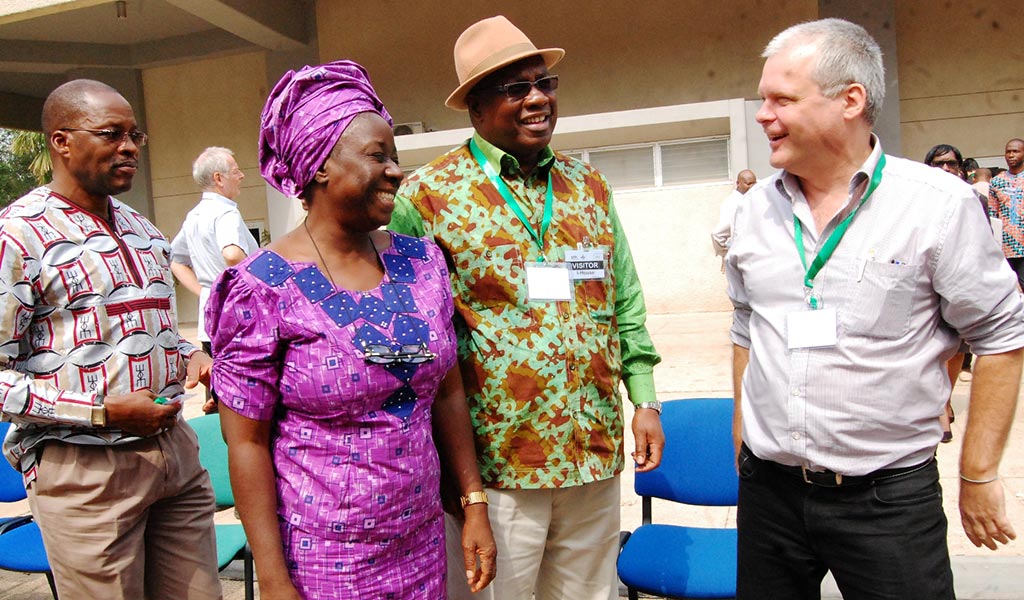
L-R: Jacob Mignouna, Program Officer, Gates Foundation; Comfort Awe, representative of Nigeria’s Minister of Agriculture and Rural Development; Abdulai Jalloh, Coordinator, ACAI; and Bernard Vanlauwe, Director, Central Africa, IITA at the first ACAI Meeting in Ibadan.
Contributed by
Recent stories
No items found