
IITA NEWS

Agriculture Cabinet Secretary launches KALRO/IITA factory for aflasafeKE01, a product for controlling aflatoxin in Kenya
October 4, 2019

The Cabinet Secretary, Ministry of Agriculture, Hon. Mwangi Kiunjuri, officially inaugurated a plant to manufacturing the safe and effective product for controlling aflatoxin in staple crops in Kenya, known as Aflasafe KE01.

Agriculture Cabinet Secretary launches KALRO/IITA factory for aflasafeKE01, a product for controlling aflatoxin in
Kenya’s Agriculture Cabinet Secretary, Hon Mwangi Kiunjuri,, making his speech after he officially commissioned the KALRO/IITA aflasafe factory.

The plant is the second of its kind in Africa and was constructed as a partnership between the Kenya Agriculture Livestock Research Organization (KALRO) and the International Institute of Tropical Agriculture (IITA) to tackle aflatoxin, a major threat to the country’s food security, at KALRO-Katumani. Built at a cost of $1.2  it is fully operational and can produce up to 5 tons of Aflasafe KE01 per day with the possibility of expansion.


Speaking at the event, Hon Mwangi Kiunjuri noted that the plant marked an important milestone in the fight against aflatoxin, a well-known carcinogenic and a major health challenge in the country.

He said the Government of Kenya was very committed to ensuring the country is food secure and aflatoxin was a threat to this goal.

I have been informed the plant had already procced 120 tons of the product ready for distribution and my ministry will take up 70 tons for demonstration.  We will also use up 10% of the money we have set aside for subsidies to work with country governments to in aflatoxin hot spot areas to subsidize the product for farmers to create awareness,” he said.

Aflatoxin is a deadly chemical produced by naturally occurring fungi that attack many crops including maize – which is a key staple food for a majority of the country’s population – while in the field and in storage.

“Aflatoxin is a silent killer and is usually very difficult to control once it contaminates our grains, our feed and products such as milk and eggs. We are therefore happy that we have a very effective antidote for it,” said Dr Victor Manyong, the IITA Director for Eastern Africa, speaking at the launching event.
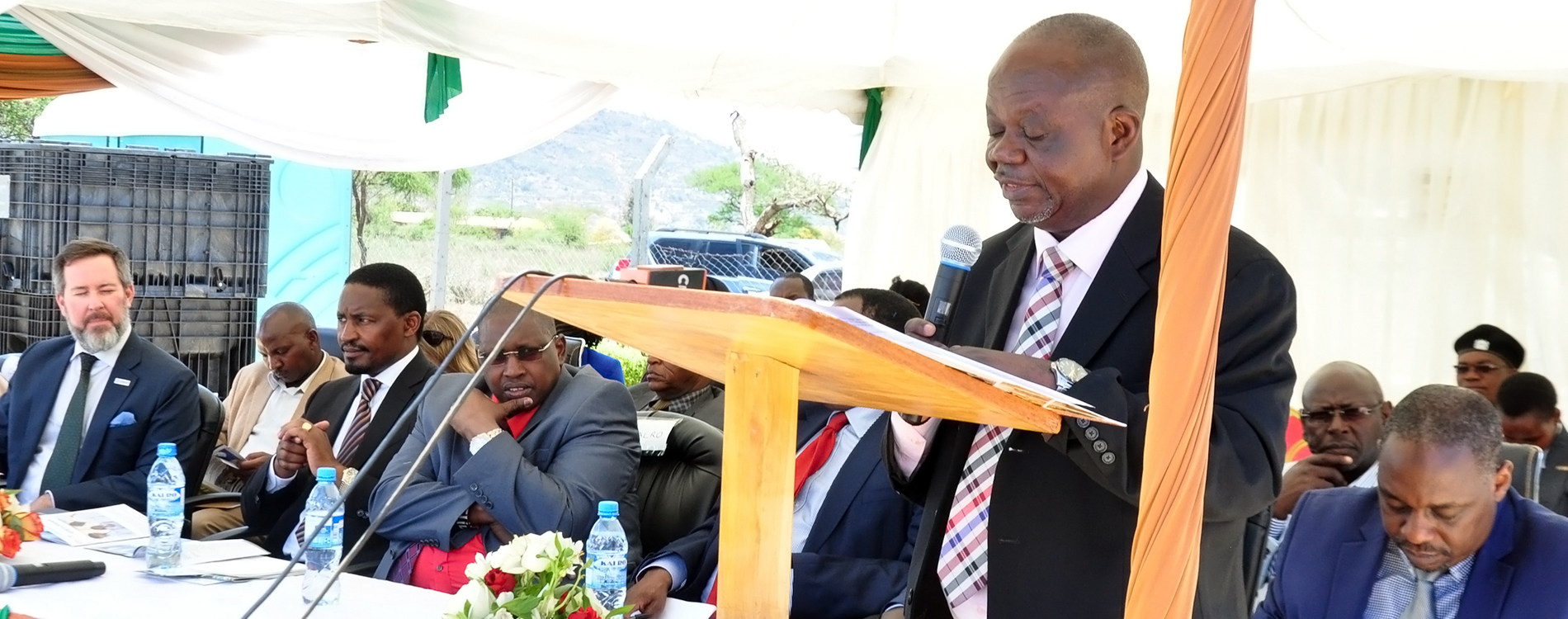
IITA-Eastern Africa hub director, Victor Manyong, making his speech after the commissioning of the KALRO/IITA aflsafe factory

Dr Manyong further commended the Kenyan Government through the Ministry of Agriculture and partners led by KALRO for their support that saw the fast paced development of the Aflasafe product and the construction of the plant, saying this is a clear indication of their dedication for ensuring that the country is food secure.

Also present at the event was the Patrick Wilson, Deputy Mission Director for United States Agency for International Development (USAID) Kenya and East Africa, who noted that aflatoxin was a global problem even in the United States.

He congratulated the team for their efforts that led to the development of the safe and effective technology to control aflatoxin. He noted the current challenge was to sustainably scale-up the technology to ensure all farmers are able to access it.

“This facility is a first of its kind in East Africa giving  Kenya the opportunity to lead the region in tacklaing aflatoxins. Tanzania, Malawi and Rwanda are also moving towards aflasafe production in their countries in partnership with the private sector,” Wilson said.


Aflasafe is a completely safe natural product that drastically reduces aflatoxins in crops. The base technology was first developed by the United States Department of Agriculture (USDA). IITA together with USDA, adapted and improved the technology for use in Africa starting in Nigeria where Aflasafe was first registered and the first plant in Africa constructed.

In Kenya it was developed through a collaboration of KALRO, IITA, USDA-ARS among many other partners. It has shown high efficacy of up to 98% in reducing aflatoxin levels in maize and has demonstrated its ability to maintain low or no contamination both at pre- and post-harvest.

Partners involved in the development of the Kenyan strain of the aflatoxin and its registration in the country include Kenya Plant Health Inspectorate Service (KEPHIS), Ministry of Agriculture, National Irrigation Board, and county governments, African Agricultural Technology Foundation (AATF), and ACDI-VOCA. It has been registered by the Pest Control Products Board (PCPB) with KALRO as the registrant.

USAID, Bill & Melinda Gates Foundation, USDA, and CGIAR Research Program on Agriculture for Nutrition and Health supported the effort. All these partners were also behind the construction of this modular Aflasafe KE01 manufacturing factory at KALRO Katumani and a regional laboratory to assist in constant monitoring and surveillance efforts of aflatoxin and capacity building.
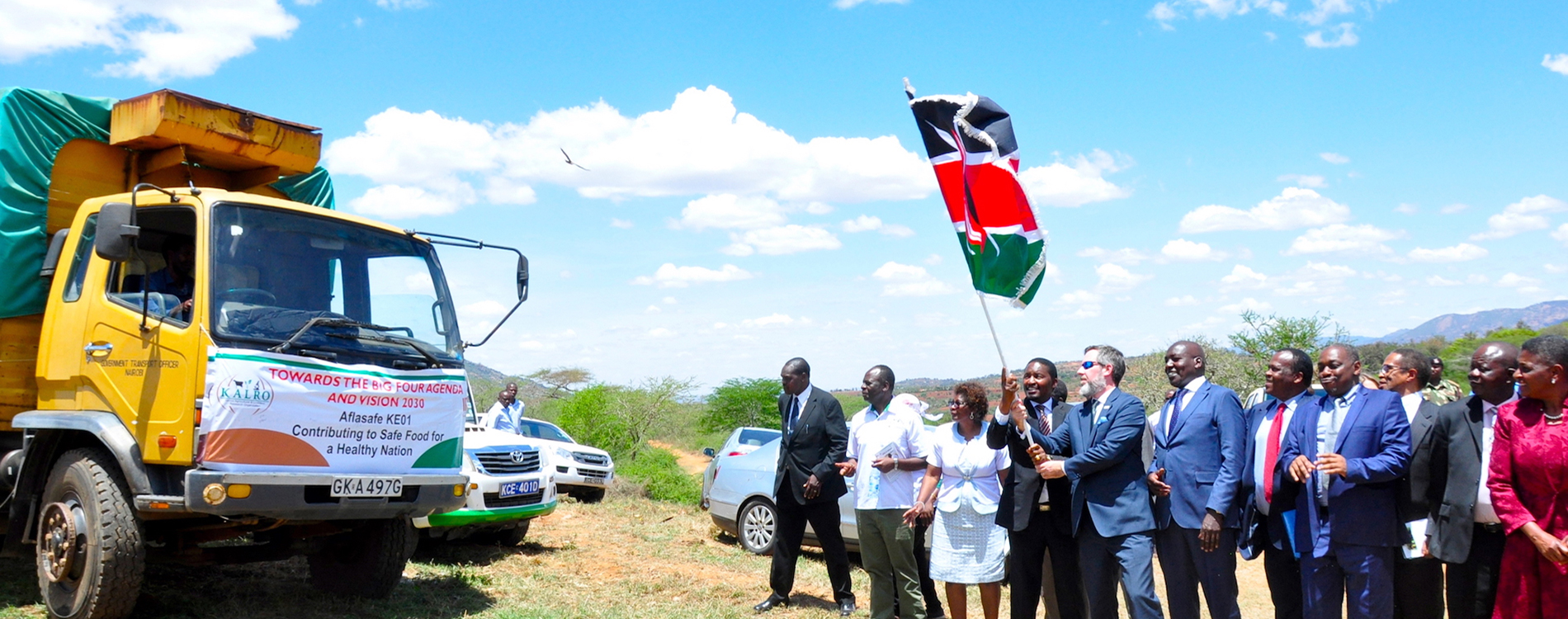
Agriculture Cabinet Secretary launches KALRO/IITA plant for manufacturing aflasafeKE, a safe technology for controlling deadly aflatoxin in Kenya
Hon. Mwangi Kiunjuri, the Cabinet Secretary in Kenya’s Agriculture ministry, and Patrick J. Wilson, Deputy Mission Director for USAID Kenya and Eastern Africa, wave off a lorry carrying aflasafeKE01 purchased by the ministry for demonstrating to farmers in aflatoxin hot spot areas in the country.

The construction of the plant was initiated in 2016 and finalized last year. IITA is providing technical backstopping while KALRO staff will manufacture Aflasafe KE01. The modular facility also serves as an incubator of the technology to attract the private sector which will be ultimately responsible for wide-scale production and distribution of the product.

In addition to Kenya and Nigeria, local versions of Aflasafe are available in Burkina Faso, The Gambia, Ghana, Senegal, Mozambique, Malawi, Zambia, and neighboring Tanzania.

For more information about Aflasafe, go to: https://aflasafe.com/

Media contact

Catherine Njuguna, c.njuguna@cgiar.org


Contributed by

Related news

No items found

Leave a Reply

Your email address will not be published. Required fields are marked *

Scroll to Top
Olaosebikan, Olamide

Olamide Deborah Nwanze is a Senior Research Associate specializing in gender mainstreaming research to inform participatory and inclusive breeding, variety development, and seed systems policies regarding root, tuber, and banana (RTB) crops in the International Institute of Tropical Agriculture Headquarters, Ibadan, Nigeria. She is a PhD candidate at the University of Ibadan and holds an MSc and B. Agric in Agricultural Extension and Rural Development. Olamide is a fellow of the African Women in Agricultural Research and Development – Gender Responsive Agricultural Systems Policy (AWARD-GRASP) and the Gender Responsive Researchers Equipped for Agricultural Transformation (GREAT). She seeks to apply her gender-mainstreaming learnings, gender-responsive research, and policy development, and review expertise to facilitate women, youth, children, and vulnerable social group’s access to and adoption of agricultural Innovations that guarantee food, nutrition, income, and livelihood security in Africa. Her current roles include mentoring research fellows, development of guides and training manuals, implementation and adaptation of gender frameworks and tools, value chain actors’ engagement as citizen science partners, policy review and redesign, data management, and analysis. Her current research explores mixed methods and participatory and interdisciplinary approaches to capture and highlight gender dynamics, needs, preferences, and challenges stakeholders face within the agricultural livelihood value chain to prioritize gender-inclusive strategies in breeding programs, policy design, and implementation.

At IITA, she contributes to the implementation of the CGIAR Accelerated Breeding Initiative and Genetic Innovation Programs; participatory and gender research within the NextGen CassavaHarvestPlusRTBFoods, and Tricot-ClimMob 1000Farms Projects; and gender knowledge communication via the G-LENS webinar series, video documentary, policy briefspublications, and blogs.


Recent publications

de Sousa, K., van Etten, J., Manners, R. Bello, A., Teeken, B., Olaosebikan, O., et al. 2024. The tricot approach: an agile framework for decentralized on-farm testing supported by citizen science. A retrospective. Agron. Sustain. Dev. 44, 8. https://doi.org/10.1007/s13593-023-00937-1

Madu, T., Onwuka, S., Nwafor, S., Onyemauwa, N., Ejechi, M., Ofoeze, M., Ukeje, B., Eluagu, C., Olaosebikan, O., Okoye, B., 2024. Gender-Inclusive Consumer Studies Improve Cassava Breeding in Nigeria in: Frontiers in Sociology, volume 9, number: 1224504, doi: 10.3389/fsoc.2024.1224504

Olaosebikan, O.; Bello, A.; Utoblo, O.; Okoye, B.; Olutegbe, N.; Garner, E.; Teeken, B.; Bryan, E.; Forsythe, L.; Cole, S.; Madu, T. 2023.  Stressors and Resilience within the Cassava Value Chain in Nigeria: Preferred Cassava Variety Traits and Response Strategies of Men and Women to Inform Breeding. Sustainability 15, 7837. https://doi.org/10.3390/su15107837

Okoye, B., Ofoeze, M., Ejechi, M., Onwuka, S., Nwafor, S., Onyemauwa, N., Ukeje, B., Eluagu, C., Obidiegwu, J.*, Olaosebikan, O., Madu, T.* 2023. Prioritizing preferred traits in the yam value chain in Nigeria: a gender situation analysis in: Frontiers in Sociology, volume 8, number: 1232626, pages 1 – 9, ISSN 2297-7775, 2023. https://www.frontiersin.org/articles/10.3389/fsoc.2023.1232626/full

Olaosebikan, O., Bello, A. A., de Sousa, K., Ndjouenkeu, R., Adesokan, M., Alamu, E. O., Agbona, A., van Etten, J., Kegah, F. N.*, Dufour, D., Bouniol, A., Teeken, B. 2023. Consumer acceptability of cassava gari-eba food products across cultural and environmental settings using the triadic comparison of technologies approach (tricot) in: Journal of the Science of Food and Agriculture,

Teeken, B., Olaosebikan, O., Bello, A. A., Madu, T.*, Cole, S. M. 2023. Qualitative assessment on the positionality and preferences of dyads in relation to cassava-related activities: working with tricot trial citizen scientists https://hdl.handle.net/10568/138326 Type: Manual

Bouniol, A., Ceballos, H., Bello, A. A., Teeken, B., Olaosebikan, O., Owoade, D., Agbona, A., Fotso Kuate, A., Madu, T.*, Okoye, B.*, Ofoeze, M.*, Nwafor, S.*, Onyemauwa, N.*, Adinsi, L.*, Forsythe, L., Dufour, D. 2023. Varietal impact on women’s labour, workload and related drudgery in processing root, tuber and banana crops: focus on cassava in sub-Saharan Africa in: Journal of the Science of Food and Agriculture, pages 1 – 25, ISSN 0022-5142,

Bello, A. A., Agbona, A., Olaosebikan, O., Edughaen, G., Dufour, D., Bouniol, A., Iluebbey, P., Ndjouenkeu, R.*, Rabbi, I. Y., Teeken, B. 2023. Genetic and environmental effects on processing productivity and food product yield: drudgery of women’s work in: Journal of the Science of Food and Agriculture, pages 1 – 32, ISSN 0022-5142, 5

Cavicchioli, M., Zimbiti, T., Teeken, B., Nwanze, D.O., Liani, M., Parkes, E. & Bello, A. 2023. IITA-Gender Responsive Breeding Training Report. Genetic Resources Center, IITA-HQ, Ibadan, 21-23 September, 2022. Ibadan, Nigeria: IITA, (34 p.).https://hdl.handle.net/10568/131368

Agbona, A. Peteti P., Teeken B., Olaosebikan O. Bello, A. A., Parkes, E., Rabbi, I. Y., Mueller, L., Egesi, C., Kulakow, P. 2022. Data Management in Multi-disciplinary African RTB Crop Breeding Programs. In: Williamson, H.F., Leonelli, S. (eds) Towards Responsible Plant Data Linkage: Data Challenges for Agricultural Research and Development. Springer, Cham. https://doi.org/10.1007/978-3-031-13276-6_5

Lora Forsythe, Pricilla Marimo, Sarah Mayanja, Olamide D. Olaosebikan, Esme Stuart, Bela Teeken, Benjamin Okoye, Tessy Madu, (2021). Cross-product Gender Analysis of RTBfoods Step 2 Gendered Food Mapping on RTB Products. Understanding the Drivers of Trait Preferences and the Development of Multi-user RTB Product Profiles, WP1. London, UK: RTBfoods Field Scientific Report, 30 p.

Teeken, B., Garner, E., Agbona, A., Balogun, I., Olaosebikan, O., Bello, A., Madu, T., Okoye, B., Egesi, C., Kulakow, P. and Tufan, H.A. 2021. Beyond “Women’s Traits”: Exploring How Gender, Social Difference, and Household Characteristics Influence Trait Preferences. Frontiers Sustainable Food Systems 5:740926. https://doi.org/10.3389/fsufs.2021.740926

Teeken, B., Agbona, A., Bello, A., Olaosebikan, O., Alamu, E., Adesokan, M., Awoyale, W., Madu, T., Okoye, B., Chijioke, U., Owoade, D., Okoro, M., Bouniol, A., Dufour, D., Hershey, C., Rabbi, I., Maziya‐Dixon, B., Egesi, C., Tufan, H. and Kulakow, P. (020. Understanding cassava varietal preferences through pairwise ranking of gari‐eba and fufu prepared by local farmer–processors. Int J Food Sci Technol. https://doi.org/10.1111/ijfs.14862

Bela Teeken, Olamide Olaosebikan, Ireti Balogun, Benjamin Okoye, Tessy Madu, Steven Cole, Abolore Bello, Elizabeth Parkes. (2020). Piloting the G+ customer and product profile tools for gender-responsive cassava breeding in Nigeria. Nigeria: International Institute of Tropical Agriculture (IITA). https://hdl.handle.net/20.500.11766/13000