Annual CocoaSoils Week highlights achievements toward sustainable cocoa production in Africa
June 6, 2022
Researchers, civil society organizations, and private and public sector stakeholders from Cameroon, Côte d’Ivoire, Ghana, and Nigeria converged at the Annual CocoaSoils Week 2022 at IITA headquarters, Ibadan, from 9 to 11 May. The event aimed to facilitate expert discussions on progress towards closing knowledge gaps in cocoa production and outline the priority areas for the program’s next phase.
It also aimed to mobilize partners’ support to facilitate the adoption of the program’s Integrated Soil Fertility Management (ISFM) recommendations by smallholder cocoa farmers for increased cocoa productivity in Cameroon, Côte d’Ivoire, Ghana, and Nigeria.
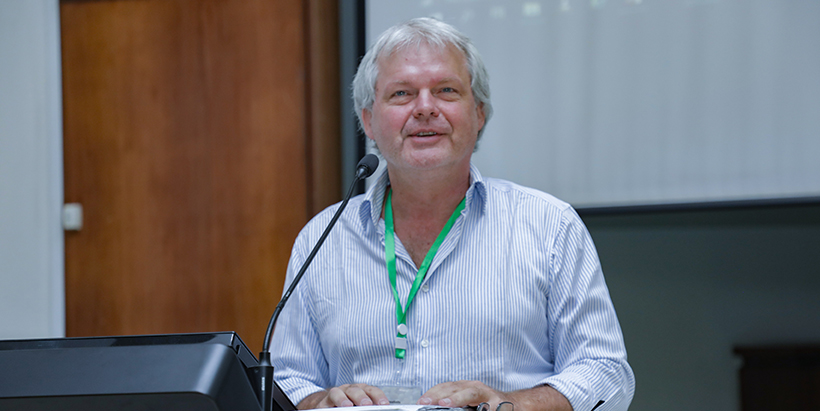
Dr Bernard Vanlauwe commending the participants on the success of the program’s first phase
Director of Research for Development (R4D), Central Africa and Natural Resource Management, Bernard Vanlauwe, commended the project team for the success of the program’s first phase.
According to Vanlauwe, the program receives continued interest and support from global stakeholders in the cocoa sector as it transitions into the new global initiative Excellence in Agronomy (EiA). “We are looking forward to getting the transition managed as efficiently as possible,” he said.
The forum covered the Partnerships for Delivery (P4D) session, where they discussed activities and lessons learned from Cameroon, Côte d’Ivoire, Ghana, and Nigeria. In addition, discussions on how to mobilize partners’ contributions to facilitate the adoption of recommendations for increased cocoa productivity in target countries.
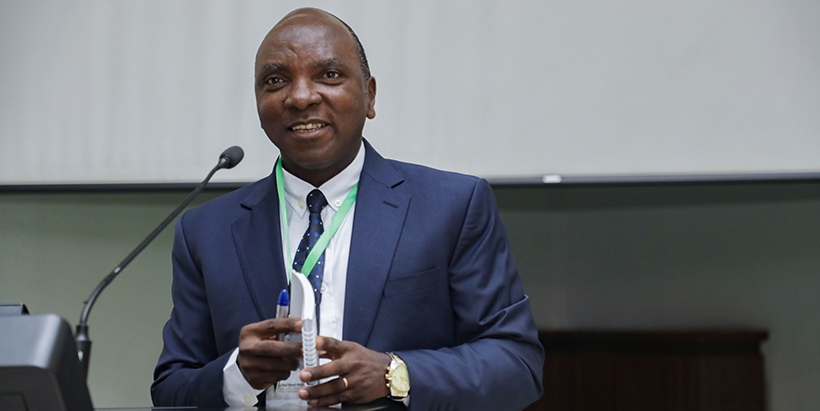
Jean Paul Nlend-Nkott giving a recap of the P4D achievements
The R4D session focused on sharing preliminary results from Core and Satellite field trials, feedback on the experimental process, and charting the future of CocoaSoils’ research work. Also, discussions on progress towards new fertilizer recommendations and how these can enhance soil health, productivity, profitability, and reduce deforestation in cocoa systems.
The participants went on a field trip to the Core and Satellite trials in Ondo State on the third day of the event to see firsthand the progress of the research trials.
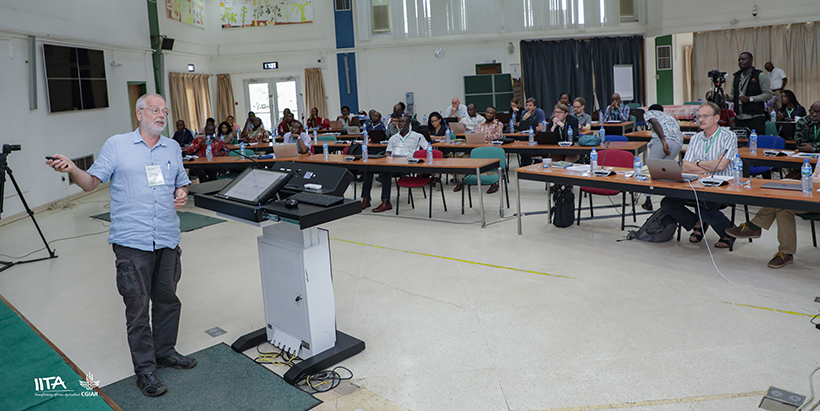
Dr Stefan Hauser presenting on the preliminary results and key lessons from the R4D session
About the CocoaSoils Program
CocoaSoils is a global R4D and P4D program led by IITA in collaboration with Wageningen University and Research (WUR) and the Sustainable Trade Initiative (IDH). CocoaSoils focuses on developing the latest knowledge in ISFM and Good Agricultural Practices (GAPs) for cocoa farmers in Africa to create a sustainable cocoa sector. The research on ISFM and GAPs is being disseminated to smallholder cocoa farmers in Ghana, Cameroon, Cote d’Ivoire, and Nigeria using the extension channels of private sector partners.
The program benefits from partnerships with the National Cocoa Research Institutes of Cameroon (IRAD), Côte d’Ivoire (CNRA), Ghana (CRIG), and Nigeria (CRIN); international research centers, including the International Centre for Tropical Agriculture (CIAT), the World Agroforestry Centre (ICRAF), the UN Environment World Conservation Monitoring Centre (UNEP-WCMC), and Climate 42; cocoa companies such as Barry Callebaut, Sucden, Cargill, Kuapa Kokoo, Mars, Mondelēz, Nestlé, Olatunde International, and Tulip Cocoa; fertilizer companies—ICL, Yara, and Bayer; and the World Cocoa Foundation (WCF).
Contributed by Anita Akinyomade
Olamide Deborah Nwanze is a Senior Research Associate specializing in gender mainstreaming research to inform participatory and inclusive breeding, variety development, and seed systems policies regarding root, tuber, and banana (RTB) crops in the International Institute of Tropical Agriculture Headquarters, Ibadan, Nigeria. She is a PhD candidate at the University of Ibadan and holds an MSc and B. Agric in Agricultural Extension and Rural Development. Olamide is a fellow of the African Women in Agricultural Research and Development – Gender Responsive Agricultural Systems Policy (AWARD-GRASP) and the Gender Responsive Researchers Equipped for Agricultural Transformation (GREAT). She seeks to apply her gender-mainstreaming learnings, gender-responsive research, and policy development, and review expertise to facilitate women, youth, children, and vulnerable social group’s access to and adoption of agricultural Innovations that guarantee food, nutrition, income, and livelihood security in Africa. Her current roles include mentoring research fellows, development of guides and training manuals, implementation and adaptation of gender frameworks and tools, value chain actors’ engagement as citizen science partners, policy review and redesign, data management, and analysis. Her current research explores mixed methods and participatory and interdisciplinary approaches to capture and highlight gender dynamics, needs, preferences, and challenges stakeholders face within the agricultural livelihood value chain to prioritize gender-inclusive strategies in breeding programs, policy design, and implementation.
de Sousa, K., van Etten, J., Manners, R. Bello, A., Teeken, B., Olaosebikan, O., et al. 2024. The tricot approach: an agile framework for decentralized on-farm testing supported by citizen science. A retrospective. Agron. Sustain. Dev. 44, 8. https://doi.org/10.1007/s13593-023-00937-1
Madu, T., Onwuka, S., Nwafor, S., Onyemauwa, N., Ejechi, M., Ofoeze, M., Ukeje, B., Eluagu, C., Olaosebikan, O., Okoye, B., 2024. Gender-Inclusive Consumer Studies Improve Cassava Breeding in Nigeria in: Frontiers in Sociology, volume 9, number: 1224504, doi: 10.3389/fsoc.2024.1224504
Olaosebikan, O.; Bello, A.; Utoblo, O.; Okoye, B.; Olutegbe, N.; Garner, E.; Teeken, B.; Bryan, E.; Forsythe, L.; Cole, S.; Madu, T. 2023. Stressors and Resilience within the Cassava Value Chain in Nigeria: Preferred Cassava Variety Traits and Response Strategies of Men and Women to Inform Breeding. Sustainability 15, 7837. https://doi.org/10.3390/su15107837
Okoye, B., Ofoeze, M., Ejechi, M., Onwuka, S., Nwafor, S., Onyemauwa, N., Ukeje, B., Eluagu, C., Obidiegwu, J.*, Olaosebikan, O., Madu, T.* 2023. Prioritizing preferred traits in the yam value chain in Nigeria: a gender situation analysis in: Frontiers in Sociology, volume 8, number: 1232626, pages 1 – 9, ISSN 2297-7775, 2023. https://www.frontiersin.org/articles/10.3389/fsoc.2023.1232626/full
Olaosebikan, O., Bello, A. A., de Sousa, K., Ndjouenkeu, R., Adesokan, M., Alamu, E. O., Agbona, A., van Etten, J., Kegah, F. N.*, Dufour, D., Bouniol, A., Teeken, B. 2023. Consumer acceptability of cassava gari-eba food products across cultural and environmental settings using the triadic comparison of technologies approach (tricot) in: Journal of the Science of Food and Agriculture,
Teeken, B., Olaosebikan, O., Bello, A. A., Madu, T.*, Cole, S. M. 2023. Qualitative assessment on the positionality and preferences of dyads in relation to cassava-related activities: working with tricot trial citizen scientists https://hdl.handle.net/10568/138326 Type: Manual
Bouniol, A., Ceballos, H., Bello, A. A., Teeken, B., Olaosebikan, O., Owoade, D., Agbona, A., Fotso Kuate, A., Madu, T.*, Okoye, B.*, Ofoeze, M.*, Nwafor, S.*, Onyemauwa, N.*, Adinsi, L.*, Forsythe, L., Dufour, D. 2023. Varietal impact on women’s labour, workload and related drudgery in processing root, tuber and banana crops: focus on cassava in sub-Saharan Africa in: Journal of the Science of Food and Agriculture, pages 1 – 25, ISSN 0022-5142,
Bello, A. A., Agbona, A., Olaosebikan, O., Edughaen, G., Dufour, D., Bouniol, A., Iluebbey, P., Ndjouenkeu, R.*, Rabbi, I. Y., Teeken, B. 2023. Genetic and environmental effects on processing productivity and food product yield: drudgery of women’s work in: Journal of the Science of Food and Agriculture, pages 1 – 32, ISSN 0022-5142, 5
Cavicchioli, M., Zimbiti, T., Teeken, B., Nwanze, D.O., Liani, M., Parkes, E. & Bello, A. 2023. IITA-Gender Responsive Breeding Training Report. Genetic Resources Center, IITA-HQ, Ibadan, 21-23 September, 2022. Ibadan, Nigeria: IITA, (34 p.).https://hdl.handle.net/10568/131368
Agbona, A. Peteti P., Teeken B., Olaosebikan O. Bello, A. A., Parkes, E., Rabbi, I. Y., Mueller, L., Egesi, C., Kulakow, P. 2022. Data Management in Multi-disciplinary African RTB Crop Breeding Programs. In: Williamson, H.F., Leonelli, S. (eds) Towards Responsible Plant Data Linkage: Data Challenges for Agricultural Research and Development. Springer, Cham. https://doi.org/10.1007/978-3-031-13276-6_5
Lora Forsythe, Pricilla Marimo, Sarah Mayanja, Olamide D. Olaosebikan, Esme Stuart, Bela Teeken, Benjamin Okoye, Tessy Madu, (2021). Cross-product Gender Analysis of RTBfoods Step 2 Gendered Food Mapping on RTB Products. Understanding the Drivers of Trait Preferences and the Development of Multi-user RTB Product Profiles, WP1. London, UK: RTBfoods Field Scientific Report, 30 p.
Teeken, B., Garner, E., Agbona, A., Balogun, I., Olaosebikan, O., Bello, A., Madu, T., Okoye, B., Egesi, C., Kulakow, P. and Tufan, H.A. 2021. Beyond “Women’s Traits”: Exploring How Gender, Social Difference, and Household Characteristics Influence Trait Preferences. Frontiers Sustainable Food Systems 5:740926. https://doi.org/10.3389/fsufs.2021.740926
Teeken, B., Agbona, A., Bello, A., Olaosebikan, O., Alamu, E., Adesokan, M., Awoyale, W., Madu, T., Okoye, B., Chijioke, U., Owoade, D., Okoro, M., Bouniol, A., Dufour, D., Hershey, C., Rabbi, I., Maziya‐Dixon, B., Egesi, C., Tufan, H. and Kulakow, P. (020. Understanding cassava varietal preferences through pairwise ranking of gari‐eba and fufu prepared by local farmer–processors. Int J Food Sci Technol.https://doi.org/10.1111/ijfs.14862
Bela Teeken, Olamide Olaosebikan, Ireti Balogun, Benjamin Okoye, Tessy Madu, Steven Cole, Abolore Bello, Elizabeth Parkes. (2020). Piloting the G+ customer and product profile tools for gender-responsive cassava breeding in Nigeria. Nigeria: International Institute of Tropical Agriculture (IITA). https://hdl.handle.net/20.500.11766/13000