
IITA NEWS

Awareness creation meeting on BBTD: presentation of response plan against BBTD
August 13, 2024

Plantain is one of the most important food crops, contributing 16% of farmers’ incomes and 4.5% to agricultural GDP in Cameroon. It is one of the priority crops included in Cameroon’s development strategy (SND30) for increasing production and reducing importation. However, plantain cultivation faces banana bunchy top disease (BBTD) caused by the banana bunchy top virus (BBTV), which is spread by the banana aphid and infected planting material.
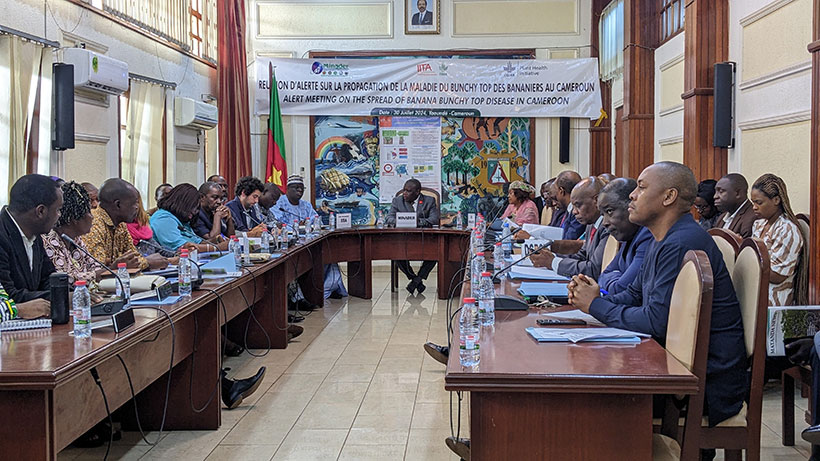
Participants in the conference room of MINADER

In Cameroon, BBTD was reported in 2008 and confined to a single district at the border with Gabon. Although the infection was limited to this district from 2008 to 2022, BBTD is insidiously spreading to the north of the country, and this spread is usually through infected plant materials by human movement, constituting a significant threat to the development of the plantain sector. IITA-CGIAR Virologist and member of the ALLIANCE against BBTV initiative, Lava Kumar, acknowledged funding from CGIAR for combating BBTV in Africa from 2012 to 2021 through the CRP-RTB Program and from 2022 onwards through the CGIAR Plant Health Initiative. He said the CGIAR Trust Fund donor’s support enabled emergency response actions, development, and transfer of innovations to partners.

The BBTD awareness creation meeting funded by the CGIAR Plant Health Initiative aimed to inform high decision levels of the Ministry of Agriculture and Rural Development, political decision-makers, and stakeholders in the plantain value chain about the status of BBTV spread and control methods to halt the contagion, and discuss a response plan to be implemented for BBTD control in Cameroon. The meeting was held on 30 July at the Ministry of Agriculture and Rural Development (MINADER) and organized by IITA Cameroon in collaboration with the National Fruits Crops Development Project (PNDCF), a specialized program of MINADER.
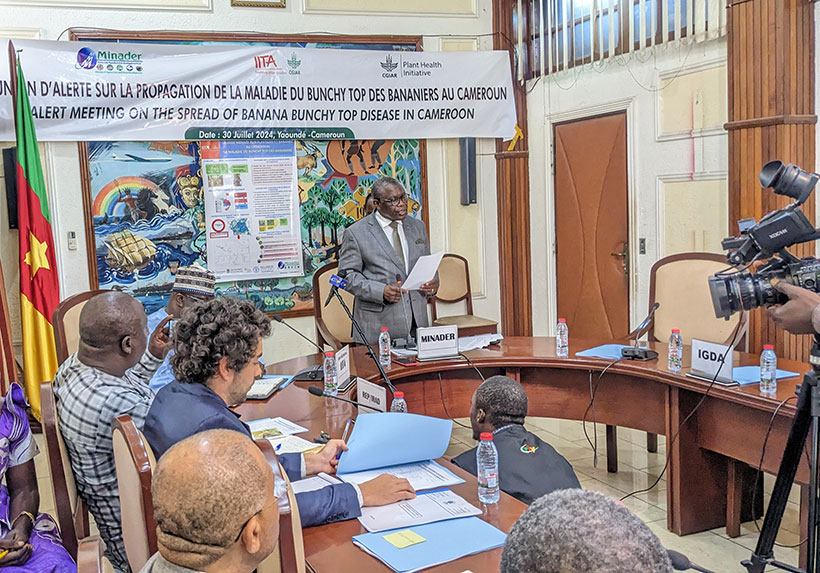
His Excellency Gabriel Mbairobe, the Ministry of Agriculture and Rural Development-Cameroon in his speech
His Excellency Gabriel Mbairobe, the Minister of Agriculture and Rural Development for Cameroon during his speech

His Excellency Gabriel Mbairobe, the Minister of Agriculture and Rural Development, presided over the meeting, assisted by the General Secretary of MINADER. In his speech, the Minister recalled the value of plantain in Cameroon for livelihood and income, warning the participants about the necessity of taking action to tackle this disease and even eradicate it from Cameroon. He then acknowledged IITA for its strong involvement in BBTD research and for sounding the alarm that led to this meeting.

During the meeting, Sergine Ngatat, a Plant Pathologist at IITA Cameroon, presented on BBTD symptoms and damage, the extent of BBTD spread in Cameroon, which is so far confined within the Ambam district /Ntem Valley Division in the South Region at the border area with Gabon and Equatorial Guinea, and some actions undertaken towards BBTD control in the country’s endemic area.

Eric Avom, the National Coordinator of the National Fruits Crops Development Project (PNDCF), presented a response plan against BBTD in Cameroon for 2025 to 2027, including phytosanitation of infected materials and replacement with clean planting materials, surveillance, quarantine regulation of seed movement, and awareness-raising campaigns.

IITA Deputy Director for Central Africa Hub and IITA Country Representative in Cameroon, Komi Fiaboe, emphasized the necessity of controlling the movement of plantain seeds, given that for Cameroon, the seed is a contributor at 95% for BBTV spread and highly recommended the use of vitroplants as clean planting materials in the endemic area while recalling the importance of training the farmers on BBTD symptom recognition.
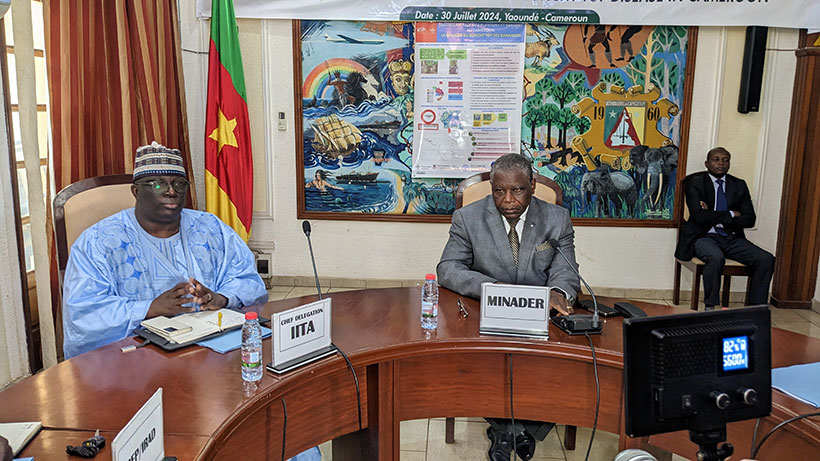
From left to right, Dr Komi FIABOE, the IITA Deputy Director for central Africa Hub and IITA Country Representative and His Excellency Gabriel MBAIROBE, the Ministry of Agriculture and Rural Development-Cameroon

A plenary session was conducted, with discussions and recommendations to complement the response plan against BBTD in Cameroon.

In the end, the Minister of Agriculture pleaded with IITA to search for alternative safe herbicides and biopesticides for phytosanitation of BBTV-infected materials in the endemic area,  urged Quarantine Authority to take the necessary actions for implementation of the by-law on plantain seed movement from the endemic area, and requested the implementation of a response plan that will not only limit its spread to inside of the country but will definitively eradicate this dangerous plantain disease from the country.

The meeting enlightened participants on BBTD and ended with validating the response plan against BBTD in Cameroon.

Contributed by Sergine Ngatat


Contributed by

Related news

No items found

Leave a Reply

Your email address will not be published. Required fields are marked *

Scroll to Top
Olaosebikan, Olamide

Olamide Deborah Nwanze is a Senior Research Associate specializing in gender mainstreaming research to inform participatory and inclusive breeding, variety development, and seed systems policies regarding root, tuber, and banana (RTB) crops in the International Institute of Tropical Agriculture Headquarters, Ibadan, Nigeria. She is a PhD candidate at the University of Ibadan and holds an MSc and B. Agric in Agricultural Extension and Rural Development. Olamide is a fellow of the African Women in Agricultural Research and Development – Gender Responsive Agricultural Systems Policy (AWARD-GRASP) and the Gender Responsive Researchers Equipped for Agricultural Transformation (GREAT). She seeks to apply her gender-mainstreaming learnings, gender-responsive research, and policy development, and review expertise to facilitate women, youth, children, and vulnerable social group’s access to and adoption of agricultural Innovations that guarantee food, nutrition, income, and livelihood security in Africa. Her current roles include mentoring research fellows, development of guides and training manuals, implementation and adaptation of gender frameworks and tools, value chain actors’ engagement as citizen science partners, policy review and redesign, data management, and analysis. Her current research explores mixed methods and participatory and interdisciplinary approaches to capture and highlight gender dynamics, needs, preferences, and challenges stakeholders face within the agricultural livelihood value chain to prioritize gender-inclusive strategies in breeding programs, policy design, and implementation.

At IITA, she contributes to the implementation of the CGIAR Accelerated Breeding Initiative and Genetic Innovation Programs; participatory and gender research within the NextGen CassavaHarvestPlusRTBFoods, and Tricot-ClimMob 1000Farms Projects; and gender knowledge communication via the G-LENS webinar series, video documentary, policy briefspublications, and blogs.


Recent publications

de Sousa, K., van Etten, J., Manners, R. Bello, A., Teeken, B., Olaosebikan, O., et al. 2024. The tricot approach: an agile framework for decentralized on-farm testing supported by citizen science. A retrospective. Agron. Sustain. Dev. 44, 8. https://doi.org/10.1007/s13593-023-00937-1

Madu, T., Onwuka, S., Nwafor, S., Onyemauwa, N., Ejechi, M., Ofoeze, M., Ukeje, B., Eluagu, C., Olaosebikan, O., Okoye, B., 2024. Gender-Inclusive Consumer Studies Improve Cassava Breeding in Nigeria in: Frontiers in Sociology, volume 9, number: 1224504, doi: 10.3389/fsoc.2024.1224504

Olaosebikan, O.; Bello, A.; Utoblo, O.; Okoye, B.; Olutegbe, N.; Garner, E.; Teeken, B.; Bryan, E.; Forsythe, L.; Cole, S.; Madu, T. 2023.  Stressors and Resilience within the Cassava Value Chain in Nigeria: Preferred Cassava Variety Traits and Response Strategies of Men and Women to Inform Breeding. Sustainability 15, 7837. https://doi.org/10.3390/su15107837

Okoye, B., Ofoeze, M., Ejechi, M., Onwuka, S., Nwafor, S., Onyemauwa, N., Ukeje, B., Eluagu, C., Obidiegwu, J.*, Olaosebikan, O., Madu, T.* 2023. Prioritizing preferred traits in the yam value chain in Nigeria: a gender situation analysis in: Frontiers in Sociology, volume 8, number: 1232626, pages 1 – 9, ISSN 2297-7775, 2023. https://www.frontiersin.org/articles/10.3389/fsoc.2023.1232626/full

Olaosebikan, O., Bello, A. A., de Sousa, K., Ndjouenkeu, R., Adesokan, M., Alamu, E. O., Agbona, A., van Etten, J., Kegah, F. N.*, Dufour, D., Bouniol, A., Teeken, B. 2023. Consumer acceptability of cassava gari-eba food products across cultural and environmental settings using the triadic comparison of technologies approach (tricot) in: Journal of the Science of Food and Agriculture,

Teeken, B., Olaosebikan, O., Bello, A. A., Madu, T.*, Cole, S. M. 2023. Qualitative assessment on the positionality and preferences of dyads in relation to cassava-related activities: working with tricot trial citizen scientists https://hdl.handle.net/10568/138326 Type: Manual

Bouniol, A., Ceballos, H., Bello, A. A., Teeken, B., Olaosebikan, O., Owoade, D., Agbona, A., Fotso Kuate, A., Madu, T.*, Okoye, B.*, Ofoeze, M.*, Nwafor, S.*, Onyemauwa, N.*, Adinsi, L.*, Forsythe, L., Dufour, D. 2023. Varietal impact on women’s labour, workload and related drudgery in processing root, tuber and banana crops: focus on cassava in sub-Saharan Africa in: Journal of the Science of Food and Agriculture, pages 1 – 25, ISSN 0022-5142,

Bello, A. A., Agbona, A., Olaosebikan, O., Edughaen, G., Dufour, D., Bouniol, A., Iluebbey, P., Ndjouenkeu, R.*, Rabbi, I. Y., Teeken, B. 2023. Genetic and environmental effects on processing productivity and food product yield: drudgery of women’s work in: Journal of the Science of Food and Agriculture, pages 1 – 32, ISSN 0022-5142, 5

Cavicchioli, M., Zimbiti, T., Teeken, B., Nwanze, D.O., Liani, M., Parkes, E. & Bello, A. 2023. IITA-Gender Responsive Breeding Training Report. Genetic Resources Center, IITA-HQ, Ibadan, 21-23 September, 2022. Ibadan, Nigeria: IITA, (34 p.).https://hdl.handle.net/10568/131368

Agbona, A. Peteti P., Teeken B., Olaosebikan O. Bello, A. A., Parkes, E., Rabbi, I. Y., Mueller, L., Egesi, C., Kulakow, P. 2022. Data Management in Multi-disciplinary African RTB Crop Breeding Programs. In: Williamson, H.F., Leonelli, S. (eds) Towards Responsible Plant Data Linkage: Data Challenges for Agricultural Research and Development. Springer, Cham. https://doi.org/10.1007/978-3-031-13276-6_5

Lora Forsythe, Pricilla Marimo, Sarah Mayanja, Olamide D. Olaosebikan, Esme Stuart, Bela Teeken, Benjamin Okoye, Tessy Madu, (2021). Cross-product Gender Analysis of RTBfoods Step 2 Gendered Food Mapping on RTB Products. Understanding the Drivers of Trait Preferences and the Development of Multi-user RTB Product Profiles, WP1. London, UK: RTBfoods Field Scientific Report, 30 p.

Teeken, B., Garner, E., Agbona, A., Balogun, I., Olaosebikan, O., Bello, A., Madu, T., Okoye, B., Egesi, C., Kulakow, P. and Tufan, H.A. 2021. Beyond “Women’s Traits”: Exploring How Gender, Social Difference, and Household Characteristics Influence Trait Preferences. Frontiers Sustainable Food Systems 5:740926. https://doi.org/10.3389/fsufs.2021.740926

Teeken, B., Agbona, A., Bello, A., Olaosebikan, O., Alamu, E., Adesokan, M., Awoyale, W., Madu, T., Okoye, B., Chijioke, U., Owoade, D., Okoro, M., Bouniol, A., Dufour, D., Hershey, C., Rabbi, I., Maziya‐Dixon, B., Egesi, C., Tufan, H. and Kulakow, P. (020. Understanding cassava varietal preferences through pairwise ranking of gari‐eba and fufu prepared by local farmer–processors. Int J Food Sci Technol. https://doi.org/10.1111/ijfs.14862

Bela Teeken, Olamide Olaosebikan, Ireti Balogun, Benjamin Okoye, Tessy Madu, Steven Cole, Abolore Bello, Elizabeth Parkes. (2020). Piloting the G+ customer and product profile tools for gender-responsive cassava breeding in Nigeria. Nigeria: International Institute of Tropical Agriculture (IITA). https://hdl.handle.net/20.500.11766/13000