
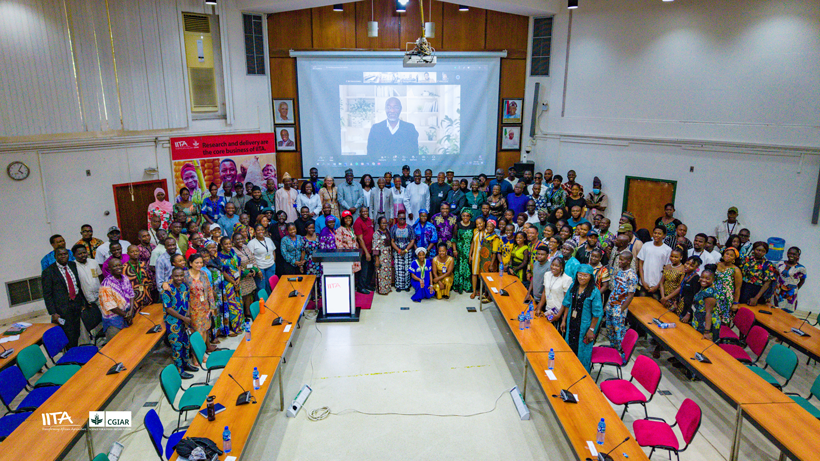
Arusha, Tanzania, 23 May 2022. After a two-year lockdown, an international team of banana researchers convenes for a three-day workshop in Arusha to continue forging a path to speed up the breeding process and deliver new bananas to East African farmers. Together with the Hon. Hussein Bashe, Tanzanian Minister of Agriculture, the project partners will also celebrate the release in Tanzania of the first new, high-yielding cooking banana varieties produced by CGIAR’s International Institute of Tropical Agriculture (IITA) in collaboration with Tanzania Agricultural Research Institute (TARI) and partners.
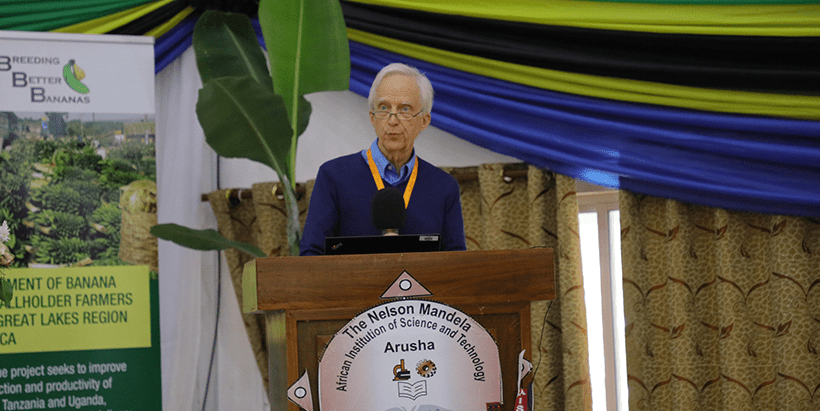
The “Accelerated Breeding of Better Bananas” (ABBB) project (http://breedingbetterbananas.org/) led by IITA aims to deliver improved, disease-resistant, high-yielding cooking banana varieties to farmers across the region. The project team is working on speeding up the breeding cycle of bananas to deliver new varieties to farmers faster. They are especially interested in providing pest- and disease-resistant varieties that farmers and consumers will like.
Previously, new varieties have taken around 20 years to develop. This is mainly due to the huge challenge in breeding banana, which is probably the most difficult crop to breed due to their sterility and poor seed formation. This project aims to breed resistance against the major pests and diseases and halve the time to deliver new varieties. The project is already seeing major progress, improvements, and faster breeding speeds.
The project works with the national banana breeding programs in Tanzania and Uganda, focused on East Africa Highland banana (EAHB) or Matooke and Mchare. Pests and diseases are particularly damaging to yields in East Africa. By breeding new varieties with resistance to these threats, yields on the farm can be substantially increased. However, it is necessary to ensure that varieties resistant to these pests and diseases grow well with an acceptable taste. This exceptional international team of researchers put breeders with geneticists, molecular scientists, agronomists, plant physiologists, nutritionists, pathologists, and even data management experts to revolutionize banana breeding in the region.
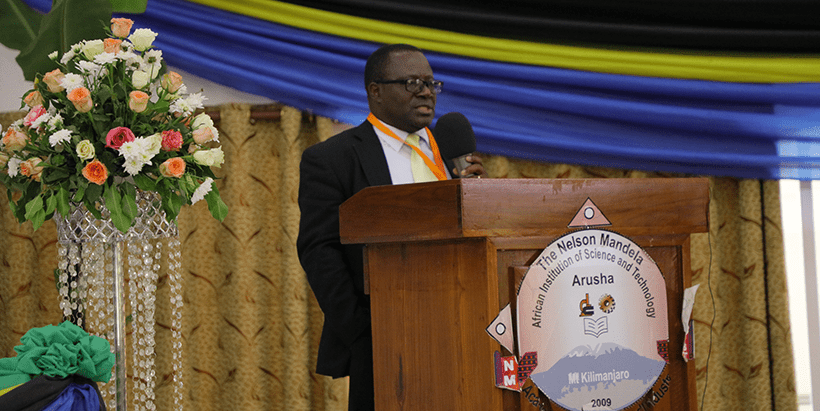 In Tanzania and Uganda, banana is a staple and major source of income for millions of smallholder farmers. These two countries alone produce over half of all bananas grown in Africa, with an annual value of US$4.3 billion. However, farmers are producing a mere fraction of what is possible, mostly due to attacks by pests and diseases and the use of local, low-yielding varieties. New, high-yielding pest and disease-resistant varieties bred naturally will make a significant difference in reducing this huge yield gap.
In the ABBB project, IITA coordinates activities among the 15 partners. “Only a handful of banana breeding programs exist because banana is such a difficult crop to breed,” says Prof Rony Swennen, Lead Banana Breeder at IITA and the project team lead.”
The new varieties have passed the regulatory requirements for releasing new varieties in Tanzania. Dr Geoffrey Mkamilo, Director General of the Tanzanian Agricultural Research Institute (TARI), said, “This is a special moment for banana farmers in Tanzania and the banana community in general. We look forward to more improved varieties coming out of this project and Tanzania’s newly established banana breeding program in Arusha”.
Dr Mpoki Shimwela, the TARI Banana Program Leader, continued, “We are now multiplying planting material of the newly released varieties at TARI and with private tissue culture companies to ensure large quantities of seedlings are available for farmers.”
The new banana varieties were produced in Uganda and called NARITAs, as they were jointly produced by NARO and IITA. “The NARITAs are a huge success in Uganda,” states Dr Priver Bwesigye, Banana Program Leader in Uganda. “The farmers appreciate their high yield and that they taste the same as traditional varieties.” Shimwela adds, “The NARITA varieties have been renamed as TARIBAN in Tanzania to acknowledge the extensive efforts by TARI to test and evaluate them here. The farmers love them!”
“To overcome the challenges in breeding bananas and improve a major staple food crop, this project has demonstrated scientific and international harmony for the greater good in East Africa,” says Dr Leena Tripathi, IITA Director, Eastern Africa Hub. Under the project, researchers are working closely together, using cutting-edge techniques in the best laboratories worldwide to address the challenges to banana breeding, improve efficiency, and reduce the time it takes to deliver much-needed improved, disease- and pest-resistant varieties to farmers.
In Uganda, hundreds of Matooke hybrid varieties have been selected for advancement to field testing, while in Tanzania, the first hybrid Mchare is now being tested in the field in Arusha, with some excellent results. Dr Allan Brown, Banana Breeder with IITA in Arusha, says, “This is very exciting for us as this is the first time we have tried to breed Mchare. In just a short time since starting this program, we are seeing some very encouraging results in the field. This will make a huge difference to Mchare farmers in Tanzania”.
About the project: Working with national partners in Tanzania and Uganda, and focusing on breeding varieties resistant to the key pest and disease threats in the region are critical to improving yields. Under the project’s coordination, the two national breeding programs link and exchange germplasm material with banana programs in Brazil, India, and Malaysia; this is unique within the banana breeding world. By linking scientists from multiple breeding programs worldwide, germplasm with resistance to diseases elsewhere can be used to provide resistance to Mchare and Matooke. A good example is Fusarium wilt disease, especially the Tropical Race 4, a global threat to banana production but not yet present in East Africa. By working with partners in different global locations where Tropical Fusarium wilt is present, newly bred varieties are being tested where the problem exists, and germplasm with resistance may be accessed. This project has facilitated the linkage with worldwide breeding programs to exchange banana varieties and use the best materials.
A crucial aspect of the project is its attention to fostering the next generation of scientists and building capacity in banana breeding programs in East Africa. The project places a huge emphasis on training and capacity building, with multiple postgraduate trainees involved and supported by the project. The future is looking bright for banana and all those who depend on it in East Africa.
The regional breeding activities are being conducted at the Nelson Mandela African Institution of Science and Technology (NM-AIST) in Arusha, Tanzania, in close collaboration with regional Tanzania Agriculture Research Institutes (TARI) in the banana growing areas, and at the Banana Breeding Programme of the National Agricultural Research Organization (NARO), at Kawanda, and IITA-Sendusu, and at regional Uganda research sites in Uganda.
Meanwhile, the vast amount of data collected through this project is being compiled, organized, and stored on a dedicated banana database called MusaBase (https://musabase.org/). This database is freely accessible and available to everyone, everywhere, to access and utilize. It is also linked to the two banana breeding programs in Tanzania and Uganda through a new mechanism that enables the tracking of each banana plant, its parentage, and all its growth and agronomic performance. Development of new tools like this through the project helps speed up and ensure accurate information and monitoring along the whole banana breeding pipeline. This project is being conducted within the Accelerated Breeding Initiative of CGIAR.
The ABBB project is implemented in collaboration with TARI Tanzania, NARO Uganda, Swedish University of Agriculture – Sweden; Stellenbosch University, South Africa; University of Malaya, Malaysia; EMBRAPA, Brazil; National Research Centre for Banana (NRCB), India; Boyce Thomson Institute, USA; University of Queensland, Australia; Institute of Experimental Botany, Czech Republic; Katholieke Universiteit Leuven, Belgium; Nature Source Improved Plants, USA; Wageningen University & Research and KeyGene, the Netherlands.
About IITA, www.iita.org
The International Institute of Tropical Agriculture (IITA) is a not-for-profit institution that generates agricultural innovations to meet Africa’s most pressing challenges of hunger, malnutrition, poverty, and natural resource degradation. Working with various partners across sub-Saharan Africa, we improve livelihoods, enhance food and nutrition security, increase employment, and preserve natural resource integrity. IITA is a member of CGIAR, a global agriculture research partnership for a food-secure future.
Media contact:
Gloriana Ndibalema, Communication Assistant, IITA-Tanzania
Mobile: +255 747 298 288
Email: g.ndibalema@cgiar.org
Contributed by
Recent stories