
NEWS

BASICS-II kicks off partnership to promote improved cassava varieties cultivation and consumption
March 22, 2021

SANO Foods Limited and IITA, through the Building an Economically Sustainable, Integrated Cassava Seed System, Phase 2 (BASICS-II) project, have embarked on a public-private sector partnership to promote the cultivation of improved cassava varieties and the consumption of locally processed products in Nigeria. The initiative recently kicked off with a “Joint public exhibition of fortified foods and cassava varietal display” at IITA, Ibadan.

The exhibition displayed newly released cassava varieties such as Game Changer, Obasanjo-2, Hope, Poundable, and Baba-70. Other displayed varieties were TME 419, Farmer’s Pride, Dixon, Ayaya, Sunshine, and Fine face. All these varieties have yields above 20 t/ha, unlike local varieties that give less than 10 t/ha. The processed foods on display included fortified orange-fleshed sweet potato (OFSP) garri, OFSP bread, and lemongrass tea.
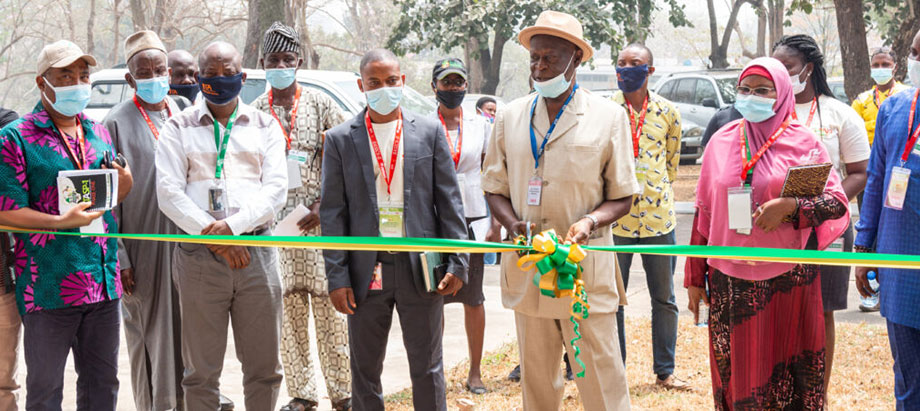
BASICS-II kicks off partnership to promote improved cassava varieties cultivation and consumption
Development and Delivery Office Director, Alfred Dixon, cuts the ribbon to kick off the exhibition.

The deal will create awareness about the newly released cassava varieties and draw consumers’ attention to the availability of locally made and nutritious food products designed to tackle malnutrition.

The IITA Yam Improvement for Incomes and Food Security in West Africa, Phase II (YIFSWA-II) displayed improved yam varieties and products, while the IITA mechanization unit showcased locally fabricated cassava harvesters.

In his keynote address, IITA Deputy Director-General (Partnerships for Delivery), Kenton Dashiell, noted that breeders were progressing well in developing crop varieties but needed the inputs of other stakeholders like the government and processors, who would add value to the research products. The final development requires partnerships and collaboration with the private sector to add value to these crops. “I believe that is what SANO is doing, and I’m sure we will get to learn more from them,” he emphasized.

The IITA Development and Delivery Office Director, Alfred Dixon, described the SANO-BASICS-II partnership as a “win-win collaboration.” He stressed the need to harness cassava’s potential as a poverty fighter to create jobs, fight food insecurity, and boost Nigeria’s economy.
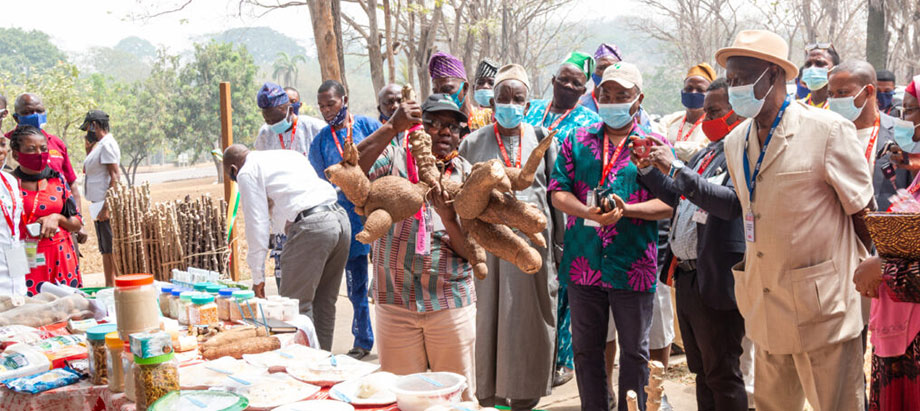
BASICS-II kicks off partnership to promote improved cassava varieties cultivation and consumption
IITA’s International Trials Manager, Peter Iluebbey, showcasing an improved cassava variety

“Together, we will create an economically sustainable cassava value chain where every actor will have a space and benefit from cassava,” Dixon continued. “We will raise awareness and trigger the adoption of these varieties by farmers.”

SANO Foods Acting General Manager, Mr Solomon Ojeleye, pointed out SANO’s vision to provide healthy foods rich in vitamins. He identified turmeric garri and OFSP garri as two products the company developed through research to add nutritional value to cassava.

He said, “We have over 39 products in the market, and all of them are organic because we put the health of our consumers first. We use puree, flour, and roots of yellow cassava, orange-fleshed sweet potato, yellow maize, and other crops to produce several confectioneries that include bread, cookies and cakes, and baby food.

According to Mercy Diebiru-Ojo, Vegetative Seed Production Expert at IITA GoSeeed, some new and improved varieties currently being promoted boast high vitamin A content. They also have excellent garri and fufu qualities and superb dry matter content, and these are important properties for food processors, flour millers, and industries.

IITA BASICS-II Project Manager, Prof. Lateef Sanni, said working with organizations like SANO Foods would advance the cassava value chain.

Other scientists who spoke at the event were: Michael Abberton, IITA Director for West Africa Hub; Ismail Rabbi, IITA Molecular Geneticist and Breeder; and YIIFSWA-II Tissue Culture Specialist, Morufat Balogun. Engr. Thierno Diallo, IITA Post-Harvest Engineer, also made a presentation on locally produced cassava harvesters.


Contributed by

Recent stories

No items found

Leave a Reply

Your email address will not be published. Required fields are marked *

Scroll to Top
Olaosebikan, Olamide

Olamide Deborah Nwanze is a Senior Research Associate specializing in gender mainstreaming research to inform participatory and inclusive breeding, variety development, and seed systems policies regarding root, tuber, and banana (RTB) crops in the International Institute of Tropical Agriculture Headquarters, Ibadan, Nigeria. She is a PhD candidate at the University of Ibadan and holds an MSc and B. Agric in Agricultural Extension and Rural Development. Olamide is a fellow of the African Women in Agricultural Research and Development – Gender Responsive Agricultural Systems Policy (AWARD-GRASP) and the Gender Responsive Researchers Equipped for Agricultural Transformation (GREAT). She seeks to apply her gender-mainstreaming learnings, gender-responsive research, and policy development, and review expertise to facilitate women, youth, children, and vulnerable social group’s access to and adoption of agricultural Innovations that guarantee food, nutrition, income, and livelihood security in Africa. Her current roles include mentoring research fellows, development of guides and training manuals, implementation and adaptation of gender frameworks and tools, value chain actors’ engagement as citizen science partners, policy review and redesign, data management, and analysis. Her current research explores mixed methods and participatory and interdisciplinary approaches to capture and highlight gender dynamics, needs, preferences, and challenges stakeholders face within the agricultural livelihood value chain to prioritize gender-inclusive strategies in breeding programs, policy design, and implementation.

At IITA, she contributes to the implementation of the CGIAR Accelerated Breeding Initiative and Genetic Innovation Programs; participatory and gender research within the NextGen CassavaHarvestPlusRTBFoods, and Tricot-ClimMob 1000Farms Projects; and gender knowledge communication via the G-LENS webinar series, video documentary, policy briefspublications, and blogs.


Recent publications

de Sousa, K., van Etten, J., Manners, R. Bello, A., Teeken, B., Olaosebikan, O., et al. 2024. The tricot approach: an agile framework for decentralized on-farm testing supported by citizen science. A retrospective. Agron. Sustain. Dev. 44, 8. https://doi.org/10.1007/s13593-023-00937-1

Madu, T., Onwuka, S., Nwafor, S., Onyemauwa, N., Ejechi, M., Ofoeze, M., Ukeje, B., Eluagu, C., Olaosebikan, O., Okoye, B., 2024. Gender-Inclusive Consumer Studies Improve Cassava Breeding in Nigeria in: Frontiers in Sociology, volume 9, number: 1224504, doi: 10.3389/fsoc.2024.1224504

Olaosebikan, O.; Bello, A.; Utoblo, O.; Okoye, B.; Olutegbe, N.; Garner, E.; Teeken, B.; Bryan, E.; Forsythe, L.; Cole, S.; Madu, T. 2023.  Stressors and Resilience within the Cassava Value Chain in Nigeria: Preferred Cassava Variety Traits and Response Strategies of Men and Women to Inform Breeding. Sustainability 15, 7837. https://doi.org/10.3390/su15107837

Okoye, B., Ofoeze, M., Ejechi, M., Onwuka, S., Nwafor, S., Onyemauwa, N., Ukeje, B., Eluagu, C., Obidiegwu, J.*, Olaosebikan, O., Madu, T.* 2023. Prioritizing preferred traits in the yam value chain in Nigeria: a gender situation analysis in: Frontiers in Sociology, volume 8, number: 1232626, pages 1 – 9, ISSN 2297-7775, 2023. https://www.frontiersin.org/articles/10.3389/fsoc.2023.1232626/full

Olaosebikan, O., Bello, A. A., de Sousa, K., Ndjouenkeu, R., Adesokan, M., Alamu, E. O., Agbona, A., van Etten, J., Kegah, F. N.*, Dufour, D., Bouniol, A., Teeken, B. 2023. Consumer acceptability of cassava gari-eba food products across cultural and environmental settings using the triadic comparison of technologies approach (tricot) in: Journal of the Science of Food and Agriculture,

Teeken, B., Olaosebikan, O., Bello, A. A., Madu, T.*, Cole, S. M. 2023. Qualitative assessment on the positionality and preferences of dyads in relation to cassava-related activities: working with tricot trial citizen scientists https://hdl.handle.net/10568/138326 Type: Manual

Bouniol, A., Ceballos, H., Bello, A. A., Teeken, B., Olaosebikan, O., Owoade, D., Agbona, A., Fotso Kuate, A., Madu, T.*, Okoye, B.*, Ofoeze, M.*, Nwafor, S.*, Onyemauwa, N.*, Adinsi, L.*, Forsythe, L., Dufour, D. 2023. Varietal impact on women’s labour, workload and related drudgery in processing root, tuber and banana crops: focus on cassava in sub-Saharan Africa in: Journal of the Science of Food and Agriculture, pages 1 – 25, ISSN 0022-5142,

Bello, A. A., Agbona, A., Olaosebikan, O., Edughaen, G., Dufour, D., Bouniol, A., Iluebbey, P., Ndjouenkeu, R.*, Rabbi, I. Y., Teeken, B. 2023. Genetic and environmental effects on processing productivity and food product yield: drudgery of women’s work in: Journal of the Science of Food and Agriculture, pages 1 – 32, ISSN 0022-5142, 5

Cavicchioli, M., Zimbiti, T., Teeken, B., Nwanze, D.O., Liani, M., Parkes, E. & Bello, A. 2023. IITA-Gender Responsive Breeding Training Report. Genetic Resources Center, IITA-HQ, Ibadan, 21-23 September, 2022. Ibadan, Nigeria: IITA, (34 p.).https://hdl.handle.net/10568/131368

Agbona, A. Peteti P., Teeken B., Olaosebikan O. Bello, A. A., Parkes, E., Rabbi, I. Y., Mueller, L., Egesi, C., Kulakow, P. 2022. Data Management in Multi-disciplinary African RTB Crop Breeding Programs. In: Williamson, H.F., Leonelli, S. (eds) Towards Responsible Plant Data Linkage: Data Challenges for Agricultural Research and Development. Springer, Cham. https://doi.org/10.1007/978-3-031-13276-6_5

Lora Forsythe, Pricilla Marimo, Sarah Mayanja, Olamide D. Olaosebikan, Esme Stuart, Bela Teeken, Benjamin Okoye, Tessy Madu, (2021). Cross-product Gender Analysis of RTBfoods Step 2 Gendered Food Mapping on RTB Products. Understanding the Drivers of Trait Preferences and the Development of Multi-user RTB Product Profiles, WP1. London, UK: RTBfoods Field Scientific Report, 30 p.

Teeken, B., Garner, E., Agbona, A., Balogun, I., Olaosebikan, O., Bello, A., Madu, T., Okoye, B., Egesi, C., Kulakow, P. and Tufan, H.A. 2021. Beyond “Women’s Traits”: Exploring How Gender, Social Difference, and Household Characteristics Influence Trait Preferences. Frontiers Sustainable Food Systems 5:740926. https://doi.org/10.3389/fsufs.2021.740926

Teeken, B., Agbona, A., Bello, A., Olaosebikan, O., Alamu, E., Adesokan, M., Awoyale, W., Madu, T., Okoye, B., Chijioke, U., Owoade, D., Okoro, M., Bouniol, A., Dufour, D., Hershey, C., Rabbi, I., Maziya‐Dixon, B., Egesi, C., Tufan, H. and Kulakow, P. (020. Understanding cassava varietal preferences through pairwise ranking of gari‐eba and fufu prepared by local farmer–processors. Int J Food Sci Technol. https://doi.org/10.1111/ijfs.14862

Bela Teeken, Olamide Olaosebikan, Ireti Balogun, Benjamin Okoye, Tessy Madu, Steven Cole, Abolore Bello, Elizabeth Parkes. (2020). Piloting the G+ customer and product profile tools for gender-responsive cassava breeding in Nigeria. Nigeria: International Institute of Tropical Agriculture (IITA). https://hdl.handle.net/20.500.11766/13000