
Biocontrol: The silent revolution to pest control
October 13, 2018
On 21 September, IITA Insect Ecologist Manuele Tamò gave a seminar presentation at IITA Ibadan Headquarters, to highlight achievements and challenges encountered in combating some of the insect pests that pose a threat to cowpea (Vigna unguiculata) production in Africa.
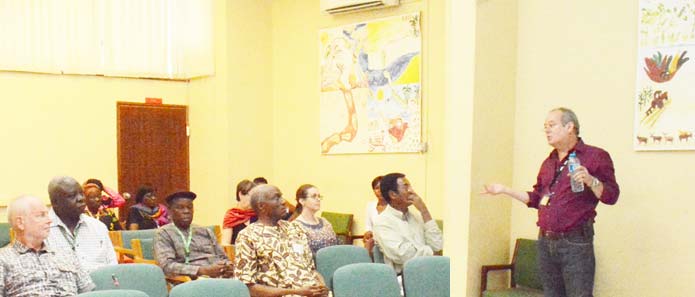 The seminar titled “Biorisk management: The silent revolution…” was attended by IITA management staff and scientists, with the aim to learn and understand some of the techniques deployed in habitat management against major insect pests in legume systems. Over the years, Tamò, along with other scientists, discovered a natural solution called classical biological control. “This natural response to controlling invasive pest species is an option that controls pests by reestablishing the natural balance. This method should be considered first, particularly in the case of unfamiliar invasive species,” he stated.
In his welcome address, Robert Asiedu, Director, Research for Development, IITA-West Africa emphasized the efforts made by Tamò in the management and prevention of pests attack on crops in Africa. “As we all know, Tamò has been part of the strong team that has brought so many successes in IITA, especially in devising ways to reduce the outbreak of pests in the field; thereby increasing productivity and crop yield.”
In his presentation, Tamò said: “One major constraint to the increased and sustainable production of cowpea is the damage caused by field insect pests, particularly during the flowering and post-flowering growth stages.” Among the most serious pest species attacking cowpea are flower pod borers (Muruca vitrata) and pod and seed-sucking bugs such as Riptortus dentipesfab and Clavigralla tomentosicollisstal. It has been reported that M. vitrata is the most devastating insect pest causing yield losses of about 80% in cowpea,” he added.
Tamò’s current research focuses on several regional integrated pest management (IPM) projects. Through this, he has established extensive links with other scientists and extension agents in 11 African countries. He is also engaged in collaborative activities with entomologists and biological control specialists in international research centers such as the International Centre of Insect Physiology and Ecology (icipe) and the International Crops Research Institute for the Semi-Arid Tropics (ICRISAT), Africa Rice Center (AfricaRice), and several universities worldwide.
In the future, Tamò explained that scaling out biocontrol approach to all major cowpea producing countries in West Africa will serve as the best option in reducing the population of pest infestation, especially M. vitrata to about 40–60% depending on the agroecological region.
The seminar titled “Biorisk management: The silent revolution…” was attended by IITA management staff and scientists, with the aim to learn and understand some of the techniques deployed in habitat management against major insect pests in legume systems. Over the years, Tamò, along with other scientists, discovered a natural solution called classical biological control. “This natural response to controlling invasive pest species is an option that controls pests by reestablishing the natural balance. This method should be considered first, particularly in the case of unfamiliar invasive species,” he stated.
In his welcome address, Robert Asiedu, Director, Research for Development, IITA-West Africa emphasized the efforts made by Tamò in the management and prevention of pests attack on crops in Africa. “As we all know, Tamò has been part of the strong team that has brought so many successes in IITA, especially in devising ways to reduce the outbreak of pests in the field; thereby increasing productivity and crop yield.”
In his presentation, Tamò said: “One major constraint to the increased and sustainable production of cowpea is the damage caused by field insect pests, particularly during the flowering and post-flowering growth stages.” Among the most serious pest species attacking cowpea are flower pod borers (Muruca vitrata) and pod and seed-sucking bugs such as Riptortus dentipesfab and Clavigralla tomentosicollisstal. It has been reported that M. vitrata is the most devastating insect pest causing yield losses of about 80% in cowpea,” he added.
Tamò’s current research focuses on several regional integrated pest management (IPM) projects. Through this, he has established extensive links with other scientists and extension agents in 11 African countries. He is also engaged in collaborative activities with entomologists and biological control specialists in international research centers such as the International Centre of Insect Physiology and Ecology (icipe) and the International Crops Research Institute for the Semi-Arid Tropics (ICRISAT), Africa Rice Center (AfricaRice), and several universities worldwide.
In the future, Tamò explained that scaling out biocontrol approach to all major cowpea producing countries in West Africa will serve as the best option in reducing the population of pest infestation, especially M. vitrata to about 40–60% depending on the agroecological region.
Manuele Tam ò , IITA Insect Ecologist, giving his seminar presentation.
Contributed by
Recent stories
No items found