
Biodiversity focus: IITA-Ibadan Campus is a hotspot for bird conservation
June 22, 2019
By supporting about 270 different species of birds, the 1000-ha IITA Campus in Ibadan remains one of Nigeria’s hotspots for bird conservation. The campus is blessed with different kinds of habitats, including forest, wetland, farmland, and residential areas.
 “This huge diversity of birds is attributable to the different kinds of habitats found within the campus,” said Adewale Awoyemi, Ornithologist and IITA Forest Center Manager. According to him, “Birds evolve morphological, physiological, and behavioral features that enable them to adapt to different habitats, with some showing a high level of specialization.
Some of the bird species within the campus, may be found in one habitat but not in others. For instance, the Red-cheeked Wattle-eye Platysteira blissetti is a skulking species found only in the forest and not in any other habitats within the campus. The same applies to the Laughing Dove, an urban bird species, which is hardly found in other habitats.”
The AG Leventis Foundation is renowned for supporting biodiversity conservation worldwide. Answering questions about what motivates the foundation to support bird and forest conservation within the IITA-Ibadan Campus, Phil Hall said, “The campus is rich in bird diversity, and is home to the Ibadan Malimbe, Malimbus ibadanensis, an endemic and endangered weaver bird. The IITA Forest Reserve, which is about 35% of the campus land mass, has been recognized by BirdLife International, as an Important Bird Area (IBA) by supporting about 70 different species of birds, which are restricted to the Guinea-Congo Forests Biome. The AG Leventis Foundation has been supporting bird monitoring within the campus for the past 30 years and will continue to do so.”
Asked how birds are monitored, Awoyemi added, “Basically, birds are monitored using various census techniques such as point counts, line transects, and mist-netting. In doing these, different kinds of equipment such as binoculars, telescopes, and guidebooks are used to enhance identification.”
He continued, “After identifying birds, the number of individual species, the habitats where they are found, time of day, and date are noted throughout the year. This data is compared across years to understand population trends.”
Speaking on IITA’s commitment to bird conservation, Hilde Koper-Limbourg, IITA Deputy Director General, Corporate Services (DDG-CS), said, “We are working closely with the Forest Center to create awareness within and outside the campus, and are also revising our environmental policy, which favors biodiversity conservation. Although I am not an ornithologist, I think the numbers of birds are increasing within our campus in Ibadan, especially around the lakes and forests.”
Awoyemi agrees, “The numbers of many bird species are increasing, which may be associated with the sustainable habitats found within the campus. Although some species have been lost, others have been gained for the campus. Species such as raptors that are declining in numbers are likely to be affected by factors outside the campus. Urbanization is one of such factors as the IITA-Ibadan Campus is almost isolated from surrounding forest patches, most of which are no longer healthy and safe.
“The IITA Forest Reserve still retains significant bird diversity for which it was designated an IBA,” Awoyemi concluded.
“This huge diversity of birds is attributable to the different kinds of habitats found within the campus,” said Adewale Awoyemi, Ornithologist and IITA Forest Center Manager. According to him, “Birds evolve morphological, physiological, and behavioral features that enable them to adapt to different habitats, with some showing a high level of specialization.
Some of the bird species within the campus, may be found in one habitat but not in others. For instance, the Red-cheeked Wattle-eye Platysteira blissetti is a skulking species found only in the forest and not in any other habitats within the campus. The same applies to the Laughing Dove, an urban bird species, which is hardly found in other habitats.”
The AG Leventis Foundation is renowned for supporting biodiversity conservation worldwide. Answering questions about what motivates the foundation to support bird and forest conservation within the IITA-Ibadan Campus, Phil Hall said, “The campus is rich in bird diversity, and is home to the Ibadan Malimbe, Malimbus ibadanensis, an endemic and endangered weaver bird. The IITA Forest Reserve, which is about 35% of the campus land mass, has been recognized by BirdLife International, as an Important Bird Area (IBA) by supporting about 70 different species of birds, which are restricted to the Guinea-Congo Forests Biome. The AG Leventis Foundation has been supporting bird monitoring within the campus for the past 30 years and will continue to do so.”
Asked how birds are monitored, Awoyemi added, “Basically, birds are monitored using various census techniques such as point counts, line transects, and mist-netting. In doing these, different kinds of equipment such as binoculars, telescopes, and guidebooks are used to enhance identification.”
He continued, “After identifying birds, the number of individual species, the habitats where they are found, time of day, and date are noted throughout the year. This data is compared across years to understand population trends.”
Speaking on IITA’s commitment to bird conservation, Hilde Koper-Limbourg, IITA Deputy Director General, Corporate Services (DDG-CS), said, “We are working closely with the Forest Center to create awareness within and outside the campus, and are also revising our environmental policy, which favors biodiversity conservation. Although I am not an ornithologist, I think the numbers of birds are increasing within our campus in Ibadan, especially around the lakes and forests.”
Awoyemi agrees, “The numbers of many bird species are increasing, which may be associated with the sustainable habitats found within the campus. Although some species have been lost, others have been gained for the campus. Species such as raptors that are declining in numbers are likely to be affected by factors outside the campus. Urbanization is one of such factors as the IITA-Ibadan Campus is almost isolated from surrounding forest patches, most of which are no longer healthy and safe.
“The IITA Forest Reserve still retains significant bird diversity for which it was designated an IBA,” Awoyemi concluded.
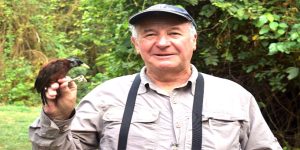
Phil Hall from the AG Leventis Foundation holds the Capuchin Babbler Phyllanthus atripennis, a Near Threatened Bird Species.
Contributed by
Recent stories
No items found