Biotechnology Society of Nigeria to improve Africa’s agricultural system
August 29, 2019
The Biotechnology Society of Nigeria (BSN) held its 32nd Annual International Conference at IITA-Ibadan on 18–22 August. The conference assembled people from mainstream biotechnology and related disciplines to discuss ways to enhance food security in sub-Saharan Africa through biotechnology.
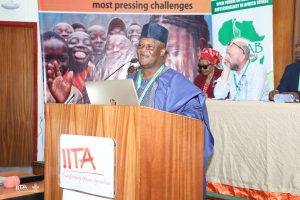
Prof Vincent Ado Tenebe, Chairman, BSN Board of Trustees, addressing the attendees.
BSN celebrated 38 years since its inception on 11 August 1981 at the University of Jos. It now has 16 working groups/thematic sessions representing the pool of experts reflecting the multidisciplinary nature of biotech. This allows for greater networking and collaborative opportunities among researchers involved in those disciplines in Nigeria and the international community.
The Society has grown over its nearly four-decade history as a foremost scientific society of biotechnologists in Nigeria. One of the major functions of BSN is to encourage the exchange of ideas among scientists of different disciplines on the concept and application of biotechnology through meetings such as conferences, symposia, workshops, public lectures, exhibitions, and publications.
BSN, working towards achieving its goal of enhancing food security in sub-Saharan Africa, plans to replicate partnerships with CGIAR centers like IITA and the national agricultural research systems (NARS) of Nigeria, as this has always provided international focus and direction for productivity through research.
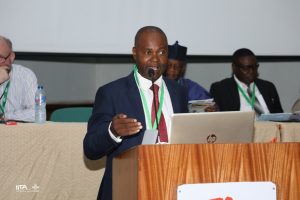
BSN President Prof Benjamin Ewa Ubi giving a presentation
While delivering his keynote address, Benjamin Ewa Ebi, President of BSN, emphasized IITA’s contribution and the strategic role it has played in BSN through capacity development and other deliverables. “IITA does not only give fish but also teaches how to fish,” he said.
In validation of the relationship between BSN and IITA, May-Guri Saethre, IITA Deputy Director General, Research for Development, noted that biotechnology is an integral part of IITA’s research program. “I really hope this conference will provide an arena for group discussions and some new research topics to ensure productivity between BSN and IITA,” she said.
In the course of the meeting, the keynote speaker—Executive Director of Forum for Agricultural Research in Africa (FARA), Dr Yemi Akinbamijo—highlighted the importance of food to man and importance of biotechnology to enhancing African agriculture. He said, “For the 800 million people going to bed hungry, food is medicine. Although there is a strong demand on Africa’s agriculture to do twice as much with half the resources, this is doable if biochemists will rise.”
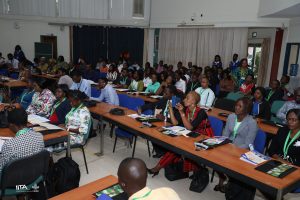
Participants at the conference.
Also stating the importance of biotechnology, the Chairman BSN Board of Trustees, Vincent Ado Tenebe, mentioned the problems of food security and unemployment in Nigeria, and biotechnology being the only solution to these problems. “The major problem we have is jobs for the youth. If we can provide a solution to unemployment through the different aspects of biotechnology and get the youth engaged, they will be productive,” he said.
While addressing participants, Michael Abberton, Head of IITA’s Genetic Resources Center and Chairman, Local Organizing Committee, said he hoped the meeting, both in its formal and informal parts, would lay the foundations for new research and inspire a new generation to take that research forward.
Olamide Deborah Nwanze is a Senior Research Associate specializing in gender mainstreaming research to inform participatory and inclusive breeding, variety development, and seed systems policies regarding root, tuber, and banana (RTB) crops in the International Institute of Tropical Agriculture Headquarters, Ibadan, Nigeria. She is a PhD candidate at the University of Ibadan and holds an MSc and B. Agric in Agricultural Extension and Rural Development. Olamide is a fellow of the African Women in Agricultural Research and Development – Gender Responsive Agricultural Systems Policy (AWARD-GRASP) and the Gender Responsive Researchers Equipped for Agricultural Transformation (GREAT). She seeks to apply her gender-mainstreaming learnings, gender-responsive research, and policy development, and review expertise to facilitate women, youth, children, and vulnerable social group’s access to and adoption of agricultural Innovations that guarantee food, nutrition, income, and livelihood security in Africa. Her current roles include mentoring research fellows, development of guides and training manuals, implementation and adaptation of gender frameworks and tools, value chain actors’ engagement as citizen science partners, policy review and redesign, data management, and analysis. Her current research explores mixed methods and participatory and interdisciplinary approaches to capture and highlight gender dynamics, needs, preferences, and challenges stakeholders face within the agricultural livelihood value chain to prioritize gender-inclusive strategies in breeding programs, policy design, and implementation.
de Sousa, K., van Etten, J., Manners, R. Bello, A., Teeken, B., Olaosebikan, O., et al. 2024. The tricot approach: an agile framework for decentralized on-farm testing supported by citizen science. A retrospective. Agron. Sustain. Dev. 44, 8. https://doi.org/10.1007/s13593-023-00937-1
Madu, T., Onwuka, S., Nwafor, S., Onyemauwa, N., Ejechi, M., Ofoeze, M., Ukeje, B., Eluagu, C., Olaosebikan, O., Okoye, B., 2024. Gender-Inclusive Consumer Studies Improve Cassava Breeding in Nigeria in: Frontiers in Sociology, volume 9, number: 1224504, doi: 10.3389/fsoc.2024.1224504
Olaosebikan, O.; Bello, A.; Utoblo, O.; Okoye, B.; Olutegbe, N.; Garner, E.; Teeken, B.; Bryan, E.; Forsythe, L.; Cole, S.; Madu, T. 2023. Stressors and Resilience within the Cassava Value Chain in Nigeria: Preferred Cassava Variety Traits and Response Strategies of Men and Women to Inform Breeding. Sustainability 15, 7837. https://doi.org/10.3390/su15107837
Okoye, B., Ofoeze, M., Ejechi, M., Onwuka, S., Nwafor, S., Onyemauwa, N., Ukeje, B., Eluagu, C., Obidiegwu, J.*, Olaosebikan, O., Madu, T.* 2023. Prioritizing preferred traits in the yam value chain in Nigeria: a gender situation analysis in: Frontiers in Sociology, volume 8, number: 1232626, pages 1 – 9, ISSN 2297-7775, 2023. https://www.frontiersin.org/articles/10.3389/fsoc.2023.1232626/full
Olaosebikan, O., Bello, A. A., de Sousa, K., Ndjouenkeu, R., Adesokan, M., Alamu, E. O., Agbona, A., van Etten, J., Kegah, F. N.*, Dufour, D., Bouniol, A., Teeken, B. 2023. Consumer acceptability of cassava gari-eba food products across cultural and environmental settings using the triadic comparison of technologies approach (tricot) in: Journal of the Science of Food and Agriculture,
Teeken, B., Olaosebikan, O., Bello, A. A., Madu, T.*, Cole, S. M. 2023. Qualitative assessment on the positionality and preferences of dyads in relation to cassava-related activities: working with tricot trial citizen scientists https://hdl.handle.net/10568/138326 Type: Manual
Bouniol, A., Ceballos, H., Bello, A. A., Teeken, B., Olaosebikan, O., Owoade, D., Agbona, A., Fotso Kuate, A., Madu, T.*, Okoye, B.*, Ofoeze, M.*, Nwafor, S.*, Onyemauwa, N.*, Adinsi, L.*, Forsythe, L., Dufour, D. 2023. Varietal impact on women’s labour, workload and related drudgery in processing root, tuber and banana crops: focus on cassava in sub-Saharan Africa in: Journal of the Science of Food and Agriculture, pages 1 – 25, ISSN 0022-5142,
Bello, A. A., Agbona, A., Olaosebikan, O., Edughaen, G., Dufour, D., Bouniol, A., Iluebbey, P., Ndjouenkeu, R.*, Rabbi, I. Y., Teeken, B. 2023. Genetic and environmental effects on processing productivity and food product yield: drudgery of women’s work in: Journal of the Science of Food and Agriculture, pages 1 – 32, ISSN 0022-5142, 5
Cavicchioli, M., Zimbiti, T., Teeken, B., Nwanze, D.O., Liani, M., Parkes, E. & Bello, A. 2023. IITA-Gender Responsive Breeding Training Report. Genetic Resources Center, IITA-HQ, Ibadan, 21-23 September, 2022. Ibadan, Nigeria: IITA, (34 p.).https://hdl.handle.net/10568/131368
Agbona, A. Peteti P., Teeken B., Olaosebikan O. Bello, A. A., Parkes, E., Rabbi, I. Y., Mueller, L., Egesi, C., Kulakow, P. 2022. Data Management in Multi-disciplinary African RTB Crop Breeding Programs. In: Williamson, H.F., Leonelli, S. (eds) Towards Responsible Plant Data Linkage: Data Challenges for Agricultural Research and Development. Springer, Cham. https://doi.org/10.1007/978-3-031-13276-6_5
Lora Forsythe, Pricilla Marimo, Sarah Mayanja, Olamide D. Olaosebikan, Esme Stuart, Bela Teeken, Benjamin Okoye, Tessy Madu, (2021). Cross-product Gender Analysis of RTBfoods Step 2 Gendered Food Mapping on RTB Products. Understanding the Drivers of Trait Preferences and the Development of Multi-user RTB Product Profiles, WP1. London, UK: RTBfoods Field Scientific Report, 30 p.
Teeken, B., Garner, E., Agbona, A., Balogun, I., Olaosebikan, O., Bello, A., Madu, T., Okoye, B., Egesi, C., Kulakow, P. and Tufan, H.A. 2021. Beyond “Women’s Traits”: Exploring How Gender, Social Difference, and Household Characteristics Influence Trait Preferences. Frontiers Sustainable Food Systems 5:740926. https://doi.org/10.3389/fsufs.2021.740926
Teeken, B., Agbona, A., Bello, A., Olaosebikan, O., Alamu, E., Adesokan, M., Awoyale, W., Madu, T., Okoye, B., Chijioke, U., Owoade, D., Okoro, M., Bouniol, A., Dufour, D., Hershey, C., Rabbi, I., Maziya‐Dixon, B., Egesi, C., Tufan, H. and Kulakow, P. (020. Understanding cassava varietal preferences through pairwise ranking of gari‐eba and fufu prepared by local farmer–processors. Int J Food Sci Technol.https://doi.org/10.1111/ijfs.14862
Bela Teeken, Olamide Olaosebikan, Ireti Balogun, Benjamin Okoye, Tessy Madu, Steven Cole, Abolore Bello, Elizabeth Parkes. (2020). Piloting the G+ customer and product profile tools for gender-responsive cassava breeding in Nigeria. Nigeria: International Institute of Tropical Agriculture (IITA). https://hdl.handle.net/20.500.11766/13000

 While delivering his keynote address, Benjamin Ewa Ebi, President of BSN, emphasized IITA’s contribution and the strategic role it has played in BSN through capacity development and other deliverables. “IITA does not only give fish but also teaches how to fish,” he said.
In validation of the relationship between BSN and IITA, May-Guri Saethre, IITA Deputy Director General, Research for Development, noted that biotechnology is an integral part of IITA’s research program. “I really hope this conference will provide an arena for group discussions and some new research topics to ensure productivity between BSN and IITA,” she said.
In the course of the meeting, the keynote speaker—Executive Director of Forum for Agricultural Research in Africa (FARA), Dr Yemi Akinbamijo—highlighted the importance of food to man and importance of biotechnology to enhancing African agriculture. He said, “For the 800 million people going to bed hungry, food is medicine. Although there is a strong demand on Africa’s agriculture to do twice as much with half the resources, this is doable if biochemists will rise.”
While delivering his keynote address, Benjamin Ewa Ebi, President of BSN, emphasized IITA’s contribution and the strategic role it has played in BSN through capacity development and other deliverables. “IITA does not only give fish but also teaches how to fish,” he said.
In validation of the relationship between BSN and IITA, May-Guri Saethre, IITA Deputy Director General, Research for Development, noted that biotechnology is an integral part of IITA’s research program. “I really hope this conference will provide an arena for group discussions and some new research topics to ensure productivity between BSN and IITA,” she said.
In the course of the meeting, the keynote speaker—Executive Director of Forum for Agricultural Research in Africa (FARA), Dr Yemi Akinbamijo—highlighted the importance of food to man and importance of biotechnology to enhancing African agriculture. He said, “For the 800 million people going to bed hungry, food is medicine. Although there is a strong demand on Africa’s agriculture to do twice as much with half the resources, this is doable if biochemists will rise.”
 Also stating the importance of biotechnology, the Chairman BSN Board of Trustees, Vincent Ado Tenebe, mentioned the problems of food security and unemployment in Nigeria, and biotechnology being the only solution to these problems. “The major problem we have is jobs for the youth. If we can provide a solution to unemployment through the different aspects of biotechnology and get the youth engaged, they will be productive,” he said.
While addressing participants, Michael Abberton, Head of IITA’s Genetic Resources Center and Chairman, Local Organizing Committee, said he hoped the meeting, both in its formal and informal parts, would lay the foundations for new research and inspire a new generation to take that research forward.
Also stating the importance of biotechnology, the Chairman BSN Board of Trustees, Vincent Ado Tenebe, mentioned the problems of food security and unemployment in Nigeria, and biotechnology being the only solution to these problems. “The major problem we have is jobs for the youth. If we can provide a solution to unemployment through the different aspects of biotechnology and get the youth engaged, they will be productive,” he said.
While addressing participants, Michael Abberton, Head of IITA’s Genetic Resources Center and Chairman, Local Organizing Committee, said he hoped the meeting, both in its formal and informal parts, would lay the foundations for new research and inspire a new generation to take that research forward.