NEWS

Building regional capacity to contain Banana Bunchy Top Disease (BBTD) spread in West Africa
January 26, 2019

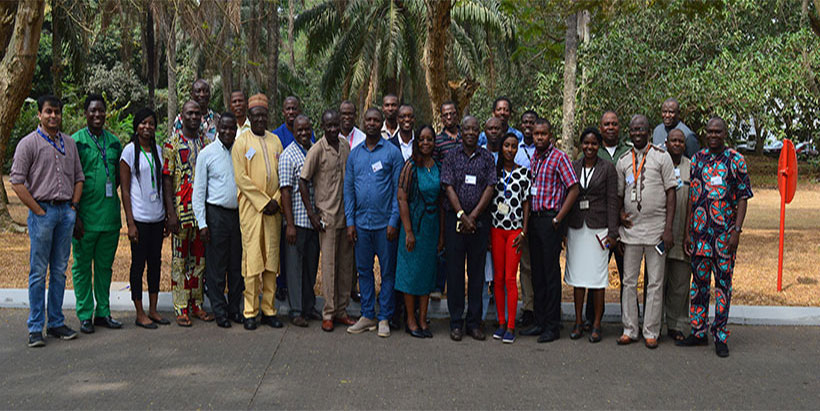
Participants of the BBTD workshop at IITA.

A training workshop on “Banana Bunchy Top Disease (BBTD) diagnosis, surveillance and emergency response” was held 14 to 16 January 2019 at IITA, Ibadan, Nigeria. The workshop, sponsored by the CGIAR Research Program on Roots, Tubers and Bananas (CRP-RTB), was attended by 20 participants from Togo – Direction de la Protection des Végétaux (DPV), Institut de Conseil et d’Appui Technique (ICAT), and Université de Kara; Ghana – Plant Protection and Regulatory Services Directorate (PPRSD)]; and Nigeria – Nigerian Agricultural Quarantine Services (NAQS), National Horticultural Research Institute (NIHORT), the National Agricultural Seed Council (NASC), and ECOWAS. The purpose of the workshop was to strengthen national capacity in disease surveillance and diagnosis and implement an emergency response to eliminate infected plants. The course offered hands-on training in the application of on-field diagnostics for the detection of BBTV using methods such as LAMP (Loop-mediated Isothermal Amplification) and RPA (Recombinase Polymerase Amplification) and using the Crop Disease Surveillance (CDS) mobile app for real-time surveillance and reporting. BBTD is a devastating viral disease of plantain and banana caused by BBTV transmitted by the banana aphid (Pentalonia nigronervosa). “BBTD outbreak in West Africa was first recognized in 2010 in Benin and 2011 in Nigeria,” said Lava Kumar, IITA virologist and Head of IITA’s Germplasm Health Unit, and organizer of the workshop. Various actions by the national programs and IITA have resulted in preventing disease expansion in these countries, he added. In September 2018, BBTV was detected for the first time in Togo, and the emergency response action implemented jointly by DPV-Togo and IITA had resulted in eradicating the disease detected in three locations in the country. “Inadvertent distribution of BBTV-infected planting material has led to widespread occurrence of the virus in sub-Saharan Africa and the same factor may have led to the virus introduction in Togo,” said Kumar. During the country presentations, Mr John Obaje, Director of Plant Quarantine, NAQS presented surveillance and eradication activities to contain the disease in Nigeria, while Sunday Akinyemi, Director of Research at NIHORT gave an update on banana production recovery using virus-free planting materials in the affected regions of Ogun State, Nigeria. Akinyemi emphasized the importance of providing farmers with incentives during the recovery period to encourage participation in the control measures. Adam Iddrisu Alidu, Head of Pathology, PPRSD Ghana; Ayaba Sanvee of DPV Togo, and Atti Tchabi of University of Kara, Togo, expounded on existing frameworks for containing regulated quarantine pests such as BBTD, and needs for implementing effective survillence. Benoit Gnonlonfin, Sanitary and Phytosanitary (SPS) Standards Adviser of the ECOWAS Commission, presented on the regional SPS framework for prevention, containment, and control of emerging diseases. He stated that implementation of SPS procedures was poor due to limited funding, weak technical capacities, and poor communication and coordination among the stakeholders. Gnonlonfin further emphasized that technologies, procedures, protocols, and experiences from Nigeria will come handy in tackling BBTD in the subregion and urged participants to work together to contain the emerging threat on banana and plantain in the subregion. Particpants developed a BBTD containment plan based on ECOWAS SPS framework for prevention, preparedness, emergency response, recovery, and and coordination. Training on the BBTD surveillance and diagnosis was carried throughout the workshop. A visit to IITA banana fields was organized and the participants were trained on the use of the CDS and data submission by Busayo Ogunya of the IT Unit. The CDS app usable on Android phones allows users to rapidly diagnose and communicate about diseases from the field. In the laboratory, participants were trained on DNA extraction and the use of new tools, LAMP, and RPA, for the detection of BBTV in field condition by Adedamola Oresanya of the Virology Unit. He highlighted the pros and cons of both methods for disease diagnosis. Methods to eradicate BBTV infected plants was organized by Yao Colombia and Taiwo Oviasuyi of Virology Unit. At the end of the workshop, participants lauded efforts of IITA and appreciated RTB, for sponsoring this workshop.

Contributed by

Recent stories

No items found

Leave a Reply

Your email address will not be published. Required fields are marked *

Scroll to Top
Olaosebikan, Olamide

Olamide Deborah Nwanze is a Senior Research Associate specializing in gender mainstreaming research to inform participatory and inclusive breeding, variety development, and seed systems policies regarding root, tuber, and banana (RTB) crops in the International Institute of Tropical Agriculture Headquarters, Ibadan, Nigeria. She is a PhD candidate at the University of Ibadan and holds an MSc and B. Agric in Agricultural Extension and Rural Development. Olamide is a fellow of the African Women in Agricultural Research and Development – Gender Responsive Agricultural Systems Policy (AWARD-GRASP) and the Gender Responsive Researchers Equipped for Agricultural Transformation (GREAT). She seeks to apply her gender-mainstreaming learnings, gender-responsive research, and policy development, and review expertise to facilitate women, youth, children, and vulnerable social group’s access to and adoption of agricultural Innovations that guarantee food, nutrition, income, and livelihood security in Africa. Her current roles include mentoring research fellows, development of guides and training manuals, implementation and adaptation of gender frameworks and tools, value chain actors’ engagement as citizen science partners, policy review and redesign, data management, and analysis. Her current research explores mixed methods and participatory and interdisciplinary approaches to capture and highlight gender dynamics, needs, preferences, and challenges stakeholders face within the agricultural livelihood value chain to prioritize gender-inclusive strategies in breeding programs, policy design, and implementation.

At IITA, she contributes to the implementation of the CGIAR Accelerated Breeding Initiative and Genetic Innovation Programs; participatory and gender research within the NextGen CassavaHarvestPlusRTBFoods, and Tricot-ClimMob 1000Farms Projects; and gender knowledge communication via the G-LENS webinar series, video documentary, policy briefspublications, and blogs.


Recent publications

de Sousa, K., van Etten, J., Manners, R. Bello, A., Teeken, B., Olaosebikan, O., et al. 2024. The tricot approach: an agile framework for decentralized on-farm testing supported by citizen science. A retrospective. Agron. Sustain. Dev. 44, 8. https://doi.org/10.1007/s13593-023-00937-1

Madu, T., Onwuka, S., Nwafor, S., Onyemauwa, N., Ejechi, M., Ofoeze, M., Ukeje, B., Eluagu, C., Olaosebikan, O., Okoye, B., 2024. Gender-Inclusive Consumer Studies Improve Cassava Breeding in Nigeria in: Frontiers in Sociology, volume 9, number: 1224504, doi: 10.3389/fsoc.2024.1224504

Olaosebikan, O.; Bello, A.; Utoblo, O.; Okoye, B.; Olutegbe, N.; Garner, E.; Teeken, B.; Bryan, E.; Forsythe, L.; Cole, S.; Madu, T. 2023.  Stressors and Resilience within the Cassava Value Chain in Nigeria: Preferred Cassava Variety Traits and Response Strategies of Men and Women to Inform Breeding. Sustainability 15, 7837. https://doi.org/10.3390/su15107837

Okoye, B., Ofoeze, M., Ejechi, M., Onwuka, S., Nwafor, S., Onyemauwa, N., Ukeje, B., Eluagu, C., Obidiegwu, J.*, Olaosebikan, O., Madu, T.* 2023. Prioritizing preferred traits in the yam value chain in Nigeria: a gender situation analysis in: Frontiers in Sociology, volume 8, number: 1232626, pages 1 – 9, ISSN 2297-7775, 2023. https://www.frontiersin.org/articles/10.3389/fsoc.2023.1232626/full

Olaosebikan, O., Bello, A. A., de Sousa, K., Ndjouenkeu, R., Adesokan, M., Alamu, E. O., Agbona, A., van Etten, J., Kegah, F. N.*, Dufour, D., Bouniol, A., Teeken, B. 2023. Consumer acceptability of cassava gari-eba food products across cultural and environmental settings using the triadic comparison of technologies approach (tricot) in: Journal of the Science of Food and Agriculture,

Teeken, B., Olaosebikan, O., Bello, A. A., Madu, T.*, Cole, S. M. 2023. Qualitative assessment on the positionality and preferences of dyads in relation to cassava-related activities: working with tricot trial citizen scientists https://hdl.handle.net/10568/138326 Type: Manual

Bouniol, A., Ceballos, H., Bello, A. A., Teeken, B., Olaosebikan, O., Owoade, D., Agbona, A., Fotso Kuate, A., Madu, T.*, Okoye, B.*, Ofoeze, M.*, Nwafor, S.*, Onyemauwa, N.*, Adinsi, L.*, Forsythe, L., Dufour, D. 2023. Varietal impact on women’s labour, workload and related drudgery in processing root, tuber and banana crops: focus on cassava in sub-Saharan Africa in: Journal of the Science of Food and Agriculture, pages 1 – 25, ISSN 0022-5142,

Bello, A. A., Agbona, A., Olaosebikan, O., Edughaen, G., Dufour, D., Bouniol, A., Iluebbey, P., Ndjouenkeu, R.*, Rabbi, I. Y., Teeken, B. 2023. Genetic and environmental effects on processing productivity and food product yield: drudgery of women’s work in: Journal of the Science of Food and Agriculture, pages 1 – 32, ISSN 0022-5142, 5

Cavicchioli, M., Zimbiti, T., Teeken, B., Nwanze, D.O., Liani, M., Parkes, E. & Bello, A. 2023. IITA-Gender Responsive Breeding Training Report. Genetic Resources Center, IITA-HQ, Ibadan, 21-23 September, 2022. Ibadan, Nigeria: IITA, (34 p.).https://hdl.handle.net/10568/131368

Agbona, A. Peteti P., Teeken B., Olaosebikan O. Bello, A. A., Parkes, E., Rabbi, I. Y., Mueller, L., Egesi, C., Kulakow, P. 2022. Data Management in Multi-disciplinary African RTB Crop Breeding Programs. In: Williamson, H.F., Leonelli, S. (eds) Towards Responsible Plant Data Linkage: Data Challenges for Agricultural Research and Development. Springer, Cham. https://doi.org/10.1007/978-3-031-13276-6_5

Lora Forsythe, Pricilla Marimo, Sarah Mayanja, Olamide D. Olaosebikan, Esme Stuart, Bela Teeken, Benjamin Okoye, Tessy Madu, (2021). Cross-product Gender Analysis of RTBfoods Step 2 Gendered Food Mapping on RTB Products. Understanding the Drivers of Trait Preferences and the Development of Multi-user RTB Product Profiles, WP1. London, UK: RTBfoods Field Scientific Report, 30 p.

Teeken, B., Garner, E., Agbona, A., Balogun, I., Olaosebikan, O., Bello, A., Madu, T., Okoye, B., Egesi, C., Kulakow, P. and Tufan, H.A. 2021. Beyond “Women’s Traits”: Exploring How Gender, Social Difference, and Household Characteristics Influence Trait Preferences. Frontiers Sustainable Food Systems 5:740926. https://doi.org/10.3389/fsufs.2021.740926

Teeken, B., Agbona, A., Bello, A., Olaosebikan, O., Alamu, E., Adesokan, M., Awoyale, W., Madu, T., Okoye, B., Chijioke, U., Owoade, D., Okoro, M., Bouniol, A., Dufour, D., Hershey, C., Rabbi, I., Maziya‐Dixon, B., Egesi, C., Tufan, H. and Kulakow, P. (020. Understanding cassava varietal preferences through pairwise ranking of gari‐eba and fufu prepared by local farmer–processors. Int J Food Sci Technol. https://doi.org/10.1111/ijfs.14862

Bela Teeken, Olamide Olaosebikan, Ireti Balogun, Benjamin Okoye, Tessy Madu, Steven Cole, Abolore Bello, Elizabeth Parkes. (2020). Piloting the G+ customer and product profile tools for gender-responsive cassava breeding in Nigeria. Nigeria: International Institute of Tropical Agriculture (IITA). https://hdl.handle.net/20.500.11766/13000