
IITA NEWS

Cameroon government strengthens partnership with IITA for agricultural innovation delivery
September 22, 2025

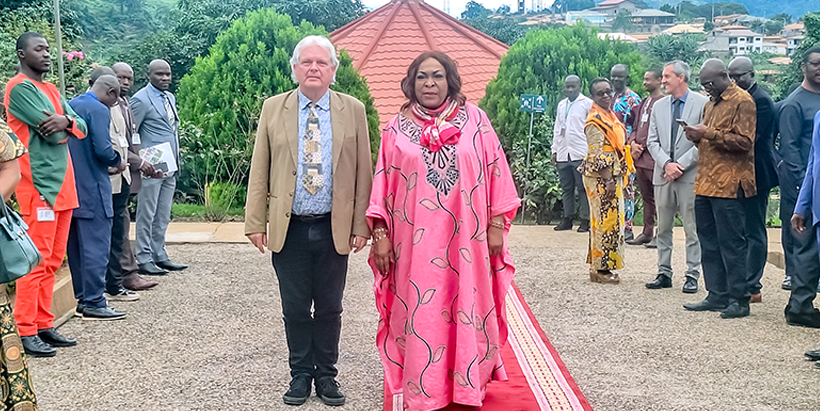
Cameroon Minister for Scientific Research and Innovation, Dr Madeleine Tchuinte with IITA Deputy Director General, Research for Development, Dr Bernard Vanlauwe.

The Cameroon Minister for Scientific Research and Innovation (MINRESI), Dr Madeleine Tchuinte, during a high-level visit to IITACGIAR’s office in Cameroon, has emphasized the government’s commitment to leveraging IITA-CGIAR’s agricultural research and innovation expertise to strengthen development partnerships, particularly in food security and agriculture.

During the visit, the Minister toured the IITA-CGIAR’s state-of-the-art research facilities in Cameroon, including the tissue culture and soil analysis laboratories, offering tangible insights into the institute’s advanced research capabilities. She underscored the importance of enhancing the capacity of national agricultural research systems, seed producers, small and medium enterprises, and farmer cooperatives. The aim is to strengthen the country’s seed systems so that farmers can increase productivity and achieve food security from the ground up – starting with the household level.

IITA-CGIAR has been active in Cameroon for over a decade, achieving significant milestones in agricultural productivity, nutrition security, and sustainability.

Key initiatives include the Agricultural Investment and Markets Development Project (PIDMA) for seed systems, the Pro-vitamin A Plantain project, and the Insect Protein project. The COCOASOILS initiative supports sustainable cocoa production, while the Soil for Africa project focuses on soil health.

The Manioc21 project has mechanized cassava processing, increasing incomes by 13%. IITA-CGIAR also promotes youth employment through the ENABLE Youth Cameroon project, training 1,770 young agripreneurs and facilitating the creation of 702 agribusinesses.
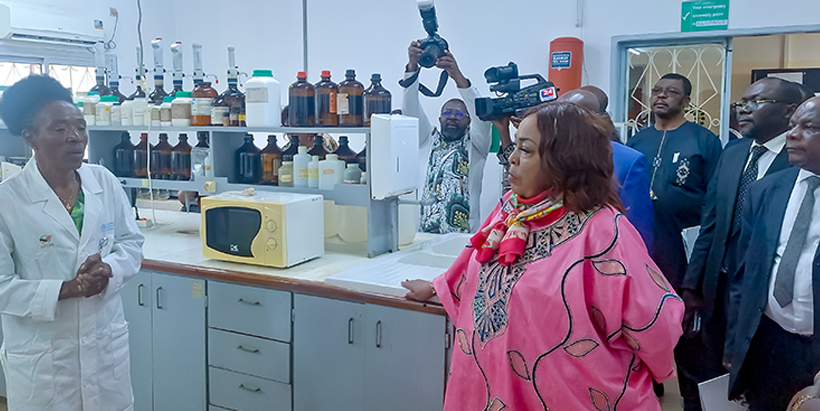
Dr Madeleine Tchuinte during a tour of the labs.

During her visit on 4 July 2025, Dr Tchuinte commended IITA’s partnership with the Government of Cameroon in accelerating agricultural research that fosters innovation and agricultural research advancement. She noted that these efforts contribute significantly to the country’s vision of transforming agriculture through science and research.

IITA Deputy Director General, Research for Development, Dr Bernard Vanlauwe, and IITA Cameroon Country Representative, Dr Komi Fiaboé, received the Minister’s delegation along with key partners, including the International Potato Center (CIP), Alliance of Bioversity and CIAT, the University of California, Los Angeles (UCLA), and the Sustainable Trade Initiative (IDH), a strong demonstration of collaboration in tackling agricultural and environmental challenges.

“My first visit to IITA has revealed its remarkable innovations and relevance to agricultural research and food security. I am deeply impressed by the work and reaffirm my keen interest in fostering closer, more proactive, and better-structured collaboration. MINRESI and IITA-CGIAR can revitalize and expand our partnership to drive agricultural research and innovation for Cameroon’s future,” added Dr Tchuinte.

Dr Vanlauwe emphasized IITA’s pivotal role as the continental coordinator for Africa within CGIAR, highlighting the need to strengthen ties with national institutions like the Institute of Agricultural Research for Development (IRAD). Partners showcased diverse contributions to sustainable development, including Bioversity seed transfers and forest restoration efforts. CIP reported successes in potato and sweet potato initiatives, garnering ministerial interest for expansion. UCLA discussed its partnership with IITA to establish the Congo Basin Institute, balancing biodiversity conservation with food sustainability. IDH highlighted Cameroonian cocoa promotion in Europe and received directives to explore seasonal crops like flowers and grapes.

“IITA and the Cameroon government have embraced a long-standing partnership, especially in research for key staple crops such as cassavamaize, and soybean, and the resulting gains in productivity,” Dr Vanlauwe reflected.

Dr Tchuinte acknowledged IITA’s extensive work and commitment to fostering partnerships collaboration. She invited IITA to participate in the upcoming 9th “Journées d’Excellence de la Recherche Scientifique et de l’Innovation du Cameroun” (JERSIC), which promotes scientific research and innovation in Cameroon. Her questions about the IITA-Government partnership led to engaging discussions, clarifying a path for revitalizing this important collaboration.

Contributed by Nanga Smauel, Nyako Melanie Chichi, and Ritha Bumwe


Contributed by

Related news

No items found

Leave a Reply

Your email address will not be published. Required fields are marked *

Scroll to Top
Olaosebikan, Olamide

Olamide Deborah Nwanze is a Senior Research Associate specializing in gender mainstreaming research to inform participatory and inclusive breeding, variety development, and seed systems policies regarding root, tuber, and banana (RTB) crops in the International Institute of Tropical Agriculture Headquarters, Ibadan, Nigeria. She is a PhD candidate at the University of Ibadan and holds an MSc and B. Agric in Agricultural Extension and Rural Development. Olamide is a fellow of the African Women in Agricultural Research and Development – Gender Responsive Agricultural Systems Policy (AWARD-GRASP) and the Gender Responsive Researchers Equipped for Agricultural Transformation (GREAT). She seeks to apply her gender-mainstreaming learnings, gender-responsive research, and policy development, and review expertise to facilitate women, youth, children, and vulnerable social group’s access to and adoption of agricultural Innovations that guarantee food, nutrition, income, and livelihood security in Africa. Her current roles include mentoring research fellows, development of guides and training manuals, implementation and adaptation of gender frameworks and tools, value chain actors’ engagement as citizen science partners, policy review and redesign, data management, and analysis. Her current research explores mixed methods and participatory and interdisciplinary approaches to capture and highlight gender dynamics, needs, preferences, and challenges stakeholders face within the agricultural livelihood value chain to prioritize gender-inclusive strategies in breeding programs, policy design, and implementation.

At IITA, she contributes to the implementation of the CGIAR Accelerated Breeding Initiative and Genetic Innovation Programs; participatory and gender research within the NextGen CassavaHarvestPlusRTBFoods, and Tricot-ClimMob 1000Farms Projects; and gender knowledge communication via the G-LENS webinar series, video documentary, policy briefspublications, and blogs.


Recent publications

de Sousa, K., van Etten, J., Manners, R. Bello, A., Teeken, B., Olaosebikan, O., et al. 2024. The tricot approach: an agile framework for decentralized on-farm testing supported by citizen science. A retrospective. Agron. Sustain. Dev. 44, 8. https://doi.org/10.1007/s13593-023-00937-1

Madu, T., Onwuka, S., Nwafor, S., Onyemauwa, N., Ejechi, M., Ofoeze, M., Ukeje, B., Eluagu, C., Olaosebikan, O., Okoye, B., 2024. Gender-Inclusive Consumer Studies Improve Cassava Breeding in Nigeria in: Frontiers in Sociology, volume 9, number: 1224504, doi: 10.3389/fsoc.2024.1224504

Olaosebikan, O.; Bello, A.; Utoblo, O.; Okoye, B.; Olutegbe, N.; Garner, E.; Teeken, B.; Bryan, E.; Forsythe, L.; Cole, S.; Madu, T. 2023.  Stressors and Resilience within the Cassava Value Chain in Nigeria: Preferred Cassava Variety Traits and Response Strategies of Men and Women to Inform Breeding. Sustainability 15, 7837. https://doi.org/10.3390/su15107837

Okoye, B., Ofoeze, M., Ejechi, M., Onwuka, S., Nwafor, S., Onyemauwa, N., Ukeje, B., Eluagu, C., Obidiegwu, J.*, Olaosebikan, O., Madu, T.* 2023. Prioritizing preferred traits in the yam value chain in Nigeria: a gender situation analysis in: Frontiers in Sociology, volume 8, number: 1232626, pages 1 – 9, ISSN 2297-7775, 2023. https://www.frontiersin.org/articles/10.3389/fsoc.2023.1232626/full

Olaosebikan, O., Bello, A. A., de Sousa, K., Ndjouenkeu, R., Adesokan, M., Alamu, E. O., Agbona, A., van Etten, J., Kegah, F. N.*, Dufour, D., Bouniol, A., Teeken, B. 2023. Consumer acceptability of cassava gari-eba food products across cultural and environmental settings using the triadic comparison of technologies approach (tricot) in: Journal of the Science of Food and Agriculture,

Teeken, B., Olaosebikan, O., Bello, A. A., Madu, T.*, Cole, S. M. 2023. Qualitative assessment on the positionality and preferences of dyads in relation to cassava-related activities: working with tricot trial citizen scientists https://hdl.handle.net/10568/138326 Type: Manual

Bouniol, A., Ceballos, H., Bello, A. A., Teeken, B., Olaosebikan, O., Owoade, D., Agbona, A., Fotso Kuate, A., Madu, T.*, Okoye, B.*, Ofoeze, M.*, Nwafor, S.*, Onyemauwa, N.*, Adinsi, L.*, Forsythe, L., Dufour, D. 2023. Varietal impact on women’s labour, workload and related drudgery in processing root, tuber and banana crops: focus on cassava in sub-Saharan Africa in: Journal of the Science of Food and Agriculture, pages 1 – 25, ISSN 0022-5142,

Bello, A. A., Agbona, A., Olaosebikan, O., Edughaen, G., Dufour, D., Bouniol, A., Iluebbey, P., Ndjouenkeu, R.*, Rabbi, I. Y., Teeken, B. 2023. Genetic and environmental effects on processing productivity and food product yield: drudgery of women’s work in: Journal of the Science of Food and Agriculture, pages 1 – 32, ISSN 0022-5142, 5

Cavicchioli, M., Zimbiti, T., Teeken, B., Nwanze, D.O., Liani, M., Parkes, E. & Bello, A. 2023. IITA-Gender Responsive Breeding Training Report. Genetic Resources Center, IITA-HQ, Ibadan, 21-23 September, 2022. Ibadan, Nigeria: IITA, (34 p.).https://hdl.handle.net/10568/131368

Agbona, A. Peteti P., Teeken B., Olaosebikan O. Bello, A. A., Parkes, E., Rabbi, I. Y., Mueller, L., Egesi, C., Kulakow, P. 2022. Data Management in Multi-disciplinary African RTB Crop Breeding Programs. In: Williamson, H.F., Leonelli, S. (eds) Towards Responsible Plant Data Linkage: Data Challenges for Agricultural Research and Development. Springer, Cham. https://doi.org/10.1007/978-3-031-13276-6_5

Lora Forsythe, Pricilla Marimo, Sarah Mayanja, Olamide D. Olaosebikan, Esme Stuart, Bela Teeken, Benjamin Okoye, Tessy Madu, (2021). Cross-product Gender Analysis of RTBfoods Step 2 Gendered Food Mapping on RTB Products. Understanding the Drivers of Trait Preferences and the Development of Multi-user RTB Product Profiles, WP1. London, UK: RTBfoods Field Scientific Report, 30 p.

Teeken, B., Garner, E., Agbona, A., Balogun, I., Olaosebikan, O., Bello, A., Madu, T., Okoye, B., Egesi, C., Kulakow, P. and Tufan, H.A. 2021. Beyond “Women’s Traits”: Exploring How Gender, Social Difference, and Household Characteristics Influence Trait Preferences. Frontiers Sustainable Food Systems 5:740926. https://doi.org/10.3389/fsufs.2021.740926

Teeken, B., Agbona, A., Bello, A., Olaosebikan, O., Alamu, E., Adesokan, M., Awoyale, W., Madu, T., Okoye, B., Chijioke, U., Owoade, D., Okoro, M., Bouniol, A., Dufour, D., Hershey, C., Rabbi, I., Maziya‐Dixon, B., Egesi, C., Tufan, H. and Kulakow, P. (020. Understanding cassava varietal preferences through pairwise ranking of gari‐eba and fufu prepared by local farmer–processors. Int J Food Sci Technol. https://doi.org/10.1111/ijfs.14862

Bela Teeken, Olamide Olaosebikan, Ireti Balogun, Benjamin Okoye, Tessy Madu, Steven Cole, Abolore Bello, Elizabeth Parkes. (2020). Piloting the G+ customer and product profile tools for gender-responsive cassava breeding in Nigeria. Nigeria: International Institute of Tropical Agriculture (IITA). https://hdl.handle.net/20.500.11766/13000