
CARE Fellowship awardees equipped with relevant research skills to enhance agribusiness in Africa
July 28, 2018
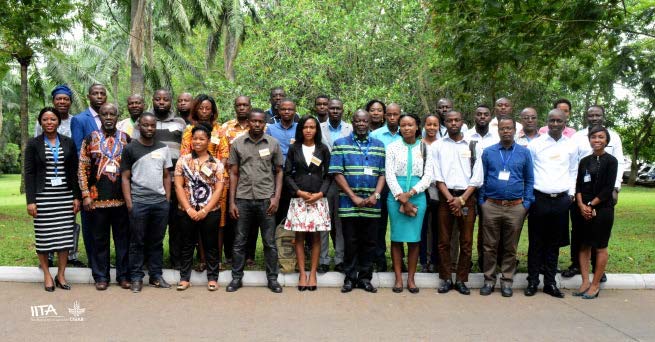
On 2–6 June, IITA organized a workshop for the 20 successful fellows that qualified for the research grant for “Enhancing Capacity to Apply Research Evidence (CARE) in policy for youth engagement in agribusiness and rural economic activities in Africa,” funded by the International Fund for Agricultural Development (IFAD).
 The workshop, attended by scholars from IFAD, identified priority countries (Benin Republic, Cameroon, DR Congo, Malawi, Nigeria, Senegal, Tanzania, and Zambia) and provided an opportunity for supervisors and IITA scientists to review young scholars’ research proposals, and strengthen awardees’ research capabilities to deliver the expected outputs of their research projects on youth engagement in Africa based on the principles of qualitative research methods. This is expected to contribute to the development of a new paradigm for knowledge creation that will lead to the growth of effective policies and agribusiness development in Africa.
Speaking at the opening ceremony, IITA Director for the Eastern Africa Hub and Leader of the Social Science and Agribusiness Research Group, Victor Manyong, stated that the training targeted youth because they are the future drivers of Africa’s and the world’s food systems and markets. “They can only achieve this by improving their research skills and problem-solving competencies and developing abilities in research for development (R4D) to inform future action plans,” he said.
The knowledge gap in understanding factors influencing youth engagement in the rural farm and non-farm economy in Africa hinders the formulation of appropriate policies and investment plans. The main assumption is that investments targeting youth self-employment in Africa can have much greater impact by ensuring that data and information, evidence, experience, and lessons learned are used to influence policy and decision-making.
Studies and surveys have shown that most researchers in sub-Saharan Africa lack key skills needed for effective decision-making relating to youth participation in the rural sector. This exposure would enable the awardees to enhance their research skills to provide empirical evidence on factors influencing youth engagement in agribusiness and bridge the knowledge gap.
In giving an overview of the CARE scholarship and its usefulness, IITA Capacity Development Office Head, Zoumana Bamba, emphasized that the training is beneficial and important to the scholars as it aims to improve the availability, exchange, dissemination, and use of research findings in the field of agribusiness to support economic growth and achievement of the Sustainable Development Goals. He added that this can be actualized by strengthening the capacity to generate, appraise, and disseminate evidence-based results to significantly increase the contribution of policies to economic growth and an enabling environment for rural youth.
During the plenary session, presentations were made on characteristics of good research design, sources of research problems and qualities of a good research problem, quantitative methods in economic and social research, introduction to data management, and introduction to open access. The session also incorporated the presentation of research proposals by the scholars after which discussions on ways forward were held with their supervisors.
The workshop, attended by scholars from IFAD, identified priority countries (Benin Republic, Cameroon, DR Congo, Malawi, Nigeria, Senegal, Tanzania, and Zambia) and provided an opportunity for supervisors and IITA scientists to review young scholars’ research proposals, and strengthen awardees’ research capabilities to deliver the expected outputs of their research projects on youth engagement in Africa based on the principles of qualitative research methods. This is expected to contribute to the development of a new paradigm for knowledge creation that will lead to the growth of effective policies and agribusiness development in Africa.
Speaking at the opening ceremony, IITA Director for the Eastern Africa Hub and Leader of the Social Science and Agribusiness Research Group, Victor Manyong, stated that the training targeted youth because they are the future drivers of Africa’s and the world’s food systems and markets. “They can only achieve this by improving their research skills and problem-solving competencies and developing abilities in research for development (R4D) to inform future action plans,” he said.
The knowledge gap in understanding factors influencing youth engagement in the rural farm and non-farm economy in Africa hinders the formulation of appropriate policies and investment plans. The main assumption is that investments targeting youth self-employment in Africa can have much greater impact by ensuring that data and information, evidence, experience, and lessons learned are used to influence policy and decision-making.
Studies and surveys have shown that most researchers in sub-Saharan Africa lack key skills needed for effective decision-making relating to youth participation in the rural sector. This exposure would enable the awardees to enhance their research skills to provide empirical evidence on factors influencing youth engagement in agribusiness and bridge the knowledge gap.
In giving an overview of the CARE scholarship and its usefulness, IITA Capacity Development Office Head, Zoumana Bamba, emphasized that the training is beneficial and important to the scholars as it aims to improve the availability, exchange, dissemination, and use of research findings in the field of agribusiness to support economic growth and achievement of the Sustainable Development Goals. He added that this can be actualized by strengthening the capacity to generate, appraise, and disseminate evidence-based results to significantly increase the contribution of policies to economic growth and an enabling environment for rural youth.
During the plenary session, presentations were made on characteristics of good research design, sources of research problems and qualities of a good research problem, quantitative methods in economic and social research, introduction to data management, and introduction to open access. The session also incorporated the presentation of research proposals by the scholars after which discussions on ways forward were held with their supervisors.
Group photograph of the IFAD CARE training participants and their facilitators.
Contributed by
Recent stories
No items found