
NEWS

CGIAR Council Chair explores IITA innovations driving agricultural transformation across Africa
October 7, 2026
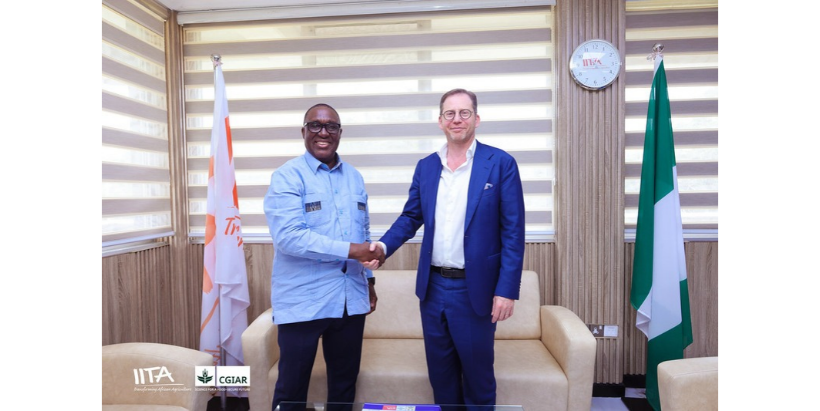
CGIAR Council Chair, Renaud Seligmann (L) warmly welcomed by IITA Director General and CGIAR Regional Director for Continental Africa, Simeon Ehui (R).

The Chair of the CGIAR Council, Renaud Seligmann, paid his first learning visit to IITA–CGIAR on 25 September. Accompanied by Sylvia Oyinlola, CGIAR Council Secretary, and other World Bank executives, they gained firsthand insight into the institute’s research, innovation, scaling, and capacity-development efforts that are transforming agriculture and food systems across Africa.

The CGIAR Council serves as the strategic governance body of CGIAR, bringing together funders and stakeholders to provide oversight, accountability, and direction for the global CGIAR research-for-development system. Welcoming the delegation, IITA’s Senior Management Team, including Director General and CGIAR Regional Director for Continental Africa, Dr Simeon Ehui, emphasized the institute’s commitment to ensuring that scientific discoveries reach farmers and consumers at scale while contributing to food security, nutrition, environmental sustainability, and economic growth.

The delegation received, through IITA’s Deputy Director General, Partnerships for Delivery and Scaling, Dr Tahirou Abdoulaye, an overview of IITA’s six mandate crops—cassava, maize, yam, soybean, banana and plantain, and cowpea—and the institute’s contributions to developing improved varieties that are high yielding, climate-resilient, disease resistant, and nutritionally enhanced. Examples included maize varieties with improved tolerance to environmental stresses; soybean varieties with higher protein content and resistance to rust; plantain varieties resistant to Black Sigatoka disease, drought- and heat-tolerant cowpea varieties; and cassava varieties with improved starch content.

Beyond crop improvement, IITA is strengthening agricultural systems through technological innovations such as Seed Tracker, a digital platform developed to improve seed traceability and enhance seed value chain integration; OGFIMS, a digital platform that supports digital extension, market linkages, and online interactions between farmers, service providers, off-takers, and other value chain actors; Aflasafe, the biological solution combating aflatoxin contamination in maize, sorghum, and groundnut; NoduMax, a legume inoculant that enhances nitrogen fixation; digital soil maps that support precision agriculture; and e-catalogues developed under the Technologies for African Agricultural Transformation (TAAT) program to improve access to proven agricultural technologies.
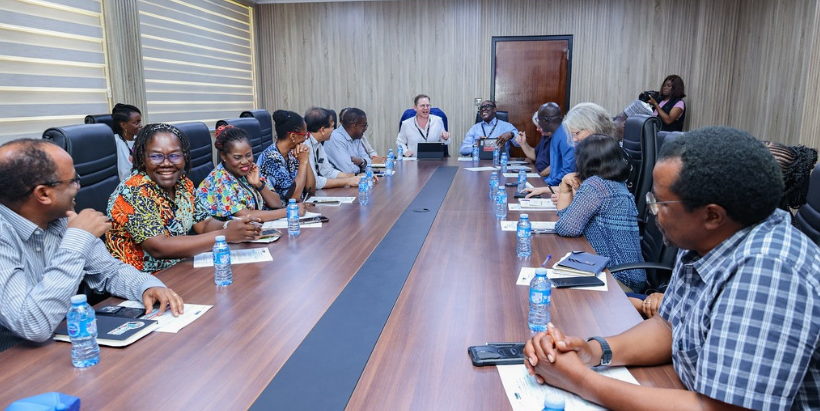
CGIAR Council Chair, Renaud Seligmann, in the accompany of IITA scientists and Senior Management Staff learning of IITA’s contributions to accelerating agricultural transformation on the continent.

Throughout the visit, Seligmann’s questions revolved around scaling, impact, and institutional collaboration with other CGIAR centers. He learned how IITA works with sister CGIAR centers, including CIMMYT, ILRI, CIAT, icipe, etc., to bridge the gap between scientific innovation and real-world adoption while strengthening partnerships with governments, development agencies, and the private sector across Africa.

The delegation toured several laboratories and research facilities, beginning with the Germplasm Health, Virology and Diagnostics Laboratory (GHVDL), where the team’s lead, Dr Lava Kumar, showcased diagnostic innovations, cocoa traceability systems, artificial intelligence-powered disease detection tools, and student-led research on pests and diseases affecting crops such as cocoa and banana. Discussions focused on the growing role of digital technologies and the increasing use of mobile phones by farmers as a pathway for deploying AI-enabled advisory and diagnostic services.

At the Genetic Resources Center (GRC), Seligmann explored conservation approaches ranging from field genebanks and in vitro storage to cryopreservation technologies designed to secure valuable genetic resources for future generations. Professor Michael Abberton, Head of GRC and Director of the West Africa Hub, also highlighted emerging applications of artificial intelligence to improve genebank workflows and user-request management.

The team visited Banana Macropropagation and Cassava and Yam Semi-Autotrophic Hydroponics (SAH) Screenhouses, where IITA staff rapidly multiply banana and plantain suckers through macropropagation, and yam and cassava seeds through SAH technologies. These innovations geometrically increase multiplication rates, enabling farmers and entrepreneurs to access large quantities of clean planting materials while creating viable agribusiness opportunities.
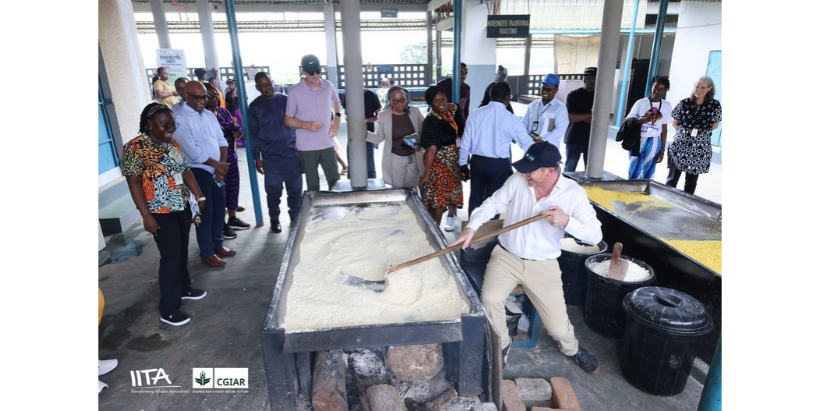
CGIAR Council Chair, Renaud Seligmann, during IITA facilities tour at the Cassava Mechanization and Processing Unit, happy to participate in the traditional frying of cassava to make garri.

At the Regional Hub for Fertilizer and Soil Health, Dr Bernard Vanlauwe, IITA Deputy Director General Research for Development (DDG-R4D) and team presented efforts to strengthen soil-health monitoring and decision-making across Africa. The facility combines laboratory testing, digital soil mapping, modeling, and artificial intelligence to generate site-specific fertilizer recommendations. These data-driven recommendations are being integrated into digital advisory tools such as AKILIMO to support farmers and national agricultural programs.

The visit concluded with stops at SmartPlot Naija and the Youth-in-Agribusiness Vegetable Screenhouses. The former, a demonstration platform promoting conservation agriculture and sustainable food production, is led by Dean Muungani, IITA Product Manager for Grain crops. At the latter, the delegation learned about IITA’s growing investments in youth engagement through the Mastercard Foundation-supported Youth Agribusiness initiatives, which equip young people with technical, entrepreneurial, and business skills to build successful careers in agriculture.

For Seligmann, the visit provided an opportunity to see how IITA’s integrated approach—combining research, scaling, partnerships, digital innovation, capacity development, and youth engagement—is contributing to agricultural transformation across Africa while strengthening CGIAR’s collective impact on food systems worldwide. With deep appreciation for IITA’s efforts in advancing research and food systems across the continent, he noted that understanding IITA’s work firsthand equips the CGIAR Council to better support and advocate for the institute’s mission


Contributed by

Folake Oduntan

Scroll to Top
Olaosebikan, Olamide

Olamide Deborah Nwanze is a Senior Research Associate specializing in gender mainstreaming research to inform participatory and inclusive breeding, variety development, and seed systems policies regarding root, tuber, and banana (RTB) crops in the International Institute of Tropical Agriculture Headquarters, Ibadan, Nigeria. She is a PhD candidate at the University of Ibadan and holds an MSc and B. Agric in Agricultural Extension and Rural Development. Olamide is a fellow of the African Women in Agricultural Research and Development – Gender Responsive Agricultural Systems Policy (AWARD-GRASP) and the Gender Responsive Researchers Equipped for Agricultural Transformation (GREAT). She seeks to apply her gender-mainstreaming learnings, gender-responsive research, and policy development, and review expertise to facilitate women, youth, children, and vulnerable social group’s access to and adoption of agricultural Innovations that guarantee food, nutrition, income, and livelihood security in Africa. Her current roles include mentoring research fellows, development of guides and training manuals, implementation and adaptation of gender frameworks and tools, value chain actors’ engagement as citizen science partners, policy review and redesign, data management, and analysis. Her current research explores mixed methods and participatory and interdisciplinary approaches to capture and highlight gender dynamics, needs, preferences, and challenges stakeholders face within the agricultural livelihood value chain to prioritize gender-inclusive strategies in breeding programs, policy design, and implementation.

At IITA, she contributes to the implementation of the CGIAR Accelerated Breeding Initiative and Genetic Innovation Programs; participatory and gender research within the NextGen Cassava, HarvestPlus, RTBFoods, and Tricot-ClimMob 1000Farms Projects; and gender knowledge communication via the G-LENS webinar series, video documentary, policy briefs, publications, and blogs.


Recent publications

de Sousa, K., van Etten, J., Manners, R. Bello, A., Teeken, B., Olaosebikan, O., et al. 2024. The tricot approach: an agile framework for decentralized on-farm testing supported by citizen science. A retrospective. Agron. Sustain. Dev. 44, 8. https://doi.org/10.1007/s13593-023-00937-1

Madu, T., Onwuka, S., Nwafor, S., Onyemauwa, N., Ejechi, M., Ofoeze, M., Ukeje, B., Eluagu, C., Olaosebikan, O., Okoye, B., 2024. Gender-Inclusive Consumer Studies Improve Cassava Breeding in Nigeria in: Frontiers in Sociology, volume 9, number: 1224504, doi: 10.3389/fsoc.2024.1224504

Olaosebikan, O.; Bello, A.; Utoblo, O.; Okoye, B.; Olutegbe, N.; Garner, E.; Teeken, B.; Bryan, E.; Forsythe, L.; Cole, S.; Madu, T. 2023.  Stressors and Resilience within the Cassava Value Chain in Nigeria: Preferred Cassava Variety Traits and Response Strategies of Men and Women to Inform Breeding. Sustainability 15, 7837. https://doi.org/10.3390/su15107837

Okoye, B., Ofoeze, M., Ejechi, M., Onwuka, S., Nwafor, S., Onyemauwa, N., Ukeje, B., Eluagu, C., Obidiegwu, J.*, Olaosebikan, O., Madu, T.* 2023. Prioritizing preferred traits in the yam value chain in Nigeria: a gender situation analysis in: Frontiers in Sociology, volume 8, number: 1232626, pages 1 – 9, ISSN 2297-7775, 2023. https://www.frontiersin.org/articles/10.3389/fsoc.2023.1232626/full

Olaosebikan, O., Bello, A. A., de Sousa, K., Ndjouenkeu, R., Adesokan, M., Alamu, E. O., Agbona, A., van Etten, J., Kegah, F. N.*, Dufour, D., Bouniol, A., Teeken, B. 2023. Consumer acceptability of cassava gari-eba food products across cultural and environmental settings using the triadic comparison of technologies approach (tricot) in: Journal of the Science of Food and Agriculture,

Teeken, B., Olaosebikan, O., Bello, A. A., Madu, T.*, Cole, S. M. 2023. Qualitative assessment on the positionality and preferences of dyads in relation to cassava-related activities: working with tricot trial citizen scientists https://hdl.handle.net/10568/138326 Type: Manual

Bouniol, A., Ceballos, H., Bello, A. A., Teeken, B., Olaosebikan, O., Owoade, D., Agbona, A., Fotso Kuate, A., Madu, T.*, Okoye, B.*, Ofoeze, M.*, Nwafor, S.*, Onyemauwa, N.*, Adinsi, L.*, Forsythe, L., Dufour, D. 2023. Varietal impact on women’s labour, workload and related drudgery in processing root, tuber and banana crops: focus on cassava in sub-Saharan Africa in: Journal of the Science of Food and Agriculture, pages 1 – 25, ISSN 0022-5142,

Bello, A. A., Agbona, A., Olaosebikan, O., Edughaen, G., Dufour, D., Bouniol, A., Iluebbey, P., Ndjouenkeu, R.*, Rabbi, I. Y., Teeken, B. 2023. Genetic and environmental effects on processing productivity and food product yield: drudgery of women’s work in: Journal of the Science of Food and Agriculture, pages 1 – 32, ISSN 0022-5142, 5

Cavicchioli, M., Zimbiti, T., Teeken, B., Nwanze, D.O., Liani, M., Parkes, E. & Bello, A. 2023. IITA-Gender Responsive Breeding Training Report. Genetic Resources Center, IITA-HQ, Ibadan, 21-23 September, 2022. Ibadan, Nigeria: IITA, (34 p.).https://hdl.handle.net/10568/131368

Agbona, A. Peteti P., Teeken B., Olaosebikan O. Bello, A. A., Parkes, E., Rabbi, I. Y., Mueller, L., Egesi, C., Kulakow, P. 2022. Data Management in Multi-disciplinary African RTB Crop Breeding Programs. In: Williamson, H.F., Leonelli, S. (eds) Towards Responsible Plant Data Linkage: Data Challenges for Agricultural Research and Development. Springer, Cham. https://doi.org/10.1007/978-3-031-13276-6_5

Lora Forsythe, Pricilla Marimo, Sarah Mayanja, Olamide D. Olaosebikan, Esme Stuart, Bela Teeken, Benjamin Okoye, Tessy Madu, (2021). Cross-product Gender Analysis of RTBfoods Step 2 Gendered Food Mapping on RTB Products. Understanding the Drivers of Trait Preferences and the Development of Multi-user RTB Product Profiles, WP1. London, UK: RTBfoods Field Scientific Report, 30 p.

Teeken, B., Garner, E., Agbona, A., Balogun, I., Olaosebikan, O., Bello, A., Madu, T., Okoye, B., Egesi, C., Kulakow, P. and Tufan, H.A. 2021. Beyond “Women’s Traits”: Exploring How Gender, Social Difference, and Household Characteristics Influence Trait Preferences. Frontiers Sustainable Food Systems 5:740926. https://doi.org/10.3389/fsufs.2021.740926

Teeken, B., Agbona, A., Bello, A., Olaosebikan, O., Alamu, E., Adesokan, M., Awoyale, W., Madu, T., Okoye, B., Chijioke, U., Owoade, D., Okoro, M., Bouniol, A., Dufour, D., Hershey, C., Rabbi, I., Maziya‐Dixon, B., Egesi, C., Tufan, H. and Kulakow, P. (020. Understanding cassava varietal preferences through pairwise ranking of gari‐eba and fufu prepared by local farmer–processors. Int J Food Sci Technol. https://doi.org/10.1111/ijfs.14862

Bela Teeken, Olamide Olaosebikan, Ireti Balogun, Benjamin Okoye, Tessy Madu, Steven Cole, Abolore Bello, Elizabeth Parkes. (2020). Piloting the G+ customer and product profile tools for gender-responsive cassava breeding in Nigeria. Nigeria: International Institute of Tropical Agriculture (IITA). https://hdl.handle.net/20.500.11766/13000