
IITA NEWS

CGIAR, IRRI, and EiA honored for transforming Vietnam’s agriculture
January 22, 2024

During the International Rice Festival held in Can Tho, Vietnam, in December 2023, the MARD recognized CGIAR, the International Rice Research Institute (IRRI), and the CGIAR Excellence in Agronomy (EiA) Initiative for their outstanding contributions to the sustainable development of Vietnam’s agriculture and rural development sector. The award was handed over at the Strategic Cultivation Management for Climate Change Adaptation and Mitigation in Vietnam on 14 December, in Can Tho City, at the workshop held to share experiences on the innovations and excellence in agronomy for adaptation to climate change and reduction of greenhouse gas emissions in rice industry of Viet Nam. The workshop attendees deliberated on sustainable advancements in rice production and innovative agronomy practices within the Mekong Delta.
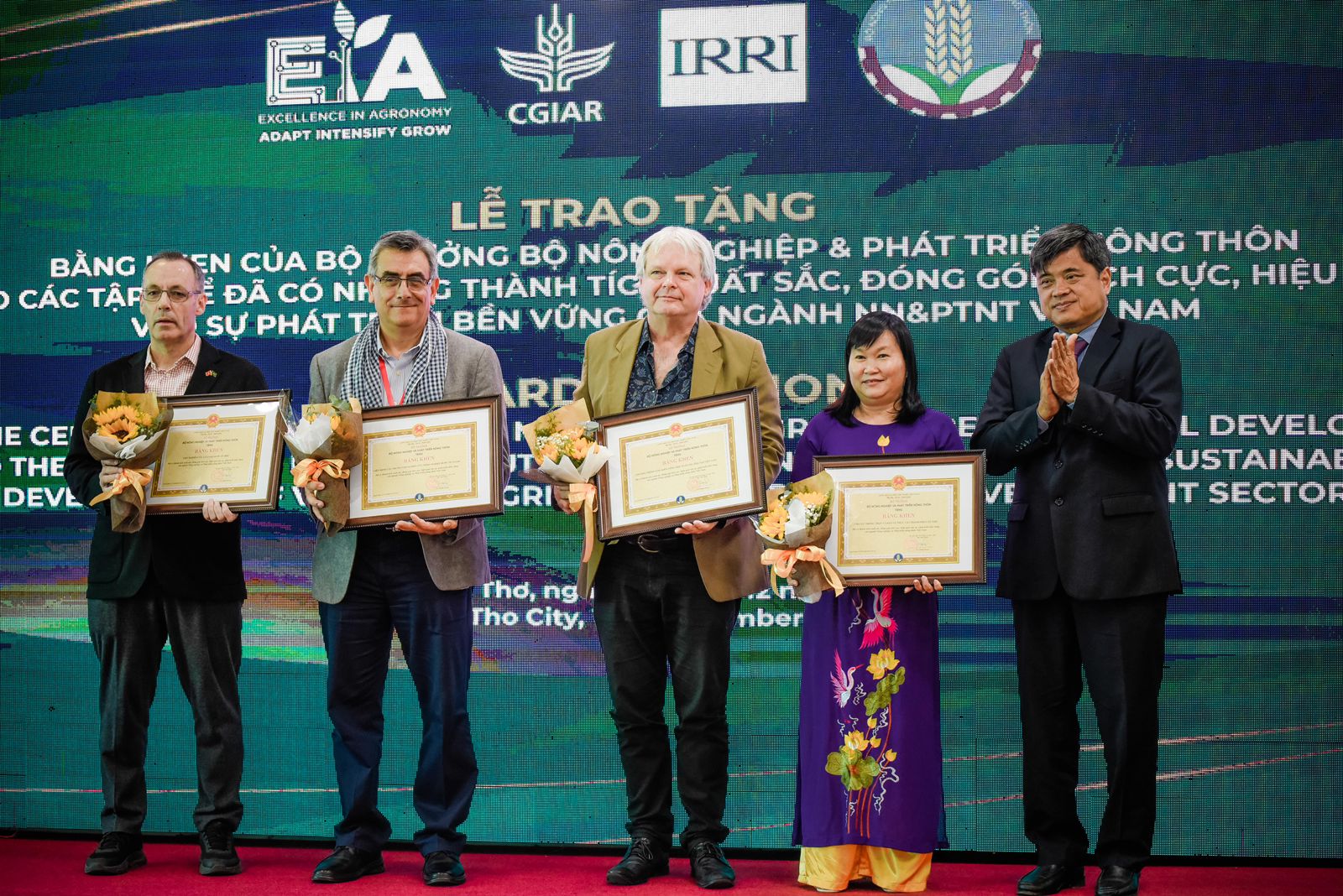
Dr Robert Caudwell, IRRI Country Representative in Vietnam; Dr Oscar Ortiz, Senior Director Crop Based Systems, Resilient Agrifood Systems (RAFS) – One CGIAR; Dr Bernard Vanlauwe, CGIAR Excellence in Agronomy Initiative Lead; Pham Thi Minh Hieu, Director, Can Tho Sub-Department of Crop Production and Plant Protection; and Tran Thanh Nam, Vice Minister of Vietnam Ministry of Agriculture and Rural Development (MARD).

The recognition of EiA, IRRI, and CGIAR was an acknowledgment of the initiative’s integral role in Vietnam’s rice production and a testament to the transformative power of collaboration and innovation in reshaping the global food system and the profound commitment shown by the Vietnamese government towards responsible and sustainable agriculture, mainly through rice production.

Vice Minister of Vietnam Ministry of Agriculture and Rural Development (MARD), Tran Thanh Nam, presented the award to IRRI, CGIAR EiA, and Can Tho’s sub-department of Crop Production and Plant Protection for their outstanding achievements and contribution to the sustainable development of Vietnam’s agriculture and rural development sector.
 Dr Oscar Ortiz, Senior Director Crop Based Systems, Resilient Agrifood Systems (RAFS) - One CGIAR.
Dr Oscar Ortiz, Senior Director Crop Based Systems, Resilient Agrifood Systems (RAFS) – One CGIAR.

The participants included Vietnam’s scientists, policymakers, relevant stakeholders, nearly 100 scientists, and global EiA partners. Notably, the delegation from the Agriculture Department of the Republic of the Philippines was headed by the Undersecretary for Rice Industry Development of the Agriculture Department.

This event allowed scientists, policymakers, and relevant stakeholders to exchange information and experience in management strategies, solution development, and duplication for adaptive agriculture in Vietnam. The presentation and open dialogue with the participation of national and international scientists, managers, and private sector representatives was followed by a launching ceremony of MARD’s Decision on promulgation of the Technical Protocol and Manual on Mechanized Direct Seeding for Increased Productivity and Reduced GHG emission in Rice Production in the Mekong River Delta as supported by IRRI and the hand-over of the Manual to provincial Department of Agriculture and Rural Development, relevant research institutes, universities and related counterparts. This event stood as a testament to the effective scaling of EiA, showcasing the launch of the MDS handbook. This handbook, resulting from collaborative endeavors with the government, has been seamlessly integrated into policies and embraced for official governmental use.

Since 2021, IRRI has facilitated the Excellence in Agronomy Initiative in Vietnam to alleviate hunger and poverty, ensure food security, close the gender equality gap, conserve biodiversity, mitigate the effects of climate change, and contribute to “South-South” cooperation in agricultural science and technology development.
Dr Robert Caudwell, IRRI Country Representative in Vietnam.

IRRI has been working with the Crop Production Department – Ministry of Agriculture and Rural Development to deploy technical packages based on mechanized direct seeding rice (mDSR) that help contribute to the target of Mekong River Delta’s “1 Must, 5 Reductions” practice, increasing efficiency and reducing greenhouse gas (GHG) emissions in rice production. Some notable activities include (i) developing technologies and verifying practical benefits from mDSR and (ii) building capacity and promoting mechanized direct seeding for improved productivity and reduced emissions in rice production in the Mekong River Delta.

Through this activity, IRRI has supported the Crop Production Department in developing Protocols on Mechanized Direct Seeding for Increased Effectiveness and Reduced GHG emissions in rice production in the Mekong River Delta and supported the demonstration of mDSR for more than 4,000 farmers in the Mekong River Delta.
Dr Bernard Vanlauwe, Initiative Lead, CGIAR Excellence in Agronomy Initiative.

Excellence in Agronomy has gained many outstanding achievements after three years of deployment in Vietnam that positively influence the development and promotion of mechanization in adaptive rice production. These innovative technologies are essential foundations for sustainable rice production and contribute to implementing the Project on sustainable development of high quality, low emission rice production associated with green growth in the Mekong River Delta by 2030 as hosted by the Ministry of Agriculture and Rural Development.

Aligned with the Vietnam-Africa Policy Dialogue’s principles, the Excellence in Agronomy Initiative aims to transform farming by enhancing productivity and profitability by 2030, nurturing soil health, and assisting smallholder farmers with agronomic gain, resource management, and climate-smart farming.

The EiA initiative is being implemented and scaled up by ten CGIAR centers in numerous regions in the world, aiming to support and replicate agronomy solutions for adaptation to climate change reduction in the affected countries. The CGIAR centers supporting the EiA represent a global force for agricultural transformation and include AfricaRice, Alliance of Bioversity and the International Center for Tropical Agriculture (CIAT), the International Maize and Wheat Improvement Center (CIMMYT), the International Potato Center (CIP), the International Center for Agricultural Research in the Dry Areas (ICARDA), the International Crops Research Institute for the Semi-Arid Tropics (ICRISAT), the International Rice Research Institute (IRRI), International Food Policy Research Institute (IFPRI), International Water Management Institute (IWMI) and International Institute of Tropical Agriculture (IITA). Their collective expertise and unwavering commitment are driving positive change, not just in Vietnam but across the globe.

Contributed by Barbra Sehlule Muzata


Contributed by

Related news

No items found

Leave a Reply

Your email address will not be published. Required fields are marked *

Scroll to Top
Olaosebikan, Olamide

Olamide Deborah Nwanze is a Senior Research Associate specializing in gender mainstreaming research to inform participatory and inclusive breeding, variety development, and seed systems policies regarding root, tuber, and banana (RTB) crops in the International Institute of Tropical Agriculture Headquarters, Ibadan, Nigeria. She is a PhD candidate at the University of Ibadan and holds an MSc and B. Agric in Agricultural Extension and Rural Development. Olamide is a fellow of the African Women in Agricultural Research and Development – Gender Responsive Agricultural Systems Policy (AWARD-GRASP) and the Gender Responsive Researchers Equipped for Agricultural Transformation (GREAT). She seeks to apply her gender-mainstreaming learnings, gender-responsive research, and policy development, and review expertise to facilitate women, youth, children, and vulnerable social group’s access to and adoption of agricultural Innovations that guarantee food, nutrition, income, and livelihood security in Africa. Her current roles include mentoring research fellows, development of guides and training manuals, implementation and adaptation of gender frameworks and tools, value chain actors’ engagement as citizen science partners, policy review and redesign, data management, and analysis. Her current research explores mixed methods and participatory and interdisciplinary approaches to capture and highlight gender dynamics, needs, preferences, and challenges stakeholders face within the agricultural livelihood value chain to prioritize gender-inclusive strategies in breeding programs, policy design, and implementation.

At IITA, she contributes to the implementation of the CGIAR Accelerated Breeding Initiative and Genetic Innovation Programs; participatory and gender research within the NextGen CassavaHarvestPlusRTBFoods, and Tricot-ClimMob 1000Farms Projects; and gender knowledge communication via the G-LENS webinar series, video documentary, policy briefspublications, and blogs.


Recent publications

de Sousa, K., van Etten, J., Manners, R. Bello, A., Teeken, B., Olaosebikan, O., et al. 2024. The tricot approach: an agile framework for decentralized on-farm testing supported by citizen science. A retrospective. Agron. Sustain. Dev. 44, 8. https://doi.org/10.1007/s13593-023-00937-1

Madu, T., Onwuka, S., Nwafor, S., Onyemauwa, N., Ejechi, M., Ofoeze, M., Ukeje, B., Eluagu, C., Olaosebikan, O., Okoye, B., 2024. Gender-Inclusive Consumer Studies Improve Cassava Breeding in Nigeria in: Frontiers in Sociology, volume 9, number: 1224504, doi: 10.3389/fsoc.2024.1224504

Olaosebikan, O.; Bello, A.; Utoblo, O.; Okoye, B.; Olutegbe, N.; Garner, E.; Teeken, B.; Bryan, E.; Forsythe, L.; Cole, S.; Madu, T. 2023.  Stressors and Resilience within the Cassava Value Chain in Nigeria: Preferred Cassava Variety Traits and Response Strategies of Men and Women to Inform Breeding. Sustainability 15, 7837. https://doi.org/10.3390/su15107837

Okoye, B., Ofoeze, M., Ejechi, M., Onwuka, S., Nwafor, S., Onyemauwa, N., Ukeje, B., Eluagu, C., Obidiegwu, J.*, Olaosebikan, O., Madu, T.* 2023. Prioritizing preferred traits in the yam value chain in Nigeria: a gender situation analysis in: Frontiers in Sociology, volume 8, number: 1232626, pages 1 – 9, ISSN 2297-7775, 2023. https://www.frontiersin.org/articles/10.3389/fsoc.2023.1232626/full

Olaosebikan, O., Bello, A. A., de Sousa, K., Ndjouenkeu, R., Adesokan, M., Alamu, E. O., Agbona, A., van Etten, J., Kegah, F. N.*, Dufour, D., Bouniol, A., Teeken, B. 2023. Consumer acceptability of cassava gari-eba food products across cultural and environmental settings using the triadic comparison of technologies approach (tricot) in: Journal of the Science of Food and Agriculture,

Teeken, B., Olaosebikan, O., Bello, A. A., Madu, T.*, Cole, S. M. 2023. Qualitative assessment on the positionality and preferences of dyads in relation to cassava-related activities: working with tricot trial citizen scientists https://hdl.handle.net/10568/138326 Type: Manual

Bouniol, A., Ceballos, H., Bello, A. A., Teeken, B., Olaosebikan, O., Owoade, D., Agbona, A., Fotso Kuate, A., Madu, T.*, Okoye, B.*, Ofoeze, M.*, Nwafor, S.*, Onyemauwa, N.*, Adinsi, L.*, Forsythe, L., Dufour, D. 2023. Varietal impact on women’s labour, workload and related drudgery in processing root, tuber and banana crops: focus on cassava in sub-Saharan Africa in: Journal of the Science of Food and Agriculture, pages 1 – 25, ISSN 0022-5142,

Bello, A. A., Agbona, A., Olaosebikan, O., Edughaen, G., Dufour, D., Bouniol, A., Iluebbey, P., Ndjouenkeu, R.*, Rabbi, I. Y., Teeken, B. 2023. Genetic and environmental effects on processing productivity and food product yield: drudgery of women’s work in: Journal of the Science of Food and Agriculture, pages 1 – 32, ISSN 0022-5142, 5

Cavicchioli, M., Zimbiti, T., Teeken, B., Nwanze, D.O., Liani, M., Parkes, E. & Bello, A. 2023. IITA-Gender Responsive Breeding Training Report. Genetic Resources Center, IITA-HQ, Ibadan, 21-23 September, 2022. Ibadan, Nigeria: IITA, (34 p.).https://hdl.handle.net/10568/131368

Agbona, A. Peteti P., Teeken B., Olaosebikan O. Bello, A. A., Parkes, E., Rabbi, I. Y., Mueller, L., Egesi, C., Kulakow, P. 2022. Data Management in Multi-disciplinary African RTB Crop Breeding Programs. In: Williamson, H.F., Leonelli, S. (eds) Towards Responsible Plant Data Linkage: Data Challenges for Agricultural Research and Development. Springer, Cham. https://doi.org/10.1007/978-3-031-13276-6_5

Lora Forsythe, Pricilla Marimo, Sarah Mayanja, Olamide D. Olaosebikan, Esme Stuart, Bela Teeken, Benjamin Okoye, Tessy Madu, (2021). Cross-product Gender Analysis of RTBfoods Step 2 Gendered Food Mapping on RTB Products. Understanding the Drivers of Trait Preferences and the Development of Multi-user RTB Product Profiles, WP1. London, UK: RTBfoods Field Scientific Report, 30 p.

Teeken, B., Garner, E., Agbona, A., Balogun, I., Olaosebikan, O., Bello, A., Madu, T., Okoye, B., Egesi, C., Kulakow, P. and Tufan, H.A. 2021. Beyond “Women’s Traits”: Exploring How Gender, Social Difference, and Household Characteristics Influence Trait Preferences. Frontiers Sustainable Food Systems 5:740926. https://doi.org/10.3389/fsufs.2021.740926

Teeken, B., Agbona, A., Bello, A., Olaosebikan, O., Alamu, E., Adesokan, M., Awoyale, W., Madu, T., Okoye, B., Chijioke, U., Owoade, D., Okoro, M., Bouniol, A., Dufour, D., Hershey, C., Rabbi, I., Maziya‐Dixon, B., Egesi, C., Tufan, H. and Kulakow, P. (020. Understanding cassava varietal preferences through pairwise ranking of gari‐eba and fufu prepared by local farmer–processors. Int J Food Sci Technol. https://doi.org/10.1111/ijfs.14862

Bela Teeken, Olamide Olaosebikan, Ireti Balogun, Benjamin Okoye, Tessy Madu, Steven Cole, Abolore Bello, Elizabeth Parkes. (2020). Piloting the G+ customer and product profile tools for gender-responsive cassava breeding in Nigeria. Nigeria: International Institute of Tropical Agriculture (IITA). https://hdl.handle.net/20.500.11766/13000