
Co-create the future: UI-SME collaboration and fair
November 28, 2020
On 12 November, the University of Ibadan organized a fair termed: The 2nd UI-SME Fair, tagged “Co-create the future: University of Ibadan and Small and Medium Enterprises,” which was held at the International Conference Center to bring together key stakeholders in the SME sector to provide crucial support for SME growth and sustainability.
The fair started with the introduction of the special guests: Prof A.I. Olayinka (VC), Prof Olanike Adeyemo (DVC Research, Innovation, and Strategic Partnership, UI), Dr Helen Komolafe (University Liberian), and Prof Adedoyin Soyibo (Pioneer Director, Center for Entrepreneurship and Innovation, UI) who chaired the occasion.
 Small and Medium Enterprise (SMEs) are independent firms that employ less than a given number of employees. In low-income countries, SMEs contribute 60% of GDP and more than 70% of employment. SMEs are crucial economic catalysts in national development, poverty alleviation, and employment generation, Olayinka said.
The fair brought together key stakeholders in the SME sector, including consultants in different domains who can support businesses. SMEs are the drivers of the economy, but because of their limitations in fostering cooperative research and development, the University serves as a tripod supporting sustainable growth and development.
According to Prof Soyibo, the trade fair acts as a marketing tool or medium for advertising and promotion. It enables producers to meet face-face with consumers in a way that provides an immediate impact on products and services”. Trade fairs provide a platform for traders and individuals to support their survival and success and create a true relationship between national and international organizations as well as local, state, and national companies.
Dr Olufunke Ezekiel, a researcher in the Department of Food Technology, UI, who showcased the “town and gown relationship”, has been involved in collaborative research and development work with OKLAN Best Ltd. Adesfood UK via OKLAN Best Ltd initiated this research project on developing a processing line for the production of frozen jute mallow, locally called “ewedu” in Nigeria. Ezekiel worked to establish suitable processing conditions to improve the vegetable’s shelf-life and its transportation, sale, and consumption without loss of nutritional value and sensory qualities. The research was developed to export jute mallow to developed countries such as the USA and the UK.
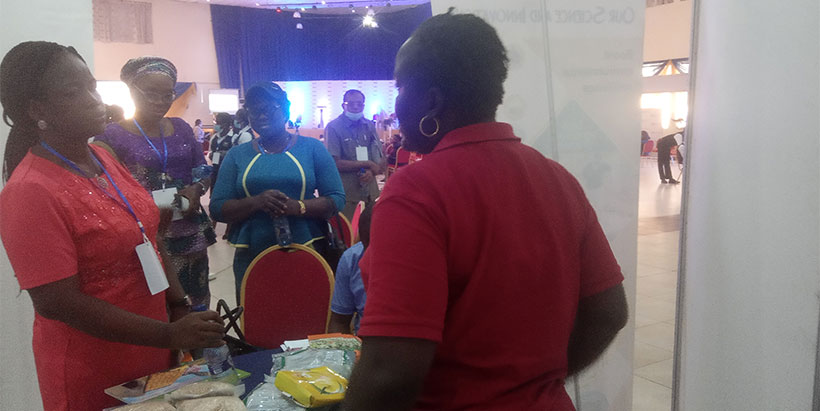
To promote visibility and knowledge sharing, IITA exhibited some products and technologies. The booth was visited by over 50 participants who wanted to learn, inquire, or purchase goods.
The first-ever UI-SME Summit started on 7 November 2019 to foster cooperative research and development support for SMEs. Due to its success, the Vice-Chancellor approved that it become an annual Fair to ensure a robust interaction between the University community and SMEs and foster a greater town-gown relationship. The summit partners were IITA, the National Agency for Food and Drug Administration (NAFDAC) and Federal Inland Revenue Services (FIRS) as well as the Bank of Industry and Paylink.ng.
Small and Medium Enterprise (SMEs) are independent firms that employ less than a given number of employees. In low-income countries, SMEs contribute 60% of GDP and more than 70% of employment. SMEs are crucial economic catalysts in national development, poverty alleviation, and employment generation, Olayinka said.
The fair brought together key stakeholders in the SME sector, including consultants in different domains who can support businesses. SMEs are the drivers of the economy, but because of their limitations in fostering cooperative research and development, the University serves as a tripod supporting sustainable growth and development.
According to Prof Soyibo, the trade fair acts as a marketing tool or medium for advertising and promotion. It enables producers to meet face-face with consumers in a way that provides an immediate impact on products and services”. Trade fairs provide a platform for traders and individuals to support their survival and success and create a true relationship between national and international organizations as well as local, state, and national companies.
Dr Olufunke Ezekiel, a researcher in the Department of Food Technology, UI, who showcased the “town and gown relationship”, has been involved in collaborative research and development work with OKLAN Best Ltd. Adesfood UK via OKLAN Best Ltd initiated this research project on developing a processing line for the production of frozen jute mallow, locally called “ewedu” in Nigeria. Ezekiel worked to establish suitable processing conditions to improve the vegetable’s shelf-life and its transportation, sale, and consumption without loss of nutritional value and sensory qualities. The research was developed to export jute mallow to developed countries such as the USA and the UK.
To promote visibility and knowledge sharing, IITA exhibited some products and technologies. The booth was visited by over 50 participants who wanted to learn, inquire, or purchase goods.
The first-ever UI-SME Summit started on 7 November 2019 to foster cooperative research and development support for SMEs. Due to its success, the Vice-Chancellor approved that it become an annual Fair to ensure a robust interaction between the University community and SMEs and foster a greater town-gown relationship. The summit partners were IITA, the National Agency for Food and Drug Administration (NAFDAC) and Federal Inland Revenue Services (FIRS) as well as the Bank of Industry and Paylink.ng.
Fair participants at the IITA stand.
Contributed by
Recent stories
No items found