Cultivating growth and competitiveness: Insights from Tanzania’s Cassava Business and Investment Forum
May 10, 2024
The Ministry of Agriculture of Tanzania, in collaboration with the Tanzania Cassava Producers and Processors Association (TACAPPA), IITA, and AGRA – Sustainably Growing Africa’s Food Systems, organized a cassava business and investment forum in Dodoma on 29 April. The event aimed to engage stakeholders, especially private-sector cassava producers, seed producers, researchers, and policymakers, to foster insightful discussions on promoting cassava in food systems diversification, commercialization, and trade at national, regional, and international levels.
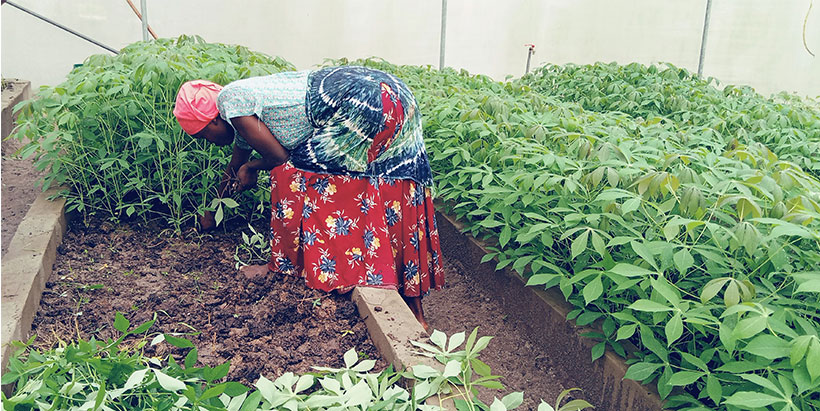
Early-generation seed multiplication using pencil stem technology at TARI Kibaha. (Photo Credit: Salum Manzi)
Dr Hussein M. Ommar, the Deputy Permanent Secretary—representing the Minister of Agriculture, Honourable Hussein Mohamed Bashe (MP), who presided over the event as the Chief Guest of Honor—expressed gratitude to the delegates for their commitment to improving the cassava sub-sector in Tanzania. Ommar highlighted the contributions of development partners, especially the Bill & Melinda Gates Foundation and Cornell University, in supporting projects (BASICS II, Muhogo Bora, and Next-Gen) on the development of a sustainable cassava seed system in the country.
“These projects have empowered over 1,000 cassava seed entrepreneurs, most of whom are youth and women. Likewise, several good varieties resistant or tolerant to major virus diseases—CBSD and CMD—have been officially released and made available to cassava farmers. These IITA-led projects and other efforts have significantly contributed to revenue generation and align with the Agenda 2030 goals,” Ommar remarked.
On the other hand, the forum also shed light on the challenges hindering the achievement of targets outlined in the National Cassava Development Strategy (NCDS) 2020 – 2030. Dr Ommar emphasized the need to reach the target of at least 3.5 billion clean cassava cuttings from improved varieties and plant at least 30% of the total area under cassava with improved varieties by 2030.
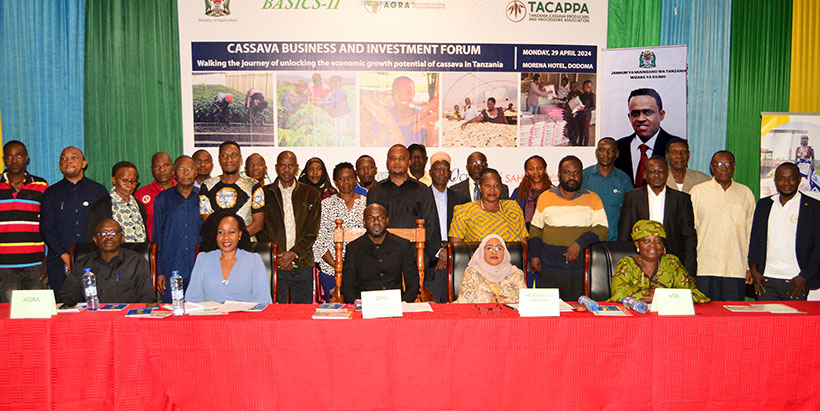
Group photo of Cassava Seed Entrepreneurs with the Chief Guest of Honor during the Cassava Business and Investment Forum. (Photo Credit: Lembris Laizer) Regina Kapinga, Head of Advocacy and Resource Mobilization and the BASICS II Tanzania project team leader at IITA, presented on building a market-led sustainable cassava supply chain for commercialization and industrialization. This highlighted all the opportunities available which could trigger the increased market-led production of cassava by smallholder farmers. She emphasized major initiatives to address some of the challenges in cassava production, including the use of technologies like Semi-Autotrophic Hydroponics (SAH) for Early Generation Seed (EGS) production and various market avenues that cassava could provide if produced with the eye of businesses creation.
Stakeholders at the forum discussed the rapid emergence of the cassava market in recent years, including the significant export of dried cassava chips to neighboring countries, including Burundi, Rwanda, DR Congo, and South Sudan. In this case, the presence of new Chinese investors interested in cassava for industrial use was highly appreciated. Bian Qiuming from China Red Sun Group expressed interest in supporting smallholder farmers to increase productivity and meet his company’s demand for dried cassava chips which is 600,000 metric tons per year for pesticide production.
A recent study by IITA and the Tanzania Agricultural Research Institute (TARI) reveals that cassava production with healthy, clean seed has about 82% yield advantage over recycled seed, providing a compelling incentive for farmers to adopt certified seeds.
Nyasebawa, the Director of Crop Development representing the Permanent Secretary of the Ministry of Agriculture, reiterated the government’s commitment to supporting the cassava sector at the closing of the meeting. He indicated to the participants that the government is emphasizing cassava as one of the priority crops and will be funded for infrastructure development and post-harvest technologies to reduce losses and enhance competitiveness.
The forum concluded with deliberations on unlocking the markets and competitiveness of cassava, effective post-harvest management, and increased productivity to meet the huge demand by potential investors. Regular joint meetings will closely monitor these action points to ensure effective implementation.
The Cassava business and investment forum brought together over 150 delegates, including investors, policymakers, government officials, farmers, seed entrepreneurs, researchers, and development partners. It served as a platform to explore opportunities, address challenges, and take the lead for the sustainable growth of Tanzania’s cassava sector.
Contributed by Lembris Laizer and Gloriana Ndibalema
Olamide Deborah Nwanze is a Senior Research Associate specializing in gender mainstreaming research to inform participatory and inclusive breeding, variety development, and seed systems policies regarding root, tuber, and banana (RTB) crops in the International Institute of Tropical Agriculture Headquarters, Ibadan, Nigeria. She is a PhD candidate at the University of Ibadan and holds an MSc and B. Agric in Agricultural Extension and Rural Development. Olamide is a fellow of the African Women in Agricultural Research and Development – Gender Responsive Agricultural Systems Policy (AWARD-GRASP) and the Gender Responsive Researchers Equipped for Agricultural Transformation (GREAT). She seeks to apply her gender-mainstreaming learnings, gender-responsive research, and policy development, and review expertise to facilitate women, youth, children, and vulnerable social group’s access to and adoption of agricultural Innovations that guarantee food, nutrition, income, and livelihood security in Africa. Her current roles include mentoring research fellows, development of guides and training manuals, implementation and adaptation of gender frameworks and tools, value chain actors’ engagement as citizen science partners, policy review and redesign, data management, and analysis. Her current research explores mixed methods and participatory and interdisciplinary approaches to capture and highlight gender dynamics, needs, preferences, and challenges stakeholders face within the agricultural livelihood value chain to prioritize gender-inclusive strategies in breeding programs, policy design, and implementation.
de Sousa, K., van Etten, J., Manners, R. Bello, A., Teeken, B., Olaosebikan, O., et al. 2024. The tricot approach: an agile framework for decentralized on-farm testing supported by citizen science. A retrospective. Agron. Sustain. Dev. 44, 8. https://doi.org/10.1007/s13593-023-00937-1
Madu, T., Onwuka, S., Nwafor, S., Onyemauwa, N., Ejechi, M., Ofoeze, M., Ukeje, B., Eluagu, C., Olaosebikan, O., Okoye, B., 2024. Gender-Inclusive Consumer Studies Improve Cassava Breeding in Nigeria in: Frontiers in Sociology, volume 9, number: 1224504, doi: 10.3389/fsoc.2024.1224504
Olaosebikan, O.; Bello, A.; Utoblo, O.; Okoye, B.; Olutegbe, N.; Garner, E.; Teeken, B.; Bryan, E.; Forsythe, L.; Cole, S.; Madu, T. 2023. Stressors and Resilience within the Cassava Value Chain in Nigeria: Preferred Cassava Variety Traits and Response Strategies of Men and Women to Inform Breeding. Sustainability 15, 7837. https://doi.org/10.3390/su15107837
Okoye, B., Ofoeze, M., Ejechi, M., Onwuka, S., Nwafor, S., Onyemauwa, N., Ukeje, B., Eluagu, C., Obidiegwu, J.*, Olaosebikan, O., Madu, T.* 2023. Prioritizing preferred traits in the yam value chain in Nigeria: a gender situation analysis in: Frontiers in Sociology, volume 8, number: 1232626, pages 1 – 9, ISSN 2297-7775, 2023. https://www.frontiersin.org/articles/10.3389/fsoc.2023.1232626/full
Olaosebikan, O., Bello, A. A., de Sousa, K., Ndjouenkeu, R., Adesokan, M., Alamu, E. O., Agbona, A., van Etten, J., Kegah, F. N.*, Dufour, D., Bouniol, A., Teeken, B. 2023. Consumer acceptability of cassava gari-eba food products across cultural and environmental settings using the triadic comparison of technologies approach (tricot) in: Journal of the Science of Food and Agriculture,
Teeken, B., Olaosebikan, O., Bello, A. A., Madu, T.*, Cole, S. M. 2023. Qualitative assessment on the positionality and preferences of dyads in relation to cassava-related activities: working with tricot trial citizen scientists https://hdl.handle.net/10568/138326 Type: Manual
Bouniol, A., Ceballos, H., Bello, A. A., Teeken, B., Olaosebikan, O., Owoade, D., Agbona, A., Fotso Kuate, A., Madu, T.*, Okoye, B.*, Ofoeze, M.*, Nwafor, S.*, Onyemauwa, N.*, Adinsi, L.*, Forsythe, L., Dufour, D. 2023. Varietal impact on women’s labour, workload and related drudgery in processing root, tuber and banana crops: focus on cassava in sub-Saharan Africa in: Journal of the Science of Food and Agriculture, pages 1 – 25, ISSN 0022-5142,
Bello, A. A., Agbona, A., Olaosebikan, O., Edughaen, G., Dufour, D., Bouniol, A., Iluebbey, P., Ndjouenkeu, R.*, Rabbi, I. Y., Teeken, B. 2023. Genetic and environmental effects on processing productivity and food product yield: drudgery of women’s work in: Journal of the Science of Food and Agriculture, pages 1 – 32, ISSN 0022-5142, 5
Cavicchioli, M., Zimbiti, T., Teeken, B., Nwanze, D.O., Liani, M., Parkes, E. & Bello, A. 2023. IITA-Gender Responsive Breeding Training Report. Genetic Resources Center, IITA-HQ, Ibadan, 21-23 September, 2022. Ibadan, Nigeria: IITA, (34 p.).https://hdl.handle.net/10568/131368
Agbona, A. Peteti P., Teeken B., Olaosebikan O. Bello, A. A., Parkes, E., Rabbi, I. Y., Mueller, L., Egesi, C., Kulakow, P. 2022. Data Management in Multi-disciplinary African RTB Crop Breeding Programs. In: Williamson, H.F., Leonelli, S. (eds) Towards Responsible Plant Data Linkage: Data Challenges for Agricultural Research and Development. Springer, Cham. https://doi.org/10.1007/978-3-031-13276-6_5
Lora Forsythe, Pricilla Marimo, Sarah Mayanja, Olamide D. Olaosebikan, Esme Stuart, Bela Teeken, Benjamin Okoye, Tessy Madu, (2021). Cross-product Gender Analysis of RTBfoods Step 2 Gendered Food Mapping on RTB Products. Understanding the Drivers of Trait Preferences and the Development of Multi-user RTB Product Profiles, WP1. London, UK: RTBfoods Field Scientific Report, 30 p.
Teeken, B., Garner, E., Agbona, A., Balogun, I., Olaosebikan, O., Bello, A., Madu, T., Okoye, B., Egesi, C., Kulakow, P. and Tufan, H.A. 2021. Beyond “Women’s Traits”: Exploring How Gender, Social Difference, and Household Characteristics Influence Trait Preferences. Frontiers Sustainable Food Systems 5:740926. https://doi.org/10.3389/fsufs.2021.740926
Teeken, B., Agbona, A., Bello, A., Olaosebikan, O., Alamu, E., Adesokan, M., Awoyale, W., Madu, T., Okoye, B., Chijioke, U., Owoade, D., Okoro, M., Bouniol, A., Dufour, D., Hershey, C., Rabbi, I., Maziya‐Dixon, B., Egesi, C., Tufan, H. and Kulakow, P. (020. Understanding cassava varietal preferences through pairwise ranking of gari‐eba and fufu prepared by local farmer–processors. Int J Food Sci Technol.https://doi.org/10.1111/ijfs.14862
Bela Teeken, Olamide Olaosebikan, Ireti Balogun, Benjamin Okoye, Tessy Madu, Steven Cole, Abolore Bello, Elizabeth Parkes. (2020). Piloting the G+ customer and product profile tools for gender-responsive cassava breeding in Nigeria. Nigeria: International Institute of Tropical Agriculture (IITA). https://hdl.handle.net/20.500.11766/13000