
IITA NEWS

Determinants influencing youth engagement in agribusiness
October 12, 2021

With agribusiness gaining more attention in entrepreneurship development, youth-operated small enterprises in agriculture can contribute significantly to growing Africa’s economy and reducing poverty. These enterprises can help address the issue of youth unemployment across the continent.
 Determinants influencing youth engagement in agribusiness
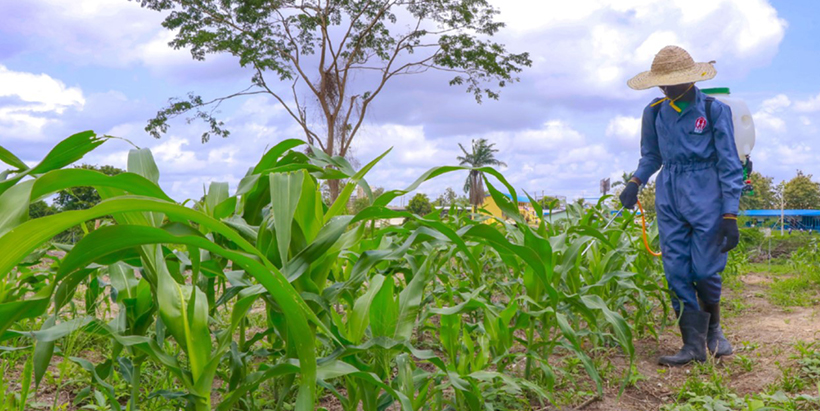
Youth farmer spraying a maize field.

Despite growing concern about the lack of interest in agriculture among African youths, engaging them in agriculture has become a prominent topic and has risen in the development agenda. According to Larissa Nawo, a young researcher with the IITACARE project, agriculture—the developing world’s single most significant source of employment—plays a pivotal role in Africa’s economic development, and Cameroon, in particular.

With the necessary support, policies, and infrastructure, small-scale agriculture practiced by youths in rural areas, can offer a sustainable and productive alternative to the expansion of large‐scale, capital‐intensive, labor‐displacing corporate farming.

Following the IFAD-sponsored study carried out in Cameroon’s central region, Nawo identified factors that drive choice for youths among the three common types of agribusiness models—plantation, commercial, and contract farming. According to the survey, the semi-urban and rural areas of Cameroon’s central region show that, regardless of gender, youths are mainly engaged in commercial farming rather than plantation or contract farming.

Also, the level of education (from primary school to tertiary), size and ownership of land (for inherited and rented land), have considerable influence on the youths’ decision to engage in plantation and contract farming. At the same time, gender and access to white-collar employment have a negative and significant influence on youth’s decision to engage in agribusiness.

With the COVID-19 pandemic worsening youth unemployment across the globe, the shortage of decent work in low- and middle-income countries is a pressing global issue facing young people now. Hence, the study proffers several recommendations that can help policymakers create sustainable policies that will engender systems to initiate an enabling environment for youths to thrive in agribusiness.

According to Larissa, increasing female youth participation in agribusiness models can initiate inclusive growth and better results. Policies can also be put in place to ensure market systems enable affordable or subsidized costs of agriculture tools and machines, among other things, to encourage youths in agribusiness and plantation farming.

While education level had a significant impact on the annual revenue generated among the youths, the study also suggests the importance of encouraging financial institutions to lend a greater percentage of their portfolio to youth agripreneurs through public-private partnership schemes.

According to the project Communication Officer, Timilehin Osunde, the IITA-CARE project is exploring ways to engage policymakers to adopt some of the recommendations being proffered by the research, as this will ensure youths become beneficiaries of a sustainable system that provides employment and reduces poverty.

IITA is working with young researchers in 10 African countries under the IFAD-sponsored Enhancing Capacity to Apply Research Evidence (CARE) in Policy for Youth Engagement in Agribusiness and Rural Economic Activities in Africa. The project seeks to enhance the understanding of the poverty reduction and employment impact, including the factors influencing youth engagement in agribusiness and rural farm and non-farm economy.


Contributed by

Recent stories

No items found

Leave a Reply

Your email address will not be published. Required fields are marked *

Scroll to Top
Olaosebikan, Olamide

Olamide Deborah Nwanze is a Senior Research Associate specializing in gender mainstreaming research to inform participatory and inclusive breeding, variety development, and seed systems policies regarding root, tuber, and banana (RTB) crops in the International Institute of Tropical Agriculture Headquarters, Ibadan, Nigeria. She is a PhD candidate at the University of Ibadan and holds an MSc and B. Agric in Agricultural Extension and Rural Development. Olamide is a fellow of the African Women in Agricultural Research and Development – Gender Responsive Agricultural Systems Policy (AWARD-GRASP) and the Gender Responsive Researchers Equipped for Agricultural Transformation (GREAT). She seeks to apply her gender-mainstreaming learnings, gender-responsive research, and policy development, and review expertise to facilitate women, youth, children, and vulnerable social group’s access to and adoption of agricultural Innovations that guarantee food, nutrition, income, and livelihood security in Africa. Her current roles include mentoring research fellows, development of guides and training manuals, implementation and adaptation of gender frameworks and tools, value chain actors’ engagement as citizen science partners, policy review and redesign, data management, and analysis. Her current research explores mixed methods and participatory and interdisciplinary approaches to capture and highlight gender dynamics, needs, preferences, and challenges stakeholders face within the agricultural livelihood value chain to prioritize gender-inclusive strategies in breeding programs, policy design, and implementation.

At IITA, she contributes to the implementation of the CGIAR Accelerated Breeding Initiative and Genetic Innovation Programs; participatory and gender research within the NextGen CassavaHarvestPlusRTBFoods, and Tricot-ClimMob 1000Farms Projects; and gender knowledge communication via the G-LENS webinar series, video documentary, policy briefspublications, and blogs.


Recent publications

de Sousa, K., van Etten, J., Manners, R. Bello, A., Teeken, B., Olaosebikan, O., et al. 2024. The tricot approach: an agile framework for decentralized on-farm testing supported by citizen science. A retrospective. Agron. Sustain. Dev. 44, 8. https://doi.org/10.1007/s13593-023-00937-1

Madu, T., Onwuka, S., Nwafor, S., Onyemauwa, N., Ejechi, M., Ofoeze, M., Ukeje, B., Eluagu, C., Olaosebikan, O., Okoye, B., 2024. Gender-Inclusive Consumer Studies Improve Cassava Breeding in Nigeria in: Frontiers in Sociology, volume 9, number: 1224504, doi: 10.3389/fsoc.2024.1224504

Olaosebikan, O.; Bello, A.; Utoblo, O.; Okoye, B.; Olutegbe, N.; Garner, E.; Teeken, B.; Bryan, E.; Forsythe, L.; Cole, S.; Madu, T. 2023.  Stressors and Resilience within the Cassava Value Chain in Nigeria: Preferred Cassava Variety Traits and Response Strategies of Men and Women to Inform Breeding. Sustainability 15, 7837. https://doi.org/10.3390/su15107837

Okoye, B., Ofoeze, M., Ejechi, M., Onwuka, S., Nwafor, S., Onyemauwa, N., Ukeje, B., Eluagu, C., Obidiegwu, J.*, Olaosebikan, O., Madu, T.* 2023. Prioritizing preferred traits in the yam value chain in Nigeria: a gender situation analysis in: Frontiers in Sociology, volume 8, number: 1232626, pages 1 – 9, ISSN 2297-7775, 2023. https://www.frontiersin.org/articles/10.3389/fsoc.2023.1232626/full

Olaosebikan, O., Bello, A. A., de Sousa, K., Ndjouenkeu, R., Adesokan, M., Alamu, E. O., Agbona, A., van Etten, J., Kegah, F. N.*, Dufour, D., Bouniol, A., Teeken, B. 2023. Consumer acceptability of cassava gari-eba food products across cultural and environmental settings using the triadic comparison of technologies approach (tricot) in: Journal of the Science of Food and Agriculture,

Teeken, B., Olaosebikan, O., Bello, A. A., Madu, T.*, Cole, S. M. 2023. Qualitative assessment on the positionality and preferences of dyads in relation to cassava-related activities: working with tricot trial citizen scientists https://hdl.handle.net/10568/138326 Type: Manual

Bouniol, A., Ceballos, H., Bello, A. A., Teeken, B., Olaosebikan, O., Owoade, D., Agbona, A., Fotso Kuate, A., Madu, T.*, Okoye, B.*, Ofoeze, M.*, Nwafor, S.*, Onyemauwa, N.*, Adinsi, L.*, Forsythe, L., Dufour, D. 2023. Varietal impact on women’s labour, workload and related drudgery in processing root, tuber and banana crops: focus on cassava in sub-Saharan Africa in: Journal of the Science of Food and Agriculture, pages 1 – 25, ISSN 0022-5142,

Bello, A. A., Agbona, A., Olaosebikan, O., Edughaen, G., Dufour, D., Bouniol, A., Iluebbey, P., Ndjouenkeu, R.*, Rabbi, I. Y., Teeken, B. 2023. Genetic and environmental effects on processing productivity and food product yield: drudgery of women’s work in: Journal of the Science of Food and Agriculture, pages 1 – 32, ISSN 0022-5142, 5

Cavicchioli, M., Zimbiti, T., Teeken, B., Nwanze, D.O., Liani, M., Parkes, E. & Bello, A. 2023. IITA-Gender Responsive Breeding Training Report. Genetic Resources Center, IITA-HQ, Ibadan, 21-23 September, 2022. Ibadan, Nigeria: IITA, (34 p.).https://hdl.handle.net/10568/131368

Agbona, A. Peteti P., Teeken B., Olaosebikan O. Bello, A. A., Parkes, E., Rabbi, I. Y., Mueller, L., Egesi, C., Kulakow, P. 2022. Data Management in Multi-disciplinary African RTB Crop Breeding Programs. In: Williamson, H.F., Leonelli, S. (eds) Towards Responsible Plant Data Linkage: Data Challenges for Agricultural Research and Development. Springer, Cham. https://doi.org/10.1007/978-3-031-13276-6_5

Lora Forsythe, Pricilla Marimo, Sarah Mayanja, Olamide D. Olaosebikan, Esme Stuart, Bela Teeken, Benjamin Okoye, Tessy Madu, (2021). Cross-product Gender Analysis of RTBfoods Step 2 Gendered Food Mapping on RTB Products. Understanding the Drivers of Trait Preferences and the Development of Multi-user RTB Product Profiles, WP1. London, UK: RTBfoods Field Scientific Report, 30 p.

Teeken, B., Garner, E., Agbona, A., Balogun, I., Olaosebikan, O., Bello, A., Madu, T., Okoye, B., Egesi, C., Kulakow, P. and Tufan, H.A. 2021. Beyond “Women’s Traits”: Exploring How Gender, Social Difference, and Household Characteristics Influence Trait Preferences. Frontiers Sustainable Food Systems 5:740926. https://doi.org/10.3389/fsufs.2021.740926

Teeken, B., Agbona, A., Bello, A., Olaosebikan, O., Alamu, E., Adesokan, M., Awoyale, W., Madu, T., Okoye, B., Chijioke, U., Owoade, D., Okoro, M., Bouniol, A., Dufour, D., Hershey, C., Rabbi, I., Maziya‐Dixon, B., Egesi, C., Tufan, H. and Kulakow, P. (020. Understanding cassava varietal preferences through pairwise ranking of gari‐eba and fufu prepared by local farmer–processors. Int J Food Sci Technol. https://doi.org/10.1111/ijfs.14862

Bela Teeken, Olamide Olaosebikan, Ireti Balogun, Benjamin Okoye, Tessy Madu, Steven Cole, Abolore Bello, Elizabeth Parkes. (2020). Piloting the G+ customer and product profile tools for gender-responsive cassava breeding in Nigeria. Nigeria: International Institute of Tropical Agriculture (IITA). https://hdl.handle.net/20.500.11766/13000