
IITA NEWS

DRC to partner with IITA in transforming its economy through agriculture
January 28, 2022

IITA partners with various African governments and the private sector to transform African agriculture, alleviate poverty, increase food security, and improve livelihoods. Over the years, IITA has developed new technologies and programs that draw the Institute closer to its goal. This activity has increased the interest of governments of various African countries to partner with IITA in improving their country’s economy through agriculture and agribusiness.
Thumbnail
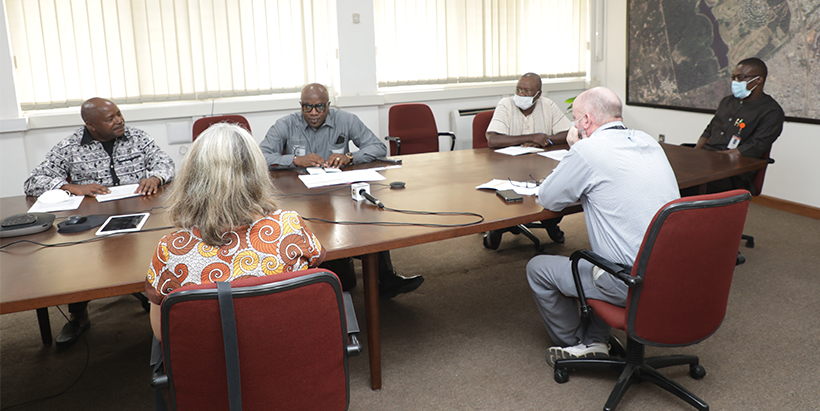
IITA DG Nteranya Sanginga (left) and management team in a meeting with Presidential delegates from DRC.

H.E. Felix Tshisekedi, the President of the Democratic Republic of Congo (DRC), is interested in partnering with IITA. He has decided to work with IITA and the African Development Bank (AfDB) to transform agriculture in Congo from subsistence to commercial. Hence, the President sent delegates to see IITA’s technologies and ongoing programs and observe areas where the government can fully work with IITA on the new project.
DRC to partner with IITA
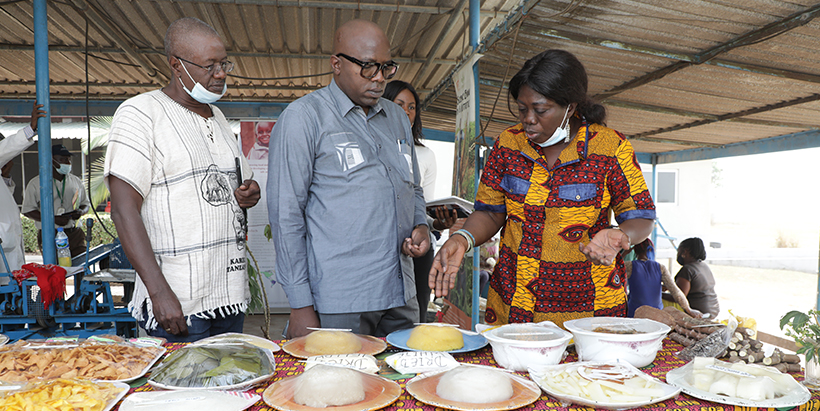
Exhibition at the IITA Cassava Breeding Unit, showcasing the various final products from cassava.

Mr Pacifique Kahasha Birindwa, an adviser to the DRC President, and his Assistant Mr Felix Karume Ntwali visited IITA Headquarters from 9 to 15 January. Following discussions with Dr Nteranya Sanginga, IITA Director General, and the management team about a partnership in upscaling agriculture in Congo, they visited various laboratories to see available technologies.

At the Genetic Resources Center (GRC), they saw the seed banks, long- and short-term storage rooms, and laboratory for seed selection and preservation. At the Bioscience Lab, they saw the sequencing machine, PCR machine, Real-time PCR machine, Ploidy analyzer, and Lyophilizer. Other laboratories visited include the Virology and Molecular Diagnostics Lab and Germplasm Health Unit (GHU) – Import and Export Lab.
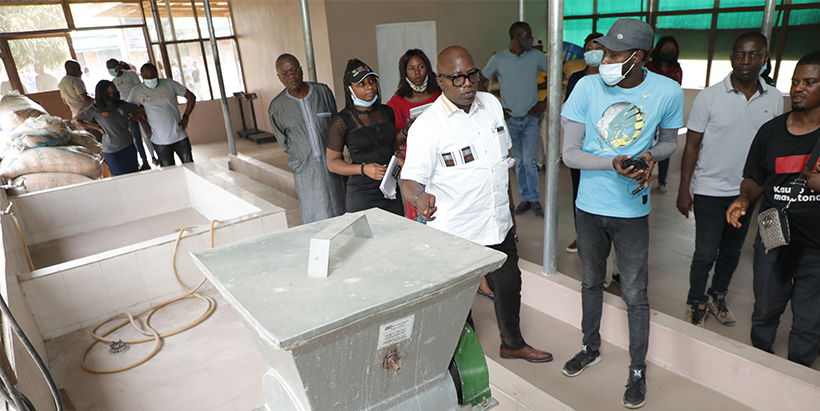
Mr Pacifique, assessing the processing center while on a tour of the facilities at Awe.

The delegates were also interested in the Institute’s youth programs. They visited the youth group, including IITA Youth Agripreneurs (IYA) for young graduates and the Start Them Early Program (STEP) for secondary school students. Following presentations from the team leads to highlight their activities—how they started, the challenges faced, and the successes achieved—some beneficiaries of the projects showcased their products and shared how they started and how far they have gone with IITA’s assistance.

The delegates also visited projects under the youth programs that have been established in communities around the Institute. Visiting Fasola Secondary School under STEP, they toured the upgraded and newly built facilities like classrooms, toilets, borehole, agribusiness hub, and ICT training facilities, done by IITA to make the learning environment more conducive for students. Students also gave testimonies of what they have learned in crop production, value addition, ICT training, and how they have started their own agribusinesses with support from IITA.
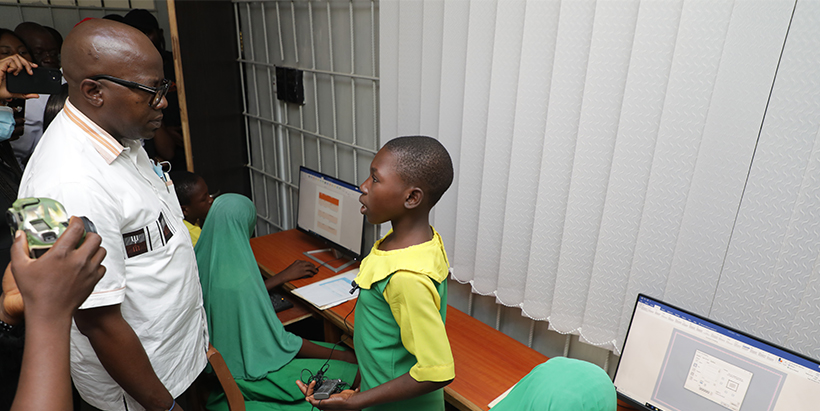
A student at Fasola, sharing how she started her branding business after undergoing ICT training under the STEP program.

At Awe under IYA, Mr Pacifique and his assistant visited a two-hectare cassava field; a vegetable greenhouse for cucumber, tomato, and pepper; an animal pen for goats and sheep; and a processing center. Through a short presentation, the team showed the work being done in capacity building for youth on agriculture and production for commercial purposes and how the Awe Community people have benefited from the project.

The delegates also visited other IITA units of interest, such as the Business Incubation Platform. They learned about Aflasafe, a product that IITA produces to mitigate aflatoxin in crops, and NoduMax for increasing plant yields. At the Cassava Breeding Unit, there was an exhibition of various machines such as the peeler/washer, grinder, presser, and dryer for manual and modern cassava processing into multiple products. There was also an exhibition of final products from cassava such as boiled vitamin A cassava, cake, chin-chin, and cassava flour.

Impressed with the technologies and programs in IITA, Mr Pacifique said, “We want DG Sanginga to replicate these programs not only in DRC but also in other countries of Africa. We want to train people who will train others so that we can take control of our economy.”


Contributed by

Related news

No items found

Leave a Reply

Your email address will not be published. Required fields are marked *

Scroll to Top
Olaosebikan, Olamide

Olamide Deborah Nwanze is a Senior Research Associate specializing in gender mainstreaming research to inform participatory and inclusive breeding, variety development, and seed systems policies regarding root, tuber, and banana (RTB) crops in the International Institute of Tropical Agriculture Headquarters, Ibadan, Nigeria. She is a PhD candidate at the University of Ibadan and holds an MSc and B. Agric in Agricultural Extension and Rural Development. Olamide is a fellow of the African Women in Agricultural Research and Development – Gender Responsive Agricultural Systems Policy (AWARD-GRASP) and the Gender Responsive Researchers Equipped for Agricultural Transformation (GREAT). She seeks to apply her gender-mainstreaming learnings, gender-responsive research, and policy development, and review expertise to facilitate women, youth, children, and vulnerable social group’s access to and adoption of agricultural Innovations that guarantee food, nutrition, income, and livelihood security in Africa. Her current roles include mentoring research fellows, development of guides and training manuals, implementation and adaptation of gender frameworks and tools, value chain actors’ engagement as citizen science partners, policy review and redesign, data management, and analysis. Her current research explores mixed methods and participatory and interdisciplinary approaches to capture and highlight gender dynamics, needs, preferences, and challenges stakeholders face within the agricultural livelihood value chain to prioritize gender-inclusive strategies in breeding programs, policy design, and implementation.

At IITA, she contributes to the implementation of the CGIAR Accelerated Breeding Initiative and Genetic Innovation Programs; participatory and gender research within the NextGen CassavaHarvestPlusRTBFoods, and Tricot-ClimMob 1000Farms Projects; and gender knowledge communication via the G-LENS webinar series, video documentary, policy briefspublications, and blogs.


Recent publications

de Sousa, K., van Etten, J., Manners, R. Bello, A., Teeken, B., Olaosebikan, O., et al. 2024. The tricot approach: an agile framework for decentralized on-farm testing supported by citizen science. A retrospective. Agron. Sustain. Dev. 44, 8. https://doi.org/10.1007/s13593-023-00937-1

Madu, T., Onwuka, S., Nwafor, S., Onyemauwa, N., Ejechi, M., Ofoeze, M., Ukeje, B., Eluagu, C., Olaosebikan, O., Okoye, B., 2024. Gender-Inclusive Consumer Studies Improve Cassava Breeding in Nigeria in: Frontiers in Sociology, volume 9, number: 1224504, doi: 10.3389/fsoc.2024.1224504

Olaosebikan, O.; Bello, A.; Utoblo, O.; Okoye, B.; Olutegbe, N.; Garner, E.; Teeken, B.; Bryan, E.; Forsythe, L.; Cole, S.; Madu, T. 2023.  Stressors and Resilience within the Cassava Value Chain in Nigeria: Preferred Cassava Variety Traits and Response Strategies of Men and Women to Inform Breeding. Sustainability 15, 7837. https://doi.org/10.3390/su15107837

Okoye, B., Ofoeze, M., Ejechi, M., Onwuka, S., Nwafor, S., Onyemauwa, N., Ukeje, B., Eluagu, C., Obidiegwu, J.*, Olaosebikan, O., Madu, T.* 2023. Prioritizing preferred traits in the yam value chain in Nigeria: a gender situation analysis in: Frontiers in Sociology, volume 8, number: 1232626, pages 1 – 9, ISSN 2297-7775, 2023. https://www.frontiersin.org/articles/10.3389/fsoc.2023.1232626/full

Olaosebikan, O., Bello, A. A., de Sousa, K., Ndjouenkeu, R., Adesokan, M., Alamu, E. O., Agbona, A., van Etten, J., Kegah, F. N.*, Dufour, D., Bouniol, A., Teeken, B. 2023. Consumer acceptability of cassava gari-eba food products across cultural and environmental settings using the triadic comparison of technologies approach (tricot) in: Journal of the Science of Food and Agriculture,

Teeken, B., Olaosebikan, O., Bello, A. A., Madu, T.*, Cole, S. M. 2023. Qualitative assessment on the positionality and preferences of dyads in relation to cassava-related activities: working with tricot trial citizen scientists https://hdl.handle.net/10568/138326 Type: Manual

Bouniol, A., Ceballos, H., Bello, A. A., Teeken, B., Olaosebikan, O., Owoade, D., Agbona, A., Fotso Kuate, A., Madu, T.*, Okoye, B.*, Ofoeze, M.*, Nwafor, S.*, Onyemauwa, N.*, Adinsi, L.*, Forsythe, L., Dufour, D. 2023. Varietal impact on women’s labour, workload and related drudgery in processing root, tuber and banana crops: focus on cassava in sub-Saharan Africa in: Journal of the Science of Food and Agriculture, pages 1 – 25, ISSN 0022-5142,

Bello, A. A., Agbona, A., Olaosebikan, O., Edughaen, G., Dufour, D., Bouniol, A., Iluebbey, P., Ndjouenkeu, R.*, Rabbi, I. Y., Teeken, B. 2023. Genetic and environmental effects on processing productivity and food product yield: drudgery of women’s work in: Journal of the Science of Food and Agriculture, pages 1 – 32, ISSN 0022-5142, 5

Cavicchioli, M., Zimbiti, T., Teeken, B., Nwanze, D.O., Liani, M., Parkes, E. & Bello, A. 2023. IITA-Gender Responsive Breeding Training Report. Genetic Resources Center, IITA-HQ, Ibadan, 21-23 September, 2022. Ibadan, Nigeria: IITA, (34 p.).https://hdl.handle.net/10568/131368

Agbona, A. Peteti P., Teeken B., Olaosebikan O. Bello, A. A., Parkes, E., Rabbi, I. Y., Mueller, L., Egesi, C., Kulakow, P. 2022. Data Management in Multi-disciplinary African RTB Crop Breeding Programs. In: Williamson, H.F., Leonelli, S. (eds) Towards Responsible Plant Data Linkage: Data Challenges for Agricultural Research and Development. Springer, Cham. https://doi.org/10.1007/978-3-031-13276-6_5

Lora Forsythe, Pricilla Marimo, Sarah Mayanja, Olamide D. Olaosebikan, Esme Stuart, Bela Teeken, Benjamin Okoye, Tessy Madu, (2021). Cross-product Gender Analysis of RTBfoods Step 2 Gendered Food Mapping on RTB Products. Understanding the Drivers of Trait Preferences and the Development of Multi-user RTB Product Profiles, WP1. London, UK: RTBfoods Field Scientific Report, 30 p.

Teeken, B., Garner, E., Agbona, A., Balogun, I., Olaosebikan, O., Bello, A., Madu, T., Okoye, B., Egesi, C., Kulakow, P. and Tufan, H.A. 2021. Beyond “Women’s Traits”: Exploring How Gender, Social Difference, and Household Characteristics Influence Trait Preferences. Frontiers Sustainable Food Systems 5:740926. https://doi.org/10.3389/fsufs.2021.740926

Teeken, B., Agbona, A., Bello, A., Olaosebikan, O., Alamu, E., Adesokan, M., Awoyale, W., Madu, T., Okoye, B., Chijioke, U., Owoade, D., Okoro, M., Bouniol, A., Dufour, D., Hershey, C., Rabbi, I., Maziya‐Dixon, B., Egesi, C., Tufan, H. and Kulakow, P. (020. Understanding cassava varietal preferences through pairwise ranking of gari‐eba and fufu prepared by local farmer–processors. Int J Food Sci Technol. https://doi.org/10.1111/ijfs.14862

Bela Teeken, Olamide Olaosebikan, Ireti Balogun, Benjamin Okoye, Tessy Madu, Steven Cole, Abolore Bello, Elizabeth Parkes. (2020). Piloting the G+ customer and product profile tools for gender-responsive cassava breeding in Nigeria. Nigeria: International Institute of Tropical Agriculture (IITA). https://hdl.handle.net/20.500.11766/13000