
Efforts launched to save 6.8 million soybean growing households in Africa from rust disease
December 7, 2016
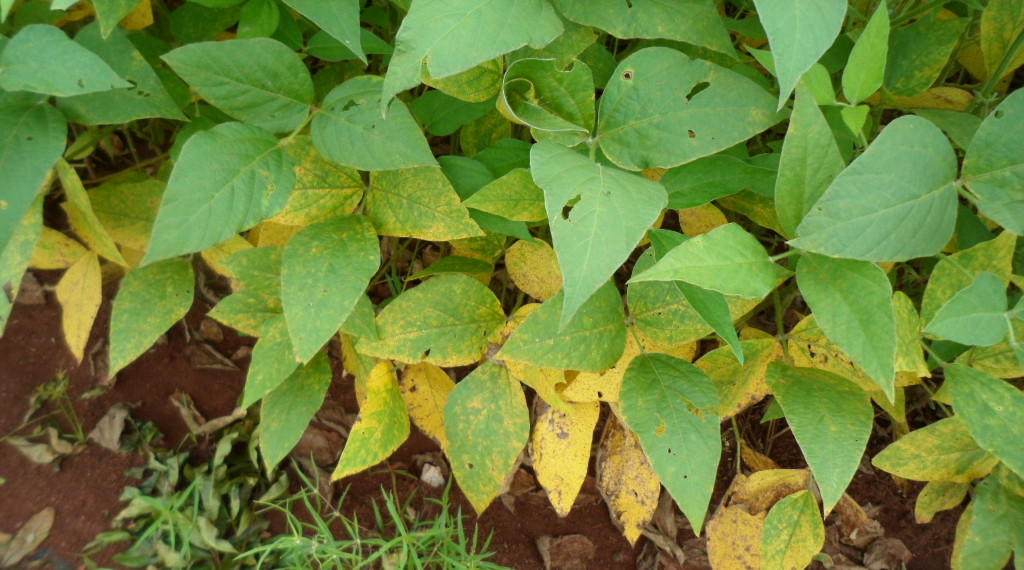
While soybean is increasingly becoming an important commercial and food crop in many countries in Africa, its production is greatly threatened by factors such as lack of access to improved varieties and inputs; abiotic factors such as poor soil fertility and unpredictable weather changes; and biotic factors such as diseases, weeds, and insect pests. However, top on the list is the very virulent soybean rust that originated from Asia and is currently rapidly spreading in the continent.
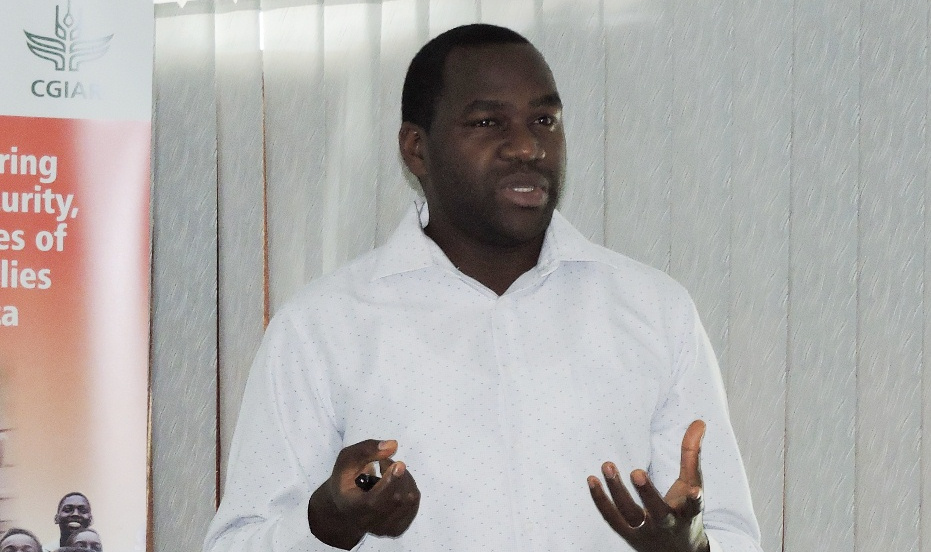 Harun Murithi, a graduate research fellow with IITA-Tanzania, while presenting on his study on the disease titled “Virulence diversity of soybean rust (Phakopsora pachyrhizi) isolates” at a seminar at the Eastern Africa hub in Dar es Salaam recently, said soybean rust is a serious constraint to the crop’s production and can cause yield losses of up to 80%.
“Soybean rust is a disease caused by two fungal pathogens P. pachryhizi and P. meibomiae which are spread by wind. Of concern is P. pachryhizi which is the most aggressive of the two. The livelihood of about 6.8 million households representing about 28.6 million people in sub-Saharan Africa that produce soybean crop is at risk”, he said.
The study seeks to support efforts to control the disease’s spread and impact by identifying resistant genes effective against P. pachyrhizi populations in Africa, and characterize the virulence spectrum of the African rust isolates in comparison to a few other isolates from other continents. The study is being conducted in collaboration with the University of Illinois and Wagenigen University.
From the study, 5 genes (Rpp1b, Rpp2, Rpp3 Rpp5a, and Rpp6) and cultivars Hyuuga and UG5 were identified as effective against soybean rust isolates from Kenya, Malawi, and Tanzania. However, he noted that the P. pachyrhizi pathotypes are highly adaptive, quickly breaking down the resistance of these genes and weakening effectiveness of the genes, therefore making control efforts very difficult.
“The P. pachyrhizi pathotypes from different regions have emerged with the ability to adapt to the resistant genes. Currently genes Rpp1, Rpp4, and Rpp5b, which had resistance to soybean rust, are no longer effective against the African rust isolates used in the study”, commented Harun.
“The recommendation therefore is to develop soybean varieties with multiple genes of resistance through gene pyramiding as a sustainable solution for soybean rust management. We also need to continue screening varieties for more sources of novel resistance genes.”
Harun Murithi, a graduate research fellow with IITA-Tanzania, while presenting on his study on the disease titled “Virulence diversity of soybean rust (Phakopsora pachyrhizi) isolates” at a seminar at the Eastern Africa hub in Dar es Salaam recently, said soybean rust is a serious constraint to the crop’s production and can cause yield losses of up to 80%.
“Soybean rust is a disease caused by two fungal pathogens P. pachryhizi and P. meibomiae which are spread by wind. Of concern is P. pachryhizi which is the most aggressive of the two. The livelihood of about 6.8 million households representing about 28.6 million people in sub-Saharan Africa that produce soybean crop is at risk”, he said.
The study seeks to support efforts to control the disease’s spread and impact by identifying resistant genes effective against P. pachyrhizi populations in Africa, and characterize the virulence spectrum of the African rust isolates in comparison to a few other isolates from other continents. The study is being conducted in collaboration with the University of Illinois and Wagenigen University.
From the study, 5 genes (Rpp1b, Rpp2, Rpp3 Rpp5a, and Rpp6) and cultivars Hyuuga and UG5 were identified as effective against soybean rust isolates from Kenya, Malawi, and Tanzania. However, he noted that the P. pachyrhizi pathotypes are highly adaptive, quickly breaking down the resistance of these genes and weakening effectiveness of the genes, therefore making control efforts very difficult.
“The P. pachyrhizi pathotypes from different regions have emerged with the ability to adapt to the resistant genes. Currently genes Rpp1, Rpp4, and Rpp5b, which had resistance to soybean rust, are no longer effective against the African rust isolates used in the study”, commented Harun.
“The recommendation therefore is to develop soybean varieties with multiple genes of resistance through gene pyramiding as a sustainable solution for soybean rust management. We also need to continue screening varieties for more sources of novel resistance genes.”
 The knowledge from the study will be useful for breeders to develop high yielding rust resistant varieties in Africa or elsewhere. Use of rust resistant varieties will increase soybean productivity among smallholder producers that would eventually lead to higher incomes, reduced poverty, and improved livelihoods.
Harun Murithi
Soybean rust
Contributed by
Recent stories
No items found