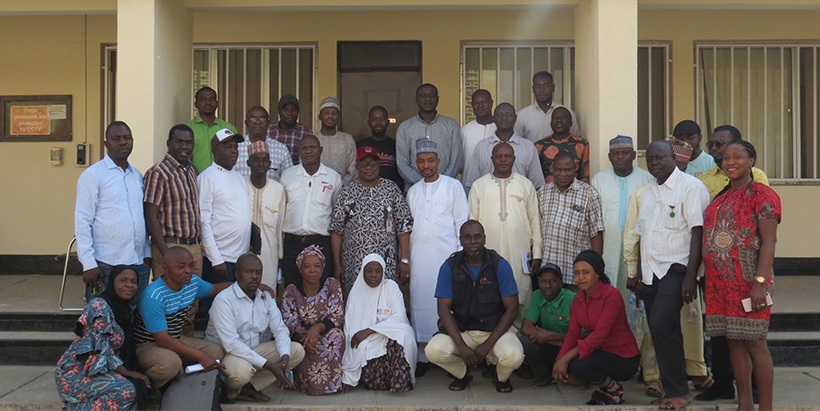
The Risk Manager from the British High Commission, Muhammad Abdulazeez, on 9 February 2023, presented and explored election processes, procedures, and security. He also identified options that are in place in some areas of Kano State. The training was held at the IITA Kano station conference room.
Attendees at the Election security training.
The Nigerian general elections (Presidential and National Assembly) are scheduled for 25 February, while the gubernatorial elections are on 11 March. The electoral campaign started on 28 September 2022, and for the first time since 1999, there are three major contenders for the Presidential elections, with different backgrounds and a diverse pool of voters.
Abdulazeez noted during his presentation that election violence has existed for a long time and is not unique to Nigeria. Violence and hard clashes between supporters of opposing political parties have been occurring countrywide, with injuries and fatalities amongst civilians recorded since the official start of the electoral campaign up to the present date, similar to the previous exercises in 2019.
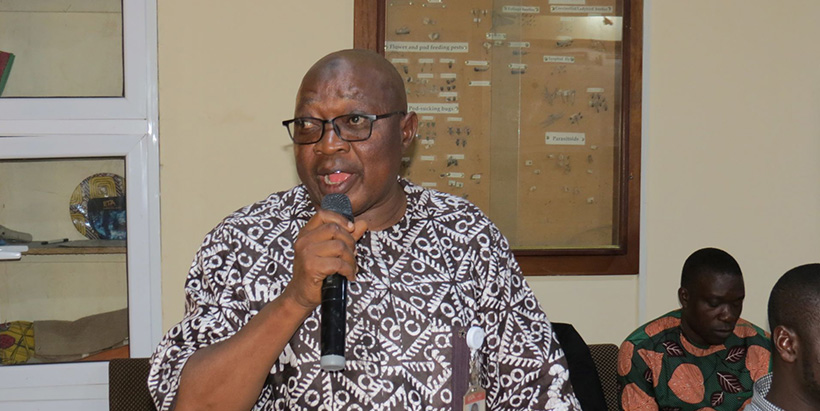
IITA Kano Station Administration Ado Rabo speaking at the Election security training.
One of those groups contributing to election violence is not only the youth but also Boko Haram, who remain opposed to any election activity, the bandits, and IPOB, who threaten the 2023 election in different ways. Boko Haram will attack for ideological reasons, bandits will carry out kidnap-for-ransom, and IPOB will seek out journalists and observers to send its threatening message while demonstrating its control over the South East.
He added that the media plays a major role in keeping the citizenry abreast of current events and raising awareness of various societal issues. He said that between 2014 and 2022, the states with the highest number of incidents were Rivers, Lagos, Kogi, Ondo, and Ekiti, respectively. While Rivers and Lagos states again topped the list of places with the highest number of deaths, followed by Taraba, Bayelsa, Delta, Ebonyi, Kano, and Kogi. He further noted that on 25 January 2023, security forces arrested 98 individuals in possession of firearms and bladed weapons, who were headed from Ibadan, Oyo State, to Ado Ekiti, Ekiti State, to attack a political rally.
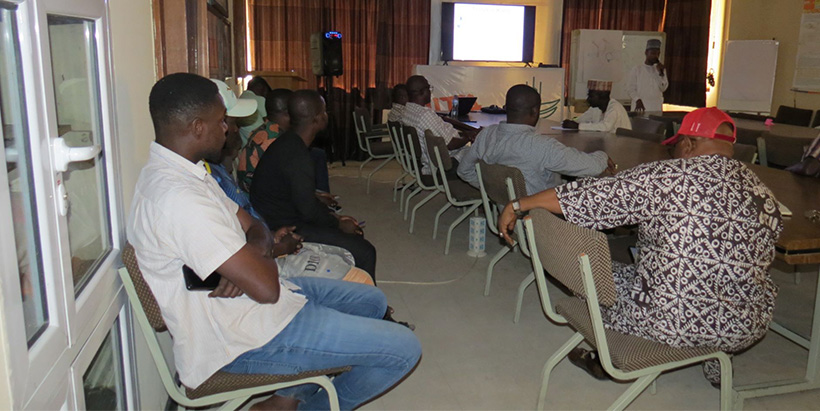
Participants during the Election security training.
However, Abdulazeez said that Kano State is one of the many Nigerian states that often experience election-related violence, whether over national or local contests. Kano has also experienced a series of ethnoreligious riots, noting that such riots usually occur before or on election day and on issues of ballot box snatching and intimidation of voters and election officials. He further listed some election violence-prone areas in Kano, which include Dala, Nassarawa, Fagge, Wudil, Bichi, Kura, Minjibir, Gwarzo, and Kabo. He advised that staff should be careful of such places as they are likely to display some riots like in previous years. He also said staff must ensure they are at their respective polling unit on time, not wear political attire, avoid ethnicity or religious conversations at the place of voting, and staff should always keep in touch with one another. ‘’If you know something, say something,’’ he added.
The presenter highlighted the meaning, significance, and recommendations of the training to IITA as follows:
To ensure they have security policies and specific plans and protocols for events such as elections to cover safety, offices, secure communication, safe havens, secure data and information, and IITA’s movements, supplies, and emergencies.
To have an Electoral Ops room set up at the country level to promote information sharing among IITA staff implementing, planning to implement, or affected by electoral assistance activities.
To also approve limitations of movements around the election dates.
To also have a sure call; someone you can call when in trouble.
To get a few handheld transceivers (walkie-talkies) in case of emergencies.
The Station Administration, Ado Rabo, thanked the presenter for a wonderful presentation and advised staff to minimize movement during the election period except when necessary, to stock up enough foodstuff in their houses, and avoid gatherings and populated areas.
Contributed by Sarah Sallau
Olamide Deborah Nwanze is a Senior Research Associate specializing in gender mainstreaming research to inform participatory and inclusive breeding, variety development, and seed systems policies regarding root, tuber, and banana (RTB) crops in the International Institute of Tropical Agriculture Headquarters, Ibadan, Nigeria. She is a PhD candidate at the University of Ibadan and holds an MSc and B. Agric in Agricultural Extension and Rural Development. Olamide is a fellow of the African Women in Agricultural Research and Development – Gender Responsive Agricultural Systems Policy (AWARD-GRASP) and the Gender Responsive Researchers Equipped for Agricultural Transformation (GREAT). She seeks to apply her gender-mainstreaming learnings, gender-responsive research, and policy development, and review expertise to facilitate women, youth, children, and vulnerable social group’s access to and adoption of agricultural Innovations that guarantee food, nutrition, income, and livelihood security in Africa. Her current roles include mentoring research fellows, development of guides and training manuals, implementation and adaptation of gender frameworks and tools, value chain actors’ engagement as citizen science partners, policy review and redesign, data management, and analysis. Her current research explores mixed methods and participatory and interdisciplinary approaches to capture and highlight gender dynamics, needs, preferences, and challenges stakeholders face within the agricultural livelihood value chain to prioritize gender-inclusive strategies in breeding programs, policy design, and implementation.
de Sousa, K., van Etten, J., Manners, R. Bello, A., Teeken, B., Olaosebikan, O., et al. 2024. The tricot approach: an agile framework for decentralized on-farm testing supported by citizen science. A retrospective. Agron. Sustain. Dev. 44, 8. https://doi.org/10.1007/s13593-023-00937-1
Madu, T., Onwuka, S., Nwafor, S., Onyemauwa, N., Ejechi, M., Ofoeze, M., Ukeje, B., Eluagu, C., Olaosebikan, O., Okoye, B., 2024. Gender-Inclusive Consumer Studies Improve Cassava Breeding in Nigeria in: Frontiers in Sociology, volume 9, number: 1224504, doi: 10.3389/fsoc.2024.1224504
Olaosebikan, O.; Bello, A.; Utoblo, O.; Okoye, B.; Olutegbe, N.; Garner, E.; Teeken, B.; Bryan, E.; Forsythe, L.; Cole, S.; Madu, T. 2023. Stressors and Resilience within the Cassava Value Chain in Nigeria: Preferred Cassava Variety Traits and Response Strategies of Men and Women to Inform Breeding. Sustainability 15, 7837. https://doi.org/10.3390/su15107837
Okoye, B., Ofoeze, M., Ejechi, M., Onwuka, S., Nwafor, S., Onyemauwa, N., Ukeje, B., Eluagu, C., Obidiegwu, J.*, Olaosebikan, O., Madu, T.* 2023. Prioritizing preferred traits in the yam value chain in Nigeria: a gender situation analysis in: Frontiers in Sociology, volume 8, number: 1232626, pages 1 – 9, ISSN 2297-7775, 2023. https://www.frontiersin.org/articles/10.3389/fsoc.2023.1232626/full
Olaosebikan, O., Bello, A. A., de Sousa, K., Ndjouenkeu, R., Adesokan, M., Alamu, E. O., Agbona, A., van Etten, J., Kegah, F. N.*, Dufour, D., Bouniol, A., Teeken, B. 2023. Consumer acceptability of cassava gari-eba food products across cultural and environmental settings using the triadic comparison of technologies approach (tricot) in: Journal of the Science of Food and Agriculture,
Teeken, B., Olaosebikan, O., Bello, A. A., Madu, T.*, Cole, S. M. 2023. Qualitative assessment on the positionality and preferences of dyads in relation to cassava-related activities: working with tricot trial citizen scientists https://hdl.handle.net/10568/138326 Type: Manual
Bouniol, A., Ceballos, H., Bello, A. A., Teeken, B., Olaosebikan, O., Owoade, D., Agbona, A., Fotso Kuate, A., Madu, T.*, Okoye, B.*, Ofoeze, M.*, Nwafor, S.*, Onyemauwa, N.*, Adinsi, L.*, Forsythe, L., Dufour, D. 2023. Varietal impact on women’s labour, workload and related drudgery in processing root, tuber and banana crops: focus on cassava in sub-Saharan Africa in: Journal of the Science of Food and Agriculture, pages 1 – 25, ISSN 0022-5142,
Bello, A. A., Agbona, A., Olaosebikan, O., Edughaen, G., Dufour, D., Bouniol, A., Iluebbey, P., Ndjouenkeu, R.*, Rabbi, I. Y., Teeken, B. 2023. Genetic and environmental effects on processing productivity and food product yield: drudgery of women’s work in: Journal of the Science of Food and Agriculture, pages 1 – 32, ISSN 0022-5142, 5
Cavicchioli, M., Zimbiti, T., Teeken, B., Nwanze, D.O., Liani, M., Parkes, E. & Bello, A. 2023. IITA-Gender Responsive Breeding Training Report. Genetic Resources Center, IITA-HQ, Ibadan, 21-23 September, 2022. Ibadan, Nigeria: IITA, (34 p.).https://hdl.handle.net/10568/131368
Agbona, A. Peteti P., Teeken B., Olaosebikan O. Bello, A. A., Parkes, E., Rabbi, I. Y., Mueller, L., Egesi, C., Kulakow, P. 2022. Data Management in Multi-disciplinary African RTB Crop Breeding Programs. In: Williamson, H.F., Leonelli, S. (eds) Towards Responsible Plant Data Linkage: Data Challenges for Agricultural Research and Development. Springer, Cham. https://doi.org/10.1007/978-3-031-13276-6_5
Lora Forsythe, Pricilla Marimo, Sarah Mayanja, Olamide D. Olaosebikan, Esme Stuart, Bela Teeken, Benjamin Okoye, Tessy Madu, (2021). Cross-product Gender Analysis of RTBfoods Step 2 Gendered Food Mapping on RTB Products. Understanding the Drivers of Trait Preferences and the Development of Multi-user RTB Product Profiles, WP1. London, UK: RTBfoods Field Scientific Report, 30 p.
Teeken, B., Garner, E., Agbona, A., Balogun, I., Olaosebikan, O., Bello, A., Madu, T., Okoye, B., Egesi, C., Kulakow, P. and Tufan, H.A. 2021. Beyond “Women’s Traits”: Exploring How Gender, Social Difference, and Household Characteristics Influence Trait Preferences. Frontiers Sustainable Food Systems 5:740926. https://doi.org/10.3389/fsufs.2021.740926
Teeken, B., Agbona, A., Bello, A., Olaosebikan, O., Alamu, E., Adesokan, M., Awoyale, W., Madu, T., Okoye, B., Chijioke, U., Owoade, D., Okoro, M., Bouniol, A., Dufour, D., Hershey, C., Rabbi, I., Maziya‐Dixon, B., Egesi, C., Tufan, H. and Kulakow, P. (020. Understanding cassava varietal preferences through pairwise ranking of gari‐eba and fufu prepared by local farmer–processors. Int J Food Sci Technol.https://doi.org/10.1111/ijfs.14862
Bela Teeken, Olamide Olaosebikan, Ireti Balogun, Benjamin Okoye, Tessy Madu, Steven Cole, Abolore Bello, Elizabeth Parkes. (2020). Piloting the G+ customer and product profile tools for gender-responsive cassava breeding in Nigeria. Nigeria: International Institute of Tropical Agriculture (IITA). https://hdl.handle.net/20.500.11766/13000