
IITA NEWS

Empowering gender research: Insights from the IITA Gender Science Network’s webinar series
November 17, 2023

For the past year, the IITACGIAR Gender Science Network (GSN) has been leading a groundbreaking initiative. Through the Gender (research) Learnings and Exchanges for New inSights (GLENS) webinar series, they have successfully spearheaded an enriching platform to augment gender research, its dissemination, and its impact. The series has executed eight enlightening sessions from March 2022 to October 2023, with the adept guidance of Senior Scientist and Gender Specialist Steven Cole and Senior Research Associate Olamide Nwanze
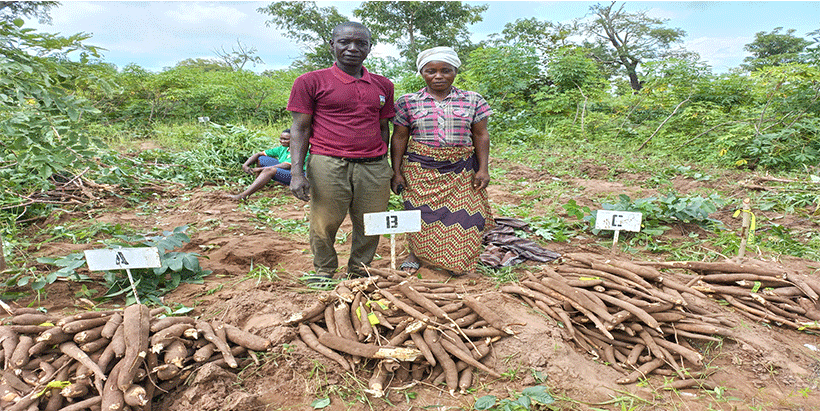
Tricot farmer and her wife at Daudu, Benue state with cassava harvested from tricot trials at 12 months for yield and post-harvest traits evaluation.
Tricot farmer and her wife at Daudu, Benue state with cassava harvested from tricot trials at 12 months for yield and post-harvest traits evaluation. (Photo credit – Bello Abolore/Bela Teeken).

Associate Social and Gender Scientist Béla Teeken presented the inaugural webinar titled “Structurally integrating gender into cassava breeding: The Triadic comparison of technologies (Tricot) and prospects.” He highlighted the innovative Tricot approach, with valuable contributions from Senior Research Supervisor Bello Abolore and Nwanze. They emphasized how this method facilitates the integration of value chain actors and consumer preferences into the breeding and trait prioritization decision process, aligning it with sustainable development goals. This strategic application of the Tricot approach for on-farm and food product evaluations holds promising prospects for inclusive and economically impactful cassava breeding initiatives.

In the subsequent session, Social Scientist and Gender Expert Gundula Fischer led a discussion on “Piloting a gender transformative approach for equitable decision-making on agricultural innovations.” Fischer showcased the outcomes of workshops conducted in Malawi and Tanzania, demonstrating the effective use of gender-transformative decision-support tools to assess and address gender-related challenges in agricultural innovation.

The third webinar, “What does she know about aflatoxins?” presented by Associate Scientist Titilayo Falade, provided a comprehensive overview of the critical issue of aflatoxin awareness among women in Nigeria. The session emphasized the need for heightened awareness and suggested leveraging social groups to effectively disseminate information.

Senior Research Associate Devis Mwakanyamale‘s presentation on “A mixed-methods research tool for improving measurements and understanding of intra-household decision making” delved into the development of a versatile research tool to analyze intra-household decision-making dynamics. This comprehensive tool promises to contribute to a better understanding of households’ decision-making processes.
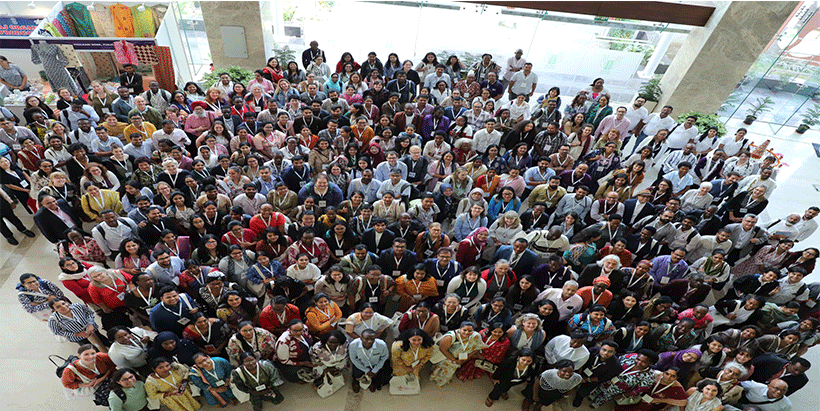
Participants - Researchers, experts, and practitioners from different organizations within 68 countries at a gender conference 2023
Participants – Researchers, experts, and practitioners from different organizations within 68 countries at a gender conference 2023 (Photo credit: Organizing Committee)

The series also explored the development and implementation of a Gender Research Key Performance Indicator (KPI) tool, as highlighted in the session led by the Head of the IITA Monitoring and Evaluation Unit, Hope Webber. This tool plays a crucial role in evaluating the integration of gender considerations within various research projects, fostering greater gender equality and participation.

IITA Capacity Development Office Head Zainatou Sore highlighted the impactful initiatives undertaken by the French Ministry of Europe and Foreign Affairs (MEAE) in Nigeria, focusing on supporting female entrepreneurship in the agri-food sector. The discussion underscored the significance of skill development and network building for women entrepreneurs, amplifying their voices in local and international market networks.

The series further delved into dynamic concepts such as gender sensitivity and gender transformation in climate-smart agriculture, as elucidated by Gender and Social Inclusion Lead of the Accelerating Impacts of CGIAR Climate Research for Africa (AICCRA) Project, Faustina Obeng Adomaa. The session provided key insights from the AICCRA project in Ghana and emphasized the importance of gender-responsive strategies in fostering inclusive climate-smart agriculture innovations and climate information services.

A compelling session led by Agricultural Economist Shiferaw Feleke delved into the intricate dynamics of gender differences in cassava trait preferences in Tanzania. Feleke highlighted the importance of understanding and addressing the various cultural and social factors influencing these preferences, implying the need for genetic and mechanical food science technologies and policy interventions.

The series has garnered resounding commendation with increasing attendance and more presenters participating. The IITA gender team takes pride in this commendable accomplishment, as Cole emphasizes their unique position as the sole research team organizing such a comprehensive series within IITA. The GLENS webinar series stands as a testament to the unwavering commitment and dedication of the GSN team in advancing gender-inclusive research and fostering meaningful impact within the agricultural sphere.

Contributed by Ochuwa Favour Daramola


Contributed by

Related news

No items found

Leave a Reply

Your email address will not be published. Required fields are marked *

Scroll to Top
Olaosebikan, Olamide

Olamide Deborah Nwanze is a Senior Research Associate specializing in gender mainstreaming research to inform participatory and inclusive breeding, variety development, and seed systems policies regarding root, tuber, and banana (RTB) crops in the International Institute of Tropical Agriculture Headquarters, Ibadan, Nigeria. She is a PhD candidate at the University of Ibadan and holds an MSc and B. Agric in Agricultural Extension and Rural Development. Olamide is a fellow of the African Women in Agricultural Research and Development – Gender Responsive Agricultural Systems Policy (AWARD-GRASP) and the Gender Responsive Researchers Equipped for Agricultural Transformation (GREAT). She seeks to apply her gender-mainstreaming learnings, gender-responsive research, and policy development, and review expertise to facilitate women, youth, children, and vulnerable social group’s access to and adoption of agricultural Innovations that guarantee food, nutrition, income, and livelihood security in Africa. Her current roles include mentoring research fellows, development of guides and training manuals, implementation and adaptation of gender frameworks and tools, value chain actors’ engagement as citizen science partners, policy review and redesign, data management, and analysis. Her current research explores mixed methods and participatory and interdisciplinary approaches to capture and highlight gender dynamics, needs, preferences, and challenges stakeholders face within the agricultural livelihood value chain to prioritize gender-inclusive strategies in breeding programs, policy design, and implementation.

At IITA, she contributes to the implementation of the CGIAR Accelerated Breeding Initiative and Genetic Innovation Programs; participatory and gender research within the NextGen CassavaHarvestPlusRTBFoods, and Tricot-ClimMob 1000Farms Projects; and gender knowledge communication via the G-LENS webinar series, video documentary, policy briefspublications, and blogs.


Recent publications

de Sousa, K., van Etten, J., Manners, R. Bello, A., Teeken, B., Olaosebikan, O., et al. 2024. The tricot approach: an agile framework for decentralized on-farm testing supported by citizen science. A retrospective. Agron. Sustain. Dev. 44, 8. https://doi.org/10.1007/s13593-023-00937-1

Madu, T., Onwuka, S., Nwafor, S., Onyemauwa, N., Ejechi, M., Ofoeze, M., Ukeje, B., Eluagu, C., Olaosebikan, O., Okoye, B., 2024. Gender-Inclusive Consumer Studies Improve Cassava Breeding in Nigeria in: Frontiers in Sociology, volume 9, number: 1224504, doi: 10.3389/fsoc.2024.1224504

Olaosebikan, O.; Bello, A.; Utoblo, O.; Okoye, B.; Olutegbe, N.; Garner, E.; Teeken, B.; Bryan, E.; Forsythe, L.; Cole, S.; Madu, T. 2023.  Stressors and Resilience within the Cassava Value Chain in Nigeria: Preferred Cassava Variety Traits and Response Strategies of Men and Women to Inform Breeding. Sustainability 15, 7837. https://doi.org/10.3390/su15107837

Okoye, B., Ofoeze, M., Ejechi, M., Onwuka, S., Nwafor, S., Onyemauwa, N., Ukeje, B., Eluagu, C., Obidiegwu, J.*, Olaosebikan, O., Madu, T.* 2023. Prioritizing preferred traits in the yam value chain in Nigeria: a gender situation analysis in: Frontiers in Sociology, volume 8, number: 1232626, pages 1 – 9, ISSN 2297-7775, 2023. https://www.frontiersin.org/articles/10.3389/fsoc.2023.1232626/full

Olaosebikan, O., Bello, A. A., de Sousa, K., Ndjouenkeu, R., Adesokan, M., Alamu, E. O., Agbona, A., van Etten, J., Kegah, F. N.*, Dufour, D., Bouniol, A., Teeken, B. 2023. Consumer acceptability of cassava gari-eba food products across cultural and environmental settings using the triadic comparison of technologies approach (tricot) in: Journal of the Science of Food and Agriculture,

Teeken, B., Olaosebikan, O., Bello, A. A., Madu, T.*, Cole, S. M. 2023. Qualitative assessment on the positionality and preferences of dyads in relation to cassava-related activities: working with tricot trial citizen scientists https://hdl.handle.net/10568/138326 Type: Manual

Bouniol, A., Ceballos, H., Bello, A. A., Teeken, B., Olaosebikan, O., Owoade, D., Agbona, A., Fotso Kuate, A., Madu, T.*, Okoye, B.*, Ofoeze, M.*, Nwafor, S.*, Onyemauwa, N.*, Adinsi, L.*, Forsythe, L., Dufour, D. 2023. Varietal impact on women’s labour, workload and related drudgery in processing root, tuber and banana crops: focus on cassava in sub-Saharan Africa in: Journal of the Science of Food and Agriculture, pages 1 – 25, ISSN 0022-5142,

Bello, A. A., Agbona, A., Olaosebikan, O., Edughaen, G., Dufour, D., Bouniol, A., Iluebbey, P., Ndjouenkeu, R.*, Rabbi, I. Y., Teeken, B. 2023. Genetic and environmental effects on processing productivity and food product yield: drudgery of women’s work in: Journal of the Science of Food and Agriculture, pages 1 – 32, ISSN 0022-5142, 5

Cavicchioli, M., Zimbiti, T., Teeken, B., Nwanze, D.O., Liani, M., Parkes, E. & Bello, A. 2023. IITA-Gender Responsive Breeding Training Report. Genetic Resources Center, IITA-HQ, Ibadan, 21-23 September, 2022. Ibadan, Nigeria: IITA, (34 p.).https://hdl.handle.net/10568/131368

Agbona, A. Peteti P., Teeken B., Olaosebikan O. Bello, A. A., Parkes, E., Rabbi, I. Y., Mueller, L., Egesi, C., Kulakow, P. 2022. Data Management in Multi-disciplinary African RTB Crop Breeding Programs. In: Williamson, H.F., Leonelli, S. (eds) Towards Responsible Plant Data Linkage: Data Challenges for Agricultural Research and Development. Springer, Cham. https://doi.org/10.1007/978-3-031-13276-6_5

Lora Forsythe, Pricilla Marimo, Sarah Mayanja, Olamide D. Olaosebikan, Esme Stuart, Bela Teeken, Benjamin Okoye, Tessy Madu, (2021). Cross-product Gender Analysis of RTBfoods Step 2 Gendered Food Mapping on RTB Products. Understanding the Drivers of Trait Preferences and the Development of Multi-user RTB Product Profiles, WP1. London, UK: RTBfoods Field Scientific Report, 30 p.

Teeken, B., Garner, E., Agbona, A., Balogun, I., Olaosebikan, O., Bello, A., Madu, T., Okoye, B., Egesi, C., Kulakow, P. and Tufan, H.A. 2021. Beyond “Women’s Traits”: Exploring How Gender, Social Difference, and Household Characteristics Influence Trait Preferences. Frontiers Sustainable Food Systems 5:740926. https://doi.org/10.3389/fsufs.2021.740926

Teeken, B., Agbona, A., Bello, A., Olaosebikan, O., Alamu, E., Adesokan, M., Awoyale, W., Madu, T., Okoye, B., Chijioke, U., Owoade, D., Okoro, M., Bouniol, A., Dufour, D., Hershey, C., Rabbi, I., Maziya‐Dixon, B., Egesi, C., Tufan, H. and Kulakow, P. (020. Understanding cassava varietal preferences through pairwise ranking of gari‐eba and fufu prepared by local farmer–processors. Int J Food Sci Technol. https://doi.org/10.1111/ijfs.14862

Bela Teeken, Olamide Olaosebikan, Ireti Balogun, Benjamin Okoye, Tessy Madu, Steven Cole, Abolore Bello, Elizabeth Parkes. (2020). Piloting the G+ customer and product profile tools for gender-responsive cassava breeding in Nigeria. Nigeria: International Institute of Tropical Agriculture (IITA). https://hdl.handle.net/20.500.11766/13000