Empowering regional and district level planners to address climate change threats to agriculture
Climate change is ranked among of the top threats to global food security given impacts such as erratic and extreme weather conditions including floods and droughts. Crop yields are expected to decline globally after 2030 and by 2050, 3% of Africa’s land will no longer be suitable for maize. In Tanzania, climate change is a major hindrance to efforts to increase agriculture productivity for food security and achieving the government’s national development vision 2025.
The Tanzania government has made tremendous efforts to mainstream climate change in all relevant national and agricultural policies and strategies, but their implementation is hampered by lack of know-how, tools and resources, and especially at the local level.
To support the government in these effort, a team of international experts are in the country to train planners and key stakeholders at the regional and district levels on how to plan for and support smallholder farmers to cope with climate change and implement climate-smart agriculture (CSA).
They are drawn from the University of California, Davis; the United States Department of Agriculture (USDA) California Climate Hub; EcoAgriculture Partners; Cornell University; and the International Institute of Tropical Agriculture (IITA)
The trainings, taking place in Morogoro, March 25–29 for training and in Ungunja, Zanzibar, April 1–5, are part of the Building Capacity for Resilient Food Security (BCRFS) project, an initiative of the United Republic of Tanzania in partnership with USDA and funds from the United States Government through the U.S. Agency for International Development (USAID).
Daina Muywanga, the District Agriculture Irrigation and Cooperative Officer (DAICO) welcoming the Participants of the pilot training course on landscape climate smart agriculture and their facilitators to a demonstration plot for CSA at Kimambila village and explaining the challenges farmers are facing due to climate change.
Commending the training, Shakwaanande Natai, Head of the Environmental Management Unit in the Ministry of Agriculture said, “this training is critically important in supporting the Government’s efforts to sustainably increase agricultural productivity, build the resilience of the rural farming communities, reducing and controlling greenhouse gas emissions, and maintaining the environment through mainstreaming CSA.”
“The training specifically brings together action-oriented leaders that can influence others and create an enabling environment for transformation of agricultural systems in the face of climate change. We hope participants will walk away from this training informed and with a landscape action plan that they can implement through policies and programs in their region with the support of a new network of leaders with similar visions,” added Caitlin Corner-Dolloff, Team Lead for Resilient Agriculture Programs, in the Office of Capacity Building and Development at the USDA.
Landscape approach to climate smart agriculture
The training program, “Landscape CSA Pilot Course,” emphasizes using leadership strengths to build collaborative interventions to scale CSA action. The training also emphasizes a landscape approach for successful and sustainable implementation of CSA.
Dr. Hassan Shelukindo, Principal Agricultural Officer, President’s Office Regional Administration and Local Government (PO-RALG) noted that the landscape approach to CSA was a new, but very important, concept because it is a holistic and participatory approach which considers the needs of diversity of land uses across landscapes, while supporting conservation of natural resources and biodiversity, to ensure sustainability of CSA practices/technologies.
During the officially opening of the workshop, Dr. Shelukindo urged the participants to make use of the knowledge gained. “Climate change is real. Though we’re not emitting much as a country we are very much affected. Let us start to do something. Change starts with you and then the community. Let us take the training seriously and start seeing how to make CSA happen in our districts,” he said.
One of the participants Alloyce Gaspar Mawere, the Regional Environmental Expert Officer from Iringa Region, said he looked forward to getting concrete knowledge on ways to arrest climate change and specifically using the landscape approach.
He pointed out Iringa region was one of the country’s food security baskets and home to three hydroelectric power stations and the planned Stiengler’s Gorge. All these crops depend on water from the great Ruaha River Basin, which has greatly reduced from drought and upstream agriculture. Therefore, without proper landscape planning, climate change will affect the country’s electricity supply as well as regional and national food security.
“From this training I would like the Local Government Authorities to leave with knowledge on collaborative planning cycle to plan for CSA for sustainable food security. Collaborative planning, which brings together stakeholders at the grassroots to address climate change challenges, will create a sense of ownership in the implementation of the plans,” he said.
Building media capacity to communicate on climate smart agriculture
A
related training was organized last year to build the knowledge base of the media on issues around climate change and CSA. It was organized as part of the project’s efforts to create awareness on CSA and brought together 12 journalists (5 women and 7 men) from Dodoma, Iringa, Mbeya, Pemba and Unguja who are involved in production of agricultural programs.
The main objective of the media training was to enable the journalists to have a solid foundation on issues around climate change and its impact on agriculture and on CSA as one of the ways to support farmers cope with the negative impact. Secondly, it aimed to strengthen their ability to develop programs and reporting on CSA through follow up mentorship and coaching.
The aim of these trainings is to have both subnational planners and media knowledgeable about of CSA and landscape approaches, so in turn, they can use their influence, networks, and platforms to inform others and inspire agricultural sector actors to implement CSA approaches across agricultural systems, thus increasing the scope and speed of change in line with national goals.
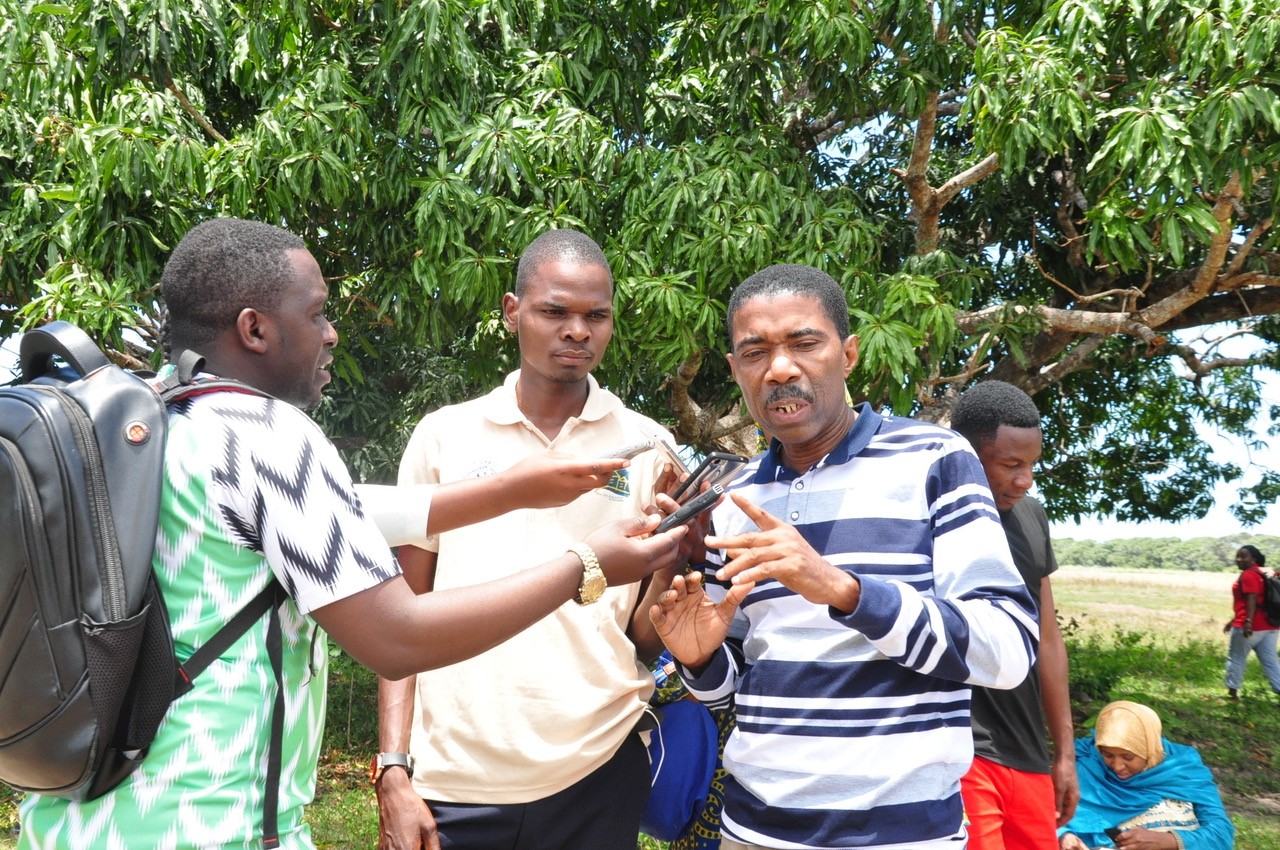
Radio journalists interviewing Nassor Mkarafuu, from the Ministry of Agriculture, Natural Resources and Livestock (MANLF), during one-day field visit to the project demonstration plots at Mahonda Sakafuni and Pangeni in North Region –Unguja, Zanzibar. The field visit gave the participants an opportunity to learn more about CSA practices and technologies practices, interact with and interview agriculture officers and farmers.
Initiated in 2017, the project seeks to strengthen the country’s capacity to respond to the challenges posed by climate change to the agriculture sector. It is led by USDA with funding from USAID and is being implemented by IITA, the United Nations Food and Agriculture Organization, and the World Agroforestry Center (ICRAF). The project has five main objectives:
- Determine potential benefits & tradeoffs of CSA practices & technologies under different local scenarios (ICRAF)
- Select CSA practices for specific production systems and regions & develop technical specifications (IITA)
- Demonstrate & disseminate information to relevant stakeholders on how to apply CSA practices to achieve agricultural resilience (IITA)
- Ensure agriculture extension trainees are knowledgeable on CSA approaches under different local scenarios & conditions to achieve agricultural resilience
- Convert agrometeorological data and analyses into timely & actionable information for farmers (FAO and TMA)
