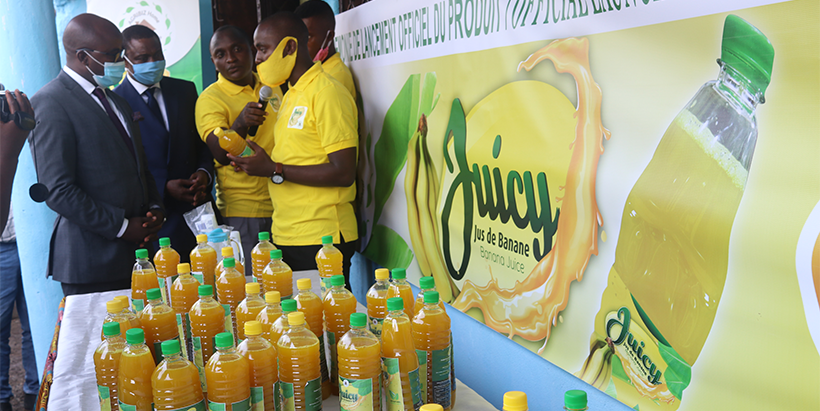
On 15 June, AgriBiz Home made history as the first start-up of the ENABLE Youth Cameroon program. At a ceremony chaired by the city of Penja Divisional Officer M. Abate, the start-up unveiled “Juicy”, its branded banana-based fruit juice, to the public. Cargèle Masso, IITA-Cameroon Country Representative and Coordinator of ENABLE Youth Cameroon, also attended the historic event.
Juicy Tasting with IITA and city of Penja officials.
Twenty-four-year-old Agripreneur Tabi Priestly Gwangwa’a, the owner of AgriBiz Home, is the first to launch a personal business within the ENABLE Youth Cameroon program. Coming from the Youth Agribusiness Incubation Center (YABIC) in Dibombari, Gwangwa’a has stood out throughout his ongoing incubation cycle, as part of the first cohort of the program. He chose to set up his business in the city of Penja, to take advantage of the banana production in the region.
Gwangwa’a holds a BSc in Agribusiness from University of Buea and always had a passion for banana because of its nutritional value. Beyond the production of bananas into fruit juice and jam, Gwangwa’a also has plans to expand his enterprise to transform the whole banana plant into various products and the resulting waste into fertilizers. Only the ultimate waste will leave the company, a significant contribution to the circular economy and environmental sustainability.
In the six months preceding the launch of the “Juicy” brand, Gwangwa’a assembled a team of young people with whom he has worked tirelessly. To ensure the successful marketing of its product, AgriBiz Home is currently prospecting potential clients and negotiating with Douala-based supermarkets such as Meno and Bonus. Although he started his activity, the young Tabi has continued to work with the experts of the Program to improve his processes, obtain the necessary support for compliance with standards and regulations in the agrifood sector, and develop his market for his products.
To launch his business, Gwangwa’a obtained funding through his participation in networking activities such as the 2019 UNDP youth entrepreneurship innovation challenge in Cameroon. He became the national champion of the UNDP Challenge, for which he received a cash prize and a fully sponsored trip to attend the third edition of the Youth Connekt Africa (YCA) Summit in Kigali, Rwanda, on 9–11 October 2019.
(L-R) Enable Youth Cameroon Program Coordinator, Dr Cargèle Masso, Divisional Officer of Penja M. Abate, AgriBiz Home CEO Priestly Tabi Gwangwa’a, and the MINADER representative in Penja.
ENABLE Youth Cameroon is one of the responses of the Government of Cameroon to the problem of unemployment among young graduates in the country. The program equips young African graduates with agribusiness skills to create decent jobs in the agricultural sector and encourage young people to set up businesses and create even more employment opportunities.
In Cameroon, IITA is implementing the ENABLE Youth initiative, following an agreement with the Ministry of Agriculture and Rural Development (MINADER). Thanks to a loan from the African Development Bank (AfDB) to the Republic of Cameroon, ENABLE Youth Cameroon will incubate 1,536 young agripreneurs divided into three cohorts of 512 each and create at least 600 agribusinesses, which will generate 6,000 job opportunities for other youths.
“The ENABLE Youth Cameroon Program has played a huge role in what I am achieving today,” said Gwangwa’a, “My perception of agriculture has changed, thanks to the orientation I had during my incubation and my constant exchanges with the experts.” He credits his many teachers for the skills he has acquired to develop his business.
“Although my training is still ongoing, I distinguish myself daily by my approach of adding value to the production of bananas. It is important for me to integrate new technologies to increase my production, sales, and marketing. I will always be an ambassador of ENABLE Youth Cameroon and I encourage my comrades to work with a lot of resilience to finalize their business plans,” he concluded.
Olamide Deborah Nwanze is a Senior Research Associate specializing in gender mainstreaming research to inform participatory and inclusive breeding, variety development, and seed systems policies regarding root, tuber, and banana (RTB) crops in the International Institute of Tropical Agriculture Headquarters, Ibadan, Nigeria. She is a PhD candidate at the University of Ibadan and holds an MSc and B. Agric in Agricultural Extension and Rural Development. Olamide is a fellow of the African Women in Agricultural Research and Development – Gender Responsive Agricultural Systems Policy (AWARD-GRASP) and the Gender Responsive Researchers Equipped for Agricultural Transformation (GREAT). She seeks to apply her gender-mainstreaming learnings, gender-responsive research, and policy development, and review expertise to facilitate women, youth, children, and vulnerable social group’s access to and adoption of agricultural Innovations that guarantee food, nutrition, income, and livelihood security in Africa. Her current roles include mentoring research fellows, development of guides and training manuals, implementation and adaptation of gender frameworks and tools, value chain actors’ engagement as citizen science partners, policy review and redesign, data management, and analysis. Her current research explores mixed methods and participatory and interdisciplinary approaches to capture and highlight gender dynamics, needs, preferences, and challenges stakeholders face within the agricultural livelihood value chain to prioritize gender-inclusive strategies in breeding programs, policy design, and implementation.
de Sousa, K., van Etten, J., Manners, R. Bello, A., Teeken, B., Olaosebikan, O., et al. 2024. The tricot approach: an agile framework for decentralized on-farm testing supported by citizen science. A retrospective. Agron. Sustain. Dev. 44, 8. https://doi.org/10.1007/s13593-023-00937-1
Madu, T., Onwuka, S., Nwafor, S., Onyemauwa, N., Ejechi, M., Ofoeze, M., Ukeje, B., Eluagu, C., Olaosebikan, O., Okoye, B., 2024. Gender-Inclusive Consumer Studies Improve Cassava Breeding in Nigeria in: Frontiers in Sociology, volume 9, number: 1224504, doi: 10.3389/fsoc.2024.1224504
Olaosebikan, O.; Bello, A.; Utoblo, O.; Okoye, B.; Olutegbe, N.; Garner, E.; Teeken, B.; Bryan, E.; Forsythe, L.; Cole, S.; Madu, T. 2023. Stressors and Resilience within the Cassava Value Chain in Nigeria: Preferred Cassava Variety Traits and Response Strategies of Men and Women to Inform Breeding. Sustainability 15, 7837. https://doi.org/10.3390/su15107837
Okoye, B., Ofoeze, M., Ejechi, M., Onwuka, S., Nwafor, S., Onyemauwa, N., Ukeje, B., Eluagu, C., Obidiegwu, J.*, Olaosebikan, O., Madu, T.* 2023. Prioritizing preferred traits in the yam value chain in Nigeria: a gender situation analysis in: Frontiers in Sociology, volume 8, number: 1232626, pages 1 – 9, ISSN 2297-7775, 2023. https://www.frontiersin.org/articles/10.3389/fsoc.2023.1232626/full
Olaosebikan, O., Bello, A. A., de Sousa, K., Ndjouenkeu, R., Adesokan, M., Alamu, E. O., Agbona, A., van Etten, J., Kegah, F. N.*, Dufour, D., Bouniol, A., Teeken, B. 2023. Consumer acceptability of cassava gari-eba food products across cultural and environmental settings using the triadic comparison of technologies approach (tricot) in: Journal of the Science of Food and Agriculture,
Teeken, B., Olaosebikan, O., Bello, A. A., Madu, T.*, Cole, S. M. 2023. Qualitative assessment on the positionality and preferences of dyads in relation to cassava-related activities: working with tricot trial citizen scientists https://hdl.handle.net/10568/138326 Type: Manual
Bouniol, A., Ceballos, H., Bello, A. A., Teeken, B., Olaosebikan, O., Owoade, D., Agbona, A., Fotso Kuate, A., Madu, T.*, Okoye, B.*, Ofoeze, M.*, Nwafor, S.*, Onyemauwa, N.*, Adinsi, L.*, Forsythe, L., Dufour, D. 2023. Varietal impact on women’s labour, workload and related drudgery in processing root, tuber and banana crops: focus on cassava in sub-Saharan Africa in: Journal of the Science of Food and Agriculture, pages 1 – 25, ISSN 0022-5142,
Bello, A. A., Agbona, A., Olaosebikan, O., Edughaen, G., Dufour, D., Bouniol, A., Iluebbey, P., Ndjouenkeu, R.*, Rabbi, I. Y., Teeken, B. 2023. Genetic and environmental effects on processing productivity and food product yield: drudgery of women’s work in: Journal of the Science of Food and Agriculture, pages 1 – 32, ISSN 0022-5142, 5
Cavicchioli, M., Zimbiti, T., Teeken, B., Nwanze, D.O., Liani, M., Parkes, E. & Bello, A. 2023. IITA-Gender Responsive Breeding Training Report. Genetic Resources Center, IITA-HQ, Ibadan, 21-23 September, 2022. Ibadan, Nigeria: IITA, (34 p.).https://hdl.handle.net/10568/131368
Agbona, A. Peteti P., Teeken B., Olaosebikan O. Bello, A. A., Parkes, E., Rabbi, I. Y., Mueller, L., Egesi, C., Kulakow, P. 2022. Data Management in Multi-disciplinary African RTB Crop Breeding Programs. In: Williamson, H.F., Leonelli, S. (eds) Towards Responsible Plant Data Linkage: Data Challenges for Agricultural Research and Development. Springer, Cham. https://doi.org/10.1007/978-3-031-13276-6_5
Lora Forsythe, Pricilla Marimo, Sarah Mayanja, Olamide D. Olaosebikan, Esme Stuart, Bela Teeken, Benjamin Okoye, Tessy Madu, (2021). Cross-product Gender Analysis of RTBfoods Step 2 Gendered Food Mapping on RTB Products. Understanding the Drivers of Trait Preferences and the Development of Multi-user RTB Product Profiles, WP1. London, UK: RTBfoods Field Scientific Report, 30 p.
Teeken, B., Garner, E., Agbona, A., Balogun, I., Olaosebikan, O., Bello, A., Madu, T., Okoye, B., Egesi, C., Kulakow, P. and Tufan, H.A. 2021. Beyond “Women’s Traits”: Exploring How Gender, Social Difference, and Household Characteristics Influence Trait Preferences. Frontiers Sustainable Food Systems 5:740926. https://doi.org/10.3389/fsufs.2021.740926
Teeken, B., Agbona, A., Bello, A., Olaosebikan, O., Alamu, E., Adesokan, M., Awoyale, W., Madu, T., Okoye, B., Chijioke, U., Owoade, D., Okoro, M., Bouniol, A., Dufour, D., Hershey, C., Rabbi, I., Maziya‐Dixon, B., Egesi, C., Tufan, H. and Kulakow, P. (020. Understanding cassava varietal preferences through pairwise ranking of gari‐eba and fufu prepared by local farmer–processors. Int J Food Sci Technol.https://doi.org/10.1111/ijfs.14862
Bela Teeken, Olamide Olaosebikan, Ireti Balogun, Benjamin Okoye, Tessy Madu, Steven Cole, Abolore Bello, Elizabeth Parkes. (2020). Piloting the G+ customer and product profile tools for gender-responsive cassava breeding in Nigeria. Nigeria: International Institute of Tropical Agriculture (IITA). https://hdl.handle.net/20.500.11766/13000

 Twenty-four-year-old Agripreneur Tabi Priestly Gwangwa’a, the owner of AgriBiz Home, is the first to launch a personal business within the ENABLE Youth Cameroon program. Coming from the Youth Agribusiness Incubation Center (YABIC) in Dibombari, Gwangwa’a has stood out throughout his ongoing incubation cycle, as part of the first cohort of the program. He chose to set up his business in the city of Penja, to take advantage of the banana production in the region.
Gwangwa’a holds a BSc in Agribusiness from University of Buea and always had a passion for banana because of its nutritional value. Beyond the production of bananas into fruit juice and jam, Gwangwa’a also has plans to expand his enterprise to transform the whole banana plant into various products and the resulting waste into fertilizers. Only the ultimate waste will leave the company, a significant contribution to the circular economy and environmental sustainability.
In the six months preceding the launch of the “Juicy” brand, Gwangwa’a assembled a team of young people with whom he has worked tirelessly. To ensure the successful marketing of its product, AgriBiz Home is currently prospecting potential clients and negotiating with Douala-based supermarkets such as Meno and Bonus. Although he started his activity, the young Tabi has continued to work with the experts of the Program to improve his processes, obtain the necessary support for compliance with standards and regulations in the agrifood sector, and develop his market for his products.
To launch his business, Gwangwa’a obtained funding through his participation in networking activities such as the 2019 UNDP youth entrepreneurship innovation challenge in Cameroon. He became the national champion of the UNDP Challenge, for which he received a cash prize and a fully sponsored trip to attend the third edition of the Youth Connekt Africa (YCA) Summit in Kigali, Rwanda, on 9–11 October 2019.
Twenty-four-year-old Agripreneur Tabi Priestly Gwangwa’a, the owner of AgriBiz Home, is the first to launch a personal business within the ENABLE Youth Cameroon program. Coming from the Youth Agribusiness Incubation Center (YABIC) in Dibombari, Gwangwa’a has stood out throughout his ongoing incubation cycle, as part of the first cohort of the program. He chose to set up his business in the city of Penja, to take advantage of the banana production in the region.
Gwangwa’a holds a BSc in Agribusiness from University of Buea and always had a passion for banana because of its nutritional value. Beyond the production of bananas into fruit juice and jam, Gwangwa’a also has plans to expand his enterprise to transform the whole banana plant into various products and the resulting waste into fertilizers. Only the ultimate waste will leave the company, a significant contribution to the circular economy and environmental sustainability.
In the six months preceding the launch of the “Juicy” brand, Gwangwa’a assembled a team of young people with whom he has worked tirelessly. To ensure the successful marketing of its product, AgriBiz Home is currently prospecting potential clients and negotiating with Douala-based supermarkets such as Meno and Bonus. Although he started his activity, the young Tabi has continued to work with the experts of the Program to improve his processes, obtain the necessary support for compliance with standards and regulations in the agrifood sector, and develop his market for his products.
To launch his business, Gwangwa’a obtained funding through his participation in networking activities such as the 2019 UNDP youth entrepreneurship innovation challenge in Cameroon. He became the national champion of the UNDP Challenge, for which he received a cash prize and a fully sponsored trip to attend the third edition of the Youth Connekt Africa (YCA) Summit in Kigali, Rwanda, on 9–11 October 2019.