
IITA NEWS

Experts share opportunities in the Nigerian agricultural sector
July 16, 2021

On 5 July, the United Nations Private Sector Advisory Group (PSAG) in Nigeria launched the maiden edition of an agribusiness Master class series, themed “The Business of Agriculture in Nigeria”. The series educates Nigerians on the immediate, mid-, and long-term opportunities for Agri-Entrepreneurship in Nigeria to help potential entrepreneurs and investors understand its broad dynamics and potential. An IITA scientist—Adebowale Akande, Head of Agribusiness for sub-Saharan Africa at IITA, was one of the panelists.
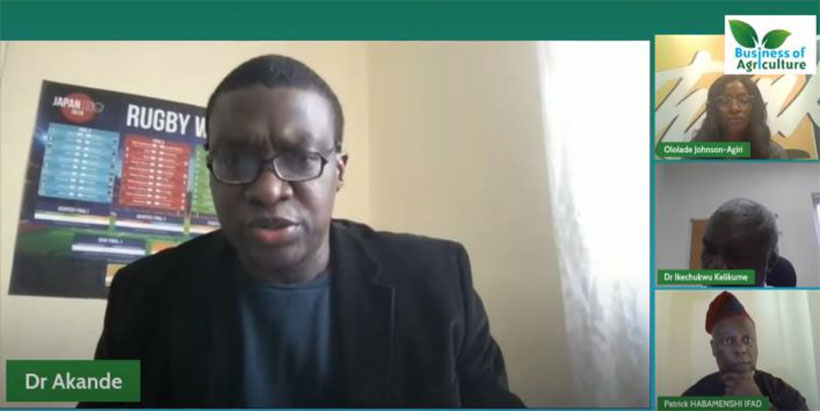
Dr Akande, sharing opportunities in agribusiness during the panel discussion.

In his speech, Dr Bolaji Balogun, Chair of PSAG, said there are millions of people in Nigeria and they are predominantly youth. The nation focuses on delivering food security and converting valuable natural resources in agriculture into revenue and inclusive growth across rural and urban economies. “Nigeria has an incredible opportunity to convert agriculture into a source of foreign currency revenues for the economy. This makes it important for this event to be held,” he said.

Abimbola Okoya, Chair of Cluster Five and the Executive Director of British America Tobacco Nigeria Foundation, gave the opening remarks. She mentioned that the Senior Special Adviser to the President on Sustainable Development Goals (SDGs) supports the program to tap into profitable opportunities in agriculture, build wealth, and achieve financial freedom in all its forms to attain the SDGs in Nigeria. Okoya further explained that the rationale behind the series is to create awareness and develop capability in agriculture. “The series aims to awaken a social consciousness on the opportunities that abound in the agricultural sector and evoke a renewed interest in the industry, accelerate access to resources that exist, and establish as well as strengthen young agripreneurs in the sector,” she said.

Dr Patrick Habamenshi, Country Director for the International Fund for African Development (IFAD), delivered the keynote address. He said agriculture would be nothing if the creation of enterprises and employment is not encouraged. Hence, this master class allows everyone to discuss the challenges and different value chains in agriculture and find their place in the sector. He advised that everyone take the opportunity to learn and ask the right questions for future action as there will be discussions on the structures in place to support young people to succeed.

During the panel discussion, Akande, also the Executive Assistant to the Governor of Oyo State on Agribusiness, shared opportunities in agribusiness. He described agriculture as a gold mine because of its eternal relevance to people’s well-being; hence, individuals can tap into various aspects such as production, value addition, and export.

Akande explained that specific skills must be learned, and knowledge gained for success in agriculture and agribusiness to be guaranteed. “Programs like this should be put in place to help change the mindset of youth and educate them on the challenges and opportunities associated with agribusiness,” he said. He added that seeking knowledge from peers who have made it in the sector despite the challenges will also help youth make better decisions regarding their engagement in the sector.

In her message, Senior Special Adviser to the President on SDGs, Her Excellency Princess Adejoke Orelope Adefulire, congratulated the leadership of PSAG for leading this effort and encouraging private sector participation in the 2030 agenda for sustainable development in Nigeria. She was represented by her Senior Technical Assistant, Dr Bala Yunusa, who said, “I believe that this will provide insights on how to strengthen system-wide solutions beyond individual organizations to explore the potential business opportunities in agriculture and inspire Nigerians to engage in agribusiness directly or indirectly.”

In her closing remarks, Ololade Johnson-Agiri, General Manager at British America Tobacco Nigeria Foundation, who also moderated the session, highlighted some expert advice from the panelists, especially the need to analyze one’s strength, do a risk assessment, and study one’s environment to identify what is profitable before going into the business of agriculture.


Contributed by

Related news

No items found

Leave a Reply

Your email address will not be published. Required fields are marked *

Scroll to Top
Olaosebikan, Olamide

Olamide Deborah Nwanze is a Senior Research Associate specializing in gender mainstreaming research to inform participatory and inclusive breeding, variety development, and seed systems policies regarding root, tuber, and banana (RTB) crops in the International Institute of Tropical Agriculture Headquarters, Ibadan, Nigeria. She is a PhD candidate at the University of Ibadan and holds an MSc and B. Agric in Agricultural Extension and Rural Development. Olamide is a fellow of the African Women in Agricultural Research and Development – Gender Responsive Agricultural Systems Policy (AWARD-GRASP) and the Gender Responsive Researchers Equipped for Agricultural Transformation (GREAT). She seeks to apply her gender-mainstreaming learnings, gender-responsive research, and policy development, and review expertise to facilitate women, youth, children, and vulnerable social group’s access to and adoption of agricultural Innovations that guarantee food, nutrition, income, and livelihood security in Africa. Her current roles include mentoring research fellows, development of guides and training manuals, implementation and adaptation of gender frameworks and tools, value chain actors’ engagement as citizen science partners, policy review and redesign, data management, and analysis. Her current research explores mixed methods and participatory and interdisciplinary approaches to capture and highlight gender dynamics, needs, preferences, and challenges stakeholders face within the agricultural livelihood value chain to prioritize gender-inclusive strategies in breeding programs, policy design, and implementation.

At IITA, she contributes to the implementation of the CGIAR Accelerated Breeding Initiative and Genetic Innovation Programs; participatory and gender research within the NextGen CassavaHarvestPlusRTBFoods, and Tricot-ClimMob 1000Farms Projects; and gender knowledge communication via the G-LENS webinar series, video documentary, policy briefspublications, and blogs.


Recent publications

de Sousa, K., van Etten, J., Manners, R. Bello, A., Teeken, B., Olaosebikan, O., et al. 2024. The tricot approach: an agile framework for decentralized on-farm testing supported by citizen science. A retrospective. Agron. Sustain. Dev. 44, 8. https://doi.org/10.1007/s13593-023-00937-1

Madu, T., Onwuka, S., Nwafor, S., Onyemauwa, N., Ejechi, M., Ofoeze, M., Ukeje, B., Eluagu, C., Olaosebikan, O., Okoye, B., 2024. Gender-Inclusive Consumer Studies Improve Cassava Breeding in Nigeria in: Frontiers in Sociology, volume 9, number: 1224504, doi: 10.3389/fsoc.2024.1224504

Olaosebikan, O.; Bello, A.; Utoblo, O.; Okoye, B.; Olutegbe, N.; Garner, E.; Teeken, B.; Bryan, E.; Forsythe, L.; Cole, S.; Madu, T. 2023.  Stressors and Resilience within the Cassava Value Chain in Nigeria: Preferred Cassava Variety Traits and Response Strategies of Men and Women to Inform Breeding. Sustainability 15, 7837. https://doi.org/10.3390/su15107837

Okoye, B., Ofoeze, M., Ejechi, M., Onwuka, S., Nwafor, S., Onyemauwa, N., Ukeje, B., Eluagu, C., Obidiegwu, J.*, Olaosebikan, O., Madu, T.* 2023. Prioritizing preferred traits in the yam value chain in Nigeria: a gender situation analysis in: Frontiers in Sociology, volume 8, number: 1232626, pages 1 – 9, ISSN 2297-7775, 2023. https://www.frontiersin.org/articles/10.3389/fsoc.2023.1232626/full

Olaosebikan, O., Bello, A. A., de Sousa, K., Ndjouenkeu, R., Adesokan, M., Alamu, E. O., Agbona, A., van Etten, J., Kegah, F. N.*, Dufour, D., Bouniol, A., Teeken, B. 2023. Consumer acceptability of cassava gari-eba food products across cultural and environmental settings using the triadic comparison of technologies approach (tricot) in: Journal of the Science of Food and Agriculture,

Teeken, B., Olaosebikan, O., Bello, A. A., Madu, T.*, Cole, S. M. 2023. Qualitative assessment on the positionality and preferences of dyads in relation to cassava-related activities: working with tricot trial citizen scientists https://hdl.handle.net/10568/138326 Type: Manual

Bouniol, A., Ceballos, H., Bello, A. A., Teeken, B., Olaosebikan, O., Owoade, D., Agbona, A., Fotso Kuate, A., Madu, T.*, Okoye, B.*, Ofoeze, M.*, Nwafor, S.*, Onyemauwa, N.*, Adinsi, L.*, Forsythe, L., Dufour, D. 2023. Varietal impact on women’s labour, workload and related drudgery in processing root, tuber and banana crops: focus on cassava in sub-Saharan Africa in: Journal of the Science of Food and Agriculture, pages 1 – 25, ISSN 0022-5142,

Bello, A. A., Agbona, A., Olaosebikan, O., Edughaen, G., Dufour, D., Bouniol, A., Iluebbey, P., Ndjouenkeu, R.*, Rabbi, I. Y., Teeken, B. 2023. Genetic and environmental effects on processing productivity and food product yield: drudgery of women’s work in: Journal of the Science of Food and Agriculture, pages 1 – 32, ISSN 0022-5142, 5

Cavicchioli, M., Zimbiti, T., Teeken, B., Nwanze, D.O., Liani, M., Parkes, E. & Bello, A. 2023. IITA-Gender Responsive Breeding Training Report. Genetic Resources Center, IITA-HQ, Ibadan, 21-23 September, 2022. Ibadan, Nigeria: IITA, (34 p.).https://hdl.handle.net/10568/131368

Agbona, A. Peteti P., Teeken B., Olaosebikan O. Bello, A. A., Parkes, E., Rabbi, I. Y., Mueller, L., Egesi, C., Kulakow, P. 2022. Data Management in Multi-disciplinary African RTB Crop Breeding Programs. In: Williamson, H.F., Leonelli, S. (eds) Towards Responsible Plant Data Linkage: Data Challenges for Agricultural Research and Development. Springer, Cham. https://doi.org/10.1007/978-3-031-13276-6_5

Lora Forsythe, Pricilla Marimo, Sarah Mayanja, Olamide D. Olaosebikan, Esme Stuart, Bela Teeken, Benjamin Okoye, Tessy Madu, (2021). Cross-product Gender Analysis of RTBfoods Step 2 Gendered Food Mapping on RTB Products. Understanding the Drivers of Trait Preferences and the Development of Multi-user RTB Product Profiles, WP1. London, UK: RTBfoods Field Scientific Report, 30 p.

Teeken, B., Garner, E., Agbona, A., Balogun, I., Olaosebikan, O., Bello, A., Madu, T., Okoye, B., Egesi, C., Kulakow, P. and Tufan, H.A. 2021. Beyond “Women’s Traits”: Exploring How Gender, Social Difference, and Household Characteristics Influence Trait Preferences. Frontiers Sustainable Food Systems 5:740926. https://doi.org/10.3389/fsufs.2021.740926

Teeken, B., Agbona, A., Bello, A., Olaosebikan, O., Alamu, E., Adesokan, M., Awoyale, W., Madu, T., Okoye, B., Chijioke, U., Owoade, D., Okoro, M., Bouniol, A., Dufour, D., Hershey, C., Rabbi, I., Maziya‐Dixon, B., Egesi, C., Tufan, H. and Kulakow, P. (020. Understanding cassava varietal preferences through pairwise ranking of gari‐eba and fufu prepared by local farmer–processors. Int J Food Sci Technol. https://doi.org/10.1111/ijfs.14862

Bela Teeken, Olamide Olaosebikan, Ireti Balogun, Benjamin Okoye, Tessy Madu, Steven Cole, Abolore Bello, Elizabeth Parkes. (2020). Piloting the G+ customer and product profile tools for gender-responsive cassava breeding in Nigeria. Nigeria: International Institute of Tropical Agriculture (IITA). https://hdl.handle.net/20.500.11766/13000