
Fall armyworm: Forum advocates cocktail of solutions before the next outbreak
October 1, 2018
Farmers across Africa are reeling under huge losses linked to the devastation by the invasive species called fall armyworm (FAW) or Spodoptera frugiperda.
With origins in Eastern and Central North America as well as South America, the caterpillar has since 2016, found its way into 44 African countries, causing significant damage to maize crops with great potential for further spread and economic damage.
 In sub-Saharan Africa, fall armyworm has caused heavy losses to staple cereals, especially maize and sorghum, affecting food security and trade, thus upsetting the continent’s plan to feed itself.
The extent of the destruction on maize alone is estimated to be between US$2.5 and 6.2 billion per year, destabilizing the livelihoods of around 300 million people.
This and many more reasons spurred experts attending the 2018 African Green Revolution Forum (AGRF2018) in Kigali, Rwanda, to explore ways of preventing or mitigating the next outbreak in Africa.
Setting the scene at a session on building the resilience of Africa’s agriculture against invasive species, Dr Dennis Rangi, Director General of the Centre for Agriculture and Biosciences International (CABI) identified continuing globalization through increasing trade, travel, and transport of goods across borders as one of the factors facilitating the spread of invasive species, with an increasing negative impact.
The problem, according to him, “is global in scope and requires international cooperation to supplement the actions of governments, the private sector, and organizations at national and local levels.”
The recent arrival of fall armyworm in India is a case in point. The caterpillar’s leap from Africa to India confirms the global nature of invasive species and the need for partnerships to tackle the pest.
According to Rangi, “a straightforward, three-pronged, internationally recognized approach to addressing the problem of invasive species, namely prevention, early detection and rapid response, and lastly control will help a great deal.”
However, transforming this approach into a reality in policy and practice remains a huge challenge in Africa as African famers usually find themselves trying to address the latest invasion, when the previous invasion is yet to be cleared.
In sub-Saharan Africa, fall armyworm has caused heavy losses to staple cereals, especially maize and sorghum, affecting food security and trade, thus upsetting the continent’s plan to feed itself.
The extent of the destruction on maize alone is estimated to be between US$2.5 and 6.2 billion per year, destabilizing the livelihoods of around 300 million people.
This and many more reasons spurred experts attending the 2018 African Green Revolution Forum (AGRF2018) in Kigali, Rwanda, to explore ways of preventing or mitigating the next outbreak in Africa.
Setting the scene at a session on building the resilience of Africa’s agriculture against invasive species, Dr Dennis Rangi, Director General of the Centre for Agriculture and Biosciences International (CABI) identified continuing globalization through increasing trade, travel, and transport of goods across borders as one of the factors facilitating the spread of invasive species, with an increasing negative impact.
The problem, according to him, “is global in scope and requires international cooperation to supplement the actions of governments, the private sector, and organizations at national and local levels.”
The recent arrival of fall armyworm in India is a case in point. The caterpillar’s leap from Africa to India confirms the global nature of invasive species and the need for partnerships to tackle the pest.
According to Rangi, “a straightforward, three-pronged, internationally recognized approach to addressing the problem of invasive species, namely prevention, early detection and rapid response, and lastly control will help a great deal.”
However, transforming this approach into a reality in policy and practice remains a huge challenge in Africa as African famers usually find themselves trying to address the latest invasion, when the previous invasion is yet to be cleared.
 To overcome these challenges, the CABI DG urged African countries to create a policy and regulatory environment that promotes sustainable approaches in tackling invasive species; and put in place a national invasive species strategy, an action plan, and a sustainable investment plan.
Dr May-Guri Saethre, Deputy Director General, Research for Development at IITA, bemoaned the fact that the burden of handling and combating invasive species on a day-to-day manner is to a large extent left to the individual smallholder farmers in Africa.
The way forward, according to her, lies in “working together with farmers, government, researchers, and the private sector as current outbreaks are wake- up calls for firm action to protect Africa’s agriculture from the destructive impact of pest outbreaks.”
“To prevent the next outbreak, technologies capable of stopping pest and disease entry into Africa by pre- emptive biological controls, horizon scanning, and effective early warning systems are available and must be deployed to prevent establishment of new pests through coordinated response and eradication programs,” Saethre added.
Chief Scientist at the USAID Bureau for Food Security, Dr Rob Bertram sees it differently. To him, fall armyworm is a reminder that we live in a small world that is increasingly becoming smaller and we are more connected than ever. The answer therefore, “is more global connectedness through south–south and north–south learning; research networks; national level leadership; and a coherent regional approach to invasive species,” he said.
In all, the experts were of the view that tackling fall armyworm in Africa requires a cocktail of solutions, which include an enabling policy environment, a science and evidence-based framework, research, and development that encourages private sector investment, local knowledge sharing, information dissemination, and surveillance.
The forum also agreed substantially with the Director General of the Rwanda Agriculture Board, Dr Dennis Kyetere, in his assertion that for Africa to feed itself, “agriculture must now be knowledge intensive and technology intensive.”
To overcome these challenges, the CABI DG urged African countries to create a policy and regulatory environment that promotes sustainable approaches in tackling invasive species; and put in place a national invasive species strategy, an action plan, and a sustainable investment plan.
Dr May-Guri Saethre, Deputy Director General, Research for Development at IITA, bemoaned the fact that the burden of handling and combating invasive species on a day-to-day manner is to a large extent left to the individual smallholder farmers in Africa.
The way forward, according to her, lies in “working together with farmers, government, researchers, and the private sector as current outbreaks are wake- up calls for firm action to protect Africa’s agriculture from the destructive impact of pest outbreaks.”
“To prevent the next outbreak, technologies capable of stopping pest and disease entry into Africa by pre- emptive biological controls, horizon scanning, and effective early warning systems are available and must be deployed to prevent establishment of new pests through coordinated response and eradication programs,” Saethre added.
Chief Scientist at the USAID Bureau for Food Security, Dr Rob Bertram sees it differently. To him, fall armyworm is a reminder that we live in a small world that is increasingly becoming smaller and we are more connected than ever. The answer therefore, “is more global connectedness through south–south and north–south learning; research networks; national level leadership; and a coherent regional approach to invasive species,” he said.
In all, the experts were of the view that tackling fall armyworm in Africa requires a cocktail of solutions, which include an enabling policy environment, a science and evidence-based framework, research, and development that encourages private sector investment, local knowledge sharing, information dissemination, and surveillance.
The forum also agreed substantially with the Director General of the Rwanda Agriculture Board, Dr Dennis Kyetere, in his assertion that for Africa to feed itself, “agriculture must now be knowledge intensive and technology intensive.”
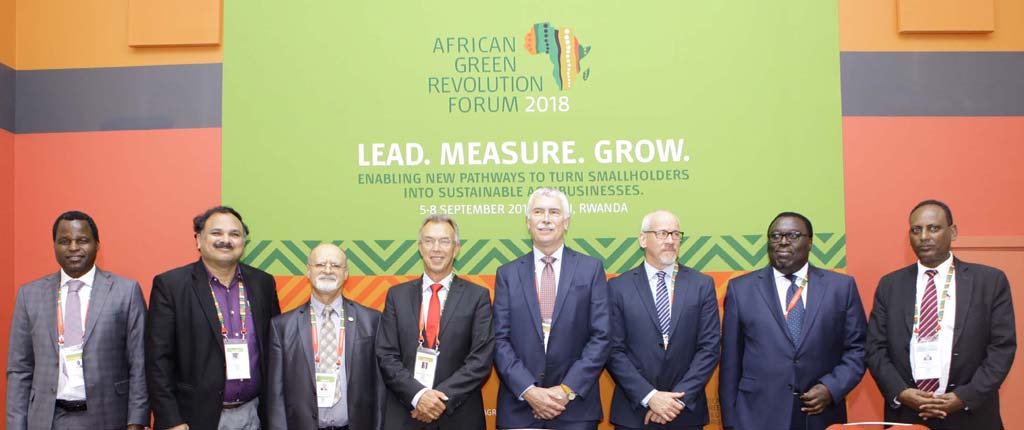
The experts and representatives of participating organizations pose for a group photo.
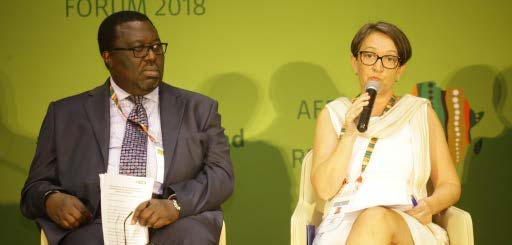
Dennis Rangi, CABI; and May-Guri Saethre, IITA, in a panel discussion
Contributed by
Recent stories
No items found