
Farmers need timely access to quality seed and other essential agricultural inputs to ensure optimal crop yield contributing to improved household-level food security. According to the International Seed Federation (ISF), “The world’s long-term stability rests on several pillars, one of which is food security. Seed is the starting point of the food system, and farmers everywhere depend on access to quality seed to grow healthy crops.”
However, according to the Food and Agriculture Organization of the United Nations (FAO), “In many developing countries (including Nigeria), farmers have not yet been able to fully benefit from the advantages of using quality seed due to a combination of factors, including inefficient seed production, distribution, and quality assurance systems, as well as bottlenecks caused by a lack of good seed policy on key issues such as access to credit for inputs.”
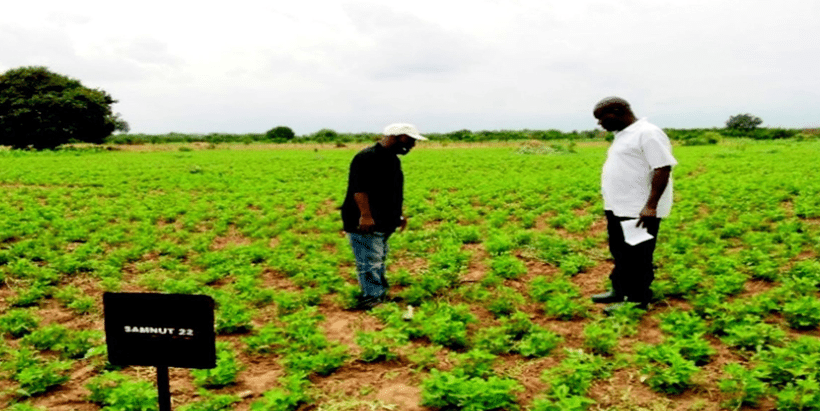
To adequately address the issue of quality seed and its availability, IITA, under the Feed the Future Nigeria Integrated Agriculture Activity, established an effective partnership in September 2019 with the National Agricultural Seeds Council (NASC). The NASC agency of the Federal Ministry of Agriculture and Rural Development (FMARD) oversees the development and regulation of Nigeria’s seed industry.
The partnership was established specifically to develop a sustainable seed system that will produce quality seeds and make them available locally in Northeast Nigeria. The Community Based Seed Enterprise (CBSE), seed companies, IITA, and NASC are the stakeholders of this seed system. Under the partnership, the Activity facilitates foundation seeds from IITA and other relevant research institutes to CBSEs, trained and supervised by the Activity and NASC officers to produce seeds certified by NASC.
The partnership facilitates the selection, training, and development of 1,185 community-based seed producers (CBSP) from the Producer Groups of Farmers. It promotes the sustainable production of certified seeds at the community level.
A recent evaluation study—Integrated Agriculture Activity 2021 annual survey—indicated that a total of 33,165 smallholder farmers are accessing 529 tons of certified seeds from the established community-based seed producers across the two implementation states—Adamawa and Borno—through this partnership.
This partnership has created access to high-yielding varieties, developed greater climate resilience, and generated income through employment creation for smallholder farmers.
Contributed by
Recent stories