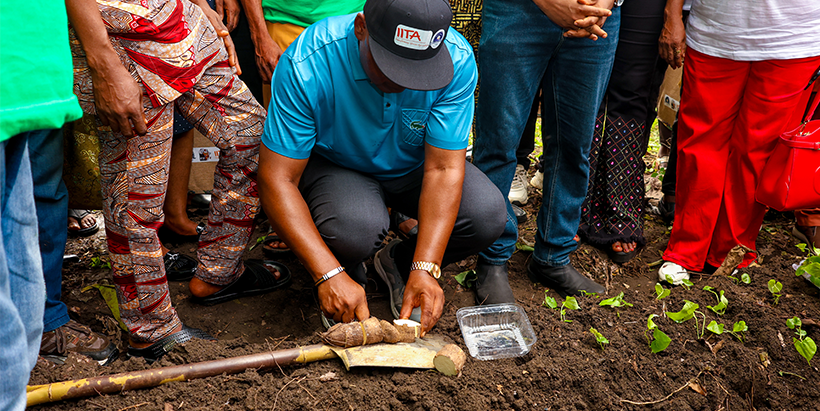
Dr Pelemo showing the farmers how to divide miniseets before planting on the field.
Yams are more than a staple food in Nigeria. For millions of households, they are central to food security, income, and cultural identity. Yet, many farmers continue to struggle with poor seed quality, limited access to improved farming practices, and limited market linkages.
In Cross River State, some farmers travel over 300 kilometers to Taraba State each planting season to source seeds, often facing high costs and the risk of poor quality planting materials.
To address these challenges and unlock new opportunities for farmers, IITA–CGIAR, in partnership with the Cross River State Government, organized a week-long Training of Trainers (ToT) program in Calabar focused on yam seed technologies, agronomic best practices, and agribusiness development. The training brought together farmers, extension agents, and government officials to strengthen the yam value chain and improve productivity across farming communities in 17 local government areas.
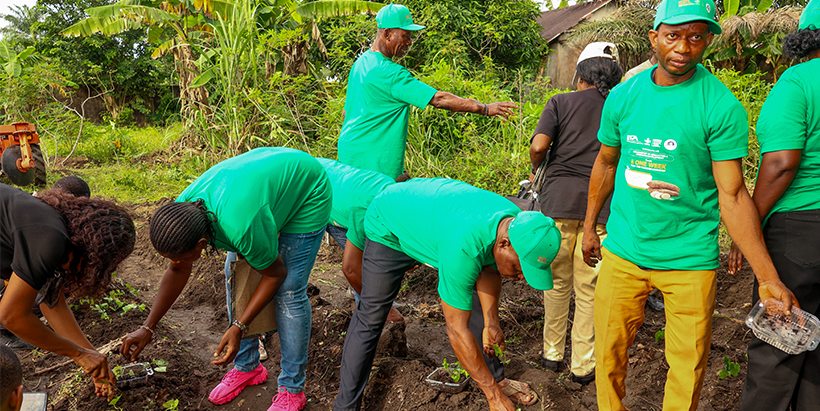
Yam farmers during the field practicals in Calabar Municipal.
At the heart of the training was a simple message: agricultural innovation delivers impact only when farmers have the knowledge and capacity to use it effectively. Participants are expected to replicate the training in their communities through a structured step-down approach that ensures wider reach at the grassroots level.
The training serves as the first phase of a broader capacity development strategy designed to equip participants with practical skills and technical expertise in modern yam seed systems and production methods.
Speaking during the training, Dr Olugboyega Pelemo, Field and Seed Systems Specialist under the IITA Yam Improvement Program, emphasized the importance of scaling innovation through capacity development.
“Innovative technologies like the minisett, vine cutting, semi-autotropic hydroponics (SAH), and mini tubers that we developed at IITA will only become visible when they are scaled, and scaling can become impactful when the capacity of key actors is developed. At the end of the seed yam production training, farmer-beneficiaries will transfer the knowledge to farmers in their various communities across Cross River State.”
The training which was organised by the IITA Yam Breeding Program along with the Capacity Development Office of IITA, focused on innovative technologies and good agronomic practices (GAP) for yam production, including improved seed systems that help farmers increase yields, reduce losses, and improve the quality of planting materials.
Modupe Banwo, IITA External Training Manager who co-facilitated sessions, enjoined the farmers to endeavor to practice what they have learnt while also sharing the knowledge as this will help drive the impact faster in the state.
The Cross River State Government says the initiative aligns with its broader agricultural development agenda, which aims to empower farmers and strengthen food systems across the state.
Commissioner for Agriculture and Irrigation Development, Johnson Andiambey Ebokpo, reaffirmed the government’s commitment to supporting farmers through capacity development and strategic partnerships.
“As part of the agricultural agenda, the government is committed to providing the requisite capacity and resources to support the farmers of Cross River. This training for yam farmers facilitated by IITA is the first and will be replicated across other crops like plantain.”
The collaboration reflects the importance of partnership between research institutions and government agencies in delivering innovation directly to farming communities.
Beyond improving farm productivity, the initiative also aims to strengthen agribusiness opportunities along the yam value chain. By developing community-based seed producers and improving access to quality seed technologies, the program seeks to create sustainable economic opportunities for farmers and rural entrepreneurs.
Farmers are already feeling the impact. Esther Emmanghe from Etung Local Government started sharing new techniques with fellow neighbors in her community immediately after the training.
“I told people about the minisett and vine cutting technology; many of us farmers will put together a group that will use all we learned during this training,” she added excitedly.
Dr Michael Udam, a secondary school vice principal and a yam farmer in Adagom community in the Ogoja local government, said that while he had some knowledge of vine cutting and minisett, the training provided new knowledge that he would pass to his community.
“I am happy that this training came now when some farmers have been complaining of traveling to far places like Taraba State to get seed yams to plant. With this training, I will start planting seed yams myself. I am sure some other farmers will do the same,” he said.
The IITA Yam Breeding Program under the leadership of Dr Asrat Amele continues to lead research and innovation that addresses the needs of farmers while promoting food security and rural development.
Through this initiative, IITA and its partners are working to ensure that improved technologies and knowledge reach farmers at scale and contribute to building a more resilient and profitable yam sector in Nigeria.
Contributed by ‘Timilehin Osunde
Olamide Deborah Nwanze is a Senior Research Associate specializing in gender mainstreaming research to inform participatory and inclusive breeding, variety development, and seed systems policies regarding root, tuber, and banana (RTB) crops in the International Institute of Tropical Agriculture Headquarters, Ibadan, Nigeria. She is a PhD candidate at the University of Ibadan and holds an MSc and B. Agric in Agricultural Extension and Rural Development. Olamide is a fellow of the African Women in Agricultural Research and Development – Gender Responsive Agricultural Systems Policy (AWARD-GRASP) and the Gender Responsive Researchers Equipped for Agricultural Transformation (GREAT). She seeks to apply her gender-mainstreaming learnings, gender-responsive research, and policy development, and review expertise to facilitate women, youth, children, and vulnerable social group’s access to and adoption of agricultural Innovations that guarantee food, nutrition, income, and livelihood security in Africa. Her current roles include mentoring research fellows, development of guides and training manuals, implementation and adaptation of gender frameworks and tools, value chain actors’ engagement as citizen science partners, policy review and redesign, data management, and analysis. Her current research explores mixed methods and participatory and interdisciplinary approaches to capture and highlight gender dynamics, needs, preferences, and challenges stakeholders face within the agricultural livelihood value chain to prioritize gender-inclusive strategies in breeding programs, policy design, and implementation.
de Sousa, K., van Etten, J., Manners, R. Bello, A., Teeken, B., Olaosebikan, O., et al. 2024. The tricot approach: an agile framework for decentralized on-farm testing supported by citizen science. A retrospective. Agron. Sustain. Dev. 44, 8. https://doi.org/10.1007/s13593-023-00937-1
Madu, T., Onwuka, S., Nwafor, S., Onyemauwa, N., Ejechi, M., Ofoeze, M., Ukeje, B., Eluagu, C., Olaosebikan, O., Okoye, B., 2024. Gender-Inclusive Consumer Studies Improve Cassava Breeding in Nigeria in: Frontiers in Sociology, volume 9, number: 1224504, doi: 10.3389/fsoc.2024.1224504
Olaosebikan, O.; Bello, A.; Utoblo, O.; Okoye, B.; Olutegbe, N.; Garner, E.; Teeken, B.; Bryan, E.; Forsythe, L.; Cole, S.; Madu, T. 2023. Stressors and Resilience within the Cassava Value Chain in Nigeria: Preferred Cassava Variety Traits and Response Strategies of Men and Women to Inform Breeding. Sustainability 15, 7837. https://doi.org/10.3390/su15107837
Okoye, B., Ofoeze, M., Ejechi, M., Onwuka, S., Nwafor, S., Onyemauwa, N., Ukeje, B., Eluagu, C., Obidiegwu, J.*, Olaosebikan, O., Madu, T.* 2023. Prioritizing preferred traits in the yam value chain in Nigeria: a gender situation analysis in: Frontiers in Sociology, volume 8, number: 1232626, pages 1 – 9, ISSN 2297-7775, 2023. https://www.frontiersin.org/articles/10.3389/fsoc.2023.1232626/full
Olaosebikan, O., Bello, A. A., de Sousa, K., Ndjouenkeu, R., Adesokan, M., Alamu, E. O., Agbona, A., van Etten, J., Kegah, F. N.*, Dufour, D., Bouniol, A., Teeken, B. 2023. Consumer acceptability of cassava gari-eba food products across cultural and environmental settings using the triadic comparison of technologies approach (tricot) in: Journal of the Science of Food and Agriculture,
Teeken, B., Olaosebikan, O., Bello, A. A., Madu, T.*, Cole, S. M. 2023. Qualitative assessment on the positionality and preferences of dyads in relation to cassava-related activities: working with tricot trial citizen scientists https://hdl.handle.net/10568/138326 Type: Manual
Bouniol, A., Ceballos, H., Bello, A. A., Teeken, B., Olaosebikan, O., Owoade, D., Agbona, A., Fotso Kuate, A., Madu, T.*, Okoye, B.*, Ofoeze, M.*, Nwafor, S.*, Onyemauwa, N.*, Adinsi, L.*, Forsythe, L., Dufour, D. 2023. Varietal impact on women’s labour, workload and related drudgery in processing root, tuber and banana crops: focus on cassava in sub-Saharan Africa in: Journal of the Science of Food and Agriculture, pages 1 – 25, ISSN 0022-5142,
Bello, A. A., Agbona, A., Olaosebikan, O., Edughaen, G., Dufour, D., Bouniol, A., Iluebbey, P., Ndjouenkeu, R.*, Rabbi, I. Y., Teeken, B. 2023. Genetic and environmental effects on processing productivity and food product yield: drudgery of women’s work in: Journal of the Science of Food and Agriculture, pages 1 – 32, ISSN 0022-5142, 5
Cavicchioli, M., Zimbiti, T., Teeken, B., Nwanze, D.O., Liani, M., Parkes, E. & Bello, A. 2023. IITA-Gender Responsive Breeding Training Report. Genetic Resources Center, IITA-HQ, Ibadan, 21-23 September, 2022. Ibadan, Nigeria: IITA, (34 p.).https://hdl.handle.net/10568/131368
Agbona, A. Peteti P., Teeken B., Olaosebikan O. Bello, A. A., Parkes, E., Rabbi, I. Y., Mueller, L., Egesi, C., Kulakow, P. 2022. Data Management in Multi-disciplinary African RTB Crop Breeding Programs. In: Williamson, H.F., Leonelli, S. (eds) Towards Responsible Plant Data Linkage: Data Challenges for Agricultural Research and Development. Springer, Cham. https://doi.org/10.1007/978-3-031-13276-6_5
Lora Forsythe, Pricilla Marimo, Sarah Mayanja, Olamide D. Olaosebikan, Esme Stuart, Bela Teeken, Benjamin Okoye, Tessy Madu, (2021). Cross-product Gender Analysis of RTBfoods Step 2 Gendered Food Mapping on RTB Products. Understanding the Drivers of Trait Preferences and the Development of Multi-user RTB Product Profiles, WP1. London, UK: RTBfoods Field Scientific Report, 30 p.
Teeken, B., Garner, E., Agbona, A., Balogun, I., Olaosebikan, O., Bello, A., Madu, T., Okoye, B., Egesi, C., Kulakow, P. and Tufan, H.A. 2021. Beyond “Women’s Traits”: Exploring How Gender, Social Difference, and Household Characteristics Influence Trait Preferences. Frontiers Sustainable Food Systems 5:740926. https://doi.org/10.3389/fsufs.2021.740926
Teeken, B., Agbona, A., Bello, A., Olaosebikan, O., Alamu, E., Adesokan, M., Awoyale, W., Madu, T., Okoye, B., Chijioke, U., Owoade, D., Okoro, M., Bouniol, A., Dufour, D., Hershey, C., Rabbi, I., Maziya‐Dixon, B., Egesi, C., Tufan, H. and Kulakow, P. (020. Understanding cassava varietal preferences through pairwise ranking of gari‐eba and fufu prepared by local farmer–processors. Int J Food Sci Technol.https://doi.org/10.1111/ijfs.14862
Bela Teeken, Olamide Olaosebikan, Ireti Balogun, Benjamin Okoye, Tessy Madu, Steven Cole, Abolore Bello, Elizabeth Parkes. (2020). Piloting the G+ customer and product profile tools for gender-responsive cassava breeding in Nigeria. Nigeria: International Institute of Tropical Agriculture (IITA). https://hdl.handle.net/20.500.11766/13000