
IITA NEWS

High soybean prices bode well for IITA’s MISST project
June 10, 2016

The soybean marketing season is in full swing. Buyers are everywhere looking for the crop. In a drought-hit farming season, soybean has generally done well and farmers are at least assured of getting something from their produce.
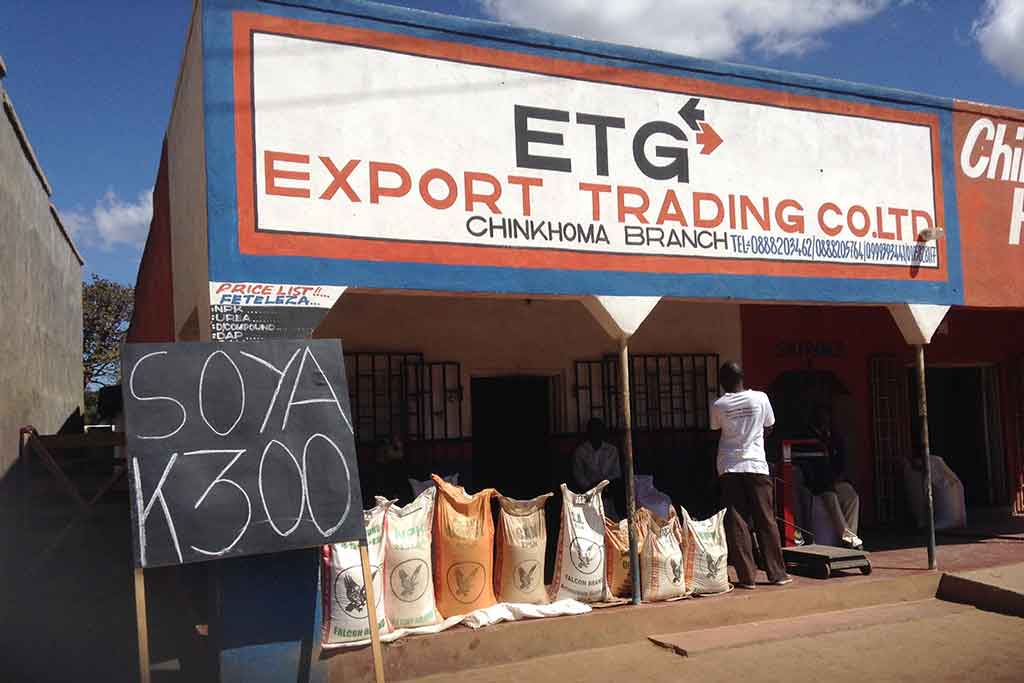
High-Soybean

Prices have been good this year. A snap survey showed that soybean prices have increased by an average of 100% since the start of the marketing period.

Chabwera Dzonzi, a soybean farmer from Chankoma Village in the area of Traditional Authority (TA) Msakambewa in Dowa was all smiles when he sold his two 50-kg bags at Tiyenazoni Traders at Mponela in the district. “

When the marketing season opened in early April, soybean prices were at around K180 per kilogram. As of midMay, I have sold my soybean at K330 (about 50 US cents) per kilogram. From the same quantity which could have given me K18,000 ($26), I have made K33,000 ($47). This is good for us farmers, and I urge all the buyers to continue offering such good prices,” narrated a happy Dzonzi.

The story was the same at most soybean buying points around Mponela. The lowest price offered within Mponela was K310, which is higher than the prices during this time last year.

John Mtelemuka of Mandere General Dealers, who buys soybean at Mponela, gave a variety of reasons for the soaring soybean prices.

“There are several reasons for such an increase in prices. One is that there is a lot of speculation among us, the buyers. There is a belief that due to the drought experienced in the last farming season, there is less production. As such, many buyers are willing to offer higher prices and buy as much as they can,” explained Mtelemuka.

Mtelemuka added that the other reason is that more and more farmers are becoming aware that they can negotiate for higher prices. And this is true of those farmers who come in groups, clubs, and cooperatives. Other (individual) farmers who heard that their colleagues sold at a higher price also demanded the higher prices.

“We have had more farmers coming with their produce as clubs. We offer better prices to those who bring 500 kg or more. Farmers have realized this, so they would like to maximize the money they make by bulking their soybean in groups,” said Mtelemuka.

The prices were similar at Madisi, Chinkhoma in Kasungu, Kasungu boma, Santhe, Kamwendo, and Waliranji in Mchinji. The rapid price rise has been the same with the Export Trading Group (ETG) at Chinkhoma in Kasungu. Febby Gwede is a Crops Buying Officer at the Chinkhoma ETG shop―she gives another possible reason for the price increase. “

What we have observed here is that farmers are holding on to their produce having realized that the price keeps changing almost each and every week. And we encourage farmers to bring their crops in cooperatives because we offer them a higher price,” explained Gwede.

A farmer selling his soybean crop at Chinkhoma ETG shop, Mphatso Patrick, said he is happy with the prices this season, and prayed that the momentum would continue to next year.

“Last year, the highest price for soybean was K250. But this year, we are already offered K330 in May. I’m asking all the soybean buying companies to maintain these kinds of prices because obviously, it will encourage more farmers to increase the production of soybean,” explained Patrick.

Dzonzi of Mponela earlier expressed similar sentiments―of increased production in the next farming season, and hoping for continued good prices.

“This year, I planted soybean on a 0.5 hectare piece of land, and because I did not plant certified seed, I only managed to harvest 350 kg (7 bags of 50-kg each). Next year, with the information you have provided about improved certified soybean varieties, I hope to dedicate about a hectare of my land to soybean because it’s much easier to produce than tobacco,” said Dzonzi.

This is where projects like the Malawi Improved Seed Systems and Technologies (MISST) being implemented by IITA are crucial in enabling farmers like Dzonzi and Patrick to access better quality seeds and better agronomic practices.

Patrick said, “I am happy that you came to visit us. I have learned a lot from you. Next season, I will make sure I acquire certified seeds so that I harvest more. And your visits to these markets will also help to keep the prices high because the buyers will know that they are being monitored”.


Contributed by

Related news

No items found

Leave a Reply

Your email address will not be published. Required fields are marked *

Scroll to Top
Olaosebikan, Olamide

Olamide Deborah Nwanze is a Senior Research Associate specializing in gender mainstreaming research to inform participatory and inclusive breeding, variety development, and seed systems policies regarding root, tuber, and banana (RTB) crops in the International Institute of Tropical Agriculture Headquarters, Ibadan, Nigeria. She is a PhD candidate at the University of Ibadan and holds an MSc and B. Agric in Agricultural Extension and Rural Development. Olamide is a fellow of the African Women in Agricultural Research and Development – Gender Responsive Agricultural Systems Policy (AWARD-GRASP) and the Gender Responsive Researchers Equipped for Agricultural Transformation (GREAT). She seeks to apply her gender-mainstreaming learnings, gender-responsive research, and policy development, and review expertise to facilitate women, youth, children, and vulnerable social group’s access to and adoption of agricultural Innovations that guarantee food, nutrition, income, and livelihood security in Africa. Her current roles include mentoring research fellows, development of guides and training manuals, implementation and adaptation of gender frameworks and tools, value chain actors’ engagement as citizen science partners, policy review and redesign, data management, and analysis. Her current research explores mixed methods and participatory and interdisciplinary approaches to capture and highlight gender dynamics, needs, preferences, and challenges stakeholders face within the agricultural livelihood value chain to prioritize gender-inclusive strategies in breeding programs, policy design, and implementation.

At IITA, she contributes to the implementation of the CGIAR Accelerated Breeding Initiative and Genetic Innovation Programs; participatory and gender research within the NextGen CassavaHarvestPlusRTBFoods, and Tricot-ClimMob 1000Farms Projects; and gender knowledge communication via the G-LENS webinar series, video documentary, policy briefspublications, and blogs.


Recent publications

de Sousa, K., van Etten, J., Manners, R. Bello, A., Teeken, B., Olaosebikan, O., et al. 2024. The tricot approach: an agile framework for decentralized on-farm testing supported by citizen science. A retrospective. Agron. Sustain. Dev. 44, 8. https://doi.org/10.1007/s13593-023-00937-1

Madu, T., Onwuka, S., Nwafor, S., Onyemauwa, N., Ejechi, M., Ofoeze, M., Ukeje, B., Eluagu, C., Olaosebikan, O., Okoye, B., 2024. Gender-Inclusive Consumer Studies Improve Cassava Breeding in Nigeria in: Frontiers in Sociology, volume 9, number: 1224504, doi: 10.3389/fsoc.2024.1224504

Olaosebikan, O.; Bello, A.; Utoblo, O.; Okoye, B.; Olutegbe, N.; Garner, E.; Teeken, B.; Bryan, E.; Forsythe, L.; Cole, S.; Madu, T. 2023.  Stressors and Resilience within the Cassava Value Chain in Nigeria: Preferred Cassava Variety Traits and Response Strategies of Men and Women to Inform Breeding. Sustainability 15, 7837. https://doi.org/10.3390/su15107837

Okoye, B., Ofoeze, M., Ejechi, M., Onwuka, S., Nwafor, S., Onyemauwa, N., Ukeje, B., Eluagu, C., Obidiegwu, J.*, Olaosebikan, O., Madu, T.* 2023. Prioritizing preferred traits in the yam value chain in Nigeria: a gender situation analysis in: Frontiers in Sociology, volume 8, number: 1232626, pages 1 – 9, ISSN 2297-7775, 2023. https://www.frontiersin.org/articles/10.3389/fsoc.2023.1232626/full

Olaosebikan, O., Bello, A. A., de Sousa, K., Ndjouenkeu, R., Adesokan, M., Alamu, E. O., Agbona, A., van Etten, J., Kegah, F. N.*, Dufour, D., Bouniol, A., Teeken, B. 2023. Consumer acceptability of cassava gari-eba food products across cultural and environmental settings using the triadic comparison of technologies approach (tricot) in: Journal of the Science of Food and Agriculture,

Teeken, B., Olaosebikan, O., Bello, A. A., Madu, T.*, Cole, S. M. 2023. Qualitative assessment on the positionality and preferences of dyads in relation to cassava-related activities: working with tricot trial citizen scientists https://hdl.handle.net/10568/138326 Type: Manual

Bouniol, A., Ceballos, H., Bello, A. A., Teeken, B., Olaosebikan, O., Owoade, D., Agbona, A., Fotso Kuate, A., Madu, T.*, Okoye, B.*, Ofoeze, M.*, Nwafor, S.*, Onyemauwa, N.*, Adinsi, L.*, Forsythe, L., Dufour, D. 2023. Varietal impact on women’s labour, workload and related drudgery in processing root, tuber and banana crops: focus on cassava in sub-Saharan Africa in: Journal of the Science of Food and Agriculture, pages 1 – 25, ISSN 0022-5142,

Bello, A. A., Agbona, A., Olaosebikan, O., Edughaen, G., Dufour, D., Bouniol, A., Iluebbey, P., Ndjouenkeu, R.*, Rabbi, I. Y., Teeken, B. 2023. Genetic and environmental effects on processing productivity and food product yield: drudgery of women’s work in: Journal of the Science of Food and Agriculture, pages 1 – 32, ISSN 0022-5142, 5

Cavicchioli, M., Zimbiti, T., Teeken, B., Nwanze, D.O., Liani, M., Parkes, E. & Bello, A. 2023. IITA-Gender Responsive Breeding Training Report. Genetic Resources Center, IITA-HQ, Ibadan, 21-23 September, 2022. Ibadan, Nigeria: IITA, (34 p.).https://hdl.handle.net/10568/131368

Agbona, A. Peteti P., Teeken B., Olaosebikan O. Bello, A. A., Parkes, E., Rabbi, I. Y., Mueller, L., Egesi, C., Kulakow, P. 2022. Data Management in Multi-disciplinary African RTB Crop Breeding Programs. In: Williamson, H.F., Leonelli, S. (eds) Towards Responsible Plant Data Linkage: Data Challenges for Agricultural Research and Development. Springer, Cham. https://doi.org/10.1007/978-3-031-13276-6_5

Lora Forsythe, Pricilla Marimo, Sarah Mayanja, Olamide D. Olaosebikan, Esme Stuart, Bela Teeken, Benjamin Okoye, Tessy Madu, (2021). Cross-product Gender Analysis of RTBfoods Step 2 Gendered Food Mapping on RTB Products. Understanding the Drivers of Trait Preferences and the Development of Multi-user RTB Product Profiles, WP1. London, UK: RTBfoods Field Scientific Report, 30 p.

Teeken, B., Garner, E., Agbona, A., Balogun, I., Olaosebikan, O., Bello, A., Madu, T., Okoye, B., Egesi, C., Kulakow, P. and Tufan, H.A. 2021. Beyond “Women’s Traits”: Exploring How Gender, Social Difference, and Household Characteristics Influence Trait Preferences. Frontiers Sustainable Food Systems 5:740926. https://doi.org/10.3389/fsufs.2021.740926

Teeken, B., Agbona, A., Bello, A., Olaosebikan, O., Alamu, E., Adesokan, M., Awoyale, W., Madu, T., Okoye, B., Chijioke, U., Owoade, D., Okoro, M., Bouniol, A., Dufour, D., Hershey, C., Rabbi, I., Maziya‐Dixon, B., Egesi, C., Tufan, H. and Kulakow, P. (020. Understanding cassava varietal preferences through pairwise ranking of gari‐eba and fufu prepared by local farmer–processors. Int J Food Sci Technol. https://doi.org/10.1111/ijfs.14862

Bela Teeken, Olamide Olaosebikan, Ireti Balogun, Benjamin Okoye, Tessy Madu, Steven Cole, Abolore Bello, Elizabeth Parkes. (2020). Piloting the G+ customer and product profile tools for gender-responsive cassava breeding in Nigeria. Nigeria: International Institute of Tropical Agriculture (IITA). https://hdl.handle.net/20.500.11766/13000