
IITA-ACAI trains Liberian extension workers on weed management and agronomy best practices
January 27, 2020
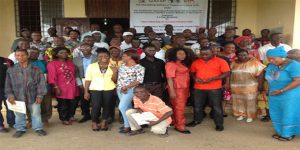
As part of efforts to transform the Liberian cassava sector, a team from the IITA-led African Cassava Agronomy Initiative (ACAI) trained about 70 extension service providers from across Liberia in Bentol, Montserrado County. The training, which took place in October 2019, centered on the IITA-ACAI developed agronomy toolkit known as the Six Steps to Cassava Weed Management and Best Planting Practices which, when applied, helps farmers to potentially double their cassava yield per hectare.
 ACAI Principal Weed Scientist, Friday Ekeleme, conducted the training along with Digital Extension and Advisory Services Specialist, Godwin Atser, IITA Head of Mechanization, Peter Kolawole, and IITA Country Representative in Liberia, Michael Edet.
The training was carried out within the framework of the Smallholder Agriculture Productivity Enhancement and Commercialization (SAPEC) Project of the Liberian Ministry of Agriculture with funding from the Global Agriculture and Food Security Program (GAFSP) and the African Development Bank (AfDB).
The 4-day training exposed participants to the successes of the IITA Cassava Weed Management Project, the basics of agronomy in cassava farming systems, calibration and the use of the IITA Herbicides Calculator, safe use of herbicides, an overview of mechanization, and cassava varietal identification.
SAPEC Coordinator, William Kawalawu, described the training as an excellent program that would help transform cassava in Liberia and provide incomes to farmers.
Like Nigeria, the cassava sector in Liberia has been undermined by poor weed control. Hand weeding, often carried out by women, is not only backbreaking but also limits farm sizes in Liberia.
Edet said the workshop was intended to provide participants with basic knowledge of cassava production and especially weed management.
“This is part of what we are supposed to do in the SAPEC Project, to empower the farmers, the focal persons, technicians with the knowledge on weed control because weeding consumes a lot of money and as such farmers run away from cassava farms as the result of the huge cost of the control of weed,” he said.
Mrs Abibatu Kromah, a director with Liberia’s Central Agricultural Research Institute (CARI), appealed to IITA to provide support to help Liberian farmers tackle weeds. “Do not leave us alone,” she pleaded.
The training attracted participants including County Agriculture Coordinators (CAC), SAPEC focal persons, technicians, farmer-based organizations, cassava farmers, the National Cassava Production and Commercialization Union, and stakeholders with an interest in cassava farming.
The participants were drawn from eight of Liberia’s 15 counties including Bomi, Bong, Grand Bassa, Margibi, Montserrado, and Sinoe.
ACAI Principal Weed Scientist, Friday Ekeleme, conducted the training along with Digital Extension and Advisory Services Specialist, Godwin Atser, IITA Head of Mechanization, Peter Kolawole, and IITA Country Representative in Liberia, Michael Edet.
The training was carried out within the framework of the Smallholder Agriculture Productivity Enhancement and Commercialization (SAPEC) Project of the Liberian Ministry of Agriculture with funding from the Global Agriculture and Food Security Program (GAFSP) and the African Development Bank (AfDB).
The 4-day training exposed participants to the successes of the IITA Cassava Weed Management Project, the basics of agronomy in cassava farming systems, calibration and the use of the IITA Herbicides Calculator, safe use of herbicides, an overview of mechanization, and cassava varietal identification.
SAPEC Coordinator, William Kawalawu, described the training as an excellent program that would help transform cassava in Liberia and provide incomes to farmers.
Like Nigeria, the cassava sector in Liberia has been undermined by poor weed control. Hand weeding, often carried out by women, is not only backbreaking but also limits farm sizes in Liberia.
Edet said the workshop was intended to provide participants with basic knowledge of cassava production and especially weed management.
“This is part of what we are supposed to do in the SAPEC Project, to empower the farmers, the focal persons, technicians with the knowledge on weed control because weeding consumes a lot of money and as such farmers run away from cassava farms as the result of the huge cost of the control of weed,” he said.
Mrs Abibatu Kromah, a director with Liberia’s Central Agricultural Research Institute (CARI), appealed to IITA to provide support to help Liberian farmers tackle weeds. “Do not leave us alone,” she pleaded.
The training attracted participants including County Agriculture Coordinators (CAC), SAPEC focal persons, technicians, farmer-based organizations, cassava farmers, the National Cassava Production and Commercialization Union, and stakeholders with an interest in cassava farming.
The participants were drawn from eight of Liberia’s 15 counties including Bomi, Bong, Grand Bassa, Margibi, Montserrado, and Sinoe.
Liberian extension workers at the training.
Contributed by
Recent stories
No items found