IITA and ABUAD strengthen partnership to drive agricultural innovation and youth empowerment
March 14, 2025
The enduring partnership between IITA–CGIAR and Afe Babalola University, Ado-Ekiti (ABUAD), is a testament to the power of strategic collaboration. By aligning their shared vision and expertise, both institutions have demonstrated how impactful partnerships can drive meaningful outcomes in agricultural research, technological advancements, and youth empowerment.
IITA DDG-P4D Kenton Dashiell and ABUAD’s Vice Chancellor Prof. Smaranda Olarinde discussing the critical areas for collaboration.
To further strengthen this collaboration, ABUAD’s delegation visited IITA headquarters in Ibadan on 21 February. The visit aimed to explore new funding opportunities, advance agricultural research, and develop initiatives that enhance livelihoods and empower youth in the sector.
Welcoming the delegation, the IITA Deputy Director General for Partnerships for Delivery (IITA-P4D), Kenton Dashiell, emphasized the significance of the partnership, describing it as a crucial roadmap for fostering innovation in agricultural research and development. He also highlighted the recognition IITA recently received from the King of Ado-Ekiti, who commended the institute for its impactful research and contributions to improving lives in the region through its collaboration with ABUAD.
“Based on the successes and testimonies from our collaboration, we enthusiastically anticipate exploring new areas of partnership,” Dashiell remarked, underscoring the potential for a more significant impact in the future.
ABUAD’s Vice-Chancellor, Prof. Smaranda Olarinde, also commended the long-standing partnership with IITA. She provided an in-depth overview of ABUAD’s facilities and programs, identifying key areas for collaboration, joint research initiatives, and capacity-building programs for students and faculty members.
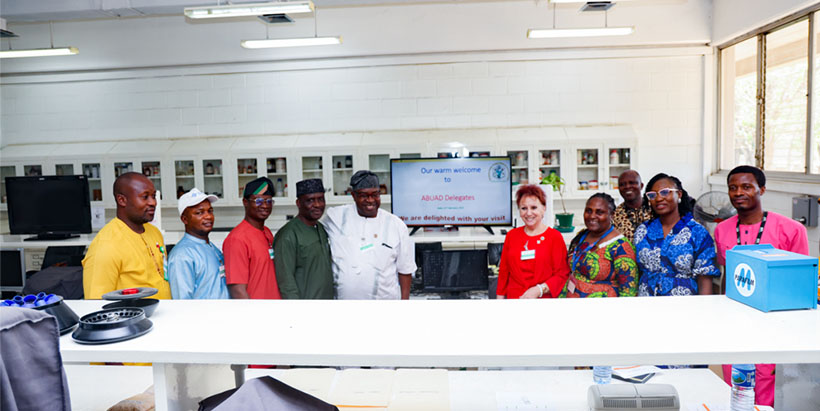
ABUAD’s delegation with IITA Virology and Germplasm Health unit team.
During their visit to some of the institute’s facilities, including IITA Virology and Germplasm Health Unit, Lydia Ogunya, an OGFIMS consultant, introduced the delegates to the Ogun State Farmer Information Management System (OGFIMS)—a World Bank-funded initiative. The delegates expressed keen interest in the platform, and discussions focused on replicating this advanced technology to benefit farmers in ABUAD and across Ekiti State.
At the IITA Youth in Agribusiness (IYA) unit, IITA-YAW Partnership and Stakeholder Engagement Manager Adetola Adenmosun advocated for a stronger collaboration between the two institutions to expand the Youth Employment in Agribusiness and Sustainable Agriculture (YEASA) project beyond the Southwest region, recognizing its significant achievements.
The wrap-up session focused on strategic areas to deepen collaboration between IITA and ABUAD. Key discussions revolved around:
Joint research proposals to drive innovation in agricultural development.
Leveraging World Bank-assisted initiatives to establish OGFIMS at ABUAD and Ekiti State.
Securing IITA’s technical training support for ABUAD’s Bogoro Center and Industrial Park.
Strengthening mechanization and irrigation systems through technical collaborations.
Dashiell commended ABUAD’s infrastructure and commitment to improving the agricultural sector, highlighting its potential to attract international grants and funding.
“IITA pledges to support ABUAD in proposal writing, research collaboration, and other strategic areas while encouraging the university to proactively seek international funding opportunities,” he affirmed.
The visit reinforced both institutions’ shared commitment to fostering innovation, enhancing agricultural productivity, and empowering the next generation of agripreneurs in Nigeria and beyond.
Contributed by Anita Akinyomade
Olamide Deborah Nwanze is a Senior Research Associate specializing in gender mainstreaming research to inform participatory and inclusive breeding, variety development, and seed systems policies regarding root, tuber, and banana (RTB) crops in the International Institute of Tropical Agriculture Headquarters, Ibadan, Nigeria. She is a PhD candidate at the University of Ibadan and holds an MSc and B. Agric in Agricultural Extension and Rural Development. Olamide is a fellow of the African Women in Agricultural Research and Development – Gender Responsive Agricultural Systems Policy (AWARD-GRASP) and the Gender Responsive Researchers Equipped for Agricultural Transformation (GREAT). She seeks to apply her gender-mainstreaming learnings, gender-responsive research, and policy development, and review expertise to facilitate women, youth, children, and vulnerable social group’s access to and adoption of agricultural Innovations that guarantee food, nutrition, income, and livelihood security in Africa. Her current roles include mentoring research fellows, development of guides and training manuals, implementation and adaptation of gender frameworks and tools, value chain actors’ engagement as citizen science partners, policy review and redesign, data management, and analysis. Her current research explores mixed methods and participatory and interdisciplinary approaches to capture and highlight gender dynamics, needs, preferences, and challenges stakeholders face within the agricultural livelihood value chain to prioritize gender-inclusive strategies in breeding programs, policy design, and implementation.
de Sousa, K., van Etten, J., Manners, R. Bello, A., Teeken, B., Olaosebikan, O., et al. 2024. The tricot approach: an agile framework for decentralized on-farm testing supported by citizen science. A retrospective. Agron. Sustain. Dev. 44, 8. https://doi.org/10.1007/s13593-023-00937-1
Madu, T., Onwuka, S., Nwafor, S., Onyemauwa, N., Ejechi, M., Ofoeze, M., Ukeje, B., Eluagu, C., Olaosebikan, O., Okoye, B., 2024. Gender-Inclusive Consumer Studies Improve Cassava Breeding in Nigeria in: Frontiers in Sociology, volume 9, number: 1224504, doi: 10.3389/fsoc.2024.1224504
Olaosebikan, O.; Bello, A.; Utoblo, O.; Okoye, B.; Olutegbe, N.; Garner, E.; Teeken, B.; Bryan, E.; Forsythe, L.; Cole, S.; Madu, T. 2023. Stressors and Resilience within the Cassava Value Chain in Nigeria: Preferred Cassava Variety Traits and Response Strategies of Men and Women to Inform Breeding. Sustainability 15, 7837. https://doi.org/10.3390/su15107837
Okoye, B., Ofoeze, M., Ejechi, M., Onwuka, S., Nwafor, S., Onyemauwa, N., Ukeje, B., Eluagu, C., Obidiegwu, J.*, Olaosebikan, O., Madu, T.* 2023. Prioritizing preferred traits in the yam value chain in Nigeria: a gender situation analysis in: Frontiers in Sociology, volume 8, number: 1232626, pages 1 – 9, ISSN 2297-7775, 2023. https://www.frontiersin.org/articles/10.3389/fsoc.2023.1232626/full
Olaosebikan, O., Bello, A. A., de Sousa, K., Ndjouenkeu, R., Adesokan, M., Alamu, E. O., Agbona, A., van Etten, J., Kegah, F. N.*, Dufour, D., Bouniol, A., Teeken, B. 2023. Consumer acceptability of cassava gari-eba food products across cultural and environmental settings using the triadic comparison of technologies approach (tricot) in: Journal of the Science of Food and Agriculture,
Teeken, B., Olaosebikan, O., Bello, A. A., Madu, T.*, Cole, S. M. 2023. Qualitative assessment on the positionality and preferences of dyads in relation to cassava-related activities: working with tricot trial citizen scientists https://hdl.handle.net/10568/138326 Type: Manual
Bouniol, A., Ceballos, H., Bello, A. A., Teeken, B., Olaosebikan, O., Owoade, D., Agbona, A., Fotso Kuate, A., Madu, T.*, Okoye, B.*, Ofoeze, M.*, Nwafor, S.*, Onyemauwa, N.*, Adinsi, L.*, Forsythe, L., Dufour, D. 2023. Varietal impact on women’s labour, workload and related drudgery in processing root, tuber and banana crops: focus on cassava in sub-Saharan Africa in: Journal of the Science of Food and Agriculture, pages 1 – 25, ISSN 0022-5142,
Bello, A. A., Agbona, A., Olaosebikan, O., Edughaen, G., Dufour, D., Bouniol, A., Iluebbey, P., Ndjouenkeu, R.*, Rabbi, I. Y., Teeken, B. 2023. Genetic and environmental effects on processing productivity and food product yield: drudgery of women’s work in: Journal of the Science of Food and Agriculture, pages 1 – 32, ISSN 0022-5142, 5
Cavicchioli, M., Zimbiti, T., Teeken, B., Nwanze, D.O., Liani, M., Parkes, E. & Bello, A. 2023. IITA-Gender Responsive Breeding Training Report. Genetic Resources Center, IITA-HQ, Ibadan, 21-23 September, 2022. Ibadan, Nigeria: IITA, (34 p.).https://hdl.handle.net/10568/131368
Agbona, A. Peteti P., Teeken B., Olaosebikan O. Bello, A. A., Parkes, E., Rabbi, I. Y., Mueller, L., Egesi, C., Kulakow, P. 2022. Data Management in Multi-disciplinary African RTB Crop Breeding Programs. In: Williamson, H.F., Leonelli, S. (eds) Towards Responsible Plant Data Linkage: Data Challenges for Agricultural Research and Development. Springer, Cham. https://doi.org/10.1007/978-3-031-13276-6_5
Lora Forsythe, Pricilla Marimo, Sarah Mayanja, Olamide D. Olaosebikan, Esme Stuart, Bela Teeken, Benjamin Okoye, Tessy Madu, (2021). Cross-product Gender Analysis of RTBfoods Step 2 Gendered Food Mapping on RTB Products. Understanding the Drivers of Trait Preferences and the Development of Multi-user RTB Product Profiles, WP1. London, UK: RTBfoods Field Scientific Report, 30 p.
Teeken, B., Garner, E., Agbona, A., Balogun, I., Olaosebikan, O., Bello, A., Madu, T., Okoye, B., Egesi, C., Kulakow, P. and Tufan, H.A. 2021. Beyond “Women’s Traits”: Exploring How Gender, Social Difference, and Household Characteristics Influence Trait Preferences. Frontiers Sustainable Food Systems 5:740926. https://doi.org/10.3389/fsufs.2021.740926
Teeken, B., Agbona, A., Bello, A., Olaosebikan, O., Alamu, E., Adesokan, M., Awoyale, W., Madu, T., Okoye, B., Chijioke, U., Owoade, D., Okoro, M., Bouniol, A., Dufour, D., Hershey, C., Rabbi, I., Maziya‐Dixon, B., Egesi, C., Tufan, H. and Kulakow, P. (020. Understanding cassava varietal preferences through pairwise ranking of gari‐eba and fufu prepared by local farmer–processors. Int J Food Sci Technol.https://doi.org/10.1111/ijfs.14862
Bela Teeken, Olamide Olaosebikan, Ireti Balogun, Benjamin Okoye, Tessy Madu, Steven Cole, Abolore Bello, Elizabeth Parkes. (2020). Piloting the G+ customer and product profile tools for gender-responsive cassava breeding in Nigeria. Nigeria: International Institute of Tropical Agriculture (IITA). https://hdl.handle.net/20.500.11766/13000