IITA and AfricaRice advance agricultural transformation in Togo
April 7, 2025
In a major development to strengthen agricultural mechanization and enhance food security in Togo, the International Institute of Tropical Agriculture (IITA) and AfricaRice, under the International Fund for Agricultural Development (IFAD)-funded Zero Hunger Project, officially handed over 29 newly fabricated processing machines to the Togo’s Ministry of Agriculture, Village Water Resources and Rural Development.
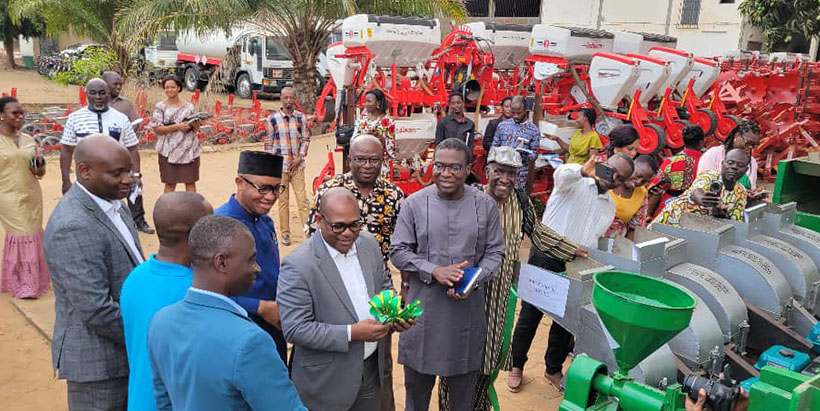
Dr Debo Akande, Dr Francis Nwilene, the Minister’s representative Solisama Djobo with the IITA and AfricaRice teams during the handover ceremony in Togo.
The equipment, designed to improve rice and cassava processing efficiency, was presented at a formal ceremony attended by key stakeholders, including government officials, private sector actors, local fabricators, and beneficiaries.
Introducing the equipment, IITA mechanization and post-harvest consultant, Diallo Thierno, who led the beneficiaries’ fabrication and capacity development, highlighted how local fabricators trained in Togo under the project are already replicating the machines.
A trained fabricator in Lomé has started producing cassava presses and threshers, while another in Kara is in the design phase for new machine production. Additionally, the host workshop, where the training took place, has identified a business opportunity in stainless steel fabrication and is working towards importing materials for local production, a move expected to drive sustainability and economic growth.
During his remarks, IITA Director of Private Sector Partnerships and the Zero Hunger Project Lead, Dr Debo Akande appreciated Togo’s Minister of Agriculture, Village Water Resources, and Rural Development, Antonie Lekpa Gbegbeni, and his Ministry adding that the country focal point, Anani Kodjogan Kpadenou, also provided the needed support in achieving the project’s objectives. He noted that this is a research-to-adoption project and stressed the need to transition from adoption to large-scale development and commercialization. He urged private sector players to take ownership, refine the machines, and enhance their competitive edge against imports.
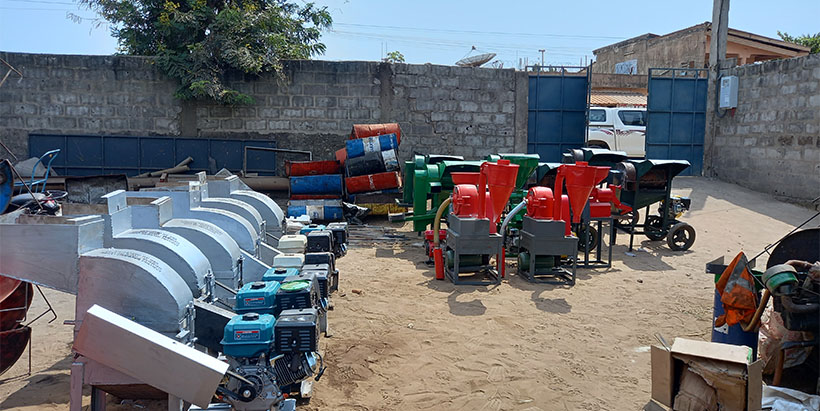
Some of the machines during the handover ceremony.
“To truly scale these innovations and make them accessible to millions of farmers and processors, we must engage private sector experts with precision engineering skills. Our locally made machines must meet high standards, capable of competing with imports from other developed nations,” he stated.
He also encouraged fabricators to label all future equipment as “Made in Togo” to strengthen national branding and local content.
The AfricaRice Regional Representative in Nigeria and the Project Co-Lead, Dr Francis Nwilene, thanked the key stakeholders – Ministry of Agriculture, Extension, Mechanization, Seed systems, and farmers, for their commitment toward the project’s success and IFAD for financial support. Dr Nwilene encouraged the trained fabricators to continue innovating and branding their machines, adding distinct design features as their signatures. He emphasized that the newly introduced machines are labor-saving and crucial for reducing drudgery and increasing efficiency in post-harvest and processing activities. He also stated that the rice thresher machine is gender-friendly and can be used for other grains. He pointed out that the youth and women can use the rice thresher to provide services to farmers during the harvesting period at a cost.
Representing the Minister of Agriculture at the event, Solisama Djobo, Director of Agricultural Seeds and Plants for Togo (DSP), expressed gratitude on behalf of the government and farmers. He reaffirmed that mechanization is a top priority in Togo’s agricultural strategy and highlighted the broader achievements of the Zero Hunger Project, including:
Training of 50 extension officers to support farmers.
Capacity building for 6,000 farmers on improved cassava and rice production techniques, including seed production.
Training of 3,000 entrepreneurs on rice and cassava value addition.
Establish two hectares each of rice and cassava seed farms as a foundation for sustainable seed production.
Developing seed certification protocols for cassava, yam, and sweet potato.
Training of 10 local fabricators, who subsequently produced the equipment being handed over.
The Minister’s representative further noted that the Togolese government is establishing six agricultural mechanization centers, two of which are set to become operational soon. IITA and Africa Rice will be major partners in ensuring the centers’ viability
“This equipment represents a major step towards our national goal of food self-sufficiency and increasing local content. By integrating these technologies into our mechanization strategy, we are laying the foundation for sustainable agricultural transformation,” he stated.
Following the remarks, the 29 cassava and rice agricultural processing equipment comprising six wet hammer mills, six cassava presses, six fryers, six rice threshers, three rice dehullers, and two rice hammer mills were formally handed over to the Ministry of Agriculture for distribution to the trained beneficiaries across the country This milestone marks a crucial step toward improving processing efficiency, reducing post-harvest loss, boosting the livelihoods of smallholder farmers, and supporting the agricultural-oriented economy in Togo.
As the event concluded, stakeholders reaffirmed their commitment to ensuring the initiative’s sustainability and scalability. The ongoing collaboration between IITA, AfricaRice, the Togolese government, and private sector actors sets the foundation for a mechanized, food-secure Togo and a pointer to a model for indigenously fabricated equipment to support African agriculture.
Contributed by Oyewale Abioye
Olamide Deborah Nwanze is a Senior Research Associate specializing in gender mainstreaming research to inform participatory and inclusive breeding, variety development, and seed systems policies regarding root, tuber, and banana (RTB) crops in the International Institute of Tropical Agriculture Headquarters, Ibadan, Nigeria. She is a PhD candidate at the University of Ibadan and holds an MSc and B. Agric in Agricultural Extension and Rural Development. Olamide is a fellow of the African Women in Agricultural Research and Development – Gender Responsive Agricultural Systems Policy (AWARD-GRASP) and the Gender Responsive Researchers Equipped for Agricultural Transformation (GREAT). She seeks to apply her gender-mainstreaming learnings, gender-responsive research, and policy development, and review expertise to facilitate women, youth, children, and vulnerable social group’s access to and adoption of agricultural Innovations that guarantee food, nutrition, income, and livelihood security in Africa. Her current roles include mentoring research fellows, development of guides and training manuals, implementation and adaptation of gender frameworks and tools, value chain actors’ engagement as citizen science partners, policy review and redesign, data management, and analysis. Her current research explores mixed methods and participatory and interdisciplinary approaches to capture and highlight gender dynamics, needs, preferences, and challenges stakeholders face within the agricultural livelihood value chain to prioritize gender-inclusive strategies in breeding programs, policy design, and implementation.
de Sousa, K., van Etten, J., Manners, R. Bello, A., Teeken, B., Olaosebikan, O., et al. 2024. The tricot approach: an agile framework for decentralized on-farm testing supported by citizen science. A retrospective. Agron. Sustain. Dev. 44, 8. https://doi.org/10.1007/s13593-023-00937-1
Madu, T., Onwuka, S., Nwafor, S., Onyemauwa, N., Ejechi, M., Ofoeze, M., Ukeje, B., Eluagu, C., Olaosebikan, O., Okoye, B., 2024. Gender-Inclusive Consumer Studies Improve Cassava Breeding in Nigeria in: Frontiers in Sociology, volume 9, number: 1224504, doi: 10.3389/fsoc.2024.1224504
Olaosebikan, O.; Bello, A.; Utoblo, O.; Okoye, B.; Olutegbe, N.; Garner, E.; Teeken, B.; Bryan, E.; Forsythe, L.; Cole, S.; Madu, T. 2023. Stressors and Resilience within the Cassava Value Chain in Nigeria: Preferred Cassava Variety Traits and Response Strategies of Men and Women to Inform Breeding. Sustainability 15, 7837. https://doi.org/10.3390/su15107837
Okoye, B., Ofoeze, M., Ejechi, M., Onwuka, S., Nwafor, S., Onyemauwa, N., Ukeje, B., Eluagu, C., Obidiegwu, J.*, Olaosebikan, O., Madu, T.* 2023. Prioritizing preferred traits in the yam value chain in Nigeria: a gender situation analysis in: Frontiers in Sociology, volume 8, number: 1232626, pages 1 – 9, ISSN 2297-7775, 2023. https://www.frontiersin.org/articles/10.3389/fsoc.2023.1232626/full
Olaosebikan, O., Bello, A. A., de Sousa, K., Ndjouenkeu, R., Adesokan, M., Alamu, E. O., Agbona, A., van Etten, J., Kegah, F. N.*, Dufour, D., Bouniol, A., Teeken, B. 2023. Consumer acceptability of cassava gari-eba food products across cultural and environmental settings using the triadic comparison of technologies approach (tricot) in: Journal of the Science of Food and Agriculture,
Teeken, B., Olaosebikan, O., Bello, A. A., Madu, T.*, Cole, S. M. 2023. Qualitative assessment on the positionality and preferences of dyads in relation to cassava-related activities: working with tricot trial citizen scientists https://hdl.handle.net/10568/138326 Type: Manual
Bouniol, A., Ceballos, H., Bello, A. A., Teeken, B., Olaosebikan, O., Owoade, D., Agbona, A., Fotso Kuate, A., Madu, T.*, Okoye, B.*, Ofoeze, M.*, Nwafor, S.*, Onyemauwa, N.*, Adinsi, L.*, Forsythe, L., Dufour, D. 2023. Varietal impact on women’s labour, workload and related drudgery in processing root, tuber and banana crops: focus on cassava in sub-Saharan Africa in: Journal of the Science of Food and Agriculture, pages 1 – 25, ISSN 0022-5142,
Bello, A. A., Agbona, A., Olaosebikan, O., Edughaen, G., Dufour, D., Bouniol, A., Iluebbey, P., Ndjouenkeu, R.*, Rabbi, I. Y., Teeken, B. 2023. Genetic and environmental effects on processing productivity and food product yield: drudgery of women’s work in: Journal of the Science of Food and Agriculture, pages 1 – 32, ISSN 0022-5142, 5
Cavicchioli, M., Zimbiti, T., Teeken, B., Nwanze, D.O., Liani, M., Parkes, E. & Bello, A. 2023. IITA-Gender Responsive Breeding Training Report. Genetic Resources Center, IITA-HQ, Ibadan, 21-23 September, 2022. Ibadan, Nigeria: IITA, (34 p.).https://hdl.handle.net/10568/131368
Agbona, A. Peteti P., Teeken B., Olaosebikan O. Bello, A. A., Parkes, E., Rabbi, I. Y., Mueller, L., Egesi, C., Kulakow, P. 2022. Data Management in Multi-disciplinary African RTB Crop Breeding Programs. In: Williamson, H.F., Leonelli, S. (eds) Towards Responsible Plant Data Linkage: Data Challenges for Agricultural Research and Development. Springer, Cham. https://doi.org/10.1007/978-3-031-13276-6_5
Lora Forsythe, Pricilla Marimo, Sarah Mayanja, Olamide D. Olaosebikan, Esme Stuart, Bela Teeken, Benjamin Okoye, Tessy Madu, (2021). Cross-product Gender Analysis of RTBfoods Step 2 Gendered Food Mapping on RTB Products. Understanding the Drivers of Trait Preferences and the Development of Multi-user RTB Product Profiles, WP1. London, UK: RTBfoods Field Scientific Report, 30 p.
Teeken, B., Garner, E., Agbona, A., Balogun, I., Olaosebikan, O., Bello, A., Madu, T., Okoye, B., Egesi, C., Kulakow, P. and Tufan, H.A. 2021. Beyond “Women’s Traits”: Exploring How Gender, Social Difference, and Household Characteristics Influence Trait Preferences. Frontiers Sustainable Food Systems 5:740926. https://doi.org/10.3389/fsufs.2021.740926
Teeken, B., Agbona, A., Bello, A., Olaosebikan, O., Alamu, E., Adesokan, M., Awoyale, W., Madu, T., Okoye, B., Chijioke, U., Owoade, D., Okoro, M., Bouniol, A., Dufour, D., Hershey, C., Rabbi, I., Maziya‐Dixon, B., Egesi, C., Tufan, H. and Kulakow, P. (020. Understanding cassava varietal preferences through pairwise ranking of gari‐eba and fufu prepared by local farmer–processors. Int J Food Sci Technol.https://doi.org/10.1111/ijfs.14862
Bela Teeken, Olamide Olaosebikan, Ireti Balogun, Benjamin Okoye, Tessy Madu, Steven Cole, Abolore Bello, Elizabeth Parkes. (2020). Piloting the G+ customer and product profile tools for gender-responsive cassava breeding in Nigeria. Nigeria: International Institute of Tropical Agriculture (IITA). https://hdl.handle.net/20.500.11766/13000