
IITA and WFP strengthen ties to achieve a world free from hunger
February 25, 2019
A delegation from the United Nations World Food Programme (WFP) in Nigeria visited IITA on 8 February, to strengthen existing collaboration and synergize ways to improve and sustain the livelihoods of people in the priority states benefiting from the Nigeria Zero Hunger Forum (NZHF). The NZHF is chaired by His Excellency, Former President of Nigeria, Chief Olusegun Obasanjo.
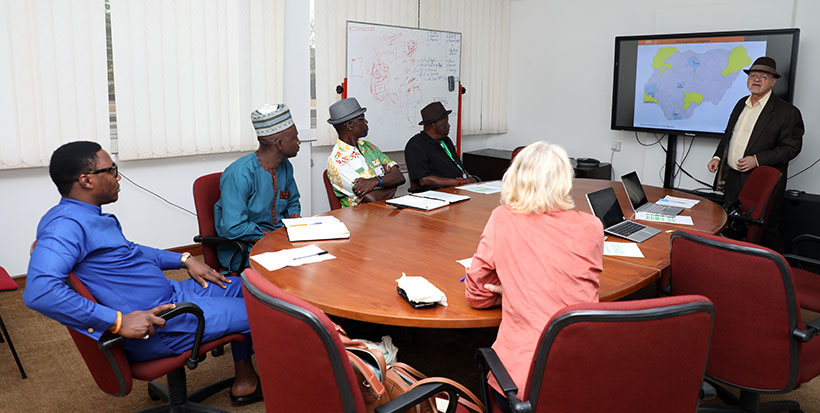 The three-member team led by Myrta Kaulard, WFP Country Director, accompanied by Akeem Ajibola, Safety Nets and Livelihoods Officer; and Tundji Sonoiki, Vulnerability Assessment and Mapping Officer, was received by the Deputy Director General, Partnerships for Delivery, Kenton Dashiell; and the Director of the Development and Delivery Office, Alfred Dixon.
In his welcome remarks, Dashiell expressed his delight on how the partnership would support and elevate the standard of living of people in the targeted states: Benue, Borno, Ebonyi, Kebbi, Ogun, and Sokoto. He said, “The partnership between IITA and WFP is essential to improve food security through the promotion of sustainable agriculture. It also brings us closer to a zero-hunger world, rapid economic growth, and increased agricultural productivity.”
Stating the purpose of their visit, Kaulard applauded IITA for its innovative research and delivery that has lifted millions of farmers out of poverty and emphasized the need to put in more effort as a team to achieve a common goal. She said, “Specifically, we came to discuss and draw a road map on how WFP could support IITA in its fight for zero hunger in Nigeria and beyond. This is also vital as the WFP in Nigeria is faced with the incredible challenge of reducing food importation and ensuring special access to nutrition, especially for children and pregnant women.”
The goals of the NZHF not only include the elimination of hunger among Nigerians but improvement in their standard of living through an implementable agenda and network of agricultural programs and activities. “Working substantially together with an institution like IITA to succeed in our target of ending hunger and poverty across the entire country is fundamental and key to ensuring a better livelihood and creating an enabling environment for all,” Kaulard stated.
The visit of the WFP team and collaboration with IITA would further consolidate the gains achieved by the NZHF in Nigeria since it started in 2017.
Dashiell further commended the work of WFP in Nigeria and the collaboration between the two institutions. “As the NZHF pledges to end hidden hunger, achieve food security, improve nutrition, and sustainable agriculture, I am optimistic that the mutual partnership between IITA and WFP would contribute to a greater attainment of our mission, which is to help the most vulnerable people to get out of poverty and malnutrition and move into prosperity and good health,” he said.
The three-member team led by Myrta Kaulard, WFP Country Director, accompanied by Akeem Ajibola, Safety Nets and Livelihoods Officer; and Tundji Sonoiki, Vulnerability Assessment and Mapping Officer, was received by the Deputy Director General, Partnerships for Delivery, Kenton Dashiell; and the Director of the Development and Delivery Office, Alfred Dixon.
In his welcome remarks, Dashiell expressed his delight on how the partnership would support and elevate the standard of living of people in the targeted states: Benue, Borno, Ebonyi, Kebbi, Ogun, and Sokoto. He said, “The partnership between IITA and WFP is essential to improve food security through the promotion of sustainable agriculture. It also brings us closer to a zero-hunger world, rapid economic growth, and increased agricultural productivity.”
Stating the purpose of their visit, Kaulard applauded IITA for its innovative research and delivery that has lifted millions of farmers out of poverty and emphasized the need to put in more effort as a team to achieve a common goal. She said, “Specifically, we came to discuss and draw a road map on how WFP could support IITA in its fight for zero hunger in Nigeria and beyond. This is also vital as the WFP in Nigeria is faced with the incredible challenge of reducing food importation and ensuring special access to nutrition, especially for children and pregnant women.”
The goals of the NZHF not only include the elimination of hunger among Nigerians but improvement in their standard of living through an implementable agenda and network of agricultural programs and activities. “Working substantially together with an institution like IITA to succeed in our target of ending hunger and poverty across the entire country is fundamental and key to ensuring a better livelihood and creating an enabling environment for all,” Kaulard stated.
The visit of the WFP team and collaboration with IITA would further consolidate the gains achieved by the NZHF in Nigeria since it started in 2017.
Dashiell further commended the work of WFP in Nigeria and the collaboration between the two institutions. “As the NZHF pledges to end hidden hunger, achieve food security, improve nutrition, and sustainable agriculture, I am optimistic that the mutual partnership between IITA and WFP would contribute to a greater attainment of our mission, which is to help the most vulnerable people to get out of poverty and malnutrition and move into prosperity and good health,” he said.
IITA Deputy Director General, Partnerships for Delivery, Kenton Dashiell, giving a presentation.
Contributed by
Recent stories
No items found