
IITA BIP management outlines future path for the unit
April 20, 2019
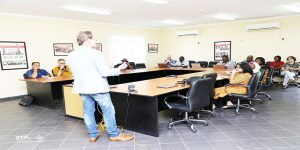
Management staff of the IITA Business Incubation Platform (BIP) held a meeting on 20 March at the IITA headquarters in Ibadan. The meeting themed, “When Science meets Business,” was organized to discuss ways to develop a scouting system in which marketable IITA products and services will be promoted through the BIP.
 IITA BIP takes innovations and accelerates them into commercial enterprises for public benefit. The goal of the unit is to help the funding of IITA’s groundbreaking research to transform African agriculture. The Head of BIP, Frederick Schreurs, stressed that there is a need for research to support business, and BIP can create a good image between donors and other partners outside IITA. BIP aims to create jobs with the support of new technologies, as well as make IITA’s technologies known, disseminate them, and generate income to make BIP sustainable.
Speaking on the creation of BIP, IITA Director General, Nteranya Sanginga mentioned that BIP was birthed in 2011, facing lots of criticism from all CG centers at the onset. Now however, it has become an obligation to invest 30% of their funds in development and interactions with the private sector.” He advised that everyone work together to bring breeders and BIP together to ensure commercialization of technologies with cooperation and interaction. “We need to be more active, more engaged, and do more of product display,” he added.
In developing the system for promoting IITA’s products, a committee of five that would advise the BIP was formed. The target is to create integration and move things forward between BIP and IITA research. Ideas were proposed in line with the goal of the system. The first was that business incubation platforms should have a clear focus on youth entrepreneurship as well as women, in combination with technology dissemination and impact creation. Also, the outcome of Monitoring and Evaluation (M&E) should be communicated to donors to demonstrate the sustainable impact of BIP and IITA science interaction.
Furthermore, there is need for full engagement of breeders and more advocacy in terms of benefits they stand to gain if they work with BIP. The importance of maintaining a close connection with the breeder, in learning exercises, was also established. It is also necessary to create interactions with local and international universities and other CGIAR centers for new products, services, and ideas, which can be channeled through the business incubation platforms.
Schreurs noted that BIP does not intend to take over resources and technologies; BIP is about cooperation and collaboration.
IITA BIP takes innovations and accelerates them into commercial enterprises for public benefit. The goal of the unit is to help the funding of IITA’s groundbreaking research to transform African agriculture. The Head of BIP, Frederick Schreurs, stressed that there is a need for research to support business, and BIP can create a good image between donors and other partners outside IITA. BIP aims to create jobs with the support of new technologies, as well as make IITA’s technologies known, disseminate them, and generate income to make BIP sustainable.
Speaking on the creation of BIP, IITA Director General, Nteranya Sanginga mentioned that BIP was birthed in 2011, facing lots of criticism from all CG centers at the onset. Now however, it has become an obligation to invest 30% of their funds in development and interactions with the private sector.” He advised that everyone work together to bring breeders and BIP together to ensure commercialization of technologies with cooperation and interaction. “We need to be more active, more engaged, and do more of product display,” he added.
In developing the system for promoting IITA’s products, a committee of five that would advise the BIP was formed. The target is to create integration and move things forward between BIP and IITA research. Ideas were proposed in line with the goal of the system. The first was that business incubation platforms should have a clear focus on youth entrepreneurship as well as women, in combination with technology dissemination and impact creation. Also, the outcome of Monitoring and Evaluation (M&E) should be communicated to donors to demonstrate the sustainable impact of BIP and IITA science interaction.
Furthermore, there is need for full engagement of breeders and more advocacy in terms of benefits they stand to gain if they work with BIP. The importance of maintaining a close connection with the breeder, in learning exercises, was also established. It is also necessary to create interactions with local and international universities and other CGIAR centers for new products, services, and ideas, which can be channeled through the business incubation platforms.
Schreurs noted that BIP does not intend to take over resources and technologies; BIP is about cooperation and collaboration.
Fredrick Schreurs giving a presentation at the meeting.
Contributed by
Recent stories
No items found