
IITA NEWS

IITA celebrates innovation and gender balance during 2019 International Women’s Day
March 10, 2019

Over the past few decades, the global community has made a lot of effort to inspire and engage more women and girls in science. Similar efforts are ongoing to ensure gender balance and equal access in other professional and social situations. The International Women’s Day is a worldwide movement that gives center stage to these endeavors as women are celebrated annually on 8 March.
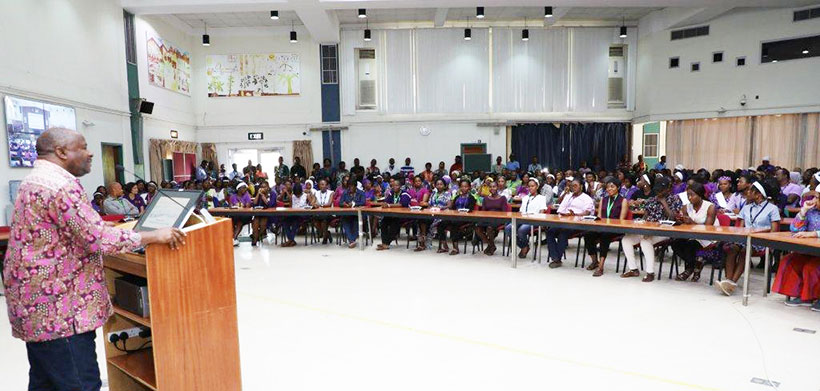
Dr Nteranya Sanginga delivering his keynote address at the plenary session.

This year IITA joined the global community in a call to action for building a gender-balanced world with the theme, “Balance for Better”. This, along with the United Nations (UN) theme of “Think Equal, Build Smart, Innovate for Change”, puts innovation by and for women and girls at the heart of efforts to achieve gender balance. Both male and female staff of the Institute marked the day with a short walk and a program that paid tribute to the successes and outputs of women colleagues.

In his keynote address, IITA Director General, Nteranya Sanginga, recognized women taking on leadership roles in the Institute. “I am proud of our IITA women and I can say it anywhere without fear,” he declared. He further said that he was pleased with the qualitative output of female staff and noted that women have a lot more to do in getting IITA to play a more significant role in research and in the world.

Hilde Koper-Limbourg, Deputy Director General, Corporate Services, spoke of the need for a mindset-change in everyone, towards achieving a balanced world. “There are ways to deal with biological and sociocultural factors which restrain women, other than not hiring them,” she noted.

IITA provides equal opportunities for women in employment and empowerment in the workplace, in consonance with the organization’s m andate of gender equality. The Institute also recognizes that the challenges of poverty, hunger, and malnutrition in Africa cannot be addressed without considering the constraints faced by women farmers. In most communities, women provide most of the agricultural labor on the family farm and process food for markets as well as family consumption. This has led to the design of many initiatives supporting the participation of women in agriculture.

When asked about women participation in international development, Hemant Nitturkar, Project Coordinator of Building and Economically Sustainable, Integrated Seed System for Cassava in Nigeria (BASICS), gave kudos to IITA women on their active involvement in segments formerly considered masculine. He said, “Women and men are equal stakeholders in the development of the world, and if one half of the world, representing women, is restricted from contributing to the development of the world, a lot would be missing.”

According to the UN, achieving a gender-balanced world requires innovations that work for both women and men, leaving no one behind.

This view was echoed by Irmgard Hoeschle-Zeledon, Manager of Africa Rising West Africa and East / Southern Africa. She said, “International Women’s Day should be a day where people unite to discuss the way forward for both women and men. It is necessary for women to think about the inferior to superior relations between them and men, especially in the homes where men are seen as bosses and have the final say in everything. Although we are different, we should be equal.” She suggested that to move forward, women should try to represent wherever they find themselves such that “superiority of one gender will become extinct.”

Commenting on the biological, political, and sociocultural constraints faced by women, IITA Plant Breeder and Geneticist Christian Fatokun noted, “Many women still perform credibly in various sectors all over the world regardless of the factors described as major deterrents; with those models, other women can be motivated to embark on developmental tasks.”

IITA Organizational Development Manager, Helen Adeniji, stated that while women converge to appreciate themselves and make action plans, people should remember that the world expects a balance between men and women. She stated, “Everyone has the ability to compete and achieve, and everyone should be given the opportunity to create innovation for the world. It is left to women to step up their game and compete favorably by presenting excellence in their chosen fields.”

The crux of the International Women’s Day is to encourage and support women to reach their full potential by being pioneers of innovation and change, in spite of national, ethnic, linguistic, cultural, economic, or political divisions. According to Sanginga, “We need leaders and builders; if a woman plays that role, she cannot be left behind.”

View photos on flickr


Contributed by

Related news

No items found

Leave a Reply

Your email address will not be published. Required fields are marked *

Scroll to Top
Olaosebikan, Olamide

Olamide Deborah Nwanze is a Senior Research Associate specializing in gender mainstreaming research to inform participatory and inclusive breeding, variety development, and seed systems policies regarding root, tuber, and banana (RTB) crops in the International Institute of Tropical Agriculture Headquarters, Ibadan, Nigeria. She is a PhD candidate at the University of Ibadan and holds an MSc and B. Agric in Agricultural Extension and Rural Development. Olamide is a fellow of the African Women in Agricultural Research and Development – Gender Responsive Agricultural Systems Policy (AWARD-GRASP) and the Gender Responsive Researchers Equipped for Agricultural Transformation (GREAT). She seeks to apply her gender-mainstreaming learnings, gender-responsive research, and policy development, and review expertise to facilitate women, youth, children, and vulnerable social group’s access to and adoption of agricultural Innovations that guarantee food, nutrition, income, and livelihood security in Africa. Her current roles include mentoring research fellows, development of guides and training manuals, implementation and adaptation of gender frameworks and tools, value chain actors’ engagement as citizen science partners, policy review and redesign, data management, and analysis. Her current research explores mixed methods and participatory and interdisciplinary approaches to capture and highlight gender dynamics, needs, preferences, and challenges stakeholders face within the agricultural livelihood value chain to prioritize gender-inclusive strategies in breeding programs, policy design, and implementation.

At IITA, she contributes to the implementation of the CGIAR Accelerated Breeding Initiative and Genetic Innovation Programs; participatory and gender research within the NextGen CassavaHarvestPlusRTBFoods, and Tricot-ClimMob 1000Farms Projects; and gender knowledge communication via the G-LENS webinar series, video documentary, policy briefspublications, and blogs.


Recent publications

de Sousa, K., van Etten, J., Manners, R. Bello, A., Teeken, B., Olaosebikan, O., et al. 2024. The tricot approach: an agile framework for decentralized on-farm testing supported by citizen science. A retrospective. Agron. Sustain. Dev. 44, 8. https://doi.org/10.1007/s13593-023-00937-1

Madu, T., Onwuka, S., Nwafor, S., Onyemauwa, N., Ejechi, M., Ofoeze, M., Ukeje, B., Eluagu, C., Olaosebikan, O., Okoye, B., 2024. Gender-Inclusive Consumer Studies Improve Cassava Breeding in Nigeria in: Frontiers in Sociology, volume 9, number: 1224504, doi: 10.3389/fsoc.2024.1224504

Olaosebikan, O.; Bello, A.; Utoblo, O.; Okoye, B.; Olutegbe, N.; Garner, E.; Teeken, B.; Bryan, E.; Forsythe, L.; Cole, S.; Madu, T. 2023.  Stressors and Resilience within the Cassava Value Chain in Nigeria: Preferred Cassava Variety Traits and Response Strategies of Men and Women to Inform Breeding. Sustainability 15, 7837. https://doi.org/10.3390/su15107837

Okoye, B., Ofoeze, M., Ejechi, M., Onwuka, S., Nwafor, S., Onyemauwa, N., Ukeje, B., Eluagu, C., Obidiegwu, J.*, Olaosebikan, O., Madu, T.* 2023. Prioritizing preferred traits in the yam value chain in Nigeria: a gender situation analysis in: Frontiers in Sociology, volume 8, number: 1232626, pages 1 – 9, ISSN 2297-7775, 2023. https://www.frontiersin.org/articles/10.3389/fsoc.2023.1232626/full

Olaosebikan, O., Bello, A. A., de Sousa, K., Ndjouenkeu, R., Adesokan, M., Alamu, E. O., Agbona, A., van Etten, J., Kegah, F. N.*, Dufour, D., Bouniol, A., Teeken, B. 2023. Consumer acceptability of cassava gari-eba food products across cultural and environmental settings using the triadic comparison of technologies approach (tricot) in: Journal of the Science of Food and Agriculture,

Teeken, B., Olaosebikan, O., Bello, A. A., Madu, T.*, Cole, S. M. 2023. Qualitative assessment on the positionality and preferences of dyads in relation to cassava-related activities: working with tricot trial citizen scientists https://hdl.handle.net/10568/138326 Type: Manual

Bouniol, A., Ceballos, H., Bello, A. A., Teeken, B., Olaosebikan, O., Owoade, D., Agbona, A., Fotso Kuate, A., Madu, T.*, Okoye, B.*, Ofoeze, M.*, Nwafor, S.*, Onyemauwa, N.*, Adinsi, L.*, Forsythe, L., Dufour, D. 2023. Varietal impact on women’s labour, workload and related drudgery in processing root, tuber and banana crops: focus on cassava in sub-Saharan Africa in: Journal of the Science of Food and Agriculture, pages 1 – 25, ISSN 0022-5142,

Bello, A. A., Agbona, A., Olaosebikan, O., Edughaen, G., Dufour, D., Bouniol, A., Iluebbey, P., Ndjouenkeu, R.*, Rabbi, I. Y., Teeken, B. 2023. Genetic and environmental effects on processing productivity and food product yield: drudgery of women’s work in: Journal of the Science of Food and Agriculture, pages 1 – 32, ISSN 0022-5142, 5

Cavicchioli, M., Zimbiti, T., Teeken, B., Nwanze, D.O., Liani, M., Parkes, E. & Bello, A. 2023. IITA-Gender Responsive Breeding Training Report. Genetic Resources Center, IITA-HQ, Ibadan, 21-23 September, 2022. Ibadan, Nigeria: IITA, (34 p.).https://hdl.handle.net/10568/131368

Agbona, A. Peteti P., Teeken B., Olaosebikan O. Bello, A. A., Parkes, E., Rabbi, I. Y., Mueller, L., Egesi, C., Kulakow, P. 2022. Data Management in Multi-disciplinary African RTB Crop Breeding Programs. In: Williamson, H.F., Leonelli, S. (eds) Towards Responsible Plant Data Linkage: Data Challenges for Agricultural Research and Development. Springer, Cham. https://doi.org/10.1007/978-3-031-13276-6_5

Lora Forsythe, Pricilla Marimo, Sarah Mayanja, Olamide D. Olaosebikan, Esme Stuart, Bela Teeken, Benjamin Okoye, Tessy Madu, (2021). Cross-product Gender Analysis of RTBfoods Step 2 Gendered Food Mapping on RTB Products. Understanding the Drivers of Trait Preferences and the Development of Multi-user RTB Product Profiles, WP1. London, UK: RTBfoods Field Scientific Report, 30 p.

Teeken, B., Garner, E., Agbona, A., Balogun, I., Olaosebikan, O., Bello, A., Madu, T., Okoye, B., Egesi, C., Kulakow, P. and Tufan, H.A. 2021. Beyond “Women’s Traits”: Exploring How Gender, Social Difference, and Household Characteristics Influence Trait Preferences. Frontiers Sustainable Food Systems 5:740926. https://doi.org/10.3389/fsufs.2021.740926

Teeken, B., Agbona, A., Bello, A., Olaosebikan, O., Alamu, E., Adesokan, M., Awoyale, W., Madu, T., Okoye, B., Chijioke, U., Owoade, D., Okoro, M., Bouniol, A., Dufour, D., Hershey, C., Rabbi, I., Maziya‐Dixon, B., Egesi, C., Tufan, H. and Kulakow, P. (020. Understanding cassava varietal preferences through pairwise ranking of gari‐eba and fufu prepared by local farmer–processors. Int J Food Sci Technol. https://doi.org/10.1111/ijfs.14862

Bela Teeken, Olamide Olaosebikan, Ireti Balogun, Benjamin Okoye, Tessy Madu, Steven Cole, Abolore Bello, Elizabeth Parkes. (2020). Piloting the G+ customer and product profile tools for gender-responsive cassava breeding in Nigeria. Nigeria: International Institute of Tropical Agriculture (IITA). https://hdl.handle.net/20.500.11766/13000