
IITA NEWS

IITA commissions advanced irrigation systems and mechanized farm equipment to boost research excellence
January 12, 2026


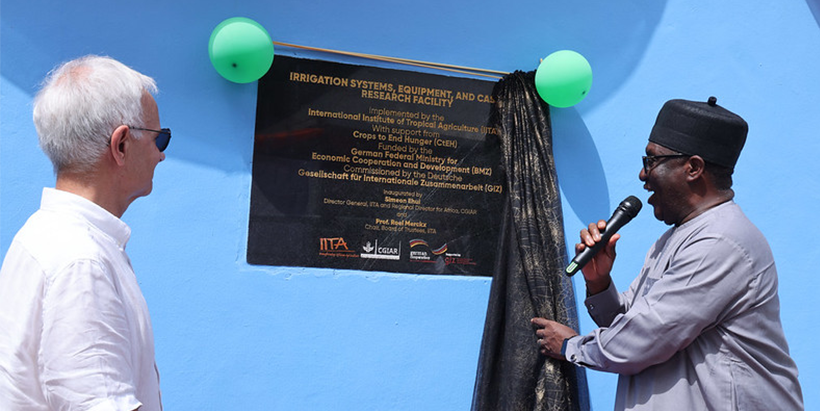
Board Chair Roel Merckx and IITA DG Simeon Ehui unveiling the newly commissioned irrigation systems, equipment, and enhanced cassava research facility.

IITACGIAR commissioned newly installed advanced irrigation systems and state-of-the-art mechanized farm equipment at the Research Farm Unit on 4 December. The commissioning, with members of the IITA Board of Trustees present, reaffirmed IITA’s commitment to scaling climate-smart research through modern mechanization for the continent. The investment—funded by the German Federal Ministry for Economic Cooperation and Development (BMZ) and implemented by GIZ through the Crops to End Hunger (CtEH) initiative—represents one of the most significant upgrades to IITA’s research infrastructure in recent years.

The commissioning ceremony drew IITA leadership, scientists, farm managers, technical teams, and development partners who expressed pride in a project that strengthens IITA’s ability to deliver cutting-edge, climate-smart agricultural solutions for Africa. IITA Director General and CGIAR Regional Director for Continental Africa, Dr Simeon Ehui described the moment as “a proud step forward for our Institute,” noting that the infrastructure positions IITA to accelerate innovation and deliver improved varieties to farmers across the continent. He acknowledged the unwavering support of BMZ, GIZ, CtEH, and partners who “continue to stand with IITA in transforming African agriculture.”
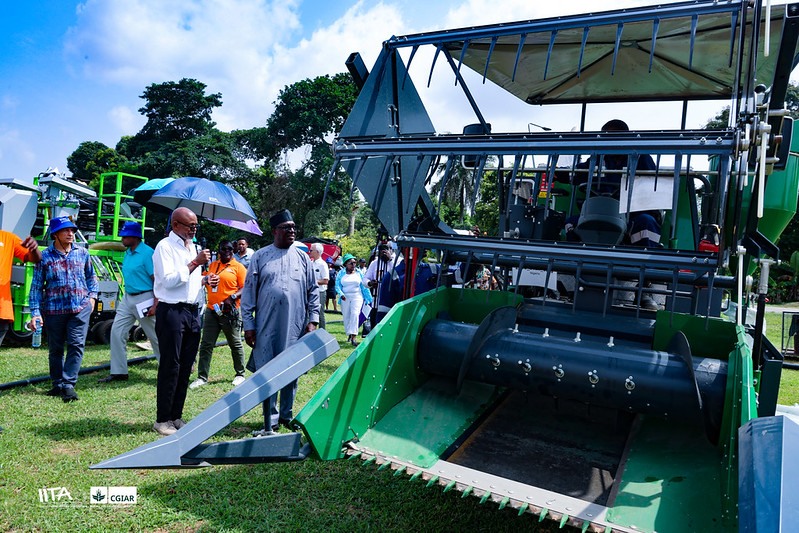
Alick Mulenga, Head of IITA Farm Management and Breeding Operations leading Dr Simeon Ehui and invited guests on a guided tour and demonstration of the irrigation facility and newly acquired farm machinery.

The newly installed irrigation system expands the Institute’s irrigable land with an additional 70 hectares, enabling year-round experimentation and eliminating seasonal limitations that previously slowed breeding progress. The system features a modern filtration unit, lateral irrigation infrastructure, and mechanized solutions that enhance efficiency in field operations.

Hapson Mushoriwa, Head of IITA Breeding Programs, emphasized that these investments arrive at a critical time. “Africa faces depleted soils, a rapidly growing population, and the escalating challenges of climate change,” he said. “With this irrigation system, we can collect high-quality phenotype data, scale up seed multiplication, run large-scale trials, and shorten breeding cycles. This is how we accelerate genetic gains and modernize our breeding programs to meet today’s challenges.”

Head of IITA Farm Management and Breeding Operations, Alick Mulenga, highlighted that beyond irrigation, the project includes major upgrades to research infrastructure long overdue for renewal. “Infrastructure in project proposals is often the first to be rejected,” he noted. “But this investment changes that story. It allows us to run more efficient, reliable, and safer field operations.”

Representing GIZ, Dr Sarah Schmidt, Advisor Fund International Agricultural Research (FIA) GIZ reaffirmed the commitment of the German government to agricultural transformation in Africa, describing CtEH’s support to IITA as one of the largest single investments the initiative has made. “This reflects our strong commitment to productive, sustainable agriculture and the future of African agrifood systems,” she said. “These facilities will accelerate breeding, respond to climate challenges, and create economic opportunities across value chains. Looking forward to the improved varieties that will be developed for farmers in East, West, and Central Africa.”
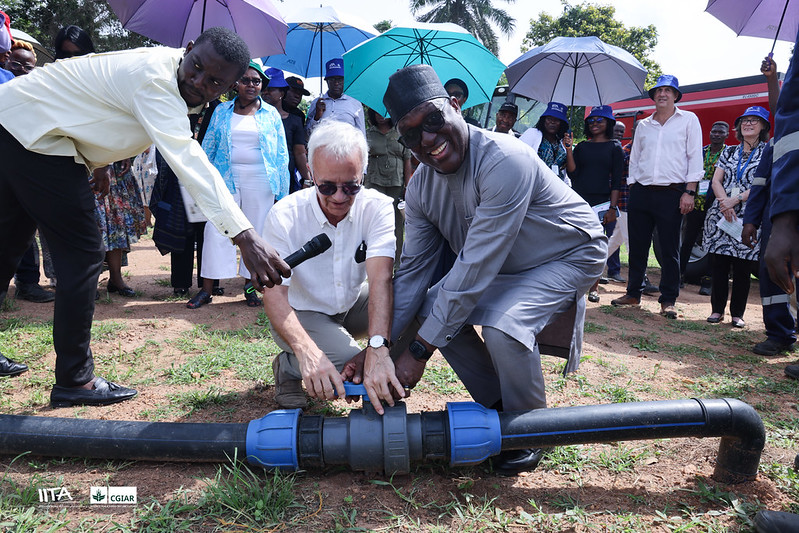
Dr Simeon Ehui and Board Chair Prof. Roel Merckx testing the newly installed irrigation system.

IITA Deputy Director General, Research for Development (R4D), Dr Bernard Vanlauwe, with deep appreciation to GIZ underscored the importance of responsible resource use. “Collecting reliable data is one of our key mandates—these facilities give us the tools to do it better, faster, and more consistently,” he said. “Let’s keep using funding right to deliver improved varieties into the hands of farmers.”

IITA Board Chair, Professor Roel Merckx, commended the Institute’s dedication to improving its working environment. “You cannot have a high-performing institute without staff being proud of their facilities,” he noted, thanking GIZ for supporting infrastructure development—an area many funders hesitate to finance.

The ceremony ended with a guided field tour and demonstrations, during which some of the scientists expressed optimism about the facility’s potential to strengthen breeding efficiency, improve data quality, and reinforce IITA’s leadership in agricultural innovation.

“Together with our partners,” Dr Ehui said, “we are building a resilient, food-secure Africa—one innovation at a time.”

Contributed by Folake Oduntan


Contributed by

Related news

No items found

Leave a Reply

Your email address will not be published. Required fields are marked *

Scroll to Top
Olaosebikan, Olamide

Olamide Deborah Nwanze is a Senior Research Associate specializing in gender mainstreaming research to inform participatory and inclusive breeding, variety development, and seed systems policies regarding root, tuber, and banana (RTB) crops in the International Institute of Tropical Agriculture Headquarters, Ibadan, Nigeria. She is a PhD candidate at the University of Ibadan and holds an MSc and B. Agric in Agricultural Extension and Rural Development. Olamide is a fellow of the African Women in Agricultural Research and Development – Gender Responsive Agricultural Systems Policy (AWARD-GRASP) and the Gender Responsive Researchers Equipped for Agricultural Transformation (GREAT). She seeks to apply her gender-mainstreaming learnings, gender-responsive research, and policy development, and review expertise to facilitate women, youth, children, and vulnerable social group’s access to and adoption of agricultural Innovations that guarantee food, nutrition, income, and livelihood security in Africa. Her current roles include mentoring research fellows, development of guides and training manuals, implementation and adaptation of gender frameworks and tools, value chain actors’ engagement as citizen science partners, policy review and redesign, data management, and analysis. Her current research explores mixed methods and participatory and interdisciplinary approaches to capture and highlight gender dynamics, needs, preferences, and challenges stakeholders face within the agricultural livelihood value chain to prioritize gender-inclusive strategies in breeding programs, policy design, and implementation.

At IITA, she contributes to the implementation of the CGIAR Accelerated Breeding Initiative and Genetic Innovation Programs; participatory and gender research within the NextGen CassavaHarvestPlusRTBFoods, and Tricot-ClimMob 1000Farms Projects; and gender knowledge communication via the G-LENS webinar series, video documentary, policy briefspublications, and blogs.


Recent publications

de Sousa, K., van Etten, J., Manners, R. Bello, A., Teeken, B., Olaosebikan, O., et al. 2024. The tricot approach: an agile framework for decentralized on-farm testing supported by citizen science. A retrospective. Agron. Sustain. Dev. 44, 8. https://doi.org/10.1007/s13593-023-00937-1

Madu, T., Onwuka, S., Nwafor, S., Onyemauwa, N., Ejechi, M., Ofoeze, M., Ukeje, B., Eluagu, C., Olaosebikan, O., Okoye, B., 2024. Gender-Inclusive Consumer Studies Improve Cassava Breeding in Nigeria in: Frontiers in Sociology, volume 9, number: 1224504, doi: 10.3389/fsoc.2024.1224504

Olaosebikan, O.; Bello, A.; Utoblo, O.; Okoye, B.; Olutegbe, N.; Garner, E.; Teeken, B.; Bryan, E.; Forsythe, L.; Cole, S.; Madu, T. 2023.  Stressors and Resilience within the Cassava Value Chain in Nigeria: Preferred Cassava Variety Traits and Response Strategies of Men and Women to Inform Breeding. Sustainability 15, 7837. https://doi.org/10.3390/su15107837

Okoye, B., Ofoeze, M., Ejechi, M., Onwuka, S., Nwafor, S., Onyemauwa, N., Ukeje, B., Eluagu, C., Obidiegwu, J.*, Olaosebikan, O., Madu, T.* 2023. Prioritizing preferred traits in the yam value chain in Nigeria: a gender situation analysis in: Frontiers in Sociology, volume 8, number: 1232626, pages 1 – 9, ISSN 2297-7775, 2023. https://www.frontiersin.org/articles/10.3389/fsoc.2023.1232626/full

Olaosebikan, O., Bello, A. A., de Sousa, K., Ndjouenkeu, R., Adesokan, M., Alamu, E. O., Agbona, A., van Etten, J., Kegah, F. N.*, Dufour, D., Bouniol, A., Teeken, B. 2023. Consumer acceptability of cassava gari-eba food products across cultural and environmental settings using the triadic comparison of technologies approach (tricot) in: Journal of the Science of Food and Agriculture,

Teeken, B., Olaosebikan, O., Bello, A. A., Madu, T.*, Cole, S. M. 2023. Qualitative assessment on the positionality and preferences of dyads in relation to cassava-related activities: working with tricot trial citizen scientists https://hdl.handle.net/10568/138326 Type: Manual

Bouniol, A., Ceballos, H., Bello, A. A., Teeken, B., Olaosebikan, O., Owoade, D., Agbona, A., Fotso Kuate, A., Madu, T.*, Okoye, B.*, Ofoeze, M.*, Nwafor, S.*, Onyemauwa, N.*, Adinsi, L.*, Forsythe, L., Dufour, D. 2023. Varietal impact on women’s labour, workload and related drudgery in processing root, tuber and banana crops: focus on cassava in sub-Saharan Africa in: Journal of the Science of Food and Agriculture, pages 1 – 25, ISSN 0022-5142,

Bello, A. A., Agbona, A., Olaosebikan, O., Edughaen, G., Dufour, D., Bouniol, A., Iluebbey, P., Ndjouenkeu, R.*, Rabbi, I. Y., Teeken, B. 2023. Genetic and environmental effects on processing productivity and food product yield: drudgery of women’s work in: Journal of the Science of Food and Agriculture, pages 1 – 32, ISSN 0022-5142, 5

Cavicchioli, M., Zimbiti, T., Teeken, B., Nwanze, D.O., Liani, M., Parkes, E. & Bello, A. 2023. IITA-Gender Responsive Breeding Training Report. Genetic Resources Center, IITA-HQ, Ibadan, 21-23 September, 2022. Ibadan, Nigeria: IITA, (34 p.).https://hdl.handle.net/10568/131368

Agbona, A. Peteti P., Teeken B., Olaosebikan O. Bello, A. A., Parkes, E., Rabbi, I. Y., Mueller, L., Egesi, C., Kulakow, P. 2022. Data Management in Multi-disciplinary African RTB Crop Breeding Programs. In: Williamson, H.F., Leonelli, S. (eds) Towards Responsible Plant Data Linkage: Data Challenges for Agricultural Research and Development. Springer, Cham. https://doi.org/10.1007/978-3-031-13276-6_5

Lora Forsythe, Pricilla Marimo, Sarah Mayanja, Olamide D. Olaosebikan, Esme Stuart, Bela Teeken, Benjamin Okoye, Tessy Madu, (2021). Cross-product Gender Analysis of RTBfoods Step 2 Gendered Food Mapping on RTB Products. Understanding the Drivers of Trait Preferences and the Development of Multi-user RTB Product Profiles, WP1. London, UK: RTBfoods Field Scientific Report, 30 p.

Teeken, B., Garner, E., Agbona, A., Balogun, I., Olaosebikan, O., Bello, A., Madu, T., Okoye, B., Egesi, C., Kulakow, P. and Tufan, H.A. 2021. Beyond “Women’s Traits”: Exploring How Gender, Social Difference, and Household Characteristics Influence Trait Preferences. Frontiers Sustainable Food Systems 5:740926. https://doi.org/10.3389/fsufs.2021.740926

Teeken, B., Agbona, A., Bello, A., Olaosebikan, O., Alamu, E., Adesokan, M., Awoyale, W., Madu, T., Okoye, B., Chijioke, U., Owoade, D., Okoro, M., Bouniol, A., Dufour, D., Hershey, C., Rabbi, I., Maziya‐Dixon, B., Egesi, C., Tufan, H. and Kulakow, P. (020. Understanding cassava varietal preferences through pairwise ranking of gari‐eba and fufu prepared by local farmer–processors. Int J Food Sci Technol. https://doi.org/10.1111/ijfs.14862

Bela Teeken, Olamide Olaosebikan, Ireti Balogun, Benjamin Okoye, Tessy Madu, Steven Cole, Abolore Bello, Elizabeth Parkes. (2020). Piloting the G+ customer and product profile tools for gender-responsive cassava breeding in Nigeria. Nigeria: International Institute of Tropical Agriculture (IITA). https://hdl.handle.net/20.500.11766/13000