
IITA NEWS

IITA contributes to conserving Nigeria’s rarest endemic bird: Ibadan Malimbe
October 12, 2021

The Ibadan Malimbe, range-restricted and endemic to Ibadan, is an important bird for conservation. Its home, food, and climatic habitat are in the forest areas in Ibadan alone. Between 1994 and 1996, the International Union for Conservation of Nature (IUCN) listed it as critically endangered due to its rarity and closeness to extinction. It was later listed as endangered, as more birds were spotted over time.

IITA Ibadan campus, sitting on a 1000 ha and hosting about 350 ha of forest dedicated to biodiversity conservation, is home to the Ibadan Malimbe. This beautifully unique bird is the most threatened of the four endemic birds in Nigeria. The Jos Plateau Indigobird and the Rock Firefinch are range-restricted to the north, and the Anambra Waxbill and the Ibadan Malimbe to the south.
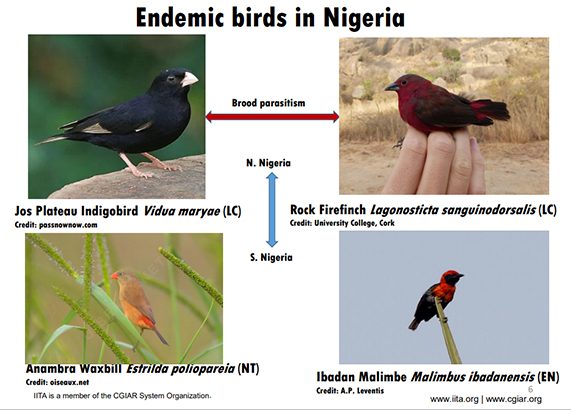
 IITA contributes to conserving Nigeria’s rarest endemic bird: Ibadan Malimbe
The four endemic birds in Nigeria.

The IITA Forest Center, headed by Adewale Awoyemi, is an internationally acclaimed Important Bird and Biodiversity Area (IBA). The Center carries out conservation activities and environmental education awareness programs, including quarterly bird monitoring and research, habitat restoration, and awareness creation programs. Through the Ibadan Bird Club (IBC), School Conservation Clubs (SCC), Radio IITA programs, international contests, and various social media platforms, the IITA Forest Center raises awareness to conserve this rare bird.

In a seminar on 18 August, Awoyemi shared the rareness and ecological importance of this bird and the contributions of IITA Forest Center to its conservation. Between 2016 and 2021, the Center has recorded 368 Red-vented Malimbe, 255 Red-headed Malimbe, and 12 Ibadan Malimbe through its bird monitoring activities. The Ibadan Malimbe accounted for less than 5% of red-headed Malimbes recorded. It is essential to conserve these birds because they help pollinate crops, clean up the environment, and serve as an important bird for ecotourism.

The Ibadan Malimbe was first sighted at the University College, Ibadan, on 18 December 1951. It feeds on vegetable matter such as the fruit fibers of oil palm and insect fragments such as tailor ants. Awoyemi enumerated causes of decline in the population of the Ibadan Malimbe as sparse forests, smaller home ranges due to increased urbanization, competition for food with related species, and increased nest destruction by children during fuelwood collection.

The Ibadan Malimbe is also a forest edge species, meaning it is not necessarily found in thick forests only. It can also be found in gardens, on trees around residential areas, and in forest suburbs. The Ibadan Malimbe can be spotted by “Its red hair that extends from its chest to its breast, distinguishing it from the red-headed and red-vented Malimbe, whose red hair is not as extended as the Ibadan Malimbe’s,” Awoyemi said. He urged anyone who spots this bird to report sightings to the IITA Forest Center for tracking and further study.

The endemic birds in Nigeria enjoy institutional support from research institutes. Up north, the AP Leventis Ornithological Research Institute (APLORI), located in Jos, Nigeria, trains Biological Science students in conservation biology emphasizing birds. They provide studies and research for the protection of the endemic birds in that area. And down south, IITA is a haven for the Ibadan Malimbe, where lots of efforts and agricultural research go to protect the Ibadan Malimbe in its conservation work through IITA Forest Center.

Awoyemi acknowledged the publicity the conservation of Ibadan Malimbe got during the recent Inqaba Genome sequencing challenge. He sought funding to sequence the genome of the Ibadan Malimbe to promote the increase of the bird population in their endemic habitat. He acknowledged the enthusiasm of many IITA community members who participated in the online voting contest to support the conservation of Ibadan Malimbe.

He urged everyone to conserve the Ibadan Malimbe by protecting its habitat, taking up habitat restoration courses, reporting sightings, joining nature clubs and IITA’s social media discussions and hubs, raising private forests, and protecting and funding existing ones.


Contributed by

Recent stories

No items found

Leave a Reply

Your email address will not be published. Required fields are marked *

Scroll to Top
Olaosebikan, Olamide

Olamide Deborah Nwanze is a Senior Research Associate specializing in gender mainstreaming research to inform participatory and inclusive breeding, variety development, and seed systems policies regarding root, tuber, and banana (RTB) crops in the International Institute of Tropical Agriculture Headquarters, Ibadan, Nigeria. She is a PhD candidate at the University of Ibadan and holds an MSc and B. Agric in Agricultural Extension and Rural Development. Olamide is a fellow of the African Women in Agricultural Research and Development – Gender Responsive Agricultural Systems Policy (AWARD-GRASP) and the Gender Responsive Researchers Equipped for Agricultural Transformation (GREAT). She seeks to apply her gender-mainstreaming learnings, gender-responsive research, and policy development, and review expertise to facilitate women, youth, children, and vulnerable social group’s access to and adoption of agricultural Innovations that guarantee food, nutrition, income, and livelihood security in Africa. Her current roles include mentoring research fellows, development of guides and training manuals, implementation and adaptation of gender frameworks and tools, value chain actors’ engagement as citizen science partners, policy review and redesign, data management, and analysis. Her current research explores mixed methods and participatory and interdisciplinary approaches to capture and highlight gender dynamics, needs, preferences, and challenges stakeholders face within the agricultural livelihood value chain to prioritize gender-inclusive strategies in breeding programs, policy design, and implementation.

At IITA, she contributes to the implementation of the CGIAR Accelerated Breeding Initiative and Genetic Innovation Programs; participatory and gender research within the NextGen CassavaHarvestPlusRTBFoods, and Tricot-ClimMob 1000Farms Projects; and gender knowledge communication via the G-LENS webinar series, video documentary, policy briefspublications, and blogs.


Recent publications

de Sousa, K., van Etten, J., Manners, R. Bello, A., Teeken, B., Olaosebikan, O., et al. 2024. The tricot approach: an agile framework for decentralized on-farm testing supported by citizen science. A retrospective. Agron. Sustain. Dev. 44, 8. https://doi.org/10.1007/s13593-023-00937-1

Madu, T., Onwuka, S., Nwafor, S., Onyemauwa, N., Ejechi, M., Ofoeze, M., Ukeje, B., Eluagu, C., Olaosebikan, O., Okoye, B., 2024. Gender-Inclusive Consumer Studies Improve Cassava Breeding in Nigeria in: Frontiers in Sociology, volume 9, number: 1224504, doi: 10.3389/fsoc.2024.1224504

Olaosebikan, O.; Bello, A.; Utoblo, O.; Okoye, B.; Olutegbe, N.; Garner, E.; Teeken, B.; Bryan, E.; Forsythe, L.; Cole, S.; Madu, T. 2023.  Stressors and Resilience within the Cassava Value Chain in Nigeria: Preferred Cassava Variety Traits and Response Strategies of Men and Women to Inform Breeding. Sustainability 15, 7837. https://doi.org/10.3390/su15107837

Okoye, B., Ofoeze, M., Ejechi, M., Onwuka, S., Nwafor, S., Onyemauwa, N., Ukeje, B., Eluagu, C., Obidiegwu, J.*, Olaosebikan, O., Madu, T.* 2023. Prioritizing preferred traits in the yam value chain in Nigeria: a gender situation analysis in: Frontiers in Sociology, volume 8, number: 1232626, pages 1 – 9, ISSN 2297-7775, 2023. https://www.frontiersin.org/articles/10.3389/fsoc.2023.1232626/full

Olaosebikan, O., Bello, A. A., de Sousa, K., Ndjouenkeu, R., Adesokan, M., Alamu, E. O., Agbona, A., van Etten, J., Kegah, F. N.*, Dufour, D., Bouniol, A., Teeken, B. 2023. Consumer acceptability of cassava gari-eba food products across cultural and environmental settings using the triadic comparison of technologies approach (tricot) in: Journal of the Science of Food and Agriculture,

Teeken, B., Olaosebikan, O., Bello, A. A., Madu, T.*, Cole, S. M. 2023. Qualitative assessment on the positionality and preferences of dyads in relation to cassava-related activities: working with tricot trial citizen scientists https://hdl.handle.net/10568/138326 Type: Manual

Bouniol, A., Ceballos, H., Bello, A. A., Teeken, B., Olaosebikan, O., Owoade, D., Agbona, A., Fotso Kuate, A., Madu, T.*, Okoye, B.*, Ofoeze, M.*, Nwafor, S.*, Onyemauwa, N.*, Adinsi, L.*, Forsythe, L., Dufour, D. 2023. Varietal impact on women’s labour, workload and related drudgery in processing root, tuber and banana crops: focus on cassava in sub-Saharan Africa in: Journal of the Science of Food and Agriculture, pages 1 – 25, ISSN 0022-5142,

Bello, A. A., Agbona, A., Olaosebikan, O., Edughaen, G., Dufour, D., Bouniol, A., Iluebbey, P., Ndjouenkeu, R.*, Rabbi, I. Y., Teeken, B. 2023. Genetic and environmental effects on processing productivity and food product yield: drudgery of women’s work in: Journal of the Science of Food and Agriculture, pages 1 – 32, ISSN 0022-5142, 5

Cavicchioli, M., Zimbiti, T., Teeken, B., Nwanze, D.O., Liani, M., Parkes, E. & Bello, A. 2023. IITA-Gender Responsive Breeding Training Report. Genetic Resources Center, IITA-HQ, Ibadan, 21-23 September, 2022. Ibadan, Nigeria: IITA, (34 p.).https://hdl.handle.net/10568/131368

Agbona, A. Peteti P., Teeken B., Olaosebikan O. Bello, A. A., Parkes, E., Rabbi, I. Y., Mueller, L., Egesi, C., Kulakow, P. 2022. Data Management in Multi-disciplinary African RTB Crop Breeding Programs. In: Williamson, H.F., Leonelli, S. (eds) Towards Responsible Plant Data Linkage: Data Challenges for Agricultural Research and Development. Springer, Cham. https://doi.org/10.1007/978-3-031-13276-6_5

Lora Forsythe, Pricilla Marimo, Sarah Mayanja, Olamide D. Olaosebikan, Esme Stuart, Bela Teeken, Benjamin Okoye, Tessy Madu, (2021). Cross-product Gender Analysis of RTBfoods Step 2 Gendered Food Mapping on RTB Products. Understanding the Drivers of Trait Preferences and the Development of Multi-user RTB Product Profiles, WP1. London, UK: RTBfoods Field Scientific Report, 30 p.

Teeken, B., Garner, E., Agbona, A., Balogun, I., Olaosebikan, O., Bello, A., Madu, T., Okoye, B., Egesi, C., Kulakow, P. and Tufan, H.A. 2021. Beyond “Women’s Traits”: Exploring How Gender, Social Difference, and Household Characteristics Influence Trait Preferences. Frontiers Sustainable Food Systems 5:740926. https://doi.org/10.3389/fsufs.2021.740926

Teeken, B., Agbona, A., Bello, A., Olaosebikan, O., Alamu, E., Adesokan, M., Awoyale, W., Madu, T., Okoye, B., Chijioke, U., Owoade, D., Okoro, M., Bouniol, A., Dufour, D., Hershey, C., Rabbi, I., Maziya‐Dixon, B., Egesi, C., Tufan, H. and Kulakow, P. (020. Understanding cassava varietal preferences through pairwise ranking of gari‐eba and fufu prepared by local farmer–processors. Int J Food Sci Technol. https://doi.org/10.1111/ijfs.14862

Bela Teeken, Olamide Olaosebikan, Ireti Balogun, Benjamin Okoye, Tessy Madu, Steven Cole, Abolore Bello, Elizabeth Parkes. (2020). Piloting the G+ customer and product profile tools for gender-responsive cassava breeding in Nigeria. Nigeria: International Institute of Tropical Agriculture (IITA). https://hdl.handle.net/20.500.11766/13000