IITA Corps members organize seminar on alleviating hunger and poverty
March 5, 2021
The IITANational Youth Service Corps (NYSC) community recently organized a one-day seminar themed “Alleviating hunger and poverty through agriculture: Today’s youth; tomorrow’s leaders” for corps members across Nigeria. The immersive full-day event took place on 15 February and aimed to motivate and empower corps members to engage in productive research and business opportunities in agriculture. The seminar also inspired corps members to take up roles as leaders and enhance their advocacy skills to move forward in and after their service year.
The seminar was a hybrid event taking place both physically and virtually. IITA Deputy Director General for Cooperate Services, Hilde Koper, gave a welcome address at the session moderated by IITA corps member Dolapo Ajibare. Koper advised that youth should work together in a culture of impact.
IITA DG giving his remarks at the seminar.
In his keynote address, the NYSC Director General, Brigadier General Shuaibu Ibrahim, urged the corpers to seize the opportunities in the agriculture sector, especially at a time of global economic challenge. The Oyo State NYSC Coordinator, Grace Ogbuogebe, appreciated the energetic young graduates on the topical issue concerning the role of youth in agriculture. She advised them to use their potentials and energy to embrace agriculture and contribute immensely to alleviating hunger and poverty through agriculture.
Sanni Lateef, IITA Project Manager for BASICS II project, encouraged youth to find solutions to research problems in agriculture to nurture agricultural development in Africa. “Youth involvement in research partnerships will give them quality assurance, which is very important,” he said. Lava Kumar, Virologist and Head of IITA Germplasm Health Unit, spoke about employing digital smart farming tools and strategies to transform agriculture.
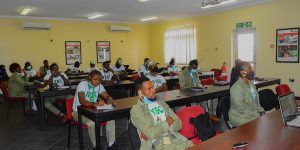
Cross-section of participants during a session at the seminar.IITA Youth Agripreneur (IYA) Business Development Officer Osun Idowu spoke about the youth initiatives: IYA and Empowering Novel Agribusiness-Led Employment for Youth in African Agriculture – Technology for African Agricultural Transformation (ENABLE-TAAT). IYA engages youth in modern agriculture careers and agribusiness, which is a potent means to address youth empowerment. ENABLE-TAAT involves youth in out-scaling the Technologies for African Agricultural Transformation (TAAT)’s key technologies. “This can be done by changing youth’s mindset towards agriculture for them to see agriculture as a profitable business and a source of great employment opportunities,” he noted.
IITA Postdoctoral Fellow Titilayo Falade presented on Youth Leadership: Building a corps of youth to influence national development through agriculture. “As a young person interested in leadership and agriculture, it is necessary to acquire information in gaining skills, in exploring approaches, and in using what you learn,” she said. Falade also encouraged the youth to lead themselves first and be the leader today.
Corp members with (L-R) the Local Government Inspector, Head of IITA CDO, State Coordinator, Zonal inspector, BDO for IYASylvia Oyinlola, Head of Administration, West Africa Hub, spoke on Agricultural risks and opportunities: Assessment and management. She stated that taking risks will open up the potential of identifying business opportunities. Zaina Sore, Head, Capacity Development Office, spoke on the need for youth capacity building to foster agricultural innovation. She advised the youth to tap into youth empowerment initiatives, be courageous to take risks, and explore different interests. Seun Ogidan and Esther Olatubosun gave agro-testimonials.
A panel moderated by IITA corps member Sunday Ijegwa analyzed ways to “Achieve a No Poverty and Zero Hunger SDG: The Role of African Youth.” The session featured four panelists: Morufat Balogun, Tissue Culture Specialist for YIIFSWA, Yinka Fakunle, Head IT Unit, IITA, Kazeem Bolarinwa, Special Assistant on Youth and Sports to the Oyo State Governor, and Adetomiwa Ogunsuwa, Managing Director for A-tops consultancy.
IITA Director General Nteranya Sanginga advised the youth to emulate the experience of their colleagues in the Start Them Early Program (STEP) and IYA, highlighting the need to be courageous and innovative. He also challenged the youth to be the change that Africa is looking for.
IITA corps member Emmanuel Ogunbase concluded the session with a vote of thanks, appreciating the participants, panelists, and resource persons, including Hilde Koper, Kenton Dashiell, and Katherine Lopez, for their contributions to the success of the seminar.
Olamide Deborah Nwanze is a Senior Research Associate specializing in gender mainstreaming research to inform participatory and inclusive breeding, variety development, and seed systems policies regarding root, tuber, and banana (RTB) crops in the International Institute of Tropical Agriculture Headquarters, Ibadan, Nigeria. She is a PhD candidate at the University of Ibadan and holds an MSc and B. Agric in Agricultural Extension and Rural Development. Olamide is a fellow of the African Women in Agricultural Research and Development – Gender Responsive Agricultural Systems Policy (AWARD-GRASP) and the Gender Responsive Researchers Equipped for Agricultural Transformation (GREAT). She seeks to apply her gender-mainstreaming learnings, gender-responsive research, and policy development, and review expertise to facilitate women, youth, children, and vulnerable social group’s access to and adoption of agricultural Innovations that guarantee food, nutrition, income, and livelihood security in Africa. Her current roles include mentoring research fellows, development of guides and training manuals, implementation and adaptation of gender frameworks and tools, value chain actors’ engagement as citizen science partners, policy review and redesign, data management, and analysis. Her current research explores mixed methods and participatory and interdisciplinary approaches to capture and highlight gender dynamics, needs, preferences, and challenges stakeholders face within the agricultural livelihood value chain to prioritize gender-inclusive strategies in breeding programs, policy design, and implementation.
de Sousa, K., van Etten, J., Manners, R. Bello, A., Teeken, B., Olaosebikan, O., et al. 2024. The tricot approach: an agile framework for decentralized on-farm testing supported by citizen science. A retrospective. Agron. Sustain. Dev. 44, 8. https://doi.org/10.1007/s13593-023-00937-1
Madu, T., Onwuka, S., Nwafor, S., Onyemauwa, N., Ejechi, M., Ofoeze, M., Ukeje, B., Eluagu, C., Olaosebikan, O., Okoye, B., 2024. Gender-Inclusive Consumer Studies Improve Cassava Breeding in Nigeria in: Frontiers in Sociology, volume 9, number: 1224504, doi: 10.3389/fsoc.2024.1224504
Olaosebikan, O.; Bello, A.; Utoblo, O.; Okoye, B.; Olutegbe, N.; Garner, E.; Teeken, B.; Bryan, E.; Forsythe, L.; Cole, S.; Madu, T. 2023. Stressors and Resilience within the Cassava Value Chain in Nigeria: Preferred Cassava Variety Traits and Response Strategies of Men and Women to Inform Breeding. Sustainability 15, 7837. https://doi.org/10.3390/su15107837
Okoye, B., Ofoeze, M., Ejechi, M., Onwuka, S., Nwafor, S., Onyemauwa, N., Ukeje, B., Eluagu, C., Obidiegwu, J.*, Olaosebikan, O., Madu, T.* 2023. Prioritizing preferred traits in the yam value chain in Nigeria: a gender situation analysis in: Frontiers in Sociology, volume 8, number: 1232626, pages 1 – 9, ISSN 2297-7775, 2023. https://www.frontiersin.org/articles/10.3389/fsoc.2023.1232626/full
Olaosebikan, O., Bello, A. A., de Sousa, K., Ndjouenkeu, R., Adesokan, M., Alamu, E. O., Agbona, A., van Etten, J., Kegah, F. N.*, Dufour, D., Bouniol, A., Teeken, B. 2023. Consumer acceptability of cassava gari-eba food products across cultural and environmental settings using the triadic comparison of technologies approach (tricot) in: Journal of the Science of Food and Agriculture,
Teeken, B., Olaosebikan, O., Bello, A. A., Madu, T.*, Cole, S. M. 2023. Qualitative assessment on the positionality and preferences of dyads in relation to cassava-related activities: working with tricot trial citizen scientists https://hdl.handle.net/10568/138326 Type: Manual
Bouniol, A., Ceballos, H., Bello, A. A., Teeken, B., Olaosebikan, O., Owoade, D., Agbona, A., Fotso Kuate, A., Madu, T.*, Okoye, B.*, Ofoeze, M.*, Nwafor, S.*, Onyemauwa, N.*, Adinsi, L.*, Forsythe, L., Dufour, D. 2023. Varietal impact on women’s labour, workload and related drudgery in processing root, tuber and banana crops: focus on cassava in sub-Saharan Africa in: Journal of the Science of Food and Agriculture, pages 1 – 25, ISSN 0022-5142,
Bello, A. A., Agbona, A., Olaosebikan, O., Edughaen, G., Dufour, D., Bouniol, A., Iluebbey, P., Ndjouenkeu, R.*, Rabbi, I. Y., Teeken, B. 2023. Genetic and environmental effects on processing productivity and food product yield: drudgery of women’s work in: Journal of the Science of Food and Agriculture, pages 1 – 32, ISSN 0022-5142, 5
Cavicchioli, M., Zimbiti, T., Teeken, B., Nwanze, D.O., Liani, M., Parkes, E. & Bello, A. 2023. IITA-Gender Responsive Breeding Training Report. Genetic Resources Center, IITA-HQ, Ibadan, 21-23 September, 2022. Ibadan, Nigeria: IITA, (34 p.).https://hdl.handle.net/10568/131368
Agbona, A. Peteti P., Teeken B., Olaosebikan O. Bello, A. A., Parkes, E., Rabbi, I. Y., Mueller, L., Egesi, C., Kulakow, P. 2022. Data Management in Multi-disciplinary African RTB Crop Breeding Programs. In: Williamson, H.F., Leonelli, S. (eds) Towards Responsible Plant Data Linkage: Data Challenges for Agricultural Research and Development. Springer, Cham. https://doi.org/10.1007/978-3-031-13276-6_5
Lora Forsythe, Pricilla Marimo, Sarah Mayanja, Olamide D. Olaosebikan, Esme Stuart, Bela Teeken, Benjamin Okoye, Tessy Madu, (2021). Cross-product Gender Analysis of RTBfoods Step 2 Gendered Food Mapping on RTB Products. Understanding the Drivers of Trait Preferences and the Development of Multi-user RTB Product Profiles, WP1. London, UK: RTBfoods Field Scientific Report, 30 p.
Teeken, B., Garner, E., Agbona, A., Balogun, I., Olaosebikan, O., Bello, A., Madu, T., Okoye, B., Egesi, C., Kulakow, P. and Tufan, H.A. 2021. Beyond “Women’s Traits”: Exploring How Gender, Social Difference, and Household Characteristics Influence Trait Preferences. Frontiers Sustainable Food Systems 5:740926. https://doi.org/10.3389/fsufs.2021.740926
Teeken, B., Agbona, A., Bello, A., Olaosebikan, O., Alamu, E., Adesokan, M., Awoyale, W., Madu, T., Okoye, B., Chijioke, U., Owoade, D., Okoro, M., Bouniol, A., Dufour, D., Hershey, C., Rabbi, I., Maziya‐Dixon, B., Egesi, C., Tufan, H. and Kulakow, P. (020. Understanding cassava varietal preferences through pairwise ranking of gari‐eba and fufu prepared by local farmer–processors. Int J Food Sci Technol.https://doi.org/10.1111/ijfs.14862
Bela Teeken, Olamide Olaosebikan, Ireti Balogun, Benjamin Okoye, Tessy Madu, Steven Cole, Abolore Bello, Elizabeth Parkes. (2020). Piloting the G+ customer and product profile tools for gender-responsive cassava breeding in Nigeria. Nigeria: International Institute of Tropical Agriculture (IITA). https://hdl.handle.net/20.500.11766/13000