
IITA Eastern Africa Hub sets out agenda for Institute’s future in the region
December 6, 2019
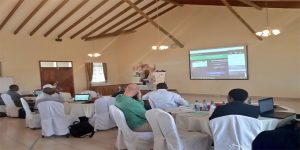
The IITA Eastern Africa Hub organized a two and a half-day retreat for its staff in Nairobi, Kenya, with the theme ‘Beyond our vision—shaping our future, together!’ During the event, the hub team with members drawn from Kenya, Madagascar, Sudan, Tanzania, and Uganda, looked at their past achievements, including the development of the first-ever East Africa highland banana hybrids, identifying the first-ever sources of resistance to deadly plant disease,s and developing a mobile app for detecting pests and disease of major staples.
 In addition, they generated ideas for building on these successes, amidst uncertainties such as changes in the CGIAR and climate change threats, for more significant impact in the region.
Speaking on the last day of the retreat that was held in Manzoni lodge, 50 km from Nairobi, IITA hub Director Victor Manyong expressed his satisfaction with the outcome of the retreat, as they were able to cover the agenda despite having a very ambitious program.
“We have spent time to take stock of what we have done in the past, we had a fun team building afternoon, and spent over a half of the time strategizing about our future in the hub and anticipating the new CGIAR changes.
“We hope we are all leaving this place with a common understanding of our work, what we have achieved, and the challenges we experienced. We also had good presentation and updates from the Communication, Monitoring and Evaluation (M&E), and Data Management teams.”
Manyong further identified areas that the Eastern Africa hub team should focus their efforts on. These were science and delivery of research outputs, country and regional alignment, data management, resource mobilization—by identifying new opportunities in the new future; increasing visibility by submitting successes stories to the communication team—and cooperating with the M&E team to support efforts to show IITA’s scorecard. The last two being key in fundraising.
On the first day of the retreat, the team shared on their activities and achievements along the five themes the Institute’s works across: Biotechnology and Genetic Improvement; Natural Resource Management; Plant Production and Health; Social Science and Agribusiness and Special Initiatives such as the ENABLE Youth program. Presentations were also made on scaling of innovations and data management.
The following day, Manyong presented on the possible new direction of the CGIAR that is pushing towards the formation of one CGIAR with a mission to end hunger by 2030 through science to transform food, land, and water systems in a climate crisis. The new five impact areas are Nutrition and food security; Poverty reduction, livelihood and jobs; Gender equality youth and social inclusion; Climate adaptation and greenhouse gas reduction; and Environment, health and biodiversity.
The hub staff looked at how the current activities in the hub were aligned to these impact areas, the gaps, and partnerships and how to strengthen the activities. They also discussed main disciplinary areas within the new GCIAR. There were 21st century breeding; Circular economy and gender; Plant health and digitalization; Excellence in agronomy; and Nutrition and food security looking at how well their activities in the hub were aligned to this areas. They also identified what could be the priority for intervention for each disciplinary area.
In addition, they generated ideas for building on these successes, amidst uncertainties such as changes in the CGIAR and climate change threats, for more significant impact in the region.
Speaking on the last day of the retreat that was held in Manzoni lodge, 50 km from Nairobi, IITA hub Director Victor Manyong expressed his satisfaction with the outcome of the retreat, as they were able to cover the agenda despite having a very ambitious program.
“We have spent time to take stock of what we have done in the past, we had a fun team building afternoon, and spent over a half of the time strategizing about our future in the hub and anticipating the new CGIAR changes.
“We hope we are all leaving this place with a common understanding of our work, what we have achieved, and the challenges we experienced. We also had good presentation and updates from the Communication, Monitoring and Evaluation (M&E), and Data Management teams.”
Manyong further identified areas that the Eastern Africa hub team should focus their efforts on. These were science and delivery of research outputs, country and regional alignment, data management, resource mobilization—by identifying new opportunities in the new future; increasing visibility by submitting successes stories to the communication team—and cooperating with the M&E team to support efforts to show IITA’s scorecard. The last two being key in fundraising.
On the first day of the retreat, the team shared on their activities and achievements along the five themes the Institute’s works across: Biotechnology and Genetic Improvement; Natural Resource Management; Plant Production and Health; Social Science and Agribusiness and Special Initiatives such as the ENABLE Youth program. Presentations were also made on scaling of innovations and data management.
The following day, Manyong presented on the possible new direction of the CGIAR that is pushing towards the formation of one CGIAR with a mission to end hunger by 2030 through science to transform food, land, and water systems in a climate crisis. The new five impact areas are Nutrition and food security; Poverty reduction, livelihood and jobs; Gender equality youth and social inclusion; Climate adaptation and greenhouse gas reduction; and Environment, health and biodiversity.
The hub staff looked at how the current activities in the hub were aligned to these impact areas, the gaps, and partnerships and how to strengthen the activities. They also discussed main disciplinary areas within the new GCIAR. There were 21st century breeding; Circular economy and gender; Plant health and digitalization; Excellence in agronomy; and Nutrition and food security looking at how well their activities in the hub were aligned to this areas. They also identified what could be the priority for intervention for each disciplinary area.
Eastern African Hub Director Victor Manyong giving a presentation on the proposed changes the CGIAR system.
Contributed by
Recent stories
No items found